
Compare · October 9, 2026
MyFitnessPal vs AI Meal Planner
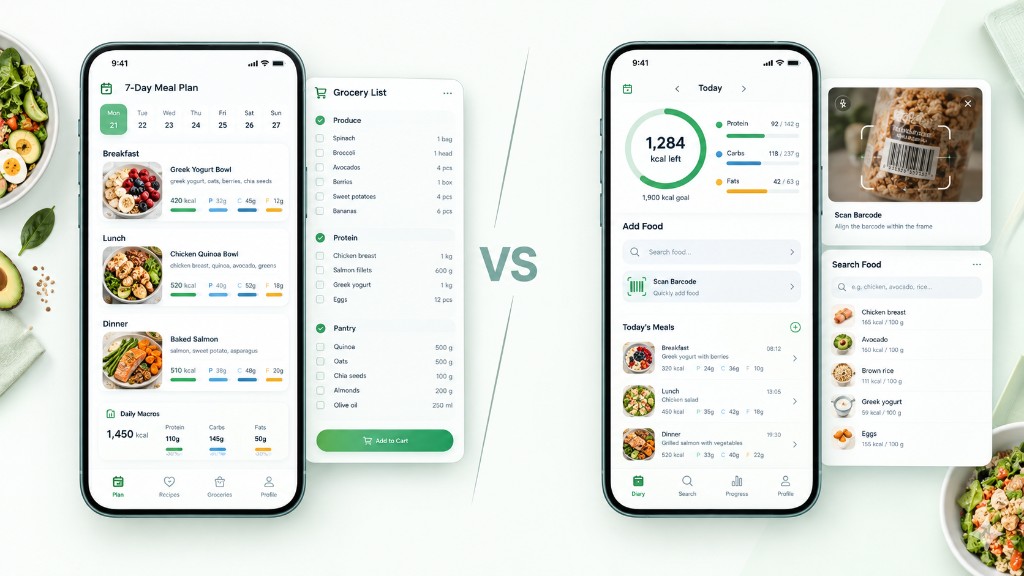
MyFitnessPal tracks what you ate. AI Meal Planner plans what you will eat. One is a food diary, the other is a meal planner — pick the tool that matches your problem.
Short answer: Use MyFitnessPal if your problem is "I do not know what I ate." Use AI Meal Planner if your problem is "I do not know what to eat" — a 7-day plan with recipes, macros, and one grocery list in about 60 seconds.
Reviewed October 9, 2026 against public MyFitnessPal features and pricing. Prices and features change.
What you get with AI Meal Planner (and not with MyFitnessPal)
MyFitnessPal is the world's most popular food diary. AI Meal Planner is a weekly meal planner. Here is what each tool does that the other does not:
| Feature | AI Meal Planner | MyFitnessPal |
|---|---|---|
| 7-day meal plan | Generated from a quiz in ~60 seconds | No meal plan — you log foods after eating |
| Recipes | Full recipes with ingredients and macros | Community recipes to browse, not a structured plan |
| Grocery list | One combined list for the week | No grocery list |
| Meal swaps | One tap — replacement stays on macros | Not applicable — no plan to swap from |
| Barcode scanner | No — the plan is pre-built | Yes — scan packaged food to log calories |
| Food database | AI generates meals from food data | 14M+ foods — community submitted, variable accuracy |
| Exercise tracking | No | Yes — log workouts and adjust calorie budget |
MyFitnessPal vs AI Meal Planner at a glance
| Feature | AI Meal Planner | MyFitnessPal |
|---|---|---|
| What it is | AI weekly meal planner | Calorie tracker & food diary |
| Best for | "Plan my week so I just cook" | "Track what I ate today" |
| Meal plan | Full 7-day plan with recipes | None — you log meals after eating |
| Macro tracking | Built into every meal automatically | Manual — log each food item |
| Grocery list | One combined list for the week | None |
| Daily time | ~2 min to check your plan | 5-15 min logging every meal |
| Intro price | $1 trial, then about $9.99/wk – $34.99/3mo | Free (with ads) or Premium ~$20/mo (confirm on MFP) |
Tracking vs planning: the core difference
MyFitnessPal answers: "How many calories did I eat today?" You search or scan each food, log it, and see if you are over or under budget. It is reactive — you eat first, then check.
AI Meal Planner answers: "What should I eat this week?" You take a quiz, get a 7-day plan with recipes, and cook from it. It is proactive — the plan exists before you shop.
Most people who search for a MyFitnessPal alternative are tired of logging. They want someone to tell them what to eat instead of tracking what they already ate. That is AI Meal Planner.
Macros: automatic vs manual
Both tools handle macros. The difference is who does the work:
MyFitnessPal: Set macro targets (Premium feature for custom goals). Then find foods that fit those targets yourself. Log each item. Check the dashboard at end of day. If you are over on carbs, too late — you already ate.
AI Meal Planner: Set macro targets in onboarding. Every meal in the plan is already built to those targets. Swap a meal and the replacement hits the same macros. You never search for "how many grams of protein in chicken breast" — it is in the recipe.
Grocery list
MyFitnessPal does not have a grocery list. You track food, not shopping.
AI Meal Planner generates one combined grocery list from the week's recipes. Ingredients are merged, leftovers counted, items grouped by category. One shop, one list. Also available as a standalone grocery list generator.
Stop logging. Start planning. Get a week of meals and one grocery list.
Build your meal plan in 2 minutesWeight loss: diary vs plan
MyFitnessPal: Creates awareness. You see your calorie intake in real time and learn which foods are calorie-dense. Logging itself reduces intake for many people. But you still decide every meal, and the "what do I eat?" problem remains.
AI Meal Planner: Removes the decision. The plan is built to your deficit with protein targets to preserve muscle. You do not need to wonder if today's lunch fits your budget — it was built to fit. Swap anything that does not appeal; the replacement holds.
If logging motivates you, use MyFitnessPal. If deciding what to eat is the bottleneck, use AI Meal Planner. They solve different problems on the same weight-loss journey.
Pricing: tracker vs planner
| Plan | AI Meal Planner | MyFitnessPal |
|---|---|---|
| Free tier | No free tier; $1 for 7-day trial | Basic tracking with ads |
| Premium | ~$9.99/wk, $19.99/mo, or $34.99/3mo | ~$20/month or ~$80/year (confirm on MFP) |
| What paid unlocks | Meal plans, recipes, macros, grocery list, swaps | Ad-free, custom macros, meal scan, nutrient dashboard |
Confirm MyFitnessPal Premium pricing at checkout. Prices change.
Which one fits
You want to track what you eat
MyFitnessPal. The barcode scanner, 14M-food database, and exercise integration make it the best calorie diary. No meal plan needed — you are the chef and the accountant.
You want a plan to cook from
AI Meal Planner. Quiz, 7-day menu, recipes, macros, one grocery list. No scanning, no logging, no end-of-day surprise that you are 400 kcal over.
You want to use both
Generate the week in AI Meal Planner. Log meals in MyFitnessPal if you want the accountability streak. The planner handles the "what," the tracker handles the "did I."
Final recommendation
MyFitnessPal: what it is good for
- Best calorie tracking app with barcode scanner.
- Huge food database (14M+ items).
- Exercise logging and calorie adjustment.
- Free tier available.
- No meal plan, no recipes, no grocery list.
AI Meal Planner: the privileges
- 7-day meal plan in about 60 seconds.
- Recipes with macros for every meal.
- One combined grocery list for the week.
- One-tap swaps that stay on macros.
- 30+ diets and allergy filters.
- No manual logging required.
Choose MyFitnessPal when: you want to track what you eat, scan barcodes, and manage calorie awareness. You are your own meal planner.
Choose AI Meal Planner when: you want the plan built for you — recipes, macros, and a grocery list ready before you step into the store.
Trade the food diary for a food plan. Meals, macros, and a grocery list — done.
Get your personalized meal planAlso see Noom vs AI Meal Planner for coaching, ChatGPT vs AI Meal Planner for free drafts, and Eat This Much vs AI Meal Planner for macro-strict planning.
FAQ
Does MyFitnessPal have meal plans?
No. MyFitnessPal is a food diary with a barcode scanner. You log what you eat after eating it. It does not generate a weekly meal plan with recipes. AI Meal Planner builds the plan before you eat — 7 days of meals, macros, and a grocery list.
Is MyFitnessPal free?
MyFitnessPal has a free tier with basic calorie tracking and ads. MyFitnessPal Premium (ad-free, macro goals, meal scan) is about $20/month or $80/year (confirm on MyFitnessPal). AI Meal Planner starts at a $1 seven-day trial, then about $9.99/week, $19.99/month, or $34.99/3 months.
Is MyFitnessPal good for weight loss?
MyFitnessPal helps with calorie awareness — logging food makes you conscious of portions and choices. But it does not tell you what to eat. You still decide every meal. AI Meal Planner removes that decision: the plan is built to your calorie deficit with protein targets to preserve muscle.
What is the best alternative to MyFitnessPal?
Depends on your need. If you want meal planning instead of food logging — AI Meal Planner. If you want a different calorie tracker — Cronometer or Lose It. If you want coaching — Noom. AI Meal Planner is the best MyFitnessPal alternative if your problem is "I do not know what to eat," not "I do not know what I ate."
MyFitnessPal vs AI Meal Planner — which is better?
Different tools. MyFitnessPal tracks what you already ate. AI Meal Planner plans what you will eat. If you need a food diary with barcode scanning, MyFitnessPal. If you need a 7-day plan with recipes and a grocery list, AI Meal Planner.
Can I use MyFitnessPal and AI Meal Planner together?
Yes. Use AI Meal Planner to generate your weekly plan and grocery list. If you also want to log meals for accountability, scan the ingredients in MyFitnessPal. The planner builds the menu; the tracker records compliance.
Does MyFitnessPal track macros?
Yes — MyFitnessPal shows protein, carbs, and fat for logged foods. Premium lets you set custom macro targets. But you still have to choose foods that hit those targets yourself. AI Meal Planner builds meals to your macro targets automatically.
Why did MyFitnessPal remove the barcode scanner from free?
MyFitnessPal moved barcode scanning to Premium in 2022 (it was later partially restored). If logging friction is your issue, consider switching to a planner where you do not need to scan anything — AI Meal Planner builds the meal plan upfront.
Is MyFitnessPal accurate for calories?
MyFitnessPal relies on a community-submitted food database. Entries can be inaccurate or outdated. Packaged foods (barcode) are usually correct; restaurant and homemade meals are estimates. AI Meal Planner calculates calories from ingredient weights in each recipe.
Is MyFitnessPal still free to use?
Yes — MyFitnessPal still has a free tier with basic calorie tracking, food logging, and limited features. However, it shows ads and some features like custom macro goals, barcode scanning (varies), and meal insights require MyFitnessPal Premium (~$20/month or ~$80/year). The free version is a food diary, not a meal planner.
Is there a better app than MyFitnessPal for free?
For calorie tracking, Cronometer and Lose It are free alternatives with cleaner databases. For meal planning — which MyFitnessPal does not do at all — AI Meal Planner generates a 7-day plan with recipes, macros, and a grocery list. Different tools for different jobs: tracking what you ate vs planning what you will eat.
What are the disadvantages of MyFitnessPal?
The main disadvantages: 1) No meal planning — it tracks food, it does not plan meals. 2) Inaccurate food database — community-submitted entries can be wrong. 3) Time-consuming — logging every meal takes 5-15 minutes daily. 4) Reactive, not proactive — you find out you are over budget after eating. 5) Premium features behind a paywall (~$20/month). 6) No grocery list generation.
What has happened to MyFitnessPal?
MyFitnessPal was acquired by Francisco Partners in 2020, moved barcode scanning to Premium in 2022 (partially restored later), and has shifted focus toward Premium subscriptions. The free tier has become more limited over time. The core product remains a calorie tracker and food diary — it has not added meal planning or grocery list features.