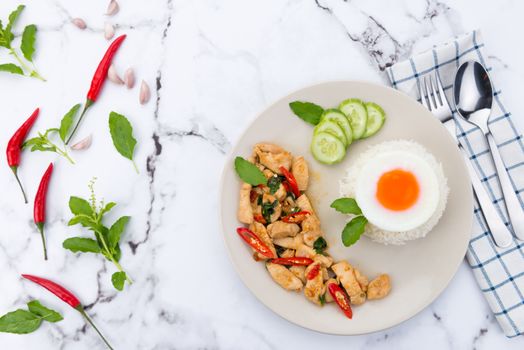
What is Thai basil chicken?
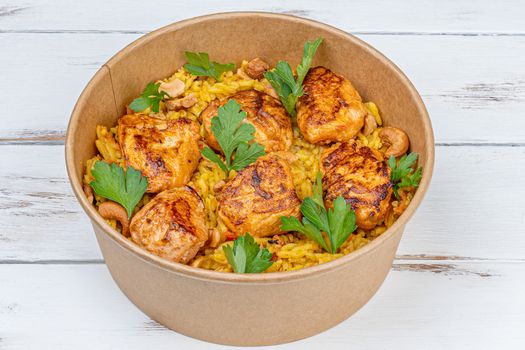
Thai basil chicken (Pad Kra Pao) on this page is 400g ground chicken, a handful of Thai basil, garlic, chilies, and a soy-oyster-fish sauce combination served over jasmine rice — about 440 calories and 35g protein per serving. It is the Thai street-food classic that takes 15 minutes from cold pan to plate. It is not a sweet teriyaki bowl or a mild cashew chicken.
If you want chicken in a creamy sauce, that is a different recipe. If you want a milder stir-fry without the anise-basil punch, try a honey garlic chicken stir-fry. This URL is Pad Kra Pao — spicy, aromatic, unapologetically Thai.
Nutrition and macros by portion
The label is one of two servings: 440 calories, 35g protein, 30g carbs, 20g fat (including rice).
| Portion | Adjustment | Calories | Protein | Carbs | Fat |
|---|---|---|---|---|---|
| Lower carb | Cauliflower rice instead of jasmine | 320 | 35g | 10g | 18g |
| This serving | As written with 70g dry rice per person | 440 | 35g | 30g | 20g |
| Hungry | Extra 100g chicken, same rice | 530 | 45g | 30g | 24g |
The protein is in the chicken — 200g ground chicken per serving delivers about 35g. The carbs are almost entirely from the rice. Skip the rice and this becomes a very low-carb, high-protein plate. Add a fried egg on top and you reach 40g+ protein per serving.
The aromatics are everything
Pad Kra Pao lives or dies on the garlic-chili paste. Mince 5 cloves of garlic with 2–4 Thai bird's eye chilies until they form an almost-paste. A mortar and pestle is traditional and releases more oils than a knife. The ratio is adjustable: 2 chilies for mild heat, 4 for authentic Thai-restaurant spicy, 6 if you want tears.
Thai chilies are small, red or green, and very hot. Serrano peppers are a decent substitute at about half the heat. Red pepper flakes work in a pinch but lack the fresh, fruity burn. The garlic should be fresh, not jarred — this is a 15-minute dish, not a slow braise where jarred garlic might hide. The aromatic hit when the garlic-chili paste hits the hot oil is what makes this dish smell like a Bangkok street stall.
Why Thai basil is non-negotiable
Thai basil (also called holy basil in some recipes) has a distinctive anise and licorice note that Italian basil completely lacks. The leaves are smaller, the stems are purple, and the flavor is more peppery. If you cannot find Thai basil at an Asian grocery, Italian basil will technically work but the dish will taste like a generic stir-fry and less like Pad Kra Pao.
Many Asian grocery stores carry Thai basil year-round. It also grows easily in a pot on a sunny windowsill. One plant produces enough basil for dozens of dishes throughout the summer. If you make this recipe often, consider growing your own — it is cheaper and always fresh.
High heat, fast cooking
Heat your wok or largest skillet over very high heat. Add oil, then the garlic-chili paste. Stir for 15 seconds — it should be fragrant instantly. If it takes longer, your pan is not hot enough. Add the ground chicken, breaking it up with a spatula. Cook 5–6 minutes, stirring occasionally, until no pink remains and some pieces are starting to brown.
Do not crowd the pan. If you are doubling the recipe, cook in batches. Overcrowded chicken releases moisture and steams instead of searing. You want some caramelization on the meat — that is where the savory depth comes from. The sound should be a sizzle, not a bubble. If it bubbles, the pan is not hot enough or there is too much food in it.
The three-sauce combination
The sauce is simple: 2 tbsp soy sauce, 1 tbsp oyster sauce, 1 tsp fish sauce, 1 tsp sugar. That is it. No cornstarch, no water — this is not a saucy stir-fry. The sauce coats the chicken and caramelizes slightly against the hot wok. Add it after the chicken is cooked, stir-fry 2 more minutes until the sauce is absorbed and starting to stick to the pan in spots.
Substitutions: No oyster sauce? Use hoisin mixed with a splash of soy. No fish sauce? Extra soy with a tiny pinch of sugar. The flavor will not be identical, but the dish will still work. Vegetarian? Skip fish sauce, use mushroom soy sauce, and replace chicken with crumbled extra-firm tofu. The tofu version needs to be pressed and cooked longer to get some color.
Basil goes in last — and off the heat
This is the most important step. Kill the heat completely. Add the entire bunch of Thai basil leaves (stems removed) and stir until just wilted — about 30 seconds from residual heat. If you add basil to a screaming-hot pan, it turns black and bitter. If you add it too early, it disintegrates into mush. The leaves should be bright green and just softened when you serve.
Use a full bunch — about 1 packed cup of leaves. Pad Kra Pao should be generously basil-forward. A few scattered leaves is not enough. The basil is a main ingredient, not a garnish. When done correctly, every bite should include a leaf or two.
Jasmine rice is traditional
Cook 140g dry jasmine rice (for 2 servings) according to package directions — usually 1:1.5 rice to water, bring to boil, cover, simmer 12–15 minutes. Fluff with a fork. Jasmine rice is fragrant and slightly sticky, which helps it absorb the sauce. Basmati works but is drier. Brown rice is fine nutritionally but changes the character of the dish.
For a crispy fried egg on top (Thai street-food style), fry an egg in the same wok after removing the chicken, with crispy edges and a runny yolk. Slide it on top of the rice and chicken. This adds about 70 calories and 6g protein per egg. Break the yolk over the chicken and rice — the richness balances the spice.
The authentic Bangkok experience
In Thailand, Pad Kra Pao is served at street stalls for about $1–2. The standard order is with a fried egg on top ("kai dao") and rice on the side. The egg yolk runs into the rice and chicken, creating extra richness. Some stalls serve it extra spicy ("phet mak") with additional chilies scattered on top.
At home, you can replicate this by frying the egg in the same wok used for the chicken. The residual oil and flavor from the stir-fry infuses into the egg. Crispy edges, runny center, served immediately on top of the rice and meat.
Meal-prep and reheating
Cook the chicken and sauce, but do not add basil. Refrigerate in an airtight container for up to 2 days. Reheat in a hot pan, then stir in fresh basil right before serving. Reheated basil turns black and bitter — always add it fresh at the end.
The rice can be cooked ahead and refrigerated for up to 4 days. Leftover rice is actually better for this dish because it is drier and absorbs sauce better. Microwave the rice, reheat the chicken in a pan, combine with fresh basil. For meal prep, keep the components separate: rice in one container, chicken in another, fresh basil in a bag. Assemble when ready to eat.
Ground pork for the traditional version
In Thailand, Pad Kra Pao is most commonly made with ground pork, not chicken. Pork has more fat and a richer flavor that some argue is more authentic. The cooking method is identical — just swap 400g ground pork for the chicken. The calorie count will be slightly higher due to the fat content.
Ground turkey works for a leaner version but lacks the richness. Ground beef is not traditional but makes a heartier dish. Firm tofu, pressed and crumbled, is the vegetarian option — it needs longer cooking to develop color and will not have the same texture as meat.
What makes this different from other chicken stir-fries
Pad Kra Pao is not sweet. There is 1 tsp of sugar in the sauce to balance the soy and fish sauce, not to make it taste like candy. If your Thai basil chicken tastes like teriyaki, you have added too much sugar or honey. The flavor profile should be savory, garlicky, spicy, and aromatic from the basil — not sweet and sticky.
Compared to honey garlic chicken, this is spicier and more herbaceous. Compared to beef stir-fry, this uses ground meat (faster cooking, more sauce absorption) and a completely different flavor profile. Pad Kra Pao is a specific dish with a specific taste — do not improvise until you have made it correctly once.
Common mistakes and how to avoid them
Pan not hot enough: The garlic should sizzle instantly. If it sits silently, your pan is too cold.
Overcrowding: Steamed ground chicken is sad. Work in batches if needed.
Adding basil to hot pan: Off the heat. Residual heat only. 30 seconds. This is non-negotiable.
Using dried basil: No. Fresh Thai basil or nothing. Dried basil tastes like dust in this application.
Too much sauce: This is not a saucy dish. The sauce should coat the chicken, not pool at the bottom of the bowl.
Reheating with basil: The basil is already cooked from the first serving. Add fresh basil when you reheat.
Skipping fish sauce: Fish sauce adds umami depth that soy sauce alone cannot provide. Use it even if you are skeptical — the fishy smell disappears when cooked.
Scaling up for a crowd
This recipe serves 2 generously. To serve 4, double the ingredients but cook the chicken in two batches. A crowded wok steams instead of sears. Make the full batch of sauce, add it at the end, and stir in double the basil. The rice scales linearly — 280g dry for 4 servings.
For a party, make the chicken ahead (without basil), keep warm in a low oven, and add fresh basil just before serving. Provide rice, fried eggs, and lime wedges on the side so guests can assemble their own bowls.
The 15-minute Thai dinner
Rice in the pot. Garlic-chili paste ready. Chicken in the hot wok for 6 minutes. Sauce in, stir-fry 2 minutes. Heat off, basil in, 30 seconds. Plate over rice. That is Pad Kra Pao. No marinating, no complicated ingredients, no restaurant required. The technique is fast and the flavor is real Thai street food.
Adjust chilies to your heat tolerance. Use ground pork for a richer, more traditional version. Add a crispy fried egg if you want the full Bangkok experience. But measure the sauce, do not skip the fish sauce, and for the love of Thai food, add the basil off the heat. 440 calories, 35g protein, 15 minutes. Better than takeout, cheaper than delivery, and ready before the delivery driver could even find your address.