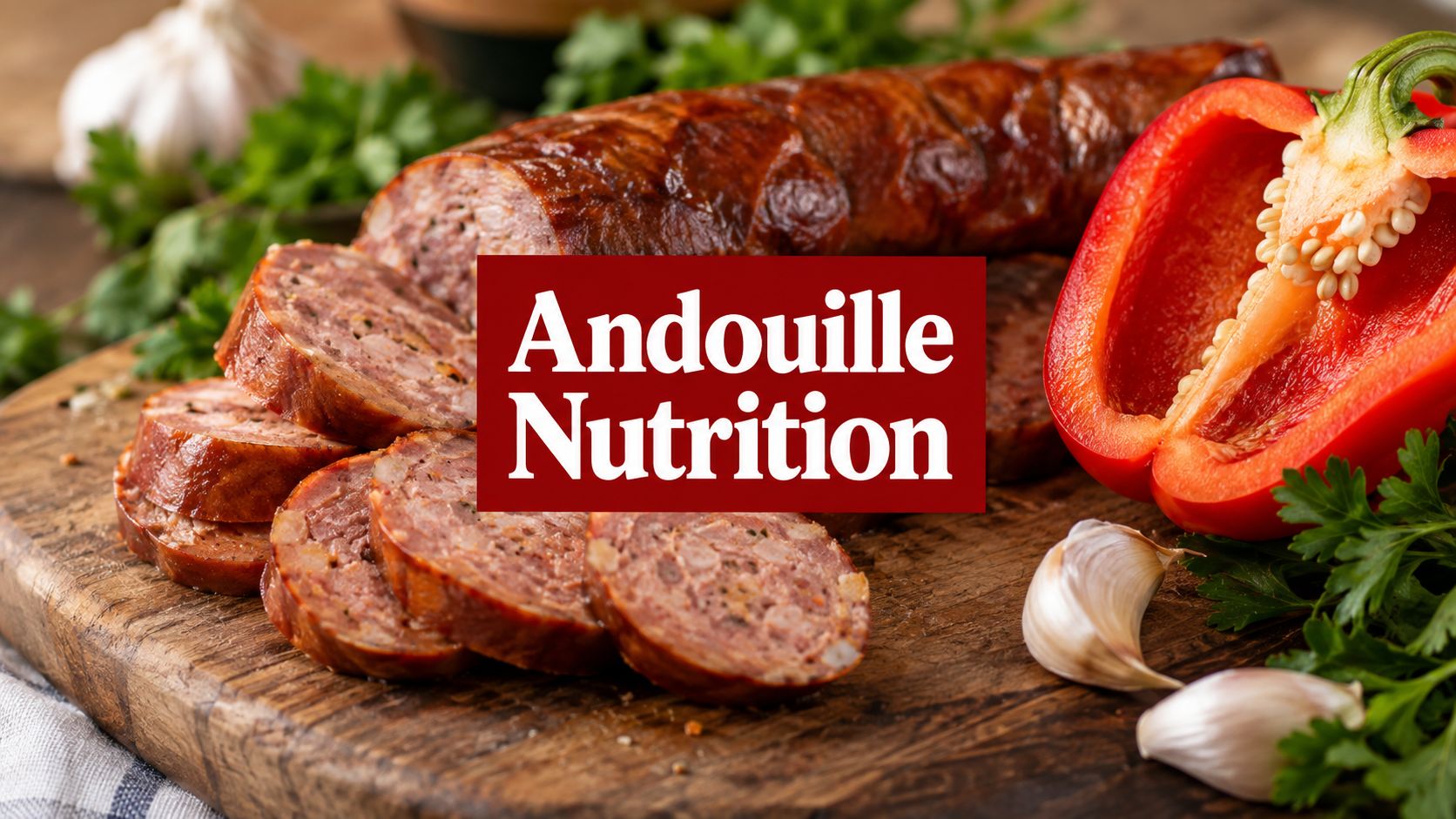
A typical andouille serving lands around 200 to 250 calories, 500 to 1,000 mg of sodium, and 12 to 14 g of protein in an 85 to 103 g link. Treat it as a concentrated flavor ingredient, not a lean, low-sodium protein, especially if you're watching blood pressure, heart health, cholesterol, or total daily sodium.
That range is wide enough to make generic “one serving” advice unreliable. A link's size, recipe, pork blend, added fat, and curing method can change what you're eating. The practical answer is simple: compare labels by equal gram weight, use smaller portions when sodium or saturated fat matters, and build the meal around vegetables, beans, lentils, whole grains, fish, or poultry instead.
Andouille comes from a long smoked-sausage tradition. Historical accounts trace its roots to French charcuterie, including Normandy and the Champagne region, before French colonizers brought the tradition to North America in the 18th century. German settlers along the Mississippi River also influenced the South Louisiana style, helping shape the smoked, highly seasoned sausage common in Cajun and Creole cooking today (historical background on andouille sausage).
That preservation history explains the nutrition profile. Smoking, curing, pork fat, and heavy seasoning create the flavor people want in gumbo, jambalaya, red beans and rice, and skillet meals. They also make sodium and saturated fat the two numbers worth checking first.
What Andouille Sausage Actually Delivers Per Serving
An 85 to 103 g serving commonly provides 200 to 250 calories, 12 to 14 g protein, 16 to 20 g total fat, 6 to 8 g saturated fat, and roughly 500 to 1,000 mg sodium (representative andouille nutrition data; USDA-derived andouille serving comparisons). Those figures make one point clear: andouille is a concentrated flavor ingredient, not a lean protein to portion casually.
Use 85 g, roughly 3 oz, as the comparison baseline. One representative link provides 200 calories, 16 g fat, 5 g saturated fat, 50 mg cholesterol, 600 mg sodium, 1 g carbohydrate, and 12 g protein. A larger 103 g label lists 250 calories and 1,010.4 mg sodium, before rice, broth, seasoning, or sauce adds anything else.
The label spread is the nutrition story
| Brand / Source | Serving Size | Calories | Protein (g) | Total Fat (g) | Saturated Fat (g) | Sodium (mg) |
|---|---|---|---|---|---|---|
| Representative database entry | 85 g | 200 | 12 | 16 | 5 | 600 |
| USDA-derived listing | 85 g | 180 | 11 | 15 | Not listed | Not listed |
| Branded dataset | 85 g | 250 | 14 | 20 | Not listed | Not listed |
| Alternate product label | 103 g | 250 | Not listed | 19 | 6 | 1,010.4 |
The 180 to 250 calories listed for an 85 g serving reflects formulation differences and added pork fat (andouille calorie and macro variability). Pork-only links, pork-and-beef blends, and chicken-based versions can produce very different panels. Skip the assumption that “chicken andouille” automatically means low sodium. Curing and seasoning still determine much of the salt.
For accurate tracking, weigh the portion and enter the specific brand instead of choosing a generic sausage in an app. AI Meal Planner's food nutrition database can help organize food entries, but the package label takes priority whenever you have it.
Buy by gram weight, not by link count. A single link is not a standardized nutrition unit, so check its serving weight before deciding how much belongs in your bowl. If the label falls near the higher end of the range, use less sausage and let beans, vegetables, or grains carry more of the meal.
Macronutrient and Sodium Breakdown
An 85 g link supplies 12 g protein, but also 16 g total fat, 5 g saturated fat, and 600 mg sodium. Protein contributes 24% of the Daily Value, while sodium contributes 25%, so andouille functions as a flavorful protein accent, not a lean protein staple (representative Daily Value data for andouille).
| Nutrient | Amount per 85 g | % Daily Value | Practical read |
|---|---|---|---|
| Calories | 200 | Not listed | Much of the energy comes from fat |
| Protein | 12 g | 24% | Useful, but not especially lean |
| Total fat | 16 g | Not listed | A major calorie source |
| Saturated fat | 5 g | Not listed | Account for it across the day |
| Cholesterol | 50 mg | Not listed | Comes from the animal-based sausage |
| Sodium | 600 mg | 25% | The first number to check |
| Carbohydrate | 1 g | Not listed | Very low carbohydrate |
Protein is useful, but fat changes the tradeoff
The 12 to 14 g protein found in many servings can fit a balanced meal, yet andouille provides less protein per calorie than lean poultry, fish, beans, or lentils. Fat supplies a large share of its energy, which makes portion size matter quickly. Slice one link across several bowls rather than building dinner around a full link.
Saturated fat also deserves a place in the calculation. One label lists 5 g per 85 g, while another lists about 6 g per 103 g. Cheese, cream sauce, bacon, and generous butter can push the meal from flavorful to unnecessarily heavy. Use vegetables, beans, or grains for volume and keep those added fats limited.
Sodium is the number to check first
Andouille sodium varies sharply by product. Some commercial Cajun-style versions provide about 470 mg per 2 oz, while other entries show 600 mg per 85 g or as much as 1,010 mg per 103 g (andouille sodium range). That spread makes brand and gram weight more useful than counting links. Compare labels at the same weight, then choose the lower-sodium option when the recipe already includes broth, canned beans, seasoning blends, or prepared rice.
For tracking, weigh the sausage and enter the package's nutrition panel rather than selecting a generic sausage entry. AI Meal Planner's food nutrition database can help organize food entries, but the package label takes priority when available.
Ingredients matter too. Curing nitrites or nitrates, smoke flavor, monosodium glutamate, and fillers may appear on the label. MSG is different from sodium chloride, but the complete ingredient list still shows whether you are buying a relatively simple sausage or a heavily formulated product. Read it before you buy, then use a smaller portion when the sodium or fat panel runs high.
How Andouille Stacks Up Against Other Sausages
At the same 85 g cooked serving, andouille usually delivers a similar calorie and protein load to other smoked sausages. The meaningful differences are sodium, saturated fat, and flavor intensity. Brand and serving size can shift the result substantially, so compare labels by grams rather than by link count.
| Sausage Type | Calories | Protein (g) | Saturated Fat (g) | Sodium (mg) | Best For |
|---|---|---|---|---|---|
| Pork andouille | 200 to 250 | 12 to 14 | 5 to 8 | 500 to 1,000 | Gumbo, jambalaya, bold smoky flavor |
| Basic smoked pork sausage | 180 to 250 | 11 to 14 | 5 to 8 | 500 to 950 | General sausage recipes |
| Kielbasa | 200 to 260 | 11 to 15 | 5 to 8 | 550 to 950 | Polish-style soups and skillet meals |
| Chicken sausage | 180 to 230 | 13 to 18 | 3 to 5 | 450 to 750 | Higher-protein, lighter meals |
| Turkey sausage | 170 to 220 | 13 to 18 | 3 to 5 | 450 to 750 | Lower-saturated-fat swaps |
These ranges are shopping guidance, not a guarantee for every package. Check the actual label at the same gram weight, because a smaller listed serving can make a product appear lower in calories or sodium than it really is (brand and serving-size variability).
Pick the sausage based on the job
Choose pork andouille when the sausage must supply smoke, heat, and Cajun character. Its strongest use is a pot of gumbo or jambalaya, where a modest amount seasons the surrounding ingredients. In a simple rice-and-vegetable bowl, chicken or turkey sausage usually fits better if you want a comparable protein role with less saturated fat.
Kielbasa is not automatically the healthier choice. It often lands toward the higher end of the sodium range. Basic smoked pork sausage resembles andouille in calories, protein, and saturated fat, but it generally provides less spice complexity. Chicken and turkey sausage commonly contain less saturated fat and may contain less sodium, yet the package panel determines whether that advantage exists.
Use the numbers at the portion you will eat. A full link can carry a very different nutrition cost from half a link, especially when the sausage is sliced into a dish with beans, greens, grains, or stock. Weigh the portion, compare sodium and saturated fat at that weight, and then choose the strongest flavor that fits your meal.
The smart swap is the product with lower sodium and saturated fat at your actual serving weight, not the sausage with the healthiest-sounding name.
For Cajun recipes, buy chicken or turkey andouille only when its label compares well with pork andouille. For recipes where sausage is one ingredient among many, use less pork andouille and let onion, garlic, paprika, herbs, and peppers carry more of the flavor.
Health Considerations for Sodium, Fat, and Additives
Three factors should limit how often andouille appears on your menu: sodium, saturated fat, and processed-meat status. Calories still matter, but the bigger issue is how much the sausage adds to an already salty or rich meal.
An 85 to 103 g link can provide roughly 500 to 1,000 mg sodium and 6 to 8 g saturated fat, depending on the brand and recipe (andouille sodium and fat range; commercial sodium variability). That amount becomes harder to fit when the same plate includes salty stock, canned beans, seasoning blends, cheese, or cured toppings.
Set a meal budget
If lunch already supplied a high-sodium entrée, serving a full link at dinner is a poor choice. Use less, select a lower-sodium product, or switch to unprocessed chicken, fish, shrimp, beans, or lentils.
| Nutrient | Per 85 g Link | % of Daily Limit |
|---|---|---|
| Sodium | 500 to 1,000 mg | Roughly 20% to 40% |
| Saturated fat | 5 to 8 g | Product-dependent |
| Protein | 12 to 14 g | About 24% to 28% of Daily Value |
These figures describe product variation, not a universal sausage standard. One dining label lists 521.8 mg sodium in 2 oz, while another retail entry lists 615 mg sodium in 2 oz. A separate Cajun-style entry lists 250 calories, 22 g fat, and 615 mg sodium for the same stated portion size (serving-size and brand spread).
Read the package at the weight you will eat. A half-link used to season beans and greens carries a different nutrition cost from a full link served as the main protein. Weigh the portion, compare sodium and saturated fat, and let that gram weight determine whether the sausage fits.
For hypertension, kidney disease, fluid retention, or a prescribed sodium target, do not make a full link your default. Build the meal around lower-sodium ingredients and use andouille as a measured accent. A low-sodium meal plan helps keep the entire day in view.
Treat processed meat as an occasional food
Andouille is processed meat because it is cured, smoked, and seasoned for preservation and flavor. Curing ingredients may include nitrites or nitrates, and high-heat cooking can intensify concerns about compounds associated with processed meats. The World Health Organization places processed meat in Group 1 for colorectal cancer hazard classification, so daily use is not a sound recommendation.
My recommendation is direct: use andouille for flavor, not as a daily protein. If you have chronic kidney disease, hypertension, cardiovascular disease, or a clinician-set sodium limit, follow that plan and choose smaller portions when advised.
Fitting Andouille Into Keto, Mediterranean, and Calorie-Controlled Diets
A representative 85 g serving contains only 1 g carbohydrate, so andouille can fit a low-carbohydrate or keto pattern. The problem is the meal around it. Sausage combined with cheese, cream, bacon, and salty sauces can turn a low-carb plate into a heavy sodium and saturated-fat load.
For keto, pair andouille with non-starchy vegetables such as cabbage, zucchini, peppers, greens, mushrooms, or cauliflower. Use a smaller portion in a skillet, and treat a full link as the meal's main protein. Do not serve it alongside eggs, cheese, and another fatty cured meat.
Use different rules for different diets
- Keto: Measure the sausage, then build the plate around vegetables and unsaturated-fat foods such as olive oil, avocado, or nuts. The AI Meal Planner keto meal plan can help organize meals around carbohydrate and macro targets.
- Mediterranean: Make andouille an occasional accent in a bean-and-greens stew, rather than the main protein. Choose fish, poultry, legumes, and whole grains more often. For related anti-inflammatory, low-FODMAP, and Mediterranean approaches, review these three diets for endometriosis management.
- Calorie-controlled: Slice the sausage thinly and spread it through the dish. Label data commonly place an 85 g serving around 200 to 250 calories, so count the portion instead of treating sausage as a free garnish (andouille calorie range).
- Diabetes-friendly eating: The carbohydrate load is low, but sodium and saturated fat still affect the overall heart-health profile. Serve andouille with fiber-rich vegetables, beans, lentils, or intact whole grains instead of refined, salty sides.
Choose the portion before you cook
Use 30 to 45 g as a flavoring portion and 85 g as a main-protein portion. Larger servings require a leaner, less processed protein choice elsewhere that day. The gram weight matters more than whether the package describes pork or poultry as the cleaner option.
A Mediterranean-style plate can combine a modest sausage portion with tomatoes, greens, beans, and whole grains. A calorie-controlled bowl can distribute thin slices across several servings. Keto can use the same flavor strategy with cabbage, mushrooms, peppers, or zucchini. Keep the portion rule firm while changing the rest of the plate.
Smarter Buying Choices and Easy Recipe Swaps
A sausage link is only as useful as its label. Compare products at the same gram weight, starting with serving size, then checking sodium, saturated fat, protein, calories, and ingredients. Choose pork or turkey listed first, and target sodium under 600 mg per 85 g when possible. A short ingredient list is another practical advantage.

Use this store-and-stove checklist
- Check the serving weight: Compare grams, not “one link.” Link sizes vary.
- Scan sodium first: If protein and calories are similar, buy the lower-sodium product.
- Review preservatives: If you avoid added nitrates or nitrites, select packaging that clearly states the product's approach.
- Skip unnecessary fillers: Corn syrup or carrageenan can indicate a more heavily formulated sausage.
Brief simmering before browning may remove some surface salt and fat, but it does not make cured sausage low in sodium. Cooking technique cannot erase the nutrition panel. Control the total by serving less and choosing lower-sodium sides.
For red beans and rice, jambalaya, or gumbo, use 30 to 45 g per serving. Let onion, celery, bell pepper, garlic, smoked paprika, thyme, and heat build the dish's flavor. Chicken andouille is a useful swap, while turkey andouille may lower saturated fat, depending on the label. A homemade Cajun-style chicken sausage with smoked paprika, garlic, and thyme gives you direct control over the ingredients.
Divide the finished pot by actual serving count, then use a recipe nutrition calculator to estimate what each bowl receives from sausage, broth, beans, rice, and vegetables. Brand differences and serving sizes change the final numbers.
Here's a practical cooking demonstration for building sausage-based dishes while keeping the rest of the recipe in view:
Key Takeaways for Building an Andouille-Friendly Meal Plan
A single andouille link can deliver substantial calories, fat, protein, and sodium. The exact amount depends on the brand and gram weight, so compare equal portions and read the nutrition panel instead of relying on a generic database entry.
Treat andouille as a flavor-first ingredient. Use a smaller serving when blood pressure, kidney health, cholesterol, or calorie control matters. Build the meal around vegetables, beans, lentils, or whole grains, and avoid combining sausage with several other salty or high-fat ingredients.
For keto meals, pair it with non-starchy vegetables. For Mediterranean-style eating, use it occasionally while fish, poultry, legumes, tomatoes, greens, and whole grains provide more of the meal. For calorie control, slice it thinly and count each piece.
The most useful default is use andouille as seasoning, not the main protein. Stretch one link across several servings, or swap in poultry-based Cajun sausage, smoked turkey, shrimp, chicken, or beans when sodium and saturated fat need tighter limits.
AI Meal Planner can create weekly meals and grocery lists around calories, macros, dietary preferences, allergies, and measured sausage portions.
AI-powered nutrition
Get Your Personalized Meal Plan
AI creates the perfect meals for your goals, lifestyle, and taste.
Start Your Journej