You've got pork chops in the fridge, curry in the cupboard, and a plan for a fast dinner. The usual failure is predictable: the sauce tastes rich, but the meat turns dry before it reaches the plate.
How do you make curry pork chop that stays juicy every time?
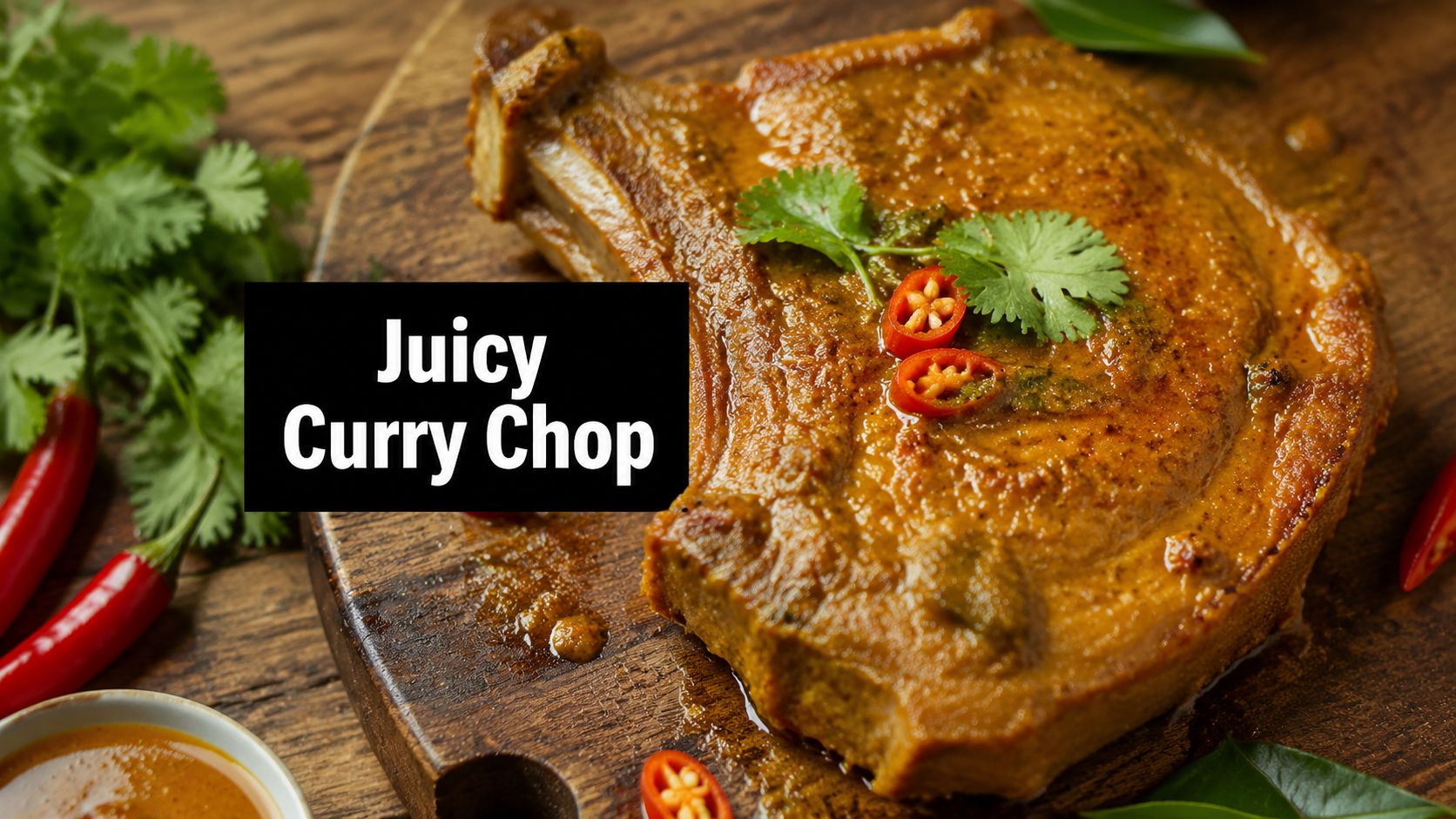
Use bone-in rib chops about 1 to 1.25 inches thick, brine them for 30 minutes, sear for about 2 to 3 minutes per side, then finish them in the curry sauce until they reach 145°F (63°C) internally. Rest the chops for 5 minutes before serving, and use a probe thermometer rather than color to judge doneness. The high-heat sear, short moist finish, and temperature check protect the pork from drying out, as supported by the tested sear-and-simmer workflow.
Curry pork chop works because it brings together two established food traditions. Japanese curry entered Japan during the Meiji era, from 1868 to 1912, and curry was already present in Japanese restaurants by 1877. Tonkatsu, the breaded pork cutlet often used in curry dishes, appeared on the Rengatei menu in 1899 under the name “pork cutlet,” while katsu curry has competing origin claims connected to 1918, 1921, and 1948, according to the Japan government's history of curry and tonkatsu.
That history matters in the kitchen. The dish isn't tied to one rigid formula, so you can use Japanese curry powder, Madras curry, or Thai red curry paste while keeping the same core technique. The reliable version is the one that treats the pork as the fragile part and the sauce as the forgiving part.
Why Most Curry Pork Chops End Up Dry and How to Fix That
The biggest mistake is pushing lean pork loin far beyond its safe finishing temperature and expecting braising liquid to repair it. Pork loin has little intramuscular fat, so prolonged high heat squeezes moisture from the muscle. Coconut milk can make the sauce luxurious, but it can't put that moisture back into the chop.
The fix starts before the pan reaches the stove. Choose bone-in rib chops about 1 to 1.25 inches thick, then brine them in salted water for 30 minutes. The brining approach is designed to help the meat retain roughly 10% extra moisture, but the exact result depends on the salt concentration and the cut. Pat the chops completely dry afterward. Wet pork steams, while dry pork browns.

Three controls make the difference
Use thickness as insurance. A thick bone-in chop gives the exterior time to brown while the center stays moist. Thin supermarket cutlets race from raw to overdone, especially once they enter a simmering curry.
Sear for flavor, not doneness. A brief sear builds browned fond in the skillet. That fond becomes part of the sauce, but the chop shouldn't be fully cooked during this stage.
Finish with a thermometer. Bring the pork to 145°F (63°C) internally, then remove it from the heat. A plan built around a 140°F pull temperature plus carryover can work with a probe thermometer, but the finished safety target remains 145°F. Resting for 5 minutes lets the juices settle through the muscle instead of spilling onto the cutting board.
Practical rule: The sauce can rescue a bland chop, but it can't rescue an overcooked one.
For organized ingredient planning, AI Meal Planner's food library can help you build a grocery list around the pork, curry base, and vegetables you already have.
What You Actually Need to Buy
Shop in three buckets: protein, sauce base, and finishers. For 4 servings, buy 4 bone-in pork rib chops. The same ingredient proportions scale cleanly for a batch of 8, although you'll need to sear the meat in batches rather than crowding one pan.
Protein
Bone-in rib chops are the practical choice. The bone contributes flavor, and the thicker cut gives you a wider window between a browned exterior and a dry center. If your butcher has thick center-cut chops, those work too, but very thin boneless chops need a shorter sauce finish.
A 30-minute salt-water brine is enough for this workflow. Don't leave the meat sitting wet after brining. Drain it, pat it dry with paper towels, and season with pepper. Go lightly on additional salt because the brine and fish sauce will both contribute seasoning.
Sauce base
- Yellow onion, garlic, and ginger: These create the aromatic foundation. Slice the onion thinly, mince the garlic, and grate the ginger so each softens quickly.
- Curry seasoning: Madras curry powder gives a warmer, sharper profile. Japanese curry powder is rounder and gentler. Thai red curry paste brings chile, herbs, and a more concentrated flavor.
- Coconut milk and chicken stock: Coconut milk supplies body and sweetness, while stock loosens the sauce enough for simmering. Use vegetable stock for a meat-free version.
- Fish sauce: Add it near the end. It brings savory depth, but early salting can make the finished curry too aggressive.
Finishers
Lime juice cuts through the richness after cooking. Fresh cilantro and sliced scallions add brightness, while toasted breadcrumbs or cashews provide crunch against the tender pork and smooth sauce. Fresh curry leaves are optional, but they're worth looking for at an Asian grocer when you want a more pronounced curry aroma.
A useful basket is simple: chops, onion, garlic, ginger, curry seasoning, coconut milk, stock, fish sauce, lime, cilantro, scallions, and one crunchy garnish. You don't need a long ingredient list to make the curry taste layered.
Cooking Curry Pork Chops Without Overcooking Them
Start with brined chops that are dry. Season both sides with pepper and only the salt your brine requires, then heat a heavy skillet over medium-high heat. Add oil when the pan is hot enough for it to shimmer, but not smoke heavily.
Sear the chops for 3 minutes per side. Listen for a steady sizzle rather than violent popping. If the pan is crowded, the temperature drops and the pork releases liquid instead of developing a brown crust. Move the chops to a warm plate once the surface is golden. They won't be cooked through yet, and that's intentional.

Lower the heat to medium. Add the sliced onion and cook for 6 to 8 minutes, stirring until it turns translucent and soft. Add the garlic and grated ginger for 60 seconds. They should smell fragrant, not toasted. Burnt garlic will dominate the curry and leave a bitter taste that coconut milk can't hide.
Build the sauce in the same skillet
Add the curry powder or paste and cook it in the oil for 45 seconds. This short blooming step releases fat-soluble aromatics. Pour in coconut milk and chicken stock, then scrape the pan with a wooden spoon. The brown bits are concentrated flavor, so don't leave them stuck to the skillet.
Return the chops to the sauce and partially cover the pan. Keep the liquid at a gentle simmer, not a hard boil. Cook for 8 to 10 minutes, turning once if needed, and check the thickest part with a probe thermometer. Remove the chops when they reach 140°F, allowing carryover heat to bring them to the safe finished temperature of 145°F (63°C).
While the pork rests for 5 minutes, let the sauce reduce slightly. Finish it with fish sauce and lime juice, then taste before adding more salt. Spoon the curry over rice, and add cilantro, scallions, or toasted cashews at the table.
For more structured meal ideas and cooking instructions, AI Meal Planner's recipe collection can help organize this dish alongside other weeknight meals.
This video demonstrates the visual cues that matter, especially crust color, simmer intensity, and sauce consistency:
Smart Swaps for Gluten-Free Low-Carb and Vegan Versions
The curry base adapts well, but every substitution changes texture. Use the matrix below to decide whether you're protecting a dietary requirement, cutting carbohydrates, or replacing the pork entirely.
| Restriction | Substitute | Texture Trade-off | Calorie Impact |
|---|---|---|---|
| Gluten-free | Cornstarch or arrowroot for flour at a 1:1 ratio | Keeps the sauce smooth, with little flavor change | Similar to the standard thickener |
| Low-carb | Cauliflower rice instead of basmati rice | Less chewy and aromatic than rice, but it keeps the sauce prominent | Lower than a rice-based plate |
| Low-carb | Half the onion, plus 1 tablespoon tomato paste | Slightly thinner sauce with deeper tomato savoriness | Lower than the full-onion version |
| Vegan | Thick portobello caps | Meaty and juicy, but without pork's fibrous bite | Usually lower than pork, depending on oil and coconut milk |
| Vegan | Seared extra-firm tofu | Firm edges and a softer center, with good sauce absorption | Often lower than pork, but varies with the tofu and cooking fat |
| Vegan | Jackfruit | Tender and shreddable, but less substantial | Lower-protein option |
Gluten-free cooks usually don't need to change the curry itself. The important check is the thickener and the labels on packaged curry blends, stock, and sauces. Cornstarch or arrowroot can replace flour at a 1:1 ratio without changing the flavor profile, although arrowroot can become less stable if boiled hard.
Low-carb cooks should make the rice swap first. Cauliflower rice reduces the starch load while keeping the plate substantial, and reducing onion by half makes room for tomato paste to restore body. The sauce will be a little thinner, but that isn't a problem if you simmer it briefly before returning the chops.
For vegan cooking, portobello caps and extra-firm tofu are stronger choices than jackfruit when protein and chew matter. Jackfruit works when you want a pulled texture, but it won't replace the protein density of pork. For more ideas in this category, browse easy gluten free vegan recipes from Gym Snack.
A low-carb meal plan can also help coordinate cauliflower rice, vegetables, and leftovers across the rest of the week.
Calories Macros and How This Dish Fits Your Goals

A standard serving of one 6-ounce bone-in chop with about three-quarters of a cup of curry sauce over rice provides around 520 calories, with roughly 38 grams of protein, 32 grams of carbohydrates, and 26 grams of fat. Use those figures for planning, not as a fixed promise. Coconut milk, rice portions, cooking oil, and the pork cut can shift the total, just as they can affect how easily the chop dries out.
Match the plate to your goal:
- For weight loss: Serve one-half cup of rice and double the non-starchy vegetables in the sauce. The meal comes to roughly 410 calories, while the pork portion and its protein stay the same.
- For muscle gain: Two chops plus 1 tablespoon of ghee in the sauce brings the meal to around 720 calories and 65 grams of protein. That is a large serving, so it suits a post-training meal or pairs with a lighter meal later.
- For maintenance: Keep the default serving, then adjust the rice to your hunger and activity.
Sodium can change sharply with the ingredients. Homemade versions generally provide 600 to 800 milligrams per serving, while restaurant versions often exceed 1,400 milligrams, according to the curry pork chop nutrition guidance. Fish sauce, stock, curry paste, and added salt all count. Low-sodium stock gives you more room to season without pushing the meal higher than intended.
A separate label-style calculation lists 450 calories, 38 grams of protein, 12 grams of carbohydrates, 28 grams of fat, and 680 milligrams of sodium for one 6-ounce bone-in chop with three-quarters of a cup of sauce. Treat that chart as a planning reference, not a laboratory measurement. For a changed chop size, rice portion, oil amount, or coconut milk quantity, use this recipe nutrition calculator before cooking.
Batch Cooking Storage Reheating and a Zero-Waste Grocery List
Batch cooking only saves time if the chops stay juicy. For 4 chops, follow the same cooking sequence and make about 1.5 times the sauce. For 8 chops, use about 2.5 times the sauce, but sear in batches. A crowded skillet steams the meat instead of browning it, leaving less fond for the curry and increasing the risk of dry edges.
Cool the chops and sauce separately in shallow containers within 2 hours. Store the chops in airtight containers for up to 3 days in the refrigerator, and refrigerate the sauce for up to 5 days, following the more conservative guidance in the curry pork chop batch recipe. Portion both into flat freezer bags if freezing. They keep well for up to 2 months.

Reheat gently
Frozen chops need refrigerator thawing before reheating. Put the thawed pork in a covered pan over low heat with a splash of water. Warm the sauce separately until it loosens, then spoon it over the meat. The goal is to restore moisture, not cook the pork through a second time.
The batch workflow also provides an oven method: reheat covered chops at 325°F for 15 minutes, with the sauce simmering separately. Check the thickest chop before serving. Thickness and starting temperature can change the result.
Shop for the recipe and one repeat meal
Build the list by store section:
- Meat counter: 8 bone-in pork rib chops for a full batch with leftovers.
- Produce: Yellow onions, garlic, ginger, limes, cilantro, scallions, cauliflower, and vegetables for the repeat meal.
- Canned goods: Coconut milk, chicken or vegetable stock, and tomato paste.
- Spices and sauces: Curry powder or Thai red curry paste, fish sauce, salt, pepper, and cooking oil.
- Pantry finishers: Rice, breadcrumbs, or cashews.
Buy enough onion for next-day fried rice, rather than leaving half a bulb unused. Extra coconut milk works in morning coffee, and curry powder can season another recipe that week. Pork trim can flavor stock. Clean vegetable scraps can go into broth when they are suitable for that use.
Timing depends on chop thickness and technique. Some preparations simmer pork for about 35 minutes, while others finish in roughly 5 to 15 minutes after searing. Use a thermometer and judge the sauce texture instead of following the clock blindly, as shown in the comparison of curry pork chop methods.
AI Meal Planner creates personalized weekly meal plans and aisle-sorted grocery lists based on your goals, dietary preferences, and allergies. Visit AI Meal Planner to plan curry pork chops, reuse leftover ingredients, and track macros that fit your routine.
AI-powered nutrition
Get Your Personalized Meal Plan
AI creates the perfect meals for your goals, lifestyle, and taste.
Start Your Journej