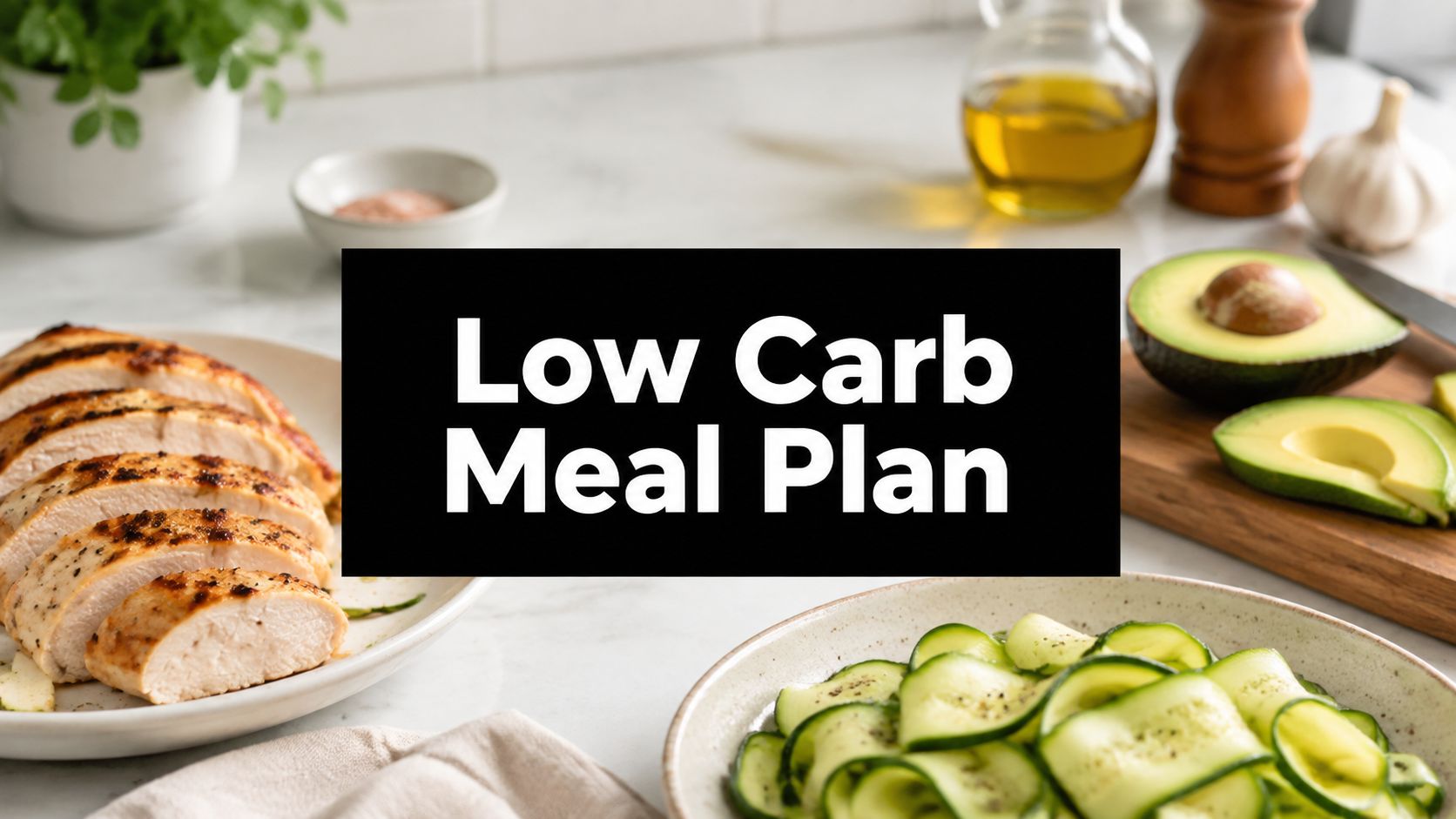
Most low-carb advice starts with the wrong obsession: cutting carbs lower and lower. A useful weight loss meal plan low carb should instead make your calorie intake manageable, keep protein high, protect fat quality, and give you meals you can repeat when work gets chaotic. Low carb is a structure, not a magic fat-loss switch.
A practical starting point is 1,400 to 1,550 calories, 110 to 140 grams of protein, and 50 to 80 grams of net carbs per day, adjusted to your body, activity, and results. Use the seven-day menu below as a template, then transition gradually toward maintenance instead of returning to unplanned refined-carbohydrate eating.
Why Low Carb Weight Loss Plans Work Best Short Term
Low-carb diets often get credited for fat loss that actually comes from several simpler changes. Removing bread, sweets, sugary drinks, pasta, and snack foods reduces the number of easy-to-overeat choices in your kitchen. Protein and fat can also make meals more filling, so you may eat less without constantly negotiating with hunger.
The early scale drop can be dramatic, but it creates unrealistic expectations. During the first week, people commonly see a 2 to 6 pound change, and glycogen depletion plus water loss may account for 60% to 80% of that movement. Those figures are practical estimates rather than universal outcomes, so don't treat the first week's scale change as pure body-fat loss.
The stronger evidence supports a more modest interpretation. A 2022 systematic review found that low-carbohydrate diets produced greater weight loss than non-carbohydrate-restricted diets at 3 to 4 months, with a mean difference of 2.59 kg, and at 6 to 8 months, with a mean difference of 2.64 kg, but the advantage wasn't maintained at later follow-ups (systematic review of low-carbohydrate diets). A separate review of meta-analyses found that low carb beat low fat by about 1.3 kg for average weight change at 6 to 12 months, while low-fat diets performed better for LDL and total cholesterol (review of low-carbohydrate and low-fat diets).
What drives the first 90 days
Three mechanisms matter most:
- Higher satiety per calorie: A protein-centered meal with vegetables and measured fat usually holds you longer than refined snacks.
- Automatic intake reduction: Food restrictions remove many calorie-dense defaults without requiring perfect tracking.
- Fewer hunger swings: Replacing rapidly digested refined carbohydrates with protein, fiber-rich vegetables, and minimally processed foods can make appetite easier to manage.
The third mechanism isn't a promise that every person's insulin response will behave identically. It means the meal pattern can reduce the repeated cycle of sweet foods, energy dips, and reactive snacking for some people.
| What Drives the First 4 Weeks of Low-Carb Weight Loss | Estimated Contribution | Sustainability Past 90 Days |
|---|---|---|
| Glycogen and water shifts | 60% to 80% of week-one scale movement | Low |
| Lower intake from food restriction | Not reliably quantifiable | Moderate to high |
| Protein and fat satiety | Not reliably quantifiable | High when meals are repeatable |
| Reduced hunger swings | Not reliably quantifiable | Depends on food quality and adherence |
The common failure comes later. Someone finishes a strict phase, adds refined carbs without changing portions, and treats the resulting hunger and water rebound as proof that low carb “stopped working.” The problem was the missing off-ramp.
For a useful comparison of structured approaches, review these evidence-based UK diet plans for 2026, then use a structured keto meal plan only if its stricter rules suit your appetite and lifestyle. My recommendation is clear: use low carb as a short-term scaffold, not a permanent identity. Build breakfast, lunch, shopping, and hunger-management habits that still work when carbohydrates gradually return.
Setting Your Calories, Carbs, and Protein Targets
A defensible macro budget starts with calories, not a dramatic carb promise. The CDC describes a practical weight-loss approach as staying within calorie needs, with standard public-health guidance often using a 500- to 1,000-calorie daily deficit as a target associated with losing about 1 to 2 pounds per week (CDC guidance on cutting calories). Treat that as a planning framework, not a guarantee.
Build the budget in four steps
1. Estimate your maintenance calories. Use the Mifflin-St Jeor equation to estimate resting needs, then apply an activity multiplier. Subtract a moderate deficit rather than choosing the lowest number you can tolerate. If you train hard, work on your feet, or have a history of restrictive dieting, an aggressive deficit can make adherence collapse.
2. Set a protein floor. Aim for 0.8 to 1.0 gram per pound of goal body weight. Eat protein first at every meal, using eggs, Greek yogurt, cottage cheese, chicken, turkey, fish, tofu, or tempeh. This target is a planning recommendation for this menu, not a universal medical prescription.
3. Choose a carb ceiling. Low carb has no single universal definition. One consensus describes lower-carbohydrate patterns as below 130 grams per day, while the acceptable macronutrient distribution range for carbohydrates remains 45% to 65% of daily calories (2024 carbohydrate consensus). Use three practical tiers:
- Moderate: 100 to 150 grams daily, useful for active people and flexible eating.
- Low: 50 to 100 grams daily, a strong starting range for many weight-loss plans.
- Ketogenic: Under 50 grams daily, a stricter option that demands more planning.
4. Fill the remaining calories with fat. Let fat complete the budget after protein and carbohydrates are set. Choose olive oil, avocado, nuts, seeds, eggs, and fatty fish more often than relying on butter, processed meats, or large amounts of cheese. Low carb isn't permission to make saturated fat the default.

For a worked example, a 180-pound sedentary woman targeting 1,400 calories could begin with 140 grams of protein, 75 grams of carbohydrates, and 80 grams of fat. Those macros equal approximately 1,600 calories, so they need to be treated as starting figures that require reconciliation in a tracking app or calculator rather than accepted as mathematically exact. Use the calorie and macro calculator, then revisit your actual intake and results every two weeks.
A 7-Day Low Carb Menu With Quick Recipes
The menu below is designed around 1,400 to 1,550 calories, 110 to 140 grams of protein, and 50 to 80 grams of net carbs daily. Meal macros are estimates for planning and will vary with brands, cooking oils, portion sizes, and recipe substitutions. Weigh calorie-dense ingredients, especially oils, nuts, cheese, and avocado.
Dinners are deliberately large enough to create the following day's lunch. That turns cooking into a batch system instead of a daily performance. Breakfast and lunch options take less than 20 minutes, and the week relies on the AI Meal Planner recipe collection for additional swap ideas when repetition starts to feel stale.
| Day | Breakfast | Lunch | Dinner | Snack | Daily Totals kcal / P / C |
|---|---|---|---|---|---|
| 1 | Greek yogurt and chia bowl, 340 / 30g / 18g | Chicken thighs with zucchini and peppers, 410 / 38g / 15g | Salmon foil packet with asparagus, 500 / 42g / 14g | Cottage cheese and cucumber, 190 / 20g / 7g | 1,440 / 130g / 54g |
| 2 | Two-egg veggie scramble, 330 / 24g / 10g | Leftover salmon and greens, 390 / 35g / 13g | Ground turkey lettuce wraps, 510 / 43g / 25g | Greek yogurt, 190 / 18g / 8g | 1,420 / 120g / 56g |
| 3 | Greek yogurt and chia bowl with berries, 360 / 30g / 25g | Leftover turkey lettuce wraps, 420 / 35g / 27g | Cauliflower-rice burrito bowl with black beans, 530 / 42g / 22g | Two boiled eggs, 170 / 13g / 2g | 1,480 / 120g / 76g |
| 4 | Two-egg veggie scramble with cottage cheese, 380 / 32g / 12g | Leftover burrito bowl, 430 / 37g / 24g | Sheet-pan chicken thighs with zucchini and peppers, 500 / 43g / 18g | Almonds, 180 / 6g / 6g | 1,490 / 118g / 60g |
| 5 | Greek yogurt and chia bowl, 340 / 30g / 18g | Leftover sheet-pan chicken, 410 / 38g / 15g | Bunless burger bowl with salad, 520 / 40g / 19g | Cottage cheese and cucumber, 190 / 20g / 7g | 1,460 / 128g / 59g |
| 6 | Two-egg veggie scramble with avocado, 410 / 25g / 20g | Leftover bunless burger bowl, 440 / 35g / 22g | Salmon foil packet with asparagus and quinoa, 540 / 43g / 36g | Greek yogurt, 180 / 17g / 8g | 1,570 / 120g / 86g |
| 7 | Greek yogurt and chia bowl, 340 / 30g / 18g | Leftover salmon salad, 400 / 35g / 14g | Ground turkey lettuce wraps, 500 / 42g / 25g | Two boiled eggs, 170 / 13g / 2g | 1,410 / 120g / 59g |
Day 3 and Day 6 are the higher-carb days, roughly 80 grams of net carbs when portions include beans, berries, or quinoa. Put those meals near demanding training if that improves performance, but don't turn a planned higher-carb day into an unrestricted cheat day.
The recipes are intentionally boring in the best sense. Greek yogurt and chia need a bowl; sheet-pan chicken needs one tray; lettuce wraps need cooked turkey and crisp vegetables; salmon foil packets need fish, asparagus, seasoning, and an oven. Eggs, cauliflower rice, and frozen vegetables cover the nights when motivation is missing.
Stock eggs, Greek yogurt, and frozen vegetables every week. Those three foods are your safety net against the drive-through decision that happens when you're tired, hungry, and underprepared.
Meal Prep Schedule That Fits a Busy Week
Sunday morning works best when you stop treating meal prep as a cooking marathon and start treating it as an assembly line. The target is a 90-minute block, with the first tasks chosen to create waiting time for chopping, portioning, and cleaning.
Start by preheating the oven to 400°F. Season 3 pounds of chicken thighs, place them on one tray, and season salmon fillets on another. While the oven heats, chop bell peppers, broccoli, and zucchini into uniform portions, then place the vegetables into 2-cup containers so every meal has a predictable base.

Boil six eggs while the chicken and salmon cook. Portion cottage cheese into single-serve cups, wash greens, and prepare a simple dressing in a jar. Use labels for the meal name and date. Don't trust memory when the refrigerator is full of identical containers.
The container rules that prevent waste
Cooked proteins belong in glass containers and last 4 days refrigerated. Freeze the day-five portions separately instead of hoping they'll remain appealing by the end of the week. Thaw them in the refrigerator before reheating, and keep dressing, avocado, and crunchy vegetables separate until serving.
For grab-and-go lunches, use this base:
- Greens: Fill the bottom with leafy vegetables.
- Protein: Add 4 to 5 ounces of cooked chicken, salmon, turkey, tofu, or tempeh.
- Vegetables: Add 1 cup of chopped or roasted vegetables.
- Measured fat: Finish with avocado or an olive-oil dressing that you've measured rather than poured freely.
The active cooking can stay close to 45 minutes per week when dinners produce lunches and the remaining time goes to boiling, chopping, and portioning. The point isn't culinary ambition. It's making the compliant choice easier than ordering takeout.
On Wednesday, run a 15-minute rescue plan. Combine leftovers into bowls or lettuce wraps, then add one fresh component such as quick cabbage slaw. Slice cabbage, add vinegar, salt, pepper, and a measured amount of olive oil. If your schedule changes, use the grocery list generator to rebuild the shopping list around the ingredients you have.
Portion Control and Smart Swaps for Any Diet
You don't need a food scale at every meal, but you do need a repeatable visual system. Use your palm for a serving of cooked protein, a cupped hand for nuts, a fist for vegetables, and two thumbs for added fats. These are rough guides, not exact macro measurements, so use a scale for ingredients that can easily dominate calories.
For moderate-carb days, use a plate with half non-starchy vegetables, one quarter protein, and one quarter smart carbohydrates such as quinoa or beans. On stricter days, replace that carbohydrate quarter with more vegetables or cauliflower rice. Keep the protein portion stable while adjusting the carbohydrate portion to match your chosen tier.
| Low-Carb Swaps for Common Dietary Needs | Vegetarian Swap | Dairy-Free Swap | Gluten-Free Swap |
|---|---|---|---|
| Chicken in a bowl | Tofu, tempeh, or edamame | Chicken remains suitable | Chicken remains suitable |
| Fish in a salad | Seitan or tempeh | Fish remains suitable | Fish remains suitable |
| Greek yogurt | Unsweetened soy yogurt | Unsweetened coconut yogurt | Plain Greek yogurt |
| Cheese topping | Nutritional yeast | Nutritional yeast or cashew cream | Cheese remains suitable |
| Soy sauce | Tamari-based tofu seasoning | Tamari, if dairy-free | Tamari, check the label |
| Breadcrumb coating | Almond flour | Almond flour | Almond flour |
The table gives food substitutions, but it doesn't make their macros identical. Check the package label for the product you use, especially with plant-based yogurt, seitan, tempeh, and coconut yogurt. Seitan also isn't suitable for people avoiding gluten, so tofu or tempeh is the better choice there.
Three rules keep the plan intact across dietary variations:
- Hold the protein floor: Keep protein around 0.7 to 1 gram per pound of goal weight, unless a clinician has given you a different target.
- Measure added oils: Track oil by tablespoon rather than counting the pan coating as “free.”
- Weigh calorie ingredients: Nuts, cheese, nut butter, avocado, and dressings are easy to underestimate.
A flexible plan beats a perfect plan you abandon after one restaurant meal. Swap the protein, keep the portion logic, and preserve the meal's role in your daily budget.
Tracking Progress and Adjusting Your Plan
Tracking should teach you, not turn every meal into an administrative task. Use a daily food log during the first two weeks to learn what your portions contain. After that, you can simplify to a weekly weigh-in, a monthly waist measurement at the navel, and an occasional food audit.
Weigh yourself weekly under the same conditions, ideally at the same time of day and before eating. Measure your waist monthly at the navel, keeping the tape position consistent. Rate energy, hunger, and workout quality from 1 to 10 so the plan reflects how you function, not just what the scale says.

Use a simple decision tree
If your weight stalls for 10 or more days while calories remain consistent, cut 25 grams of daily carbohydrates first. That adjustment is a trial, not a moral judgment about carbs.
If the stall continues for another 10 days, remove 100 calories from added fats, not from protein. Reduce oil, nuts, cheese, or dressing while keeping meals satisfying.
If both sleep and energy decline, add carbohydrates on training days rather than abandoning the plan. Persistent fatigue, dizziness, medication changes, diabetes, kidney disease, pregnancy, or breastfeeding require individualized clinical guidance before aggressive carbohydrate restriction.
The simplest metric stack is weekly weight plus monthly waist measurement. Complete a full food log every other week to catch creeping oils, snacks, sauces, and drinks. Take one photo on day 1 and another on day 30, because body-composition changes can appear in the mirror before the scale reflects them.
Practical rule: Change one variable at a time. Otherwise, you won't know whether the result came from fewer carbs, fewer calories, better sleep, or simply a more consistent week.
Transitioning Off Strict Low Carb Without Rebound
The strict phase usually isn't where people fail. They fail when they return to “normal eating” without defining what normal means. Bread at breakfast, a large restaurant portion at lunch, weekend snacks, and liquid calories can erase the structure that made the first phase work.
Use a controlled four-week step-down:
- Week 1: Add 25 grams of net carbohydrates from starchy vegetables and legumes at lunch.
- Week 2: Introduce a measured serving of whole grains such as oats or quinoa at breakfast.
- Week 3: Add one weekly flex meal with portions decided before you eat.
- Week 4: Recalibrate toward maintenance, roughly 200 to 300 calories above the deficit floor, while monitoring your trend.

Keep protein at every meal throughout the transition. Hold fat slightly lower as carbohydrates rise, keep water and fiber intake high, and add only one meaningful change at a time. A scale increase after adding carbohydrates can include water and glycogen changes, so judge the trend rather than reacting to one weigh-in.
Watch for the predictable rebound patterns:
- Weekend blowouts: Plan the restaurant meal and choose the portion before hunger takes over.
- Snack creep: Keep a defined snack rather than eating from a bag or box.
- Liquid calories: Treat sweetened drinks, alcohol, and specialty coffees as part of the calorie budget.
Choose one anchor, such as protein at breakfast, and keep a weekly weigh-in. If the transition feels difficult, AI Meal Planner onboarding can collect your goals, preferences, and allergies to generate a maintenance template with meals, macros, and a grocery list rather than leaving you to improvise.
AI Meal Planner creates personalized weekly meal plans and organized grocery lists around your goals, dietary preferences, and allergies, with calculated macros and calories for each meal. Visit AI Meal Planner to turn this low-carb structure into a repeatable plan with leftovers, meal swaps, and a controlled transition toward maintenance.
AI-powered nutrition
Get Your Personalized Meal Plan
AI creates the perfect meals for your goals, lifestyle, and taste.
Start Your Journej