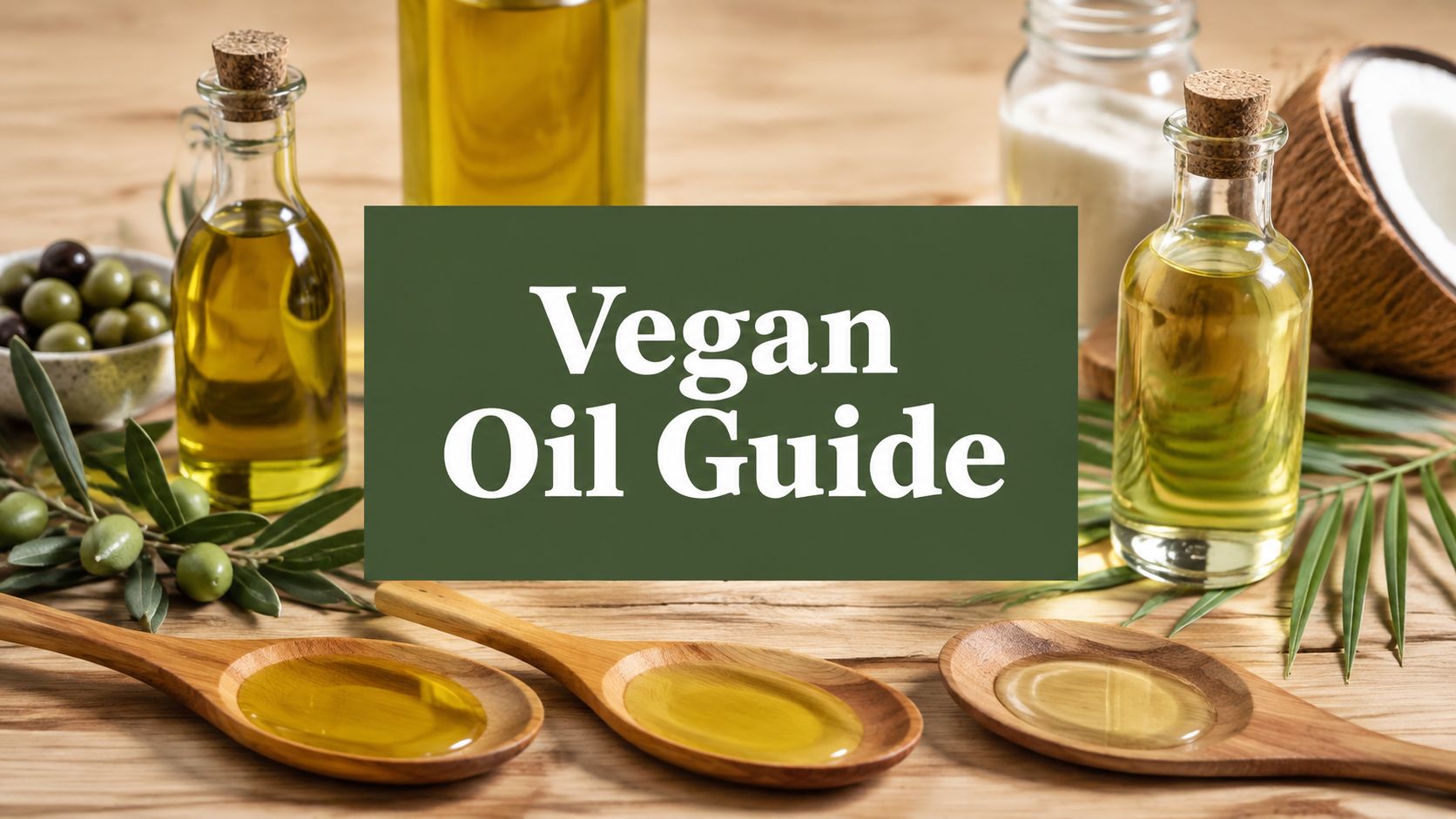
You're standing in front of the stove, recipe open, and the bottle you grabbed says “vegan” but gives you no clue whether it's right for frying, salad dressing, or baking. The best vegan cooking oil depends on the job, not just the smoke point. For most home cooks, extra virgin olive oil for everyday use, avocado or high-oleic oils for high heat, and a specialty oil for flavor covers the bases.
A vegan cooking oil is any oil made from plants with no animal-derived additives or processing aids. That sounds simple, but it's where a lot of confusion starts, because a label can be plant-based and still hide flavorings, fortifiers, or refined ingredients that aren't obviously vegan. A good first check is whether the ingredient list stays fully plant-derived, then you can move on to how the oil behaves in heat, what it tastes like, and what it means for long-term health.
What Makes a Cooking Oil Vegan and Why It Matters
A vegan cooking oil comes from plants, not animals, and that includes the fine print. The oil itself may be plant-derived, but some specialty products use butter flavor, ghee-style notes, or added ingredients that can come from animals, so the label matters more than the front-of-pack claim.
The bigger confusion is that many people treat smoke point like the only score that matters. It matters, but it's only one part of the decision, because the oil's fatty-acid profile, antioxidant content, and flavor all shape how it performs in a pan and on the plate.
Practical rule: choose the oil for the cooking method, then check the label for anything that breaks vegan status.
That shift matters because the plant oil aisle isn't a tiny niche. Global vegetable oils, the category that supplies most vegan cooking oils, rose from about 95 million tonnes in the early 2000s to 212 million tonnes in 2022 (Vegetable oil), which shows just how central these oils are to everyday food. The modern market grew through a long industrial transition, with production rising rapidly in the late 20th century as palm, soybean, rapeseed, and sunflower oils became major commodity ingredients (UNCTAD report).
For a simple label check, look for the oil source first, then scan the rest of the ingredient list for dairy-derived flavorings or processing clues. If you want a plain-English explanation of olive oil specifically, Learn Olive Oil's vegan guide is a useful reference point.
If you're building a plant-based kitchen from scratch, a structured plan helps too, and a plant-based meal plan can keep oil choices aligned with your recipes instead of leaving you to guess at the stove.
Comparing the Most Popular Plant-Based Oils
A good kitchen test starts with fat type first, then flavor, then how the oil will be used. Monounsaturated-heavy oils usually stay steadier under heat, polyunsaturated-heavy oils are more fragile, and saturated-heavy oils behave differently again, especially in baking and recipes where solid fat changes texture.
The oils most home cooks reach for
Extra virgin olive oil is rich in monounsaturated fat, tastes grassy or peppery, and fits dressings, vegetables, and moderate-heat cooking. It works well as an everyday oil because it adds flavor while still holding up in routine sautéing.
Refined olive oil is also monounsaturated-rich, but the flavor is much milder and the smoke point is higher than extra virgin. That makes it easier to use for roasting, pan-frying, and recipes where you want olive oil's structure without a strong olive taste.
Avocado oil is mostly monounsaturated fat with a very neutral flavor, so it suits high-heat cooking and dishes where you do not want the oil to stand out. One source places unrefined avocado oil around 250°C and refined around 271°C (veganfriendly.org.uk), which helps explain why it is often chosen for searing and roasting.
Canola oil is typically neutral, versatile, and useful in baking or everyday stovetop cooking. It is a practical choice when you want an oil that stays in the background and does not steer the flavor of the meal.
Sunflower oil varies a lot. Conventional sunflower is more polyunsaturated and more fragile under heat, while high-oleic sunflower shifts toward better heat stability, so the label matters here.
Safflower oil follows a similar pattern. High-oleic versions handle heat better than the more polyunsaturated forms.
Peanut oil has a clean, lightly nutty flavor and is often used for frying or stir-frying. It suits dishes that benefit from a subtle roasted note.
Refined coconut oil is different from the oils above because it is saturated-heavy and more solid at room temperature. That gives it a place in baking and some curries, but it is not the same kind of everyday health oil as olive or avocado.
Smoke point matters, but it is not the whole story. A higher smoke point does not automatically make one oil healthier in every context, and a lower smoke point does not make a oil unsuitable for all cooking. What matters is how long the oil is heated, how much oxidation it can tolerate, and whether its fatty acids fit the job.
| Oil | Dominant Fatty Acid | Smoke Point (°F) | Flavor | Best For |
|---|---|---|---|---|
| Extra virgin olive oil | Monounsaturated-rich | About 375 | Fruity, peppery | Dressings, vegetables, gentle sautéing |
| Refined olive oil | Monounsaturated-rich | Higher than EVOO | Mild | Roasting, pan-frying, everyday cooking |
| Avocado oil | Monounsaturated-rich | High | Neutral | Searing, roasting, high heat |
| Canola oil | Mixed, more neutral | Moderate to high | Neutral | Baking, stir-frying, all-purpose use |
| Sunflower oil | Often polyunsaturated-rich unless high-oleic | Varies by type | Neutral | Light cooking, frying if high-oleic |
| Safflower oil | Often polyunsaturated-rich unless high-oleic | Varies by type | Neutral | High-heat use only if high-oleic |
| Peanut oil | Monounsaturated-rich | High | Lightly nutty | Frying, stir-frying, savory dishes |
| Refined coconut oil | Saturated-heavy | Around 400 | Mild coconut | Baking, curries, texture-focused recipes |
Best Oil for Every Cooking Method
Cooking method should drive the choice. Heat, time, and flavor load are not the same thing, so the best oil for a salad isn't the best oil for a wok, and the best oil for a cake isn't the best oil for a sear.
Quick rule: use stable, mostly monounsaturated oils for high heat, and save delicate oils for cold or low-heat applications.
For high-heat frying and searing, reach for refined olive oil, avocado oil, peanut oil, or high-oleic sunflower or safflower oil. These are better matches because they tolerate heat with less breakdown, especially when the cooking session runs longer or the pan is hot enough to brown food quickly. If you're cooking something like skewered tofu, a method-heavy recipe such as how to use mesquite chips can be a useful reminder that flavor tools and heat tools aren't the same thing.
For sautéing and stir-frying, extra virgin olive oil, peanut oil, and toasted sesame oil bring more flavor to the pan. Extra virgin olive oil can absolutely belong here, especially when the heat is moderate and you want the oil to add depth instead of just acting as a neutral carrier.
For cold applications, lean into flavor and aroma. Extra virgin olive oil, walnut oil, flax oil, and avocado oil all make sense in dressings or finishing drizzles, but the more delicate nut and seed oils are better kept away from high heat so their flavor stays fresh.
For baking, the decision is about texture and flavor neutrality. Canola and sunflower oils keep cakes soft without dominating the crumb, while coconut oil and olive oil can add distinct character in quick breads, muffins, and savory bakes.
| Cooking Method | Top Oil Picks | Why It Works | Avoid |
|---|---|---|---|
| Frying | Avocado, peanut, high-oleic sunflower | Handles heat well and stays more stable | Delicate nut oils |
| Sautéing | Extra virgin olive oil, peanut oil | Enough stability, good flavor | Very fragile oils |
| Stir-frying | Refined olive oil, toasted sesame, peanut | Fast cooking, strong flavor control | Flax, walnut |
| Dressings | Extra virgin olive oil, walnut, flax, avocado | Flavor matters more than heat | Heavily refined neutral oils |
| Baking | Canola, sunflower, refined coconut | Even texture, predictable results | Strong-flavored oils if you want a clean crumb |
If you batch-cook lunches, a meal-prep recipe system helps you match oil choice to the cooking method before the week starts, which saves a lot of last-minute substitutions.
Health Tradeoffs Most Cookers Miss
The health question isn't just “is this oil vegan.” It's also what kind of fat it brings, how it behaves in heat, and what it tends to replace in your meals.
The most useful takeaway from the mortality research is practical, not academic. A large 2025 analysis of 200,000+ people followed for 30+ years found that higher intakes of plant-based oils were associated with about 16% lower total mortality, and swapping about 10 grams/day of butter for plant oils was linked to about 17% lower risk of death, with benefits driven especially by soybean, canola, and olive oil (Mass General Brigham). That doesn't make every plant oil equal, but it does support the idea that replacing butter with plant oils is a meaningful move.
The chemistry matters too. Polyunsaturated oils oxidize faster under heat, and recent research found oxidative stability tracked positively with saturated fat and negatively with polyunsaturated fat at 120 °C (PubMed). In plain English, oils with more PUFA can break down faster during cooking, which is why high-oleic oils are usually better for heat and PUFA-rich oils are better kept for cold use.

A simple hierarchy works well in real kitchens. Use extra virgin olive oil most often, add flax or walnut oil raw, choose high-oleic refined oils for frying, and keep generic soybean oil mostly in the background, especially when it shows up in processed foods. If you're tracking meal quality in a tighter way, a recipe nutrition calculator can help you see where oil calories and fat sources are landing in the week.
One practical swap makes this easier:
- Breakfast: drizzle extra virgin olive oil on vegetables instead of butter.
- Lunch: use flax oil in a cold grain bowl dressing.
- Dinner: choose high-oleic sunflower oil for searing instead of a generic blended oil.
Sustainability and Ethical Sourcing
A vegan label only tells you the oil came from plants. It does not tell you whether the crop was grown with care for forests, water, workers, or transport.
Palm oil shows why this matters. It can be efficient to produce, yet it also raises the sharpest ethical concerns when expansion comes from non-certified plantations tied to deforestation and habitat loss. Coconut oil brings a different tradeoff, because the crop may be plant-based but the drying, transport, and bottling steps can still add processing burden. The practical lesson is simple. The most sustainable bottle is not always the one with the cleanest ingredient list.
Look at sourcing details before you look at marketing language. Single-origin can help you trace where an oil came from. RSPO or Rainforest Alliance certification on palm-containing products gives a clearer sign that the supply chain is being checked. Packaging matters too. Dark glass or tin helps protect delicate oils from light, while clear plastic is a weaker fit for oils that spoil faster. Choosing cold-pressed domestic oils can also lower transport distance if local production is available.
The seed-oil-free trend adds another layer of confusion. In many cases, it is really a reaction to heavily refined omega-6-dominant oils inside ultra-processed foods, not a reason to reject every seed-derived oil in a home kitchen. A bottle of canola oil used for cooking is not the same as an industrial ingredient hidden in packaged snacks, and those two choices should not be judged the same way.
If you want a calmer way to shop, focus on one question. Will this oil be used often enough, and stored well enough, to justify buying it? Smaller bottles reduce waste if you cook slowly through a pantry. They also help delicate oils stay fresher, so less of the bottle ends up stale before you finish it.
Smart Substitutions and Storage Habits
The fastest kitchen wins come from knowing what can swap for what without wrecking the recipe. If you run out of olive oil halfway through dinner, or you need a neutral oil for a cake, the right substitute is mostly about flavor strength and heat behavior.

Simple swaps that work
- Need a neutral oil: use canola or grapeseed when you want the recipe to stay quiet.
- Need high-heat searing: use avocado or peanut oil when the pan is hot and the food needs browning.
- Need a salad dressing base: use olive or walnut oil when flavor should lead.
If you're baking something specific, like a tray of mini buns or another party-style recipe from a collection such as the Dubai gourmet mini bun image, the oil choice should support tenderness without overpowering the crumb.
Storage rules that prevent rancidity
Flax and walnut oils belong in the refrigerator because they go stale faster. Extra virgin olive oil does best in a dark cupboard away from the stove, and toasted sesame oil keeps longer when chilled after opening.
Smell and taste tell you a lot. If an oil smells paint-like, bitter, or stale, it's likely past its best; cloudy olive oil, by contrast, has often just solidified and can return to normal at room temperature.
Store delicate oils in dark glass or tin, and decant large bottles into smaller containers if you use them slowly.
If you buy oil infrequently, smaller bottles are smarter than bulk jugs. You'll waste less, and the flavor usually stays cleaner from first pour to last.
Putting It All Together in a Busy Week
A busy kitchen gets easier when the oil shelf stays small and intentional. Keep three bottles on hand. Use a high-heat neutral or high-oleic oil for searing and roasting, extra virgin olive oil for moderate heat and finishing, and one specialty oil for flavor.
The chemistry helps here, but only if you match it to the job. Smoke point matters for whether an oil can handle heat without breaking down, yet fatty-acid composition also shapes stability. Oils higher in monounsaturated fat, like olive and avocado, tend to hold up better for everyday cooking than oils that are more delicate, which is why the same bottle does not fit every pan. That is also where real-world choices come in, since sustainability and source matter too, especially for cooks trying to avoid seed oils or palm oil.
A weekly rotation keeps the decisions simple. Breakfast can use avocado oil for tofu scrambles, lunch can lean on toasted sesame in grain bowls, and dinner can shift between refined olive oil for stir-fries and olive oil for vinaigrettes. If you want a vegan-specific system, AI Meal Planner's vegan meal plans can generate weekly menus for plant-based diets.
| Day | Breakfast oil + method | Lunch oil + method | Dinner oil + method |
|---|---|---|---|
| Monday | Avocado oil, scramble | Olive oil, salad | Refined olive oil, sauté |
| Tuesday | Olive oil, toast topping | Toasted sesame oil, grain bowl | Peanut oil, stir-fry |
| Wednesday | Canola oil, muffins | Canola oil, sheet-pan lunch prep | Extra virgin olive oil, vegetables |
| Thursday | Avocado oil, pan-cook | Sesame oil, noodles | Coconut oil, curry |
| Friday | Olive oil, skillet | Peanut oil, warm bowl | Olive oil, vinaigrette |
| Saturday | Neutral oil, baking | Avocado oil, roast | Refined olive oil, pan meal |
| Sunday | Olive oil, finishing | Specialty oil, leftovers | High-heat oil, batch cook |
If you like a system that does part of the thinking for you, AI Meal Planner can build weekly meal plans and grocery lists around your dietary preferences, so you are not matching oils to recipes from scratch every night. It helps keep vegan meals organized when you repeat a few reliable cooking methods.
A short Sunday prep keeps the week steady. Pour oils into smaller opaque bottles, write the open date on the label, and mix a couple of dressings ahead of time so weekday meals start from a ready base instead of a full reset.
Quick Answers to Common Vegan Oil Questions

精製椰子油和未精製椰子油在高溫下有差別嗎? 有。精製椰子油去除較多天然雜味,煙點通常更高,適合烘焙和較熱的烹調。
橄欖油加熱後會失去好的成分嗎? 會少一些,但它仍是日常煎炒中很穩定的單元不飽和脂肪來源。高溫是否合適,還要看油的類型與你怎麼用。
壓榨式菜籽油和溶劑萃取有差嗎? 差別主要在風味和保留的細微成分,實際下鍋表現通常接近。選你喜歡的味道,也看它是否符合料理需求。
可以用礦物油做菜嗎? 不可以。礦物油不是食品級烹調油,不該進平底鍋或沙拉。
開封後的油能放多久? 多數油開封後可在一段時間內保持新鮮,堅果油通常更適合冷藏,並盡快用完。油聞起來有油耗味、苦味或黏稠感時,就該更換。
那麼怎麼記得用對油? An infographic titled Quick Answers to Common Vegan Oil FAQs with advice on refined oils, baking, and storage. 旁邊就把常用油分成烘焙、拌醬和快炒三類,操作會更直覺。
AI-powered nutrition
Get Your Personalized Meal Plan
AI creates the perfect meals for your goals, lifestyle, and taste.
Start Your Journej