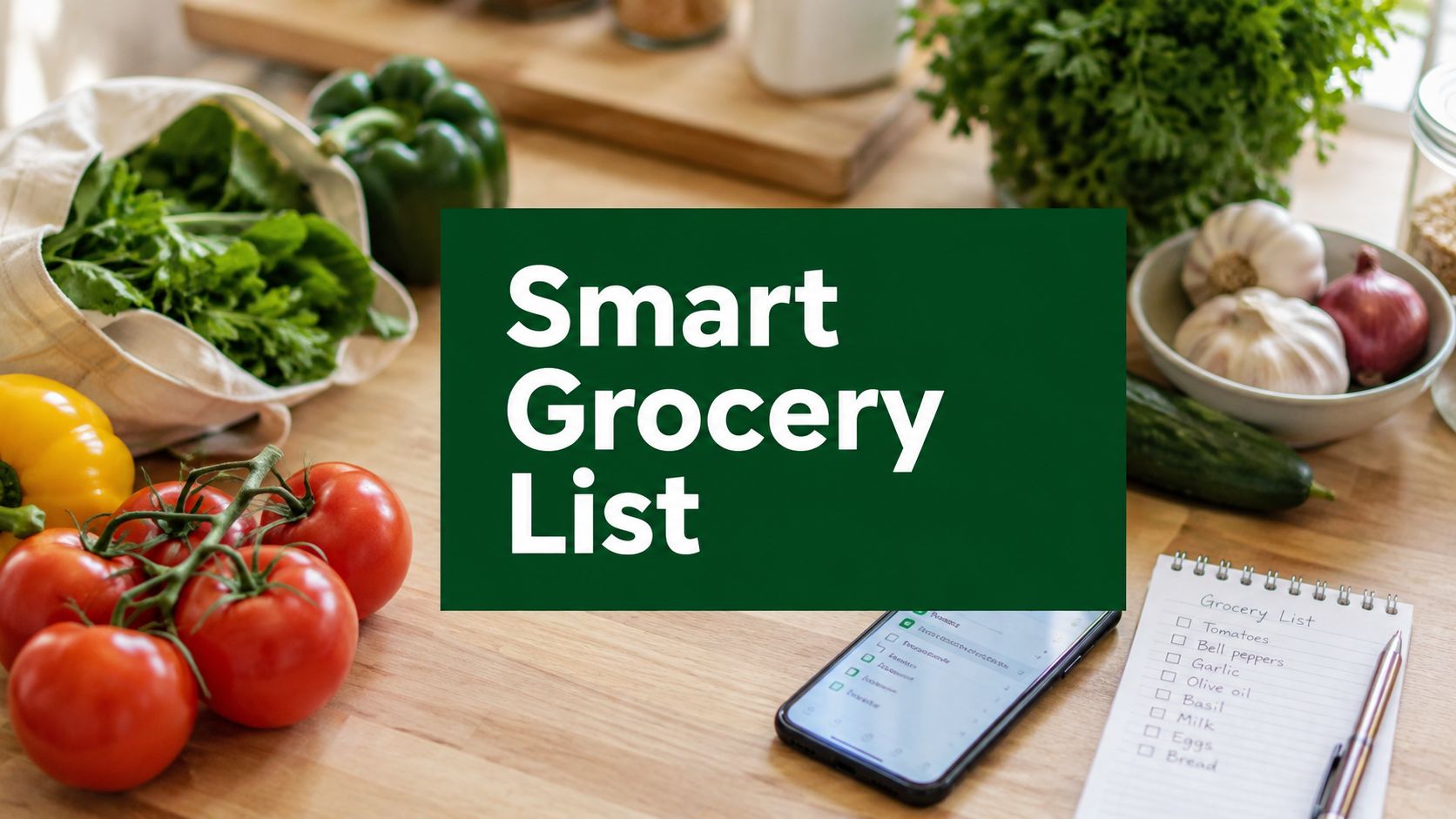
A smart grocery list is automatically generated from your planned meals, sorted by aisle, and adjusted for what you already have at home. In a 2026 survey, 60.3% of participants used a shopping list, while food waste was reported far more often among non-list users, 92% versus 55.3% among list users.
You may recognize the problem immediately. You open the refrigerator before shopping, notice a few ingredients, forget others, and then stand in the produce aisle trying to remember what dinner was supposed to be. A smart grocery list turns that uncertain process into a waste-reduction loop: check inventory, plan meals, combine ingredients, account for expiry timing, and buy only what the household can use.
The useful distinction is simple. A digital checklist helps you remember items. A smart grocery list helps decide which items belong on the list in the first place, how much you need, where to find them, and how leftovers can become part of another meal.
Why Your Grocery List Keeps Failing You
You're standing beside the spinach, holding your phone or a scrap of paper. The list says “greens,” but it doesn't say whether you need one bag or two, and it doesn't remind you that two unopened bags are already behind the milk. You buy another bag because the planned pasta recipe needs spinach. A week later, the old vegetables have wilted, and the new ones are beginning to do the same.
A handwritten list solves one narrow problem: remembering. It can remind you to buy onions, rice, yogurt, and chicken, but it usually doesn't answer the questions that cause waste:
- What quantity is needed?
- Which ingredients are already in the pantry?
- Which meals should use fragile produce first?
- Can one leftover ingredient fit into another recipe?
That gap creates familiar supermarket mistakes. You forget the main ingredient for Tuesday's dinner, buy a replacement, and then order takeout because the recipe feels incomplete. You purchase a new jar of cumin even though one is hiding behind the flour. You grab extra fruit because the family might eat it, without checking whether the current fruit is already approaching its use-by date.

The list remembers, but it doesn't reason
A paper list is static. Once you write “tomatoes,” the item stays there even if you find three tomatoes in the refrigerator or change the recipe that required them. The shopper must perform the reasoning manually, often while distracted, hungry, or rushing between errands.
The same issue appears with recurring household purchases. Subscription models can help automate replenishment for dependable staples, and a Subscribe and Save glossary can clarify how that approach works. But recurring delivery isn't the same as meal-aware planning. Automatic replenishment may send more of an item just as your household's recipes, schedule, or appetite changes.
A smart system connects the list to the kitchen's current state. It treats the refrigerator, freezer, pantry, recipes, portions, and dates as related information rather than separate reminders. That connection is what makes the list useful for preventing overbuying, not merely for making checkout faster.
What a Smart Grocery List Actually Is
A smart grocery list is a purchasing plan generated from meals and adjusted against your current inventory. Think of it as a project manager for your kitchen. It gathers ingredient requirements from recipes, combines repeated ingredients, removes items you already have, and presents the remaining work in a practical store order.
The process usually has four connected parts:
- Recipe-driven generation: You choose meals for the week, and the system extracts their ingredients.
- Quantity aggregation: If tacos need half an onion and soup needs one onion, the list combines those needs instead of creating two unrelated entries.
- Inventory awareness: Items already recorded in your pantry or refrigerator can be suppressed or reduced.
- Aisle sorting: Produce, dairy, grains, meat, frozen goods, and other categories appear in a useful shopping sequence.

Why aggregation matters in a real kitchen
Suppose Monday's recipe uses cilantro, Wednesday's grain bowl uses cilantro, and Friday's tacos use cilantro again. A basic list might show cilantro three times. A smart list should recognize the shared ingredient and present one consolidated purchase, with a quantity based on the recipes and the household size.
That same logic applies to leftover reuse. If a recipe leaves half a cabbage, the next meal can be selected to use it. The list then reflects the remaining need rather than asking you to buy another full cabbage. This is more than convenience. It creates state synchronization, meaning the list changes when the kitchen changes.
An academic review argues that an effective food-waste prevention app should combine inventory management with smart grocery lists and attach storage or spoilage guidance to individual products. It describes grocery lists as part of a broader system that can also include smart recipes, food sharing, and portion-ready delivery, rather than treating the list as a static checklist. You can explore the practical planning workflow through the AI Meal Planner tools.
Mental model: A smart grocery list is a meal plan translated into exact purchases after checking what your kitchen already owns.
How Smart Lists Cut Food Waste and Save Money
The strongest reason to use a smart grocery list isn't that it looks tidy on a phone. It's that structured planning is linked with less wasted food. A 2026 mixed-methods survey found that 60.3% of participants reported using a shopping list. Food waste was reported by 92% of people who didn't use lists, 23 out of 25 participants, compared with 55.3% of list users, 21 out of 38. The study reported a statistically significant association between list use and reduced food waste, with χ²=9.66, P=.008, and Cramér V=0.39. Read the survey details.
Those figures don't mean every list automatically prevents waste. They show why planning deserves attention. Consider a household that repeatedly buys vegetables for meals it never cooks. A list tied to actual recipes can remove speculative purchases, while an inventory check can prevent a second purchase of food already sitting at home.
Leftovers become inputs, not forgotten food
The waste-reduction loop becomes clearer with a simple example. You plan roasted chicken with rice on Monday. Instead of treating leftover rice as an accident, the next meal uses it for fried rice, a bowl, or stuffed vegetables. The list accounts for the original purchase and the follow-up meal together.
Research on household planning found that food waste over 21-day horizons varied from 0–52 grams, 46–300 grams, and 50–900 grams, depending on shopping-frequency and uncertainty profiles. The same research reported that waste could fall to as little as 3 grams per day when people selected recipes using ingredients already at home. See the household planning research.
Worldwide, the scale is much larger. One review notes that the world produces around 1.3 billion tonnes of food waste annually, which helps explain why household planning tools matter beyond personal convenience. Explore practical fridge shelf organization tips so the inventory your list relies on remains visible and usable.
A smart list can also support budgeting by reducing duplicate purchases and impulse additions, but it can't guarantee a fixed saving for every household. Use the grocery budget calculator to connect planned ingredients with your own spending decisions.

Paper List Versus Smart List at the Store
The difference becomes obvious when both methods handle the same week. With paper, you decide meals separately from shopping, inspect the pantry from memory, and adjust quantities while walking through the store. With a smart list, the meals provide the starting point, the inventory check removes duplicates, and the combined ingredients guide the trip.
| Task | Handwritten List | Smart Grocery List |
|---|---|---|
| Adding items | You write items manually | Recipes and planned meals generate ingredients |
| Aisle order | You arrange it yourself, if at all | Items are grouped by store section |
| Combining quantities | You calculate repeated ingredients | Shared ingredients are aggregated |
| Checking pantry contents | You inspect and remember manually | Recorded inventory can reduce or remove purchases |
| Using leftovers | You must plan the connection yourself | Remaining ingredients can influence later recipes |
The same trip, handled two ways
On paper, Monday's chicken recipe, Wednesday's soup, and Friday's wraps might produce separate notes: chicken, carrots, onions, tortillas, herbs, and rice. You may not notice that the recipes overlap, so you buy extra onions and a second package of herbs.
At the store, the paper shopper moves back and forth between sections, remembers missing items, and sees promotions that weren't part of the plan. The trip can still work, but the shopper carries the entire planning burden in their head.
The smart-list shopper sees one combined entry for onions, a quantity tied to the recipes, and a pantry adjustment if onions are already available. The list follows the store route, and the shopper can check off each item without losing track of what remains.
A reusable bag, such as this mini mesh grocery bag from Peppervale, can help with loose produce, but the bag doesn't solve the planning problem. The important change happens before checkout, when the system decides what the household can realistically use.
Building Your First Smart Grocery List With AI Meal Planner
Start with the kitchen rather than the supermarket. A meal plan gives the list a reason to exist, and an inventory check gives it boundaries.
Set the planning rules first
Complete the quick onboarding with your goals, dietary preferences, and allergies. Those details shape the meals that appear, so you won't spend time deleting recipes that conflict with your diet or household needs.
The platform can create a weekly plan covering breakfast, lunch, dinner, and snacks, with macros and calories calculated for the meals. It can adapt to patterns such as Keto, Vegan, Paleo, or a balanced diet, while dietary restrictions and allergies remain part of the planning criteria.

Edit the plan before accepting the list
Don't force yourself to cook meals the household won't eat. Swap a disliked dinner, replace an inconvenient ingredient, or choose a recipe that fits the evening's time limit. The platform's recipes are designed to cook in under 30 minutes, which helps keep a planned week practical for busy schedules.
Once the meals are acceptable, generate the AI grocery list. The list combines ingredients across the plan, avoids duplicate entries, uses quantities connected to the recipes, and groups products by category or aisle.
Before leaving home, compare the result with the refrigerator, freezer, and pantry. Mark what you already own, check expiry timing for perishables, and notice whether a leftover ingredient should be used earlier in the week. This review matters because no automated list can see a forgotten container at the back of your fridge unless you record or confirm it.
Over time, your swaps and preferences make future planning more useful. If the family rejects a meal, change it. If spinach repeatedly goes unused, choose a smaller quantity or schedule it earlier. The system becomes more helpful when your corrections reflect real kitchen behavior.
Common Smart Grocery List Mistakes to Avoid
A smart grocery list can still fail when people treat it as a perfect answer instead of a planning assistant. Watch for these common errors.
Mistake one, confusing digital with smart
A checklist in a notes app may be convenient, but it doesn't automatically understand recipes, inventory, quantities, expiry timing, or leftover reuse. The correction is simple: ask whether the list is connected to meals and kitchen state, not whether it merely appears on a screen.
Mistake two, entering everything from scratch
People often assume automation requires cataloging every jar and packet manually. Modern grocery and pantry tools demonstrate capture methods such as receipt parsing, barcode scanning, item auto-completion, and product matching. One grocery app description says a barcode scan can save a store, date, and line items as a trip, while another combines receipt scanning with barcode lookup and remembers brands over time. Review the grocery-list automation examples.
Start with the foods that create the most waste, such as fresh produce, dairy, and opened leftovers. Add more detail as the habit becomes useful.
Mistake three, trusting the first meal plan blindly
A generated plan may fit your dietary rules but not your schedule, equipment, budget, or taste. Review it before shopping, swap meals that won't be cooked, and make sure the cooking order uses fragile ingredients first.
Mistake four, ordering perishables without an expiry check
Recent U.S. household data associated online grocery shopping with greater overall food waste and specifically more fruit and vegetable waste. The same coverage linked shorter grocery-planning durations with less waste, so online convenience doesn't remove the need for planning. Read the online grocery and meal-planning analysis.
For delivery or pickup, choose perishables according to the meals you'll cook soon, avoid buying “just in case” produce, and schedule recipes around the items that spoil first.
Mistake five, ignoring shared-household control
A family list needs more than synchronization. People should know who added an item, whether it was purchased, and whether a change affects a planned meal. Shared grocery systems also need privacy-aware handling of purchase history and dietary information. Keep permissions focused on what each household member needs.
Your Weekly Smart Shopping Habit
A useful routine can fit into one weekly planning session. Pick meals, check the pantry and refrigerator, let the list combine and sort ingredients, then review expiry timing before you shop. At home, cook the most fragile produce first and carry planned leftovers into the next meal instead of treating them as optional extras.
Use this checklist:
- Choose meals: Pick recipes that fit your schedule and preferences.
- Check inventory: Remove food you already have and identify leftovers to use.
- Review quantities: Confirm that portions match the people eating.
- Shop by aisle: Follow the sorted list and avoid unplanned additions.
- Cook in sequence: Use short-life ingredients before sturdier foods.
- Adjust next week: Note what was wasted, disliked, or repeatedly overbought.
For households balancing nutrition and cost, the meal-plan budget options can help connect weekly menus with spending decisions. The habit works because each week teaches the next one what your kitchen uses.
AI Meal Planner creates personalized meal plans and automated grocery lists based on your goals, preferences, allergies, and meals you'll cook. Visit AI Meal Planner to generate your first leftover-aware smart grocery list and make your next supermarket trip more deliberate.
AI-powered nutrition
Get Your Personalized Meal Plan
AI creates the perfect meals for your goals, lifestyle, and taste.
Start Your Journej