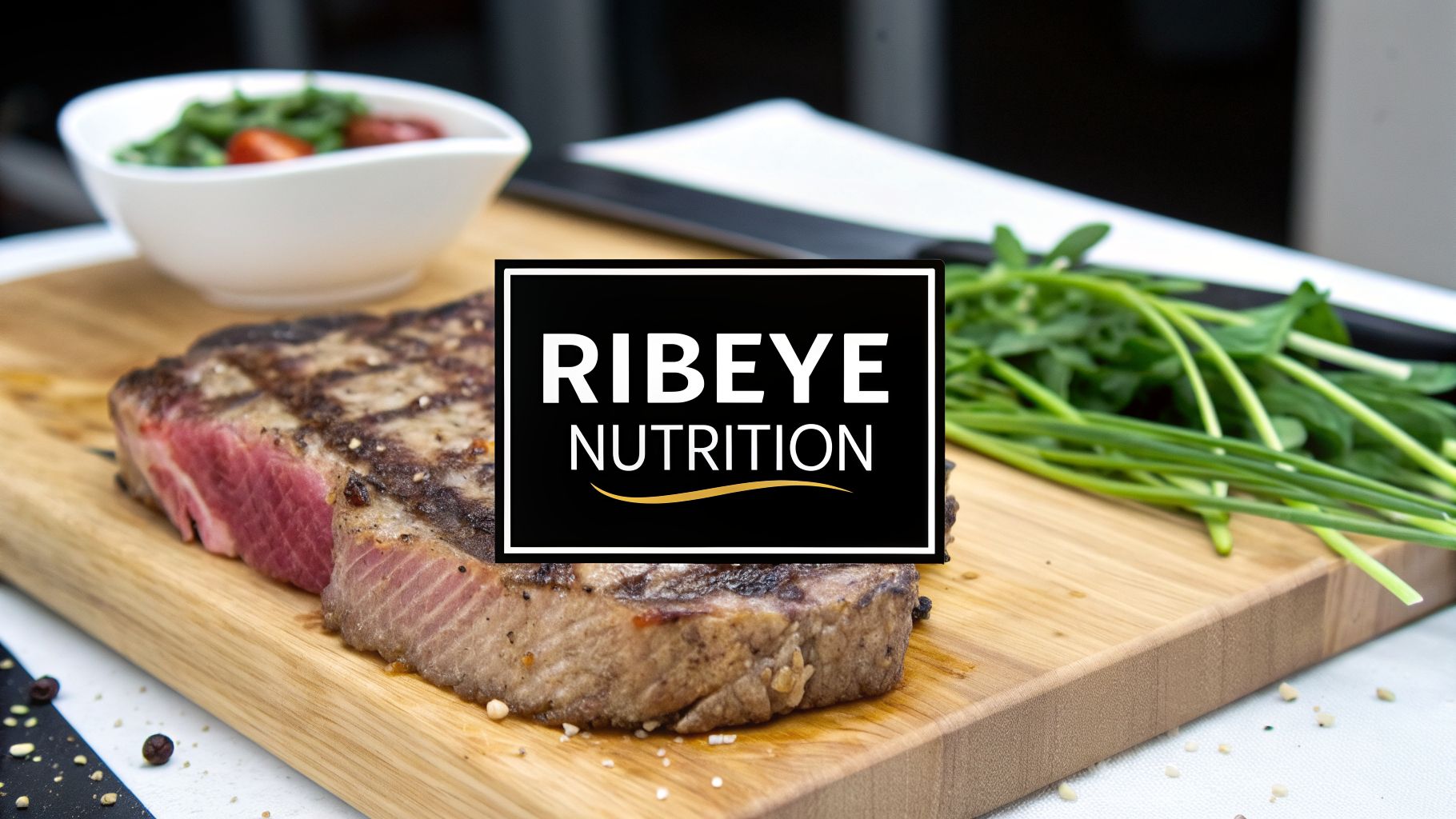
A standard 100-gram (3.5 oz) serving of cooked ribeye steak contains approximately 291 calories, 24 grams of protein, and 22 grams of fat. It is a nutrient-dense food, providing significant amounts of bioavailable iron, zinc, and B vitamins, particularly Vitamin B12. Ribeye has virtually zero carbohydrates, making it a popular choice for low-carb and ketogenic diets.
Understanding these numbers is one thing; using them to your advantage is another. Whether your goal is to build muscle, manage your weight, or stick to a low-carb diet, the specific nutritional landscape of ribeye—from its complete amino acid profile to its micronutrient content—is what makes it such a powerful tool in your meal plan.
How Are the Macronutrients in Ribeye Broken Down?
To get a feel for ribeye's nutritional identity, it helps to see the numbers in context. The main players here are protein and fat, which define the steak's role in any balanced diet. This chart gives you a quick snapshot of the macronutrient breakdown for a standard 100-gram serving.

As you can see, the calorie count is driven almost entirely by its high protein and fat content, with virtually no carbohydrates. This unique composition is exactly why ribeye is a cornerstone of certain eating styles.
Why Does This Macronutrient Ratio Matter?
That specific ratio of macros isn't just a number on a label; it’s what makes ribeye particularly effective for certain dietary goals. It’s all about how those nutrients support your body's functions.
The high fat content, for example, is fantastic for providing sustained energy and is critical for absorbing fat-soluble vitamins. This makes ribeye a perfect fit for low-carb diets where fat becomes your body's primary fuel source. If you're following a ketogenic lifestyle, you can see exactly how ribeye fits into a structured keto meal plan.
Ribeye’s value extends far beyond its macros. It’s also loaded with highly bioavailable micronutrients, including iron, zinc, and B vitamins, all of which are crucial for energy production, hormone regulation, and immune function.
Putting ribeye on your plate isn't just about hitting a protein target. You're also getting a powerful dose of essential minerals that support your overall health. Understanding this complete picture helps you plan meals that are both satisfying and nutritionally sound.
How Much Protein Can You Get From a Ribeye?
While known for its flavor and marbling, ribeye's real power for nutrition-focused individuals lies in its massive protein content. The exact amount of high-quality protein you get comes down to portion size. What you put on your plate—whether a modest cut or a full steakhouse portion—directly impacts how effectively you're fueling your body.
A common 6-ounce (170g) cooked ribeye, for example, delivers a hefty 40 grams of protein. A single serving like this can meet a significant portion of your daily protein requirement, making it an excellent choice for promoting satiety and supporting muscle repair.
How Does Protein Content Vary by Serving Size?
To see how ribeye can fit into your eating strategy, let's break down the protein content in typical steak cuts. Each size offers a different protein punch, allowing you to scale your intake to match your activity level and fitness goals.
- Standard 8-ounce (227g) Steak: This popular size serves up around 53 grams of protein, making it a powerhouse for recovering after a tough workout or building lean mass.
- Large 12-ounce (340g) Steak: A more substantial cut like this packs an impressive 80 grams of protein. For some individuals, that’s nearly their entire daily protein target met in a single, satisfying meal.
This incredible protein density makes ribeye a remarkably efficient food. To see how a cut like this can anchor a powerful eating strategy, check out our high protein meal plan.
Ribeye delivers what's known as a complete protein. This means it provides all nine essential amino acids that your body can't produce on its own. These aminos are the non-negotiable building blocks for everything from muscle synthesis to hormone production and tissue repair.
This complete amino acid profile is precisely why animal proteins like steak are often considered superior to many plant-based options, which might be lacking in one or more of these essential building blocks.
What Is the Calorie and Fat Breakdown of Ribeye?
Ribeye's signature flavor and texture come from its marbling—the intramuscular fat that makes this cut a steakhouse legend. That same marbling also drives its calorie and fat content, making it crucial to understand the numbers if you’re tracking your intake.
A good amount of its fat is monounsaturated, the same heart-friendly type you find in olive oil. But it also packs a notable punch of saturated fat, which is why portion awareness is key, especially if you’re monitoring your intake for health reasons.

How Do Calories and Fat Scale With Portion Size?
A typical 100-gram (about 3.5 ounces) serving of cooked ribeye contains approximately 291 calories and 22 grams of total fat. These numbers are the foundation, but how they scale with portion size is what really matters for meal planning.
For anyone using a tool like an AI meal planner to manage a strict calorie budget, this scaling is critical. A modest 6-ounce ribeye steak (170 grams) comes in at around 495 calories, taking up nearly 25% of a standard 2,000-calorie diet in one go.
To give you a clearer picture, here’s a quick reference for common portion sizes.
Ribeye Steak Calorie and Fat Content by Portion Size
This table provides a quick-reference breakdown of the estimated calories, total fat, and saturated fat for common serving sizes of cooked ribeye steak.
| Portion Size | Estimated Calories | Total Fat (g) | Saturated Fat (g) |
|---|---|---|---|
| 3 oz (85g) | 247 | 19 | 7.5 |
| 4 oz (113g) | 329 | 25 | 10 |
| 6 oz (170g) | 495 | 37 | 15 |
| 8 oz (227g) | 659 | 50 | 20 |
As you can see, the calories and fat content climb quickly. This data is key for accurately tracking your intake.
Here’s a fact that makes ribeye a superstar in certain diets: it derives roughly 61% of its calories from fat and 39% from protein, with virtually zero carbohydrates. This high-fat, moderate-protein, and no-carb profile makes it a perfect fit for ketogenic and other low-carb eating plans.
This natural macro ratio is why ribeye is so effective at promoting satiety and providing sustained energy without spiking blood sugar. The trick is to balance its richness by pairing a sensible portion with high-fiber, low-calorie foods like spinach salad or roasted asparagus.
What Vitamins and Minerals Does Ribeye Contain?

Beyond the impressive protein and fat numbers, the real nutritional story of a ribeye goes deeper. This cut is loaded with essential vitamins and minerals that are highly bioavailable, meaning your body absorbs and uses them far more efficiently from steak than from many plant-based sources.
A single ribeye serving delivers a serious dose of your daily needs for several key nutrients. It's particularly packed with B vitamins, which are the engines that convert food into usable energy, and crucial minerals like iron and zinc that support everything from oxygen transport to immune defense. This micronutrient density elevates ribeye from just a source of macros to a truly valuable part of a well-rounded diet.
A Powerhouse of B Vitamins
Ribeye is an incredible source of B vitamins, especially Vitamin B12, which is vital for nerve function and creating DNA and red blood cells. A single 100g serving can provide over 100% of your Recommended Daily Intake (RDI).
It’s also rich in other B vitamins:
- Vitamin B6: Plays a key role in brain development and mood regulation.
- Niacin (Vitamin B3): Helps manage cholesterol and supports brain function.
- Riboflavin (Vitamin B2): Essential for breaking down protein, fats, and carbs.
This B vitamin complex works together to keep your metabolism running efficiently.
One of the most important nutritional benefits of ribeye is its iron content. The type of iron found in red meat is heme iron, which your body absorbs much more easily than the non-heme iron from plants. This makes ribeye a fantastic choice for preventing iron-deficiency anemia.
Which Key Minerals Are in Ribeye?
Ribeye provides a potent dose of minerals that can be tough to get enough of elsewhere. It's loaded with zinc, a mineral essential for a strong immune system, wound healing, and cell growth. A single steak can easily provide over half of your daily zinc requirements.
Ribeye is also a great source of selenium, a powerful antioxidant that helps protect cells from damage and plays a vital role in thyroid health. To work nutrient-dense foods like ribeye into a structured plan, see how an AI Meal Planner can build a custom diet for you.
How Do Different Cooking Methods Change Ribeye Nutrition?
The way you cook your ribeye directly changes the final nutritional numbers, especially the fat and calorie content. The key is a process called fat rendering, where the steak's intramuscular fat melts and drips away as it heats up.
Methods that let fat drip away, like grilling or broiling on a rack, will give you a leaner final product. In contrast, pan-searing a ribeye in a pool of its own rendered fat means the meat reabsorbs some of it, leading to a higher final calorie and fat count. It’s a trade-off between leanness and rich flavor.
How Does Doneness Impact Your Steak's Nutrition?
The internal temperature—how rare or well-done you like your steak—also plays a part. A well-done steak, having been cooked longer, has had more time for fat to render out compared to the same cut cooked rare. This means a well-done steak can have a lower fat and calorie content.
- Grilling or Broiling: These are your go-to methods for fat reduction. The open grates let rendered fat escape, potentially resulting in a loss of 5-10 grams of fat for an 8-ounce ribeye compared to pan-searing.
- Pan-Searing: This classic technique creates a great crust but holds onto more fat as the steak fries in its own renderings.
- Sous-Vide: Cooking in a sealed sous-vide bag retains all juices and fat. However, the final, quick sear on a hot pan will still render some surface fat away.
Cooking meat at extremely high temperatures can form potentially harmful compounds called heterocyclic amines (HCAs). You can minimize these by flipping the steak often, avoiding deep charring, and marinating it beforehand.
While protein and micronutrient content stay relatively stable, you can influence the fat and calories in your ribeye just by choosing your cooking technique. An AI Meal Planner can help adjust for these variations automatically.
How Does Ribeye Compare to Other Popular Beef Cuts?
Understanding how ribeye stacks up nutritionally against cuts like sirloin or filet mignon is key to picking the right steak for your goals. The main difference is marbling. Ribeye's generous marbling makes it one of the richest, most flavorful cuts, but also higher in fat and calories than leaner options.
Is Ribeye Better Than Other Cuts?
If you’re prioritizing lean protein and keeping calories low, a cut like sirloin is a clear winner. It delivers a fantastic protein-to-fat ratio. However, ribeye’s higher fat content is what makes it a perfect fit for a ketogenic or other low-carb, high-fat diet. To put this into real numbers, here’s a head-to-head comparison of the approximate nutritional values for 100g (3.5 oz) of cooked steak.
Nutritional Comparison of Popular Beef Cuts (per 100g cooked)
This table compares the macronutrient profiles of ribeye, sirloin, filet mignon, and New York strip to help you choose the best cut for your dietary goals.
| Beef Cut | Protein (g) | Total Fat (g) | Saturated Fat (g) | Calories |
|---|---|---|---|---|
| Ribeye | 24 | 22 | 9 | 291 |
| Sirloin | 29 | 8 | 3 | 200 |
| Filet Mignon | 28 | 15 | 6 | 257 |
| New York Strip | 27 | 15 | 6 | 251 |
As the data shows, choosing sirloin over ribeye saves you nearly 100 calories and gives you 5 grams more protein per serving. However, the ribeye’s rich fat content is precisely what makes it a staple for some diets.
The choice really comes down to your priorities. For those following a strict meat-focused lifestyle, understanding these differences is crucial for hitting macro targets. You can learn more about this approach in our guide to building a carnivore diet meal plan. Ultimately, the right steak aligns with your personal taste, budget, and nutritional objectives.
How Can I Fit Ribeye into a Healthy Diet?
The secret to fitting a rich cut like ribeye into a healthy diet isn't avoidance; it's smart implementation. The most important tool is portion control. A well-portioned 4- to 6-ounce serving provides a huge hit of protein and key nutrients without derailing your daily calorie goals.
How Should I Build a Balanced Ribeye Meal?
The best way to enjoy ribeye is by surrounding it with high-fiber, nutrient-dense sides. This approach keeps you feeling full, adds essential vitamins, and creates a more balanced plate.
- For Weight Management: Pair a 4 oz grilled ribeye with a large portion of roasted vegetables like broccoli, bell peppers, and zucchini.
- For Muscle Gain: After training, a larger 6-8 oz portion of ribeye is perfect. Serve it with a complex carb like a sweet potato to aid recovery.
- For Keto Lifestyles: A 6 oz ribeye pan-seared in butter is a keto dream. Pair it with low-carb, high-fat sides like creamed spinach or avocado salad.
A common mistake is treating steak as a standalone meal. A well-constructed plate should always feature a variety of food groups. Think of ribeye as the high-quality protein anchor, supported by a colorful cast of vegetables.
Figuring out how to schedule these meals can feel complex. For those looking to connect diet with training, an AI fitness platform can offer personalized guidance. For a more specialized approach, our AI Meal Planner can build a custom plan that works ribeye into your diet in the right portions, as seen in our philosophy for a balanced meal plan.
Frequently Asked Questions About Ribeye Nutrition

Is grass-fed ribeye more nutritious than grain-fed?
Yes, grass-fed ribeye has a better fat profile, with more omega-3 fatty acids and conjugated linoleic acid (CLA). The protein and calorie counts are nearly identical, but grass-fed offers a slight micronutrient advantage.
Does a bone-in ribeye have different nutrition?
The bone itself doesn't add nutrients, but it can lead to a juicier steak with slightly less fat rendering out during cooking. The final nutritional difference compared to a boneless cut is minimal.
How much cholesterol is in a ribeye steak?
A 100-gram (3.5 oz) serving of cooked ribeye has about 70–80 mg of cholesterol. For most people, the saturated fat content has a greater impact on blood cholesterol levels than dietary cholesterol.
Is ribeye steak good for a ketogenic diet?
Yes, ribeye is a perfect fit for a ketogenic diet. Its high-fat, moderate-protein, and zero-carb profile helps your body reach and maintain ketosis effectively.
Can I eat ribeye steak while trying to lose weight?
Absolutely, as long as you control your portions. Stick to a 4–6 ounce serving and pair it with high-fiber, low-calorie vegetables to create a satisfying meal that fits your calorie budget.
Ready to stop guessing and start building perfectly balanced meals? The AI Meal Planner creates personalized weekly menus that fit your goals, calculating all the macros and calories for you. Discover how easy healthy eating can be at https://ai-mealplan.com/onboarding.
AI-powered nutrition
Get Your Personalized Meal Plan
AI creates the perfect meals for your goals, lifestyle, and taste.
Start Your Journej