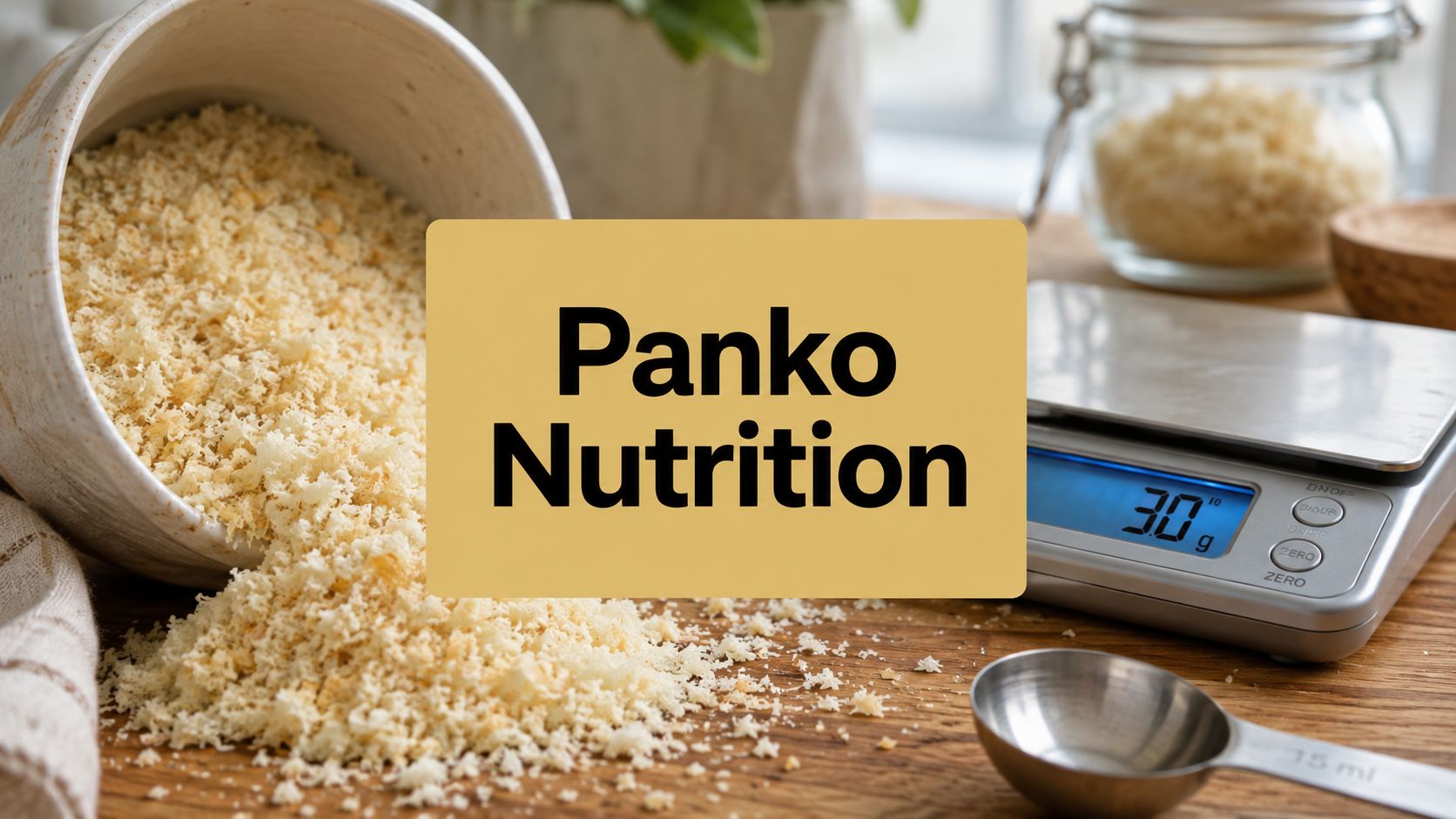
Panko nutritional information starts with a simple baseline, a 1/2 cup (30 g) serving of Kikkoman panko has 110 calories, 24 g carbohydrate, 4 g protein, 0 g total fat, and 35 mg sodium (Kikkoman USA panko label). On a per 100 g basis, panko is still mostly carbohydrate, with 358 kcal, 79 g carbs, 10 g protein, 2.1 g fat, 5.3 g fiber, and 711 mg salt on one common nutrient table (panko nutrient tables).
That means panko is best treated as a crunchy carbohydrate coating, not a protein food. The tricky part is that the label can change a lot by brand and by serving size, so the number on the box only makes sense if you know what portion you're using.
Panko looks like a small ingredient, but it can change a recipe's macro balance fast. A thin sprinkle behaves differently from a thick breading layer, and cooking method matters too, because oil adds calories that the dry label doesn't show.
What Panko Is and Why Its Label Confuses So Many People
Panko is a Japanese-style breadcrumb made to be light, flaky, and coarse. That airy texture is the reason it creates a crisp shell on fried or baked foods, and it is also why the nutrition panel can be easy to misread if you expect it to behave like a dense breadcrumb.
The main source of confusion is serving size. One brand may list 28 g as a serving, another may use 30 g, and some nutrition databases list 50 g portions as if they were standard, so two packages can both look reasonable while describing very different amounts of food (serving-size variability). That is like comparing two cereal boxes that use different scoops, the bowl looks the same, but the numbers do not line up. If you log food in an app or meal planner, start with the weight on the label, then match it to the serving you used in a foods database.
Panko also behaves differently once it hits food in a hot pan or oven. Because the flakes are larger and airier, they coat the surface differently and can take up oil and sauce in a different way than fine crumbs do. For macro tracking, that means the dry label is only the starting point, because the final dish may carry more calories and sodium after cooking than the package alone suggests.
Practical rule: read panko the way you'd read flour or rice, by weight first, then by volume if you have to estimate.
The most accurate habit is to treat the package serving as a reference point for that brand, not a standard you can apply everywhere. If you measure your own portion once, you can build a reliable mental model for breaded chicken, roasted vegetables, and any recipe where the coating changes the final macro count.
Per-Serving and Per-100g Breakdown of Panko Nutrition
Only 110 calories in a 1/2 cup serving can look tiny until you compare it with the same ingredient by weight. That is the first reason panko labels confuse home cooks, because one package may describe a spoonable volume while another source speaks in grams, and those are not the same measuring lens. A common U.S. label for Kikkoman panko lists 110 calories, 0 g fat, 35 mg sodium, 24 g carbohydrate, and 4 g protein per 1/2 cup (30 g) (Kikkoman USA panko label). Another database shows 104 kcal per 28 g with 22 g carbohydrate, 1 g fiber, 3 g protein, and 47 mg sodium (panko nutrition facts).
The pattern stays the same even when the numbers shift a little. Panko is still carbohydrate-dominant, with modest protein and very little fat before cooking. The same table referenced in the introduction lists 358 kcal, 79 g carbs, 10 g protein, 2.1 g fat, 5.3 g fiber, and 711 mg sodium per 100 g, with sodium listed in that table under the label salt. If you compare that entry with a package panel, check whether the table is using sodium or salt, because a salt figure and a sodium figure are not interchangeable (panko nutrient table).
Panko Nutrition Snapshot Across Two Common Serving Sizes
| Portion | Calories | Carbs (g) | Protein (g) | Fat (g) | Sodium (mg) | Fiber (g) |
|---|---|---|---|---|---|---|
| 1/2 cup (30 g) | 110 | 24 | 4 | 0 | 35 | not listed |
| 28 g | 104 | 22 | 3 | 1 | 47 | 1 |
Use the table as a check against your own portion size. A light coating and a thick breading do not have the same macro footprint, and panko can become a meaningful carb source before any oil touches the pan.
Macro-tracking takeaway: panko behaves like a compact starch portion with a little protein, not a high-protein or high-fat coating.
If you are logging ingredients in a calculator, the calorie and macro calculator helps turn these package numbers into a meal total.
How Panko Compares to Regular Breadcrumbs and Other Coatings
A breading can look similar on the plate and still behave very differently in a macro log. Panko's flake structure gives it a lighter crunch for the same visual coverage, so a finished dish can feel crisp without the dense, heavy shell that finer crumbs often create. For a home cook, that means the coating can add texture without making the crust feel bulky or overworked.
The clearest way to judge panko is to compare it with the swaps people use in the kitchen. Regular breadcrumbs are usually denser and tend to carry more oil in practice, almond flour lowers carbs but pushes fat higher, crushed pork rinds strip carbs down, and crushed cornflakes sit somewhere between panko and almond flour on the carb side. Panko sits between pork rinds and almond flour on the carb-to-fat spectrum, offering a middle ground for cooks who want crunch without extreme macros.

How the trade-offs usually look
| Coating | Carb load | Protein | Fat | Fiber | Gluten |
|---|---|---|---|---|---|
| Panko | moderate to high | modest | low | low | yes, unless labeled gluten-free |
| Traditional breadcrumbs | moderate to high | modest | low to moderate | low | yes |
| Almond flour | low | modest | high | some | no |
| Crushed pork rinds | very low | high | high | none | no |
| Crushed cornflakes | moderate | modest | low | low | usually yes |
That table is useful for more than choosing a crust. It also tells a meal planner how much room a coating leaves for the rest of the plate. If you want a crisp breadcrumb bite with familiar texture, panko is usually the easiest fit. If you are tightening carbs hard, panko usually misses the mark because its dry numbers still belong in the starch group.
Decision rule: use panko when you want a light, crisp coating, and swap it out when your diet needs very low carbs or no gluten.
For low-carb recipe planning, the low-carb meal plan guide helps you see where panko fits in a full day of meals.
How Cooking Method Changes Panko's Real Calorie and Sodium Impact
A label on dry panko gives you a starting point, not the full plate total. The moment crumbs hit a hot pan, oven, or fryer, the final numbers depend on how much added fat the food takes on during cooking.
Kikkoman notes that fresh panko absorbs more oil during deep-frying than dried panko (Kikkoman panko glossary, source cited in the introduction). That difference matters because the same coating can finish as a fairly light crust or as a much richer one, depending on how it is handled. Baking and air-frying usually keep the added fat lower than deep-frying, while pan-frying usually lands in the middle and depends on how much oil stays in the skillet.
A practical way to track it is to separate the crumb from the cooking fat.
- Weigh the dry panko first. That gives you the base calories and carbs from the coating itself.
- Log the oil separately. The largest calorie change often comes from the fat absorbed in the pan, not the dry crumbs.
- Match the method to the goal. Baking and air-frying make portion control easier, while deep-frying usually creates the heaviest final dish.
Sodium needs the same kind of attention. Panko is not uniform from brand to brand, and some labels are very light, with 35 mg sodium per 1/2 cup, while other products land much higher, and one nutrient table reports 711 mg salt per 100 g (product and nutrient-table variation). In practice, that means the word “panko” tells you the coating style, but not the exact salt impact of the finished meal.

For meal planning, the clearest habit is to treat panko as a dry ingredient first and then add the cooking fat on top. That gives a more realistic macro count than reading the box alone. If you build recipes often, a recipe nutrition calculator helps you see how much the coating changes once the pan, oven, or fryer enters the picture.
Where Panko Fits in Keto, Vegan, Gluten-Free, and Weight-Loss Diets
Panko works for some eating patterns and clashes hard with others. The label numbers already explain most of it, because a 28 g to 30 g serving usually brings around 21 to 24 g carbs, which is too much for most keto day budgets, even before the rest of the meal is counted (panko serving benchmarks). For keto, crushed pork rinds or almond flour usually make more sense.
For vegan eating, plain panko is often a straightforward fit because it's a breadcrumb product, but seasoned or Italian-style versions can include extra ingredients, so the package still matters. For gluten-free diets, standard wheat panko is not appropriate, which is why rice-based or corn-based gluten-free alternatives are the safer choice.
Weight loss is where panko gets misunderstood most often. It can add crunch without much fat on its own, but the total dish can still get calorie-heavy once oil is added during frying or a thick coating is used. If you're also trying to lose weight safely, the most useful move is to keep the coating thin and choose a cooking method that doesn't rely on a lot of added oil. For a broader framework, tips for losing weight safely can help you think about panko as one ingredient inside a much larger pattern.

Quick verdict by diet
- Keto: choose pork rinds or almond flour, skip standard panko.
- Vegan: plain panko often works, seasoned versions need a label check.
- Gluten-free: skip wheat panko, choose a gluten-free alternative.
- Weight-loss: use a light coating and avoid deep-frying when possible.
Panko can still fit into a balanced menu, but it's not a neutral food. It's a starch-based crunch tool, and that's how it should be logged.
How to Log Panko in MyFitnessPal, Cronometer, and an AI Meal Planner
The cleanest way to log panko is to search by brand name first, then fall back to a generic entry only if you can verify the serving size. In MyFitnessPal, that usually means trying terms like “Panko Breadcrumbs”, “Kikkoman Panko”, or the exact label name printed on your bag. Generic entries can undercount if they assume a 28 g serving and your real portion is closer to 40 g or 50 g.
A practical conversion helps here. A common benchmark is 1/2 cup = 30 g, so if you're scooping by volume, a tablespoon-based estimate is often easier once you've weighed it once. That way, you can log by grams on the first meal, then use the same spoon measure the rest of the week with less guesswork.
Cronometer is useful when sodium and fiber matter, because its verified database often gives a cleaner picture than crowd-sourced entries. That matters for panko, since the label spread includes both very low-sodium products and much saltier versions, and the fiber value can shift by brand.
An AI meal planner can take this one step further by folding the panko into the full recipe instead of asking you to track it as a separate guess. When you log a breaded chicken recipe, it can count the coating in the weekly macro summary, and if you swap the coating, the rest of the meal doesn't need to be rebuilt.
Best habit: save your most-used panko as a custom ingredient so future recipes don't force you to re-enter the same serving every time.
That one setup step prevents the most common logging error, which is treating a coating as too small to matter.
Smart Recipe Swaps and a Quick Panko Reference Card
A few small swaps can keep the same cooking style while changing the macro profile. Mixing panko with grated parmesan gives you a sharper crust for Italian-style dishes, swapping in almond flour pushes the dish toward keto, gluten-free rice panko keeps the texture closer to the original for celiac-friendly cooking, and rolled oats pulsed in a blender can add more fiber and reduce sodium when you want a more whole-grain feel.

Quick reference card
- Per 1/2 cup (30 g): about 110 calories, 24 g carbs, 4 g protein, 0 g fat, 35 mg sodium (Kikkoman USA)
- Per 100 g: about 358 kcal, 79 g carbs, 10 g protein, 2.1 g fat, 5.3 g fiber, 711 mg salt (nutrient table)
- Typical sodium range: from very low labels around 35 mg per 1/2 cup to much saltier products, so read the package every time (label variation)
- Best cooking method for calories: bake or air-fry
- Best move for sodium control: season from scratch instead of relying on pre-seasoned crumbs
If you want these numbers built into a real week of meals instead of sitting on a note app, start planning with AI Meal Planner. It can turn panko-heavy recipes into a weekly menu with the macros already counted, so you're not guessing at the grocery store or the dinner table.
AI-powered nutrition
Get Your Personalized Meal Plan
AI creates the perfect meals for your goals, lifestyle, and taste.
Start Your Journej