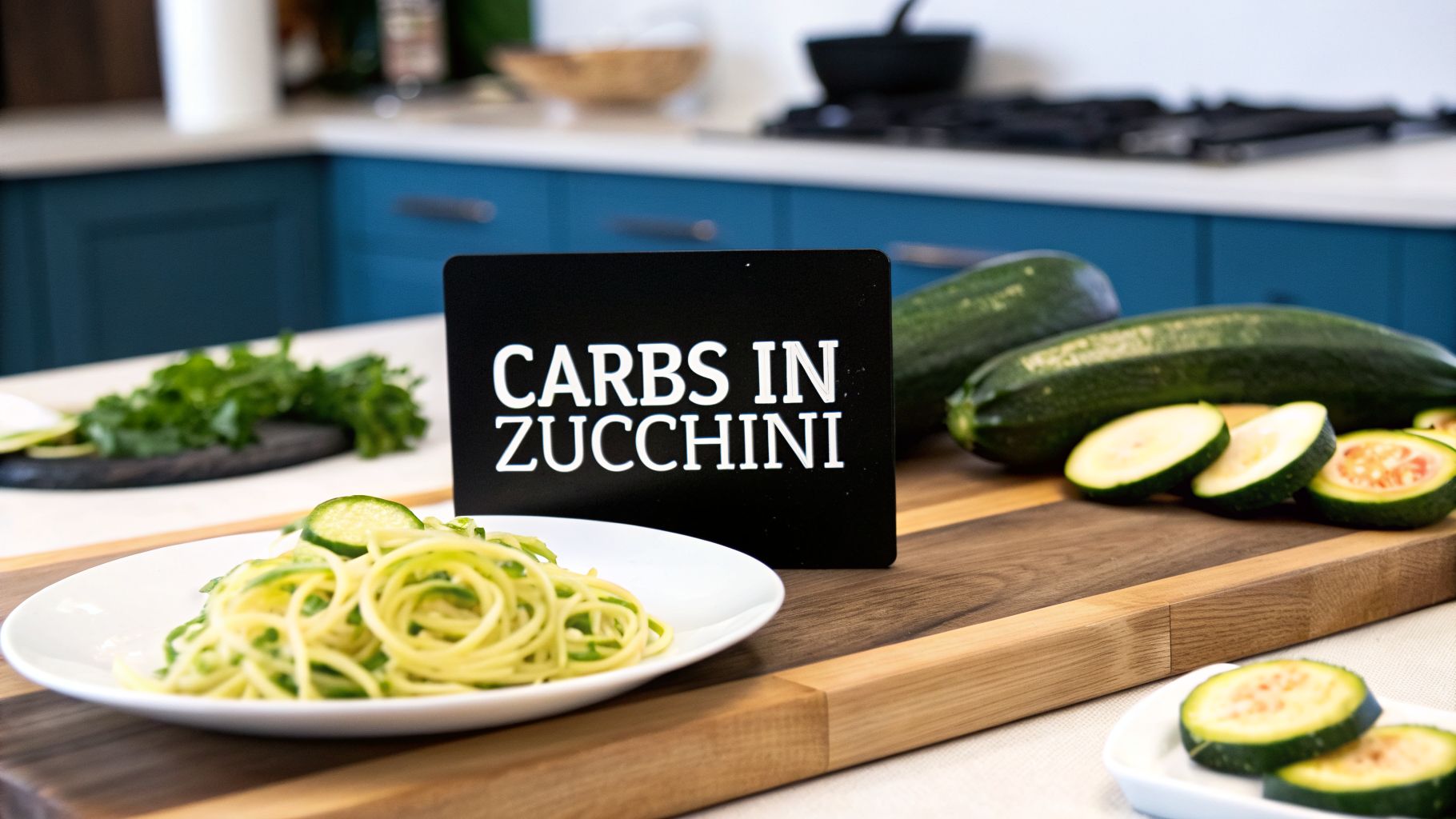
A medium zucchini (196g) contains approximately 6 grams of total carbs and 4 grams of net carbs. Per 100 grams, raw zucchini has just 3.11 grams of total carbs and 2.11 grams of net carbs, making it an excellent low-carb vegetable.

If you're tracking carbs, zucchini is one of the best vegetables you can add to your diet. It's a true low-carb champion, and its versatility makes it a staple for anyone keeping a close eye on their carb intake. This guide provides the practical carb counts and insights you need to seamlessly fit zucchini into your meals, helping you stay on track with your health goals.
What is the exact carb count in zucchini?
To fully appreciate zucchini’s role in a low-carb lifestyle, it's helpful to look at the nutritional data with precision.
For anyone who measures ingredients by weight, here is the most important metric:
100 grams of raw zucchini contains just 3.11 grams of total carbohydrates. This breaks down into 2.11 grams of net carbs and 1 gram of dietary fiber.
Let's put those numbers into a quick-reference table for common serving sizes, which can be a lifesaver when you're meal prepping.
Zucchini Carb Count Per Serving (Raw)
This table provides a quick reference for the total carbs, fiber, and net carbs in common serving sizes of raw zucchini.
| Serving Size | Total Carbs (g) | Dietary Fiber (g) | Net Carbs (g) |
|---|---|---|---|
| 100g (3.5 oz) | 3.11 | 1.0 | 2.11 |
| 1 cup, chopped (124g) | 3.86 | 1.2 | 2.66 |
| 1 cup, sliced (113g) | 3.51 | 1.1 | 2.41 |
| 1 medium zucchini (~196g) | 6.09 | 2.0 | 4.09 |
Data sourced from USDA FoodData Central and compiled for easy reference.
As you can see, no matter how you slice it, the carb count remains incredibly low. This is exactly what makes zucchini such a powerful tool in modern nutrition. For a complete nutritional deep dive, you can explore the full details on platforms like Foodstruct.com.
The extremely low carb count in zucchini offers incredible flexibility, whether you're using a sophisticated tool like the AI Meal Planner or just tracking on your own. It allows you to create large, satisfying portions without worrying about derailing your daily carb goals.
Here’s why that matters:
- Keto-Friendly Foundation: Its minimal net carbs make it a staple for staying in ketosis. You can eat it in abundance without risking your metabolic state.
- Diabetic-Friendly: Zucchini has a very low glycemic index, which helps prevent the blood sugar spikes associated with higher-carb vegetables and starches.
- Volume Eating: You can eat a lot of it, which helps you feel full and satisfied while keeping both calories and carbs incredibly low. It’s perfect for adding bulk to meals.
Why are net carbs more important than total carbs?
If you’ve spent any time in low-carb circles, you've probably heard experts talk about "net carbs" more than total carbs. This isn't just jargon; it's a critical distinction that completely changes how you look at foods like zucchini.
Think of your daily carb allowance like a budget. Total carbs are your gross pay—the entire amount before taxes and deductions. Net carbs are your take-home pay—the money that actually hits your bank account and impacts your spending power.
How does fiber affect the carb count?
The difference between total carbs and net carbs comes down to one thing: dietary fiber. Fiber is a unique type of carbohydrate that our bodies can't fully digest or absorb. It passes through your system mostly unchanged, which means it doesn't spike your blood sugar or get converted into energy the way other carbs do.
Net Carbs = Total Carbohydrates – Dietary Fiber
This simple equation is the bedrock of ketogenic and low-carb diets. By subtracting the fiber, you get a much more realistic picture of a food’s actual impact on your metabolism.
Let’s go back to our zucchini example. A cup of chopped zucchini has about 3.9 grams of total carbs, but it also contains 1.2 grams of fiber.
- Total Carbs: 3.9 g
- Fiber: 1.2 g
- Net Carbs: 3.9 g - 1.2 g = 2.7 g
So, out of almost 4 grams of carbs, only 2.7 grams are actually going to affect your blood sugar and insulin levels. This is why tracking net carbs is so essential for managing blood sugar and hitting specific diet goals, a concept central to approaches explored in articles like Decoding The Keto Craze.
How does tracking net carbs help my diet?
Switching your focus to net carbs isn't just a technicality; it has real-world advantages that can make or break your diet's success. It gives you more freedom and helps you build a more nutrient-dense plate.
Benefits of Tracking Net Carbs:
- Smarter Blood Sugar Control: For anyone with diabetes or insulin resistance, net carbs give you a far more accurate way to predict how a food will affect your glucose levels.
- More Food Freedom: This approach allows you to pack your diet with high-fiber, nutrient-rich foods like zucchini, avocados, and berries without blowing your daily carb budget.
- Keeps You Full Longer: Foods high in fiber are naturally more filling. This helps crush cravings and manage your appetite, which is a massive win for any weight loss plan.
By prioritizing net carbs, you can enjoy bigger, more satisfying portions of vegetables like zucchini. This not only makes a low-carb lifestyle feel less restrictive but also ensures you’re getting the vitamins and minerals your body needs. For those looking to add even more flexibility, learning about carb cycling can be a game-changer. You can check out our guide on how to implement carb cycling into your routine.
Does cooking change zucchini's carb count?
No, cooking does not change the total amount of carbohydrates in zucchini. The actual number of carbs and fiber in the vegetable stays stable whether you eat it raw, roasted, sautéed, or grilled.
The only real change that happens during cooking is water loss. This causes the zucchini to shrink, which concentrates its nutrients and carbs by weight. A 100-gram serving of cooked zucchini will have slightly more carbs than 100 grams of raw zucchini because it contains less water.
A Closer Look at Cooked vs. Raw Zucchini
Think of a raw zucchini as a water-logged sponge. It’s roughly 95% water. When you apply heat, that water evaporates, causing the zucchini to shrink and soften.
While the total carbs in the entire zucchini don't change, its weight does. This is a critical distinction for anyone who tracks their macros by weight.
For example, if you start with 150 grams of raw zucchini and cook it down to 100 grams, that 100-gram cooked portion now contains all the carbs from the original 150-gram raw serving.
Data from nutrition resources like Carb Manager shows that a half-cup (90g) serving of cooked zucchini has just 2.4g of total carbs and 1.5g of net carbs.
This chart shows you exactly what happens when you cook zucchini—the carbs per gram get slightly more concentrated as water cooks out.

The main takeaway here is simple: whether you eat it raw or cooked, zucchini remains an exceptionally low-carb choice. The versatility makes it incredibly easy to work into any meal plan, including those you might generate with a tool like the AI Meal Planner.
How does zucchini compare to other low-carb vegetables?
To really grasp why zucchini is such a star in any low-carb kitchen, it helps to see how it measures up against other go-to vegetables. When you put it head-to-head with other low-carb staples, zucchini consistently comes out near the top.
Net Carbs in Popular Low-Carb Vegetables
This table breaks down how zucchini compares to other common vegetables in terms of net carbs per 100g raw.
| Vegetable | Total Carbs (g) | Fiber (g) | Net Carbs (g) |
|---|---|---|---|
| Spinach | 3.6 | 2.2 | 1.4 |
| Asparagus | 3.9 | 2.1 | 1.8 |
| Zucchini | 3.1 | 1.0 | 2.1 |
| Cauliflower | 5.0 | 2.0 | 3.0 |
| Broccoli | 6.6 | 2.6 | 4.0 |
| Bell Pepper (Red) | 6.0 | 2.1 | 3.9 |
| Green Beans | 7.0 | 2.7 | 4.3 |
All values are approximate for 100g raw and can vary slightly.
As you can see, zucchini holds its own beautifully. While leafy greens like spinach might be the undisputed champs of low-carb density, zucchini gives you far more substance and versatility for just a tiny bit more carb overhead.
Making Smart Swaps for Meal Variety
Knowing these differences is what allows you to add variety to your meals without accidentally tipping over your daily carb limit. While broccoli and cauliflower are fantastic low-carb foods, their net carb count is nearly double that of zucchini. This means you can enjoy a much larger, more satisfying portion of zucchini for the exact same carb impact.
A 200-gram serving of zucchini contains about 4.2 grams of net carbs. A 200-gram serving of broccoli, in contrast, contains around 8 grams of net carbs. That’s a significant difference when you're aiming for strict keto macros.
This kind of knowledge is incredibly powerful, especially if you're new to low-carb eating or trying to make a plant-based diet work for you. For more ideas on building a diverse and satisfying menu, check out our guide on creating a vegetarian meal plan.
How can I use zucchini as a pasta and rice alternative?
One of the toughest parts of a low-carb diet is giving up comforting classics like pasta and rice. This is where zucchini steps in as a true game-changer. Thanks to its incredibly low carb count, it can transform your favorite dishes into meals that align with your goals.
The most popular way to do this is by turning zucchini into noodles, or "zoodles." This one simple swap lets you enjoy a big bowl of your favorite pasta sauce, guilt-free.

How to Make Perfect Zucchini Noodles
Making zoodles is easy, but the key to a great texture is removing excess water. Zucchini has a high water content, and if you don't handle it properly, you'll end up with a soggy mess.
- Spiralize: Turn your raw zucchini into noodles using a spiralizer, julienne peeler, or mandoline.
- Salt and Drain: Place your zoodles in a colander, sprinkle them lightly with salt, and let them sit for 20-30 minutes. This draws out a significant amount of water.
- Squeeze Dry: Gently pat the zoodles with paper towels or wrap them in a clean kitchen towel and squeeze to remove remaining moisture.
- Cook Briefly: Sauté the zoodles in a pan with olive oil for just 1-2 minutes. The goal is to warm them through, not make them soft and mushy.
A single cup of regular spaghetti has around 41 grams of net carbs, while a cup of zoodles has only 3-4 grams. You also cut calories from about 200 down to just 20. Learn more about why zucchini is a fantastic choice for your diet at WebMD.com.
Other Creative Zucchini Swaps
Zucchini’s talents don't stop at noodles. Its mild flavor and versatile texture mean you can use it to replace carbs in all sorts of dishes. For more ideas, check out our guide on building your own custom keto meal plan.
Here are a few other powerful ways to put zucchini to work:
- Zucchini Rice: Use a box grater to shred zucchini into "rice." Sauté it for a fantastic low-carb base for stir-fries, curries, or burrito bowls.
- Lasagna Layers: Slice zucchini lengthwise into thin planks. Pat them dry and use them like pasta sheets to build a hearty, low-carb lasagna.
- Zucchini Boats: Cut zucchinis in half lengthwise and scoop out the center. Fill the "boats" with seasoned ground meat and cheese, then bake until tender.
How can I build a meal plan with zucchini?
Knowing the carb count is one thing; weaving zucchini into your daily meals is where the real magic happens. It's easy to make this incredibly versatile, low-carb vegetable a go-to for breakfast, lunch, and dinner.
What are some low-carb zucchini breakfast ideas?
A zucchini frittata is a fantastic choice—it's high in protein, low in carbs, and you can prep it ahead of time. A typical slice has only about 2-3 grams of net carbs. A simple frittata made with grated zucchini, eggs, and a little cheese gives you a balanced meal that keeps you feeling full and helps stabilize your blood sugar.
What are some easy zucchini lunch ideas?
Think beyond the standard salad. Grilled zucchini planks can serve as a flavorful, sturdy base for toppings, like a breadless open-faced sandwich. Or you could go for a cheesy zucchini bake, a classic side dish that feels indulgent but is perfectly low-carb.
Here are a few simple ideas to get you started:
- Zucchini Pizza Bites: Top thick zucchini slices with tomato sauce and mozzarella. Bake until hot and bubbly.
- Stuffed Zucchini Boats: Hollow out a zucchini and fill it with seasoned ground meat, onions, and herbs for a complete meal.
- Grilled Zucchini Wraps: Use a vegetable peeler to create wide ribbons of zucchini. Grill them briefly, then use them to wrap fillings like sliced turkey and provolone.
If you're looking for more strategies on how to build these kinds of meals into a weekly schedule, our guide on creating a low-carb meal plan offers a ton of additional tips.
Frequently Asked Questions About Carbs in Zucchini
Is zucchini good for a strict keto diet?
Yes, zucchini is excellent for a strict keto diet. With only 2.11 grams of net carbs per 100g, it fits easily within the daily 20-50 gram carb limit of most ketogenic plans.
Does a bigger zucchini have more carbs?
Yes, a larger zucchini has more total carbs because it has more mass. However, the carb density (carbs per 100g) remains the same regardless of its size. For accuracy, weigh your portions.
Should I eat the zucchini skin?
Yes, you should eat the skin. It contains a high concentration of the zucchini's fiber, vitamins, and antioxidants, which helps lower the net carb count and boosts its nutritional value.
Is yellow squash as low-carb as zucchini?
Yes, yellow summer squash is nutritionally almost identical to green zucchini. It contains a similar amount of carbs (around 2-3 net carbs per 100g) and can be used as a direct substitute in recipes.
How do I stop my zucchini noodles from being watery?
The key is to draw out moisture before cooking. After spiralizing, place the zoodles in a colander, sprinkle with salt, and let them sit for 20-30 minutes. Then, squeeze them dry with a paper towel or clean cloth.
Ready to stop guessing and start building a meal plan that works for you? The AI Meal Planner creates personalized weekly menus based on your goals, preferences, and the foods you love—like zucchini! Take the first step toward effortless healthy eating by exploring your custom plan at https://ai-mealplan.com/onboarding.
AI-powered nutrition
Get Your Personalized Meal Plan
AI creates the perfect meals for your goals, lifestyle, and taste.
Start Your Journej