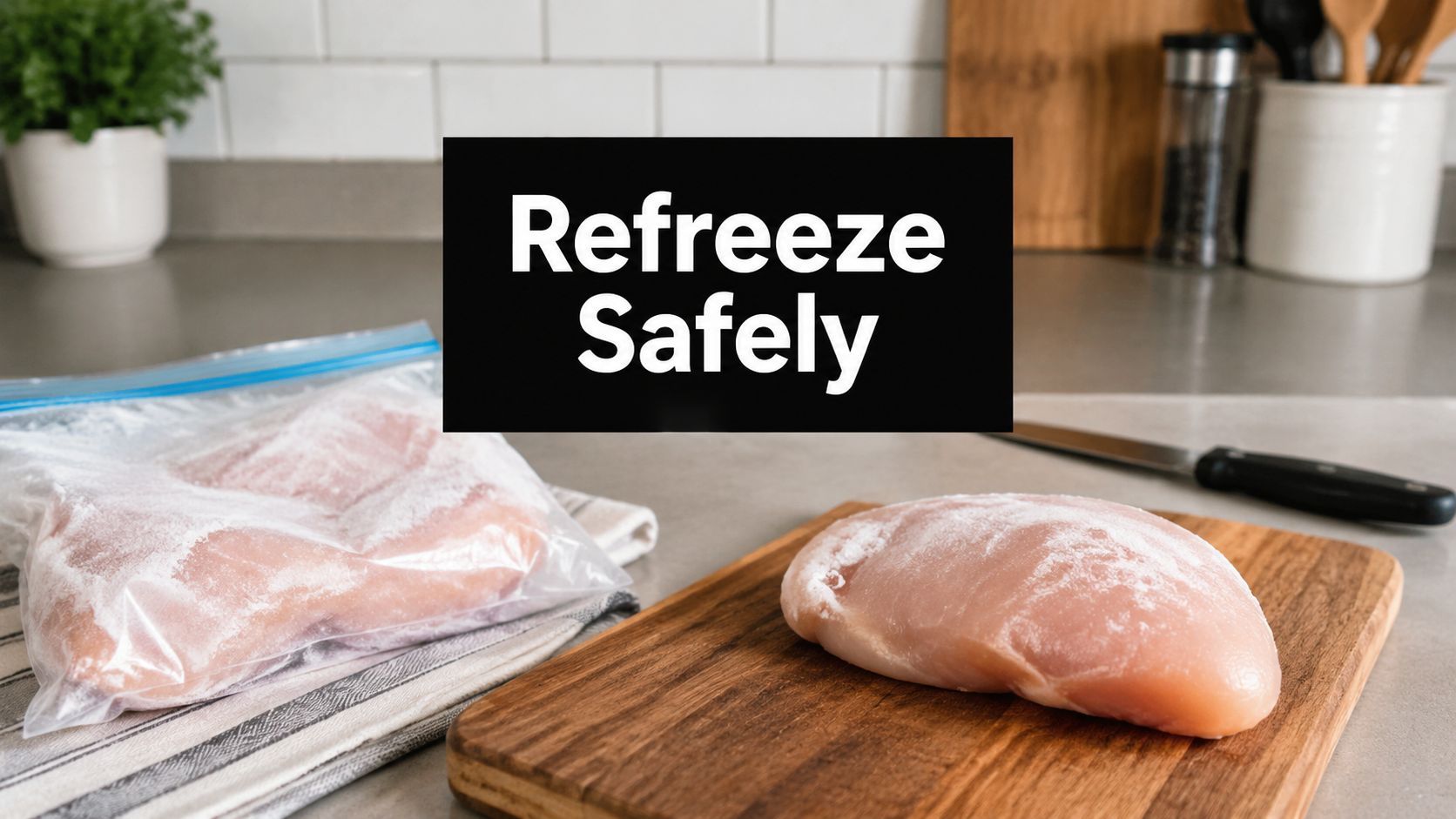
Raw chicken can be refrozen safely only when it was thawed in the refrigerator at or below 5°C (41°F) and returned to the freezer within about 1–2 days. If it was thawed by another method or left at room temperature for more than 2 hours, cook it before refreezing, or discard it if the food may have been unsafe.
You planned chicken for dinner, moved it from the freezer to the refrigerator, and then your evening changed. The package is soft but still cold, perhaps with a few ice crystals, and you're left wondering whether refreezing it will create a safety problem.
The confusion comes from advice that treats every thawing method as if it carries the same risk. It doesn't. A chicken package thawed slowly in a cold refrigerator is a different situation from one sitting on the counter or warming in a bowl of water.
Introduction to Refreezing Raw Chicken Safely
The safest way to think about refreezing is to separate food safety from food quality. Safety depends mainly on whether the chicken stayed cold and how long it remained cold after thawing. Quality concerns include moisture loss, softer texture, freezer burn, and reduced juiciness after another freeze-thaw cycle.
Nebraska Extension states that food thawed in the refrigerator can be refrozen without cooking, while guidance from CSIRO and Queensland Safe Food uses practical refrigerator windows ranging from 24 hours to 48 hours when the food remains at or below about 5°C. Those differences don't mean one source permits unsafe handling. They reflect a stricter versus broader practical limit, along with the fact that refrigerator performance and kitchen conditions vary. Nebraska Extension's refreezing guidance supports refreezing refrigerator-thawed poultry without cooking.
This guide gives you a usable decision process rather than a single rule stripped of context. You'll learn how the thawing method changes the answer, how to handle partial thawing and ice crystals, what to do after a power outage, and how to package chicken so the second freeze causes less quality loss.
For future meal planning, you can also use AI Meal Planner's food resources to build meals around ingredients before they sit thawed in the refrigerator. The practical aim is simple: keep chicken out of unsafe temperatures, make a confident decision quickly, and avoid wasting food when plans change.
How Refreezing Works and When It Is Safe
A chicken package may feel icy in the middle while its outer surface has already warmed. That difference matters. Freezing pauses bacterial growth while the meat stays frozen, but it cannot undo growth that happened during an earlier warm period.
The danger zone works like a kitchen timer. It begins when chicken leaves reliably cold storage and enters warmer conditions. Refreezing pauses that timer rather than resetting it. A package thawed slowly in a refrigerator at or below 5°C (41°F) may return to the freezer, while chicken thawed on a countertop can become unsafe even when the center still feels cold. CSIRO's guidance permits refreezing food thawed in a refrigerator at 5°C or below for no longer than 48 hours.
A refrigerator keeps the surface cold as the interior gradually thaws, limiting the conditions bacteria need to multiply. For chicken, the practical choice is to cook or refreeze it within about 1–2 days of refrigerator thawing. Queensland Safe Food applies the stricter 24-hour window for chicken thawed below 5°C, stating that refreezing may be acceptable when it stayed below 5°C and was not left thawing longer than 24 hours. Queensland Safe Food's chicken guidance explains this position.
A decision framework for the gray zones
Use the shorter window when you cannot confirm a consistently cold refrigerator. Treat the longer window as a conditional option, not a target.
- Within 24 hours: Refreezing raw chicken is generally the clearest choice if the refrigerator stayed at or below 5°C.
- Between 24 and 48 hours: Some guidance permits refreezing after continuous cold storage. Choose cooking instead if you want the more cautious path.
- Beyond 48 hours: Do not refreeze raw chicken. Cook it only when it remained safely refrigerated and shows no spoilage signs. If its temperature history is uncertain, discard it.
Partial thawing and ice crystals need context. Ice crystals show that some chicken remains frozen, but they do not prove that every surface stayed cold. A refrigerator-thawed package can generally be refrozen when its storage time is known. After a power outage, use the refrigerator's temperature history and the chicken's condition. Do not rely on a cold center alone.
Refreezing can reduce quality because thawing releases moisture from the meat. University of Nebraska guidance notes that refrigerator-thawed poultry may be safely refrozen but can lose quality through moisture loss. For handling chicken after thawing, keep a safe cooking temperatures guide available.

An AI nutritionist can help schedule meals around chicken that should be cooked soon. It cannot replace temperature checks, but planning limits uncertain thawing decisions.
Which Thawing Methods Allow Safe Refreezing
The thawing method is the first question to answer. Refrigerator thawing is the only method in this guide that normally permits raw refreezing without cooking first.
| Thawing method | Raw refreezing decision | What to do |
|---|---|---|
| Refrigerator at or below 5°C (41°F) | Generally safe within the practical window | Refreeze promptly or cook |
| Cold water | Don't refreeze raw | Cook first, then freeze the cooked chicken |
| Microwave | Don't refreeze raw | Cook immediately before freezing |
| Countertop or warm water | Don't refreeze raw | Cook immediately only if it wasn't left out too long |
Cold-water and microwave thawing can warm parts of the chicken unevenly. The outside may enter the bacterial growth zone while the middle remains firm or icy. That unevenness is the reason these methods require cooking before refreezing raw chicken. MedicineNet's refreezing explanation warns against raw refreezing after countertop, warm-water, or room-temperature thawing.
How to handle gray-zone situations
Partial thaw with ice crystals: Ice crystals are reassuring because some of the chicken is still frozen, but they don't automatically prove that every surface stayed safe. If the package was in the refrigerator, refreezing is generally acceptable. If it was on the counter or in warm water, rely on the exposure history, not the ice alone.
Cold-water thaw: Cook the chicken before refreezing. Even when the water was cold, this method isn't treated like refrigerator thawing for raw refreezing because the chicken's surface can warm during the process.
Interrupted refrigerator thaw: If you moved the chicken back into the refrigerator and it stayed at or below 5°C, count the total time since it began thawing. Don't restart the clock because the chicken became colder again.
Power outage or open refrigerator door: The key question is whether the chicken stayed at or below 5°C. If you can't establish that, or the chicken was warm for too long, don't refreeze it raw. When food has been outside safe cold storage for more than 2 hours, or more than 1 hour in temperatures above 90°F (32°C), refreezing isn't a safe rescue strategy. The New York Times' food-safety explanation reinforces the refrigerator decision window and the importance of eating or refreezing chicken within two days after thawing.

How Refreezing Affects Quality and How to Spot Spoilage
Safe refreezing doesn't guarantee excellent texture. During freezing, water inside the chicken forms ice crystals. Thawing releases some of that moisture, and another freeze-thaw cycle can make the meat softer, drier, or less juicy. Healthline's explanation of refreezing chicken describes this quality loss as a result of moisture changes during thawing, not as proof that properly handled chicken has become unsafe.
You may notice liquid collecting in the package or a surface that feels less firm than it did before the first freeze. Those signs can reflect quality loss rather than spoilage, especially when the chicken stayed continuously cold. Quality and safety overlap, though, so inspect the chicken before packaging it again.
What spoilage looks and smells like
Discard raw chicken if you notice any of these warning signs:
- Sour, sulfur-like, or distinctly unpleasant odor: Fresh chicken shouldn't have a strong off smell.
- Slimy or unusually tacky surface: Moisture is normal, but a persistent slippery coating is concerning.
- Grayish or dull color change: Color alone isn't always decisive, but a marked change combined with odor or slime is a reason to discard it.
- Excessive liquid with other warning signs: Drip in the package can occur after thawing, but it shouldn't be ignored when the chicken also smells or feels abnormal.
Don't wash questionable chicken to make it usable. Washing can spread contamination around the sink and nearby surfaces, while it won't make spoiled meat safe.
Quality check: A softer texture or extra liquid may reduce eating quality. An off odor or slimy coating is a safety warning, not merely a texture issue.
If the chicken stayed cold but looks slightly dried or has minor freezer burn, you can choose to cook it rather than refreeze it. Refreezing is a storage decision, not a way to improve meat that already looks questionable.

How to Safely Refreeze Raw Chicken Without Losing Quality
Once the chicken passes the safety check, refreeze it promptly. The process is straightforward, but careful packaging matters because the meat has already lost some moisture during thawing.
Follow this practical sequence
Confirm the thaw history. Write down or estimate when the chicken entered the refrigerator. If it has been refrigerated for less than 24 hours, the decision is usually clear. Between 24 and 48 hours, refreezing can still fit the broader guidance if the refrigerator stayed at or below 5°C, but cooking is the more conservative choice.
Inspect before touching packaging. Check smell, surface feel, and appearance. If spoilage signs are present, don't freeze the problem. Discard it.
Pat the surface dry. Use clean paper towels to remove excess liquid. This won't restore lost moisture, but it reduces surface ice and helps packaging fit closely.
Divide into meal-sized portions. Separate breasts, thighs, or smaller pieces according to how you'll use them. A single large bundle takes longer to freeze and forces you to thaw more chicken than one meal requires.
Seal out air. Use freezer-safe bags, freezer paper, foil, or vacuum-sealed packaging. Press excess air from a freezer bag before sealing, and add a second protective layer if the original package has loosened.
Label immediately. Mark the package as refrozen chicken and include the date. A clear label prevents another forgotten thaw-refreeze cycle and helps you choose it before newer packages.
Freeze promptly at 0°F (-18°C). A cold, stable freezer supports better quality. Place thin packages where they can freeze efficiently instead of stacking warm, bulky bundles together.
Two common examples
If chicken is still partly frozen with ice crystals and has been kept in the refrigerator, portion it, seal it, and return it to the freezer. If chicken has been in the refrigerator close to the broader time limit and your dinner plan has changed again, cooking it now is preferable to extending its refrigerated thaw time.
Cooked chicken is another waste-saving option. Cook it thoroughly, cool it safely, divide it into portions, and freeze the portions for soups, wraps, rice bowls, or casseroles. For meal ideas that use separate portions without thawing an entire package, browse AI Meal Planner recipes.

Smart Ways to Reduce Waste When Plans Change
The easiest refreezing problem is the one you prevent. Before moving chicken from the freezer, decide whether you'll cook the whole package, split it into portions, or use it across more than one meal.
A flexible plan also gives you a safe alternative when raw refreezing feels uncertain:
- Cook when the history is unclear: Cooking first is more useful than guessing about a warm countertop or interrupted thaw.
- Portion before freezing: Separate chicken into the quantities your household normally cooks.
- Plan overlapping meals: Use cooked chicken in tacos, salads, soup, or grain bowls so one batch can support several meals.
- Keep a freezer label: Record when chicken was thawed or refrozen so the next decision doesn't depend on memory.
- Shop with a use plan: A grocery list generator can help organize ingredients around planned meals and reduce forgotten proteins.
Use this quick checklist before refreezing:
Refrigerator thaw, at or below 5°C?
Within the 1–2 day practical window?
No warm exposure beyond the safe limit?
No sour odor, slime, or concerning discoloration?
Packed airtight and labeled?
If any answer is no, cook the chicken first when safe to do so, or discard it when its temperature history or condition makes it unsafe.
Structured weekly planning can connect thawed chicken to a specific meal before it becomes a refrigerator question. AI Meal Planner creates personalized weekly meal plans, adapts to dietary preferences and allergies, and builds grocery lists organized by aisle, helping you plan portions and use ingredients across recipes.
Visit AI Meal Planner to create a weekly menu that assigns chicken to specific meals before you thaw it. You can also use its organized grocery planning to buy the right amount, portion it earlier, and reduce last-minute refreezing decisions.
AI-powered nutrition
Get Your Personalized Meal Plan
AI creates the perfect meals for your goals, lifestyle, and taste.
Start Your Journej