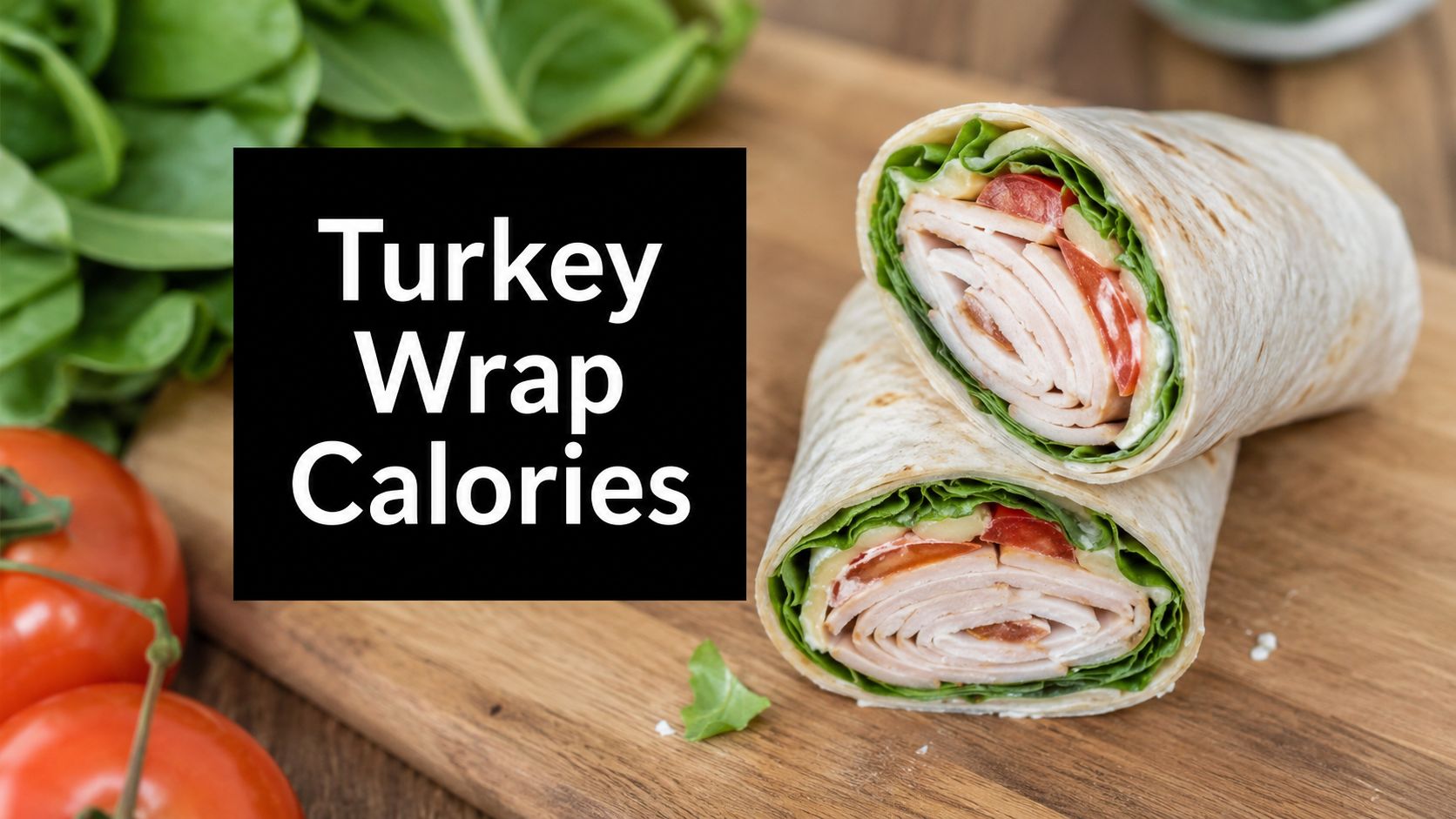
260 to 475 calories is the practical range for a turkey wrap, and the tortilla and cheese usually move the total the most. A lean half wrap can land at 264 calories per 1/2 wrap, while fuller restaurant or database versions can climb well past 400 calories.
Turkey wraps are not a single food in calorie terms, they're a formula. Once you know the tortilla, turkey, cheese, and sauce, the number gets much easier to pin down.
How Many Calories Are in a Turkey Wrap
A turkey wrap usually lands between about 260 and 475 calories, depending on the tortilla, turkey portion, cheese, and sauce. A Mayo Clinic turkey wrap lists 264 calories per 1/2 wrap with 24 g protein, 25 g carbohydrate, and 8 g fat per half wrap (Mayo Clinic turkey wrap). A generic database entry sits at 379 calories, and another lists 475 calories per serving (generic turkey wrap entry).

Practical rule: start with the wrap itself, then add the turkey, cheese, and sauce. That gets you much closer than guessing from the menu name.
The same name can hide very different calorie totals. A wrap can be half a portion or a full portion, and the filling can lean lighter or heavier depending on the tortilla, cheese, and dressing. The Mayo Clinic version is relatively lean, while the 475-calorie entry reports 34% carbs, 43% fat, and 23% protein, which is a very different nutrition profile even though both are called turkey wraps.
That spread matters for weight loss and macro tracking. A turkey wrap can behave like a light lunch, a moderate lunch, or a high-calorie meal, depending on how it's built. If you want a database-style reference point while you compare ingredients, use the turkey wrap food database to check likely portions, then adjust for the exact recipe in front of you.
What Actually Drives the Calories in a Turkey Wrap
The tortilla is usually the biggest swing factor. One source notes that a 10-inch flour tortilla can be around 300 calories, while a whole wheat wrap is about 170 calories (tortilla and wrap breakdown). That difference alone can change a wrap from a moderate lunch into something much heavier before the fillings even go in.
Turkey adds protein, but it also adds up if the portion is generous. The same source says 4 ounces of sliced turkey breast is about 140 calories, and typical wraps may use 4 to 6 ounces of turkey plus 1.5 to 2 ounces of cheese, which can push a wrap toward 500 to 800 calories (tortilla and wrap breakdown). In client logs, that's where people usually miss the math. They count the turkey as “lean” and forget that the serving size is doing a lot of work.
The calorie stack is not even
Here's the part many underestimate. A wrap with a modest turkey portion can stay reasonable, but once the tortilla gets large and the cheese gets thick, the calorie total can climb quickly. A turkey wrap is rarely “too high” because of the turkey alone. It's the structure around the turkey that changes the number.
A wrap's calorie count often behaves like a sandwich in disguise. The bread and the cheese usually decide the total before the protein does.
Veggies usually add volume more than calories, so they're the easiest place to be generous. Sauce is the variable that people forget most often, especially creamy spreads and mayo-based dressings. For a quick recipe check, the calorie and macro calculator helps when you need to see whether the wrap is built like a light lunch or a calorie-dense meal.

The practical takeaway is straightforward. If you're trying to lower calories, don't start by trimming the turkey first. Start with the tortilla, then the cheese, then the sauce. Those are the levers that usually move the total the most.
Restaurant Turkey Wraps Compared to Homemade Versions
Restaurant and deli wraps are easier to compare because the portions are usually defined. A Subway Oven Roasted Turkey Wrap is listed at 410 calories with 52% carbs, 18% fat, and 30% protein (Subway turkey wrap listing). A deli wrap with turkey, ham, and cheese is listed at 315 calories per serving. A separate generic turkey wrap entry comes in at 475 calories with 43% fat, 34% carbs, and 23% protein (generic turkey wrap entry).
| Wrap Style | Calories | Carbs % | Fat % | Protein % |
|---|---|---|---|---|
| Subway Oven Roasted Turkey Wrap | 410 | 52% | 18% | 30% |
| Deli wrap with turkey, ham, and cheese | 315 | Not listed | Not listed | Not listed |
| Generic turkey wrap | 475 | 34% | 43% | 23% |
The table makes the trade-offs easy to see. The Subway option sits in a more balanced middle ground, while the 475-calorie generic version is clearly more fat-heavy. The 315-calorie deli wrap shows that a mixed-fill wrap can stay relatively moderate when the portions are tight and the ingredients stay simple.
Homemade and restaurant wraps are not automatically better or worse. A homemade wrap can be lighter if you control the tortilla and sauce, but it can also end up heavier than a chain wrap once you use a larger tortilla, extra cheese, or multiple spreads. The same logic is what makes AI Meal Planner's recipe library useful, because it lets you compare wrap builds before you cook.
The best choice depends on the goal. If you want higher protein with moderate calories, a portioned deli or chain wrap can work well. If you want the lowest calories, a homemade wrap with a smaller tortilla and less cheese usually wins. If you want a richer macro profile, the generic higher-fat style lines up with that result.
How to Estimate Calories From Any Turkey Wrap Recipe
The fastest way to estimate a turkey wrap is to break it into parts, then add them up. Start with the tortilla, add the turkey, then add cheese and sauce, and give vegetables a small or negligible calorie allowance unless the portion is unusually large. That simple method is close enough for everyday planning and much better than guessing from the word “wrap” alone.
A practical example looks like this: a spinach tortilla at 130 calories, 4 ounces of deli turkey at 140 calories, 1 ounce of provolone at 80 calories, and 1 tablespoon of mayo at 90 calories lands around 440 calories. That's before you factor in vegetables, which usually contribute little compared with the tortilla and the dairy or dressing.

What to look for on a menu or recipe card
- Tortilla size: Larger tortillas usually create the biggest jump in calories.
- Cheese amount: One slice is manageable, but extra layers change the total fast.
- Sauce type: Mayo, creamy dressings, and rich spreads can add a lot for very little volume.
- Turkey portion: More turkey raises protein and calories together.
- Extras: Bacon, avocado, and heavy toppings can turn a light wrap into a dense one.
If a recipe uses vague words like “some cheese” or “a generous spread,” treat the calorie estimate as incomplete until the portions are clear.
A useful habit is to read wraps the way a coach reads a food log. Ask what the tortilla weighs in calorie terms, whether the sauce is creamy, and whether the cheese is doing quiet damage. If you need a faster recipe-level check, the recipe nutrition calculator is the tool that fits this job.
By the time you've done this a few times, you can usually land within about 50 calories of the actual number just by scanning the ingredients. That's enough accuracy for meal planning, fat loss tracking, and macro budgeting without turning lunch into a math project.
Smart Swaps to Lower the Calories in Your Turkey Wrap
The easiest calorie cuts come from swapping structure, not stripping the wrap bare. Moving from a 10-inch flour tortilla to a whole wheat wrap can reduce the base calorie load dramatically, and the tortilla source already shows the size of that gap at roughly 300 calories versus 170 calories (tortilla and wrap breakdown). That one choice often matters more than changing the turkey itself.
Five changes that move the total
- Choose a smaller or whole wheat tortilla: This is usually the biggest single saving because the wrap shell carries so much of the load.
- Trim the turkey portion: Dropping from 6 ounces to 4 ounces lowers the total without removing the wrap structure.
- Cut cheese in half or skip it: Cheese is calorie-dense and easy to overbuild.
- Swap mayo for mustard or Greek yogurt: Creamy sauces add quickly, so a leaner spread keeps the wrap more controlled.
- Use more lettuce, cucumber, and tomato: These add volume and crunch without pushing calories much.
The goal isn't to make every wrap austere. It's to move the meal into the calorie zone that matches your day. A lean turkey wrap with a smaller tortilla, modest turkey, and a lighter spread can sit near the low end of the range, while a richer version with extra cheese and mayo can still be useful when you need more energy.
For a practical lighter lunch, a wrap built around lean turkey, vegetables, and a restrained spread stays compact without feeling tiny. For an indulgent version, the tortilla gets larger, the cheese gets thicker, and the sauce gets creamier, which is exactly how a wrap ends up near the higher end of the calorie range described earlier.
If you want more meal-planning ideas that keep these trade-offs visible, find a dietitian-approved magazine and compare how different lunch formats handle protein, fats, and portion size.
Fitting Turkey Wraps Into a Weekly Meal Plan
A turkey wrap works well in a week of meals because it's easy to scale up or down without changing the basic format. A 400-calorie wrap fits neatly into a 1,600-calorie day for weight loss or a 2,400-calorie day for maintenance when the rest of the day is balanced around it. The wrap becomes a calorie anchor, not a guess.
That's where planning beats improvisation. One lunch can be built as a lighter wrap with fruit on the side, another can be a higher-protein version after training, and a third can use extra cheese if the rest of the day stays lighter. The food stays familiar, but the calorie budget changes based on the day's goal.
A simple weekly rhythm
- Training days: Use a fuller wrap and keep dinner lighter.
- Desk days: Use a leaner wrap and build more vegetables into the side plate.
- Busy days: Keep a repeatable wrap formula so lunch doesn't turn into decision fatigue.
A nutrition system helps here because the wrap is only one meal in the week. AI Meal Planner can generate weekly menus, calculate macros automatically, and let you swap ingredients while keeping calories in range. That's useful when you want the same lunch format to stay flexible instead of manually rebuilding the math every time.
If you like reading about food with a practical lens, the meal-planning angle also pairs well with AI Meal Planner when you want ingredient-level tracking to happen in the background. It keeps the turkey wrap where it belongs, as one option inside a larger plan, not a daily spreadsheet task.
If you want a system that handles wrap calories without guesswork, AI Meal Planner can build your weekly meals, calculate macros, and adjust ingredients when you swap tortillas, cheese, or sauce. That makes turkey wraps easier to fit into fat loss, maintenance, or higher-protein goals without redoing the math by hand every time.
AI-powered nutrition
Get Your Personalized Meal Plan
AI creates the perfect meals for your goals, lifestyle, and taste.
Start Your Journej