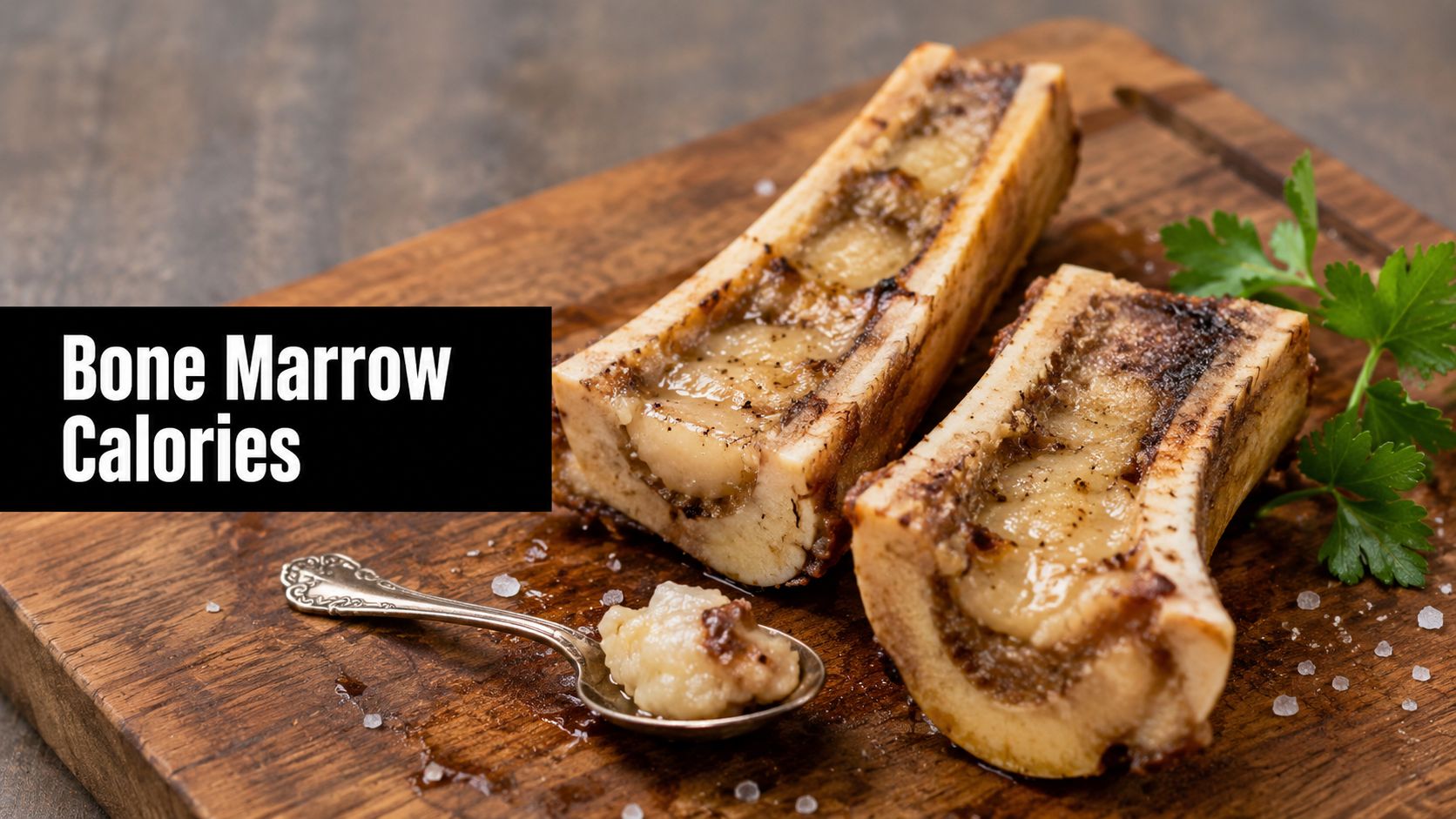
Bone marrow is very high in calories, with commonly cited figures of about 785 calories per 100 grams and around 110 calories per tablespoon (14 g). Most of those calories come from fat, which makes bone marrow better treated as a rich finishing fat than as a main protein food.
How Many Calories Are in Bone Marrow?
At roughly 110 calories per tablespoon and about 785 calories per 100 grams, bone marrow uses up calorie budget quickly for a food people often treat like a small extra. As noted earlier, those calories come mostly from fat, which is why marrow fits better into a meal plan as a rich cooking or finishing fat than as a main part of the plate.
A useful way to frame it is by comparison to other calorie add-ons. One tablespoon of marrow can affect a meal total about as much as a generous spoonful of butter or an extra serving of dressing. If you are building meals around a daily calorie target, that small scoop is not nutritionally minor.
| Serving size | Calories | Fat | Protein | Carb |
|---|---|---|---|---|
| 1 tablespoon bone marrow | About 110 | About 12 g | About 1 g | Not listed |
| 100 g bone marrow | About 785 | About 84 g | Not listed here | Not listed |
The practical distinction becomes clear. Bone marrow works more like a flavoring fat than a protein food. A tablespoon stirred into vegetables, spread on toast, or melted over steak can deliver the taste people want without turning the meal into a very high-fat entrée.
If you track intake, log it the same way you would log butter, tallow, or oil. A recipe nutrition calculator for meal planning can help you see how fast those calories add up in a full dish. For context on common misunderstandings about fat and calories, see BionicGym on calorie myths.
What Is the Exact Calorie and Macro Breakdown of Bone Marrow
Bone marrow's nutrition is easy to misunderstand because it looks substantial on the plate, but nutritionally it behaves more like a fat than like meat. The most useful way to think about bone marrow calories is this: even a small amount carries a meaningful energy load, while protein stays low.
What the cited analyses show
One commonly cited analysis reports 822 kcal per 100 g of raw beef marrow, with 88.9 g fat, 3.2 g protein, and 20.1 g saturated fat. Another source reports 785 kcal per 100 g with 84 g fat and 7 g protein. Both figures put marrow in the same category: extremely energy-dense and overwhelmingly fat-based (Tua Saúde bone marrow nutrition).

Here's the practical takeaway. Whether you use the lower or higher cited analysis, marrow remains a high-calorie fat ingredient with only a small amount of protein.
| Analysis basis | Calories | Total fat | Saturated fat | Protein |
|---|---|---|---|---|
| 100 g raw beef marrow, cited analysis | 822 kcal | 88.9 g | 20.1 g | 3.2 g |
| 100 g marrow, cited analysis | 785 kcal | 84 g | Not listed in that entry | 7 g |
Why the numbers vary
The gap between cited values doesn't mean one source is wrong. Marrow can vary by species, bone type, and whether the measurement reflects pure marrow or a bone-with-marrow product. For someone logging food, the larger point matters more than the exact small difference: marrow contributes calories quickly.
Practical rule: If you're estimating, it's safer to treat bone marrow like a dense spread or finishing fat than like a lean animal food.
This is also why the popular “calories are simple” framing can confuse people around foods like marrow. If you want a plain-English explanation of why calorie discussions often get oversimplified, BionicGym on calorie myths is a useful companion read.
How to log it without guesswork
If you're adding marrow to a roast, toast, or pan sauce, measure the amount you eat rather than the amount served in the bone. Some rendered fat may stay behind, and some people scoop only part of it.
A dedicated recipe nutrition calculator for custom ingredients is especially helpful with marrow because restaurant portions and roasted bones can vary a lot in edible yield.
How Does Bone Marrow Compare to Other Animal Fats
Bone marrow sits closest to other animal fats in kitchen use. It adds richness, body, and a savory finish. It doesn't act like steak, eggs, or Greek yogurt, which people often rely on for protein.

How to think about it in the kitchen
Butter brings dairy flavor and some water. Lard and tallow are rendered fats used for cooking and roasting. Bone marrow is different mainly because it delivers a distinct roasted, meaty richness and a soft, spreadable texture when warm.
That makes marrow especially useful as a finishing fat. A small amount on toast, stirred into a sauce, or melted over vegetables can change the character of a dish fast.
Where bone marrow stands nutritionally
Marrow isn't just empty fat, but its nutrient profile still points in one direction. It's a fat-dominant food first, with smaller amounts of protein and some micronutrients.
Bone marrow makes more sense beside butter, lard, or tallow than beside chicken breast or fish in a meal plan.
That framing clears up a common confusion. People sometimes count marrow as part of the “protein” on the plate because it comes from a bone, but from a nutrition standpoint it behaves more like a rich condiment.
What Are the Health Considerations of Eating Bone Marrow
The balanced answer is that bone marrow can fit into a healthy diet, but only if you treat it with the same care you'd give any high-fat, high-calorie ingredient. It offers some micronutrients, but the calorie cost rises quickly.
A review cited by the Weston A. Price Foundation notes that marrow contains measurable amounts of vitamin B12, riboflavin, iron, and vitamin E, while a 100 g analysis reported 86 g of fat and 1 g of protein (Weston A. Price Foundation bone marrow nutrient benefits). That's the key trade-off in one sentence: marrow has some useful nutrients, but it's still mostly fat.
What readers often get wrong
The most common mistake is assuming that “nutrient-dense” and “eat freely” mean the same thing. They don't. Bone marrow can be nutrient-containing and still be easy to overeat if you're watching total energy intake or saturated fat intake.
A second mistake is using marrow to replace a protein serving. Because protein is low relative to calories, marrow won't do the same job as fish, poultry, tofu, beans, or yogurt if your goal is satiety from protein.
Sensible ways to keep it in balance
Use portion thinking that matches the ingredient.
- Think condiment first: Spread a thin layer on toast or use a small spoonful to finish vegetables.
- Pair it with leaner foods: Roast marrow alongside a salad, beans, fish, or a lean meat instead of stacking it onto an already heavy meal.
- Watch frequency: Rich ingredients are easier to enjoy occasionally and intentionally than to build into every day meals.
- Don't chase micronutrients through marrow alone: If you want vitamin B12, iron, or riboflavin, a wider mix of foods is a more balanced route.
If you're trying to support metabolism or body composition, the bigger win usually comes from your overall pattern of eating, sleep, movement, and consistency, not from one rich food. For a broader perspective, this guide to science-backed metabolism supplements can help put single-ingredient claims in context.
How Do You Safely Portion Bone Marrow in a Meal Plan
A tablespoon of bone marrow can use up a surprisingly large share of a meal's calories. As noted earlier, even a small serving is energy-dense, so portioning matters more here than it does with many other toppings or spreads.
The most useful meal-planning rule is to treat marrow like a finishing fat. It works more like butter or bacon grease than like steak, eggs, or another main food. That distinction helps prevent a common mistake: building a meal around marrow, then realizing too late that the plate is high in calories and fat but still light in protein and fiber.

A practical starting portion is very small. For many people, 1 teaspoon to 1 tablespoon is enough to add flavor without crowding out the rest of the meal. A teaspoon stirred into a sauce or spread thinly on toast gives richness. A full roasted marrow bone at a restaurant can contain far more edible marrow than expected, which is why sharing often makes sense.
Portion ideas that fit a balanced plate
- For soup: Stir in a small spoonful at the end, then keep the rest of the bowl built around broth, vegetables, beans, or lean protein.
- On toast: Use a thin smear, not a thick layer, and add acid or freshness from parsley, lemon, or pickled vegetables.
- With steak or vegetables: Use marrow as the added fat for the dish so you are less likely to add butter or another rich topping on top of it.
One easy way to picture it is as part of your fat budget for the meal. If marrow is on the plate, scale back another concentrated fat source. That keeps the meal rich without becoming excessively heavy.
If you want tighter control, use a calorie and macro calculator for meal planning and log the amount you eat, not just the bone that was served.
What Are Practical Ways to Use Bone Marrow in Recipes
The best uses are the ones that respect marrow's intensity. Bone marrow works beautifully when it adds depth to another food instead of becoming the entire meal.
Good uses for small amounts
A warm spoonful can enrich a pan sauce for steak or mushrooms. It can replace part of the butter in mashed cauliflower or mashed potatoes. You can also mix a little roasted marrow with herbs and spread it thinly on toast beside a salad or a piece of fish.
Those approaches do two things well. They keep the portion realistic, and they let you taste marrow's buttery, savory quality without turning the meal excessively heavy.
Better as a finishing fat than a base
Marrow shines at the end of cooking. Stirring it into a finished dish preserves its luxurious texture and makes portion control easier than if you build an entire recipe around it.
A few practical ideas:
- Finish roasted vegetables: Toss hot vegetables with a small amount of marrow and chopped herbs.
- Enrich a sauce: Melt a little into a reduced pan sauce for beef or mushrooms.
- Upgrade toast: Add a thin smear, then cut richness with parsley, capers, or lemon.
- Fold into a mash: Use some marrow for texture, then stop before the dish becomes greasy.
If you like building meals around unusual ingredients, a searchable recipe collection with customizable filters makes it easier to place marrow into a broader, balanced pattern instead of improvising every time.
Should You Include Bone Marrow in Your Diet
Bone marrow can fit your diet if you enjoy it and you account for what it is: a very energy-dense animal fat with some micronutrients, not a major protein source. That makes it easier to use well.
People following low-carb, Paleo, or carnivore-style eating patterns may find it especially appealing because it's rich, satisfying, and naturally low in carbohydrate. People aiming for weight loss or monitoring saturated fat often need a stricter portion approach.
The practical decision comes down to three questions:
- Do you enjoy it enough to use it intentionally rather than casually?
- Can you keep the portion small and measured?
- Does it fit the rest of your day's meals?

If the answer is yes, marrow can be an occasional high-impact ingredient. If not, it's easy for it to crowd out foods that give you more protein, fiber, and volume for fewer calories.
Frequently Asked Questions About Bone Marrow Nutrition
Is bone marrow a good source of protein
No. Bone marrow is mainly a fat food, and the cited analyses show protein stays relatively low compared with its calorie load.
Does bone marrow have carbs
The cited composition includes no carbohydrates in one analysis, so marrow is generally treated as a very low-carb or no-carb animal fat.
Why are bone marrow calories so high
Because most of its calories come from fat. Its composition is overwhelmingly fat-based rather than protein-based.
Is bone marrow better used as a meal or a topping
Generally, a topping or finishing ingredient is the better choice. That keeps the flavor while making calories easier to manage.
Can cooking bone marrow reduce its calories
Cooking mainly changes texture and renders fat. It doesn't turn marrow into a low-calorie food.
Is bone marrow nutrient-rich
It contains micronutrients such as vitamin B12, riboflavin, iron, and vitamin E, but those nutrients come packaged in a very calorie-dense food.
Who should be most careful with bone marrow portions
Anyone tracking calories closely or trying to keep rich fats modest should measure portions carefully and use marrow sparingly.
If you want help fitting rich foods like bone marrow into a realistic routine, AI Meal Planner makes it easier to build meals around your calorie target, eating style, and preferences without doing all the math by hand.
AI-powered nutrition
Get Your Personalized Meal Plan
AI creates the perfect meals for your goals, lifestyle, and taste.
Start Your Journej