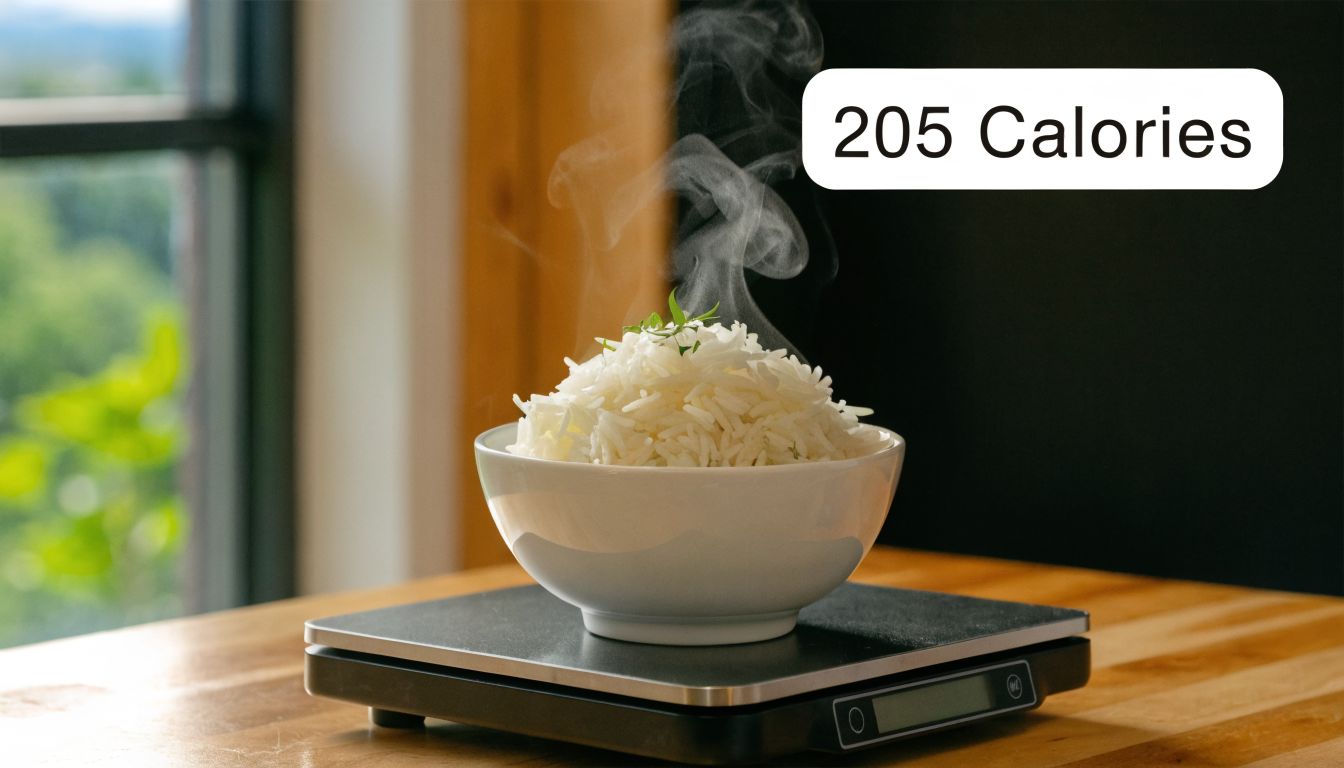
TL;DR: 1 cup cooked white basmati rice contains about 205 to 210 calories and typically weighs around 160 to 163 grams based on standard cooked servings. That number can shift with cooking method, whether you use white or brown basmati, and anything added during cooking.
If you're logging dinner in a meal planning app and rice is the one ingredient throwing off the whole entry, you're not alone. Rice looks simple, but a "cup" of cooked rice can mean different weights, different water content, and very different calorie totals.
That matters because staples are where tracking errors pile up. If your portions are off by a little at lunch and a little at dinner, your weekly calorie intake drifts without you noticing.
How Many Calories Are in 1 Cup of Cooked Basmati Rice?
How Many Calories Are in 1 Cup of Cooked Basmati Rice?
1 cup of cooked white basmati rice has about 205 to 210 calories when the serving weighs around 160 to 163 grams. A lighter cooked cup can be lower, such as 182 calories at 158 grams, while some pre-cooked cups come in at 170 calories for 125 grams according to this basmati rice calorie breakdown.
When I coach people on food logging, this is the baseline I use first: treat 1 standard cup of cooked white basmati as roughly 210 calories unless you have the cooked weight. That gets you close fast. If you're using a nutrition app or an AI nutritionist tool, the smarter move is to match the entry to the serving weight, not just the volume.
What a standard cooked cup usually looks like
| Serving | Calories | Notes |
|---|---|---|
| 1 cup cooked white basmati, 163 g | 210 | Standard white basmati cooked serving |
| 1 cup cooked in salted water, 158 g | 182 | Slightly lighter serving |
| Pre-cooked basmati cup, 125 g | 170 | Smaller branded cup |
What those calories are made of
For the standard cooked cup examples in the verified data, basmati rice is mostly carbohydrate, with a modest amount of protein and very little fat.
- Carbohydrates: about 40 to 46 grams per cup
- Protein: about 3.2 to 5.6 grams per cup
- Fat: about 0.2 to 0.6 grams per cup
Those macros make basmati rice useful when you want a predictable carb source. Carbs fuel training and daily activity, protein contributes a little to fullness and repair, and fat is low enough that rice usually doesn't crowd out the rest of your meal budget.
Practical rule: If the app gives you several entries for "1 cup cooked basmati rice," choose the one with a cooked weight attached. "1 cup" alone isn't specific enough.
Why Do Calorie Counts for Basmati Rice Vary So Much?
The short answer is water. Dry rice is calorie-dense. Cooked rice absorbs water, gets heavier, and spreads those same calories across a larger volume.

A simple way to think about it is a sponge. A dry sponge and a wet sponge are the same sponge, but the wet one weighs much more because it's holding water. Rice behaves in a similar way during cooking.
According to technical calorie data for cooked basmati rice, uncooked basmati rice averages 350 kcal per 100 grams. After boiling or steaming, it absorbs 2 to 3 times its weight in water, which drops cooked energy density to about 121 to 136 kcal per 100 grams. That's why 1 cup cooked basmati rice calories can range from 170 to 260 kcal when serving size runs from 125 to 200 grams.
A cup is volume, not a fixed weight
Many tracking errors often arise from this. A measuring cup tells you how much space the rice fills. It doesn't tell you exactly how heavy that rice is after cooking.
Two cups of cooked basmati can both look "full," but one may be fluffier and lighter while the other is denser and wetter. If one cup weighs 125 grams and another weighs 163 grams, they won't have the same calorie count.
What changes the number in real kitchens
Several things push cooked rice higher or lower:
- Cooking method: boiling and steaming don't always produce the same final water absorption
- Serving weight: a smaller packed cup and a heaped cup aren't equivalent
- Rice variety: white and brown basmati don't behave exactly the same
- Brand format: shelf-stable or microwave cups are often smaller than a home-cooked cup
Weighing cooked rice after cooking is the cleanest fix. Once you use grams, most of the confusion disappears.
What works and what doesn't
What works:
- Cook rice normally
- Weigh the portion you serve
- Log the grams, not the bowl size
What doesn't:
- Eyeballing "about a cup"
- Assuming every app entry uses the same cooked weight
- Logging plain rice when the recipe included extra ingredients
How Does White Basmati Compare to Brown Basmati?
White and brown basmati are both useful foods. The better choice depends on what you're trying to solve.

White basmati is often easier to digest and faster to cook. Brown basmati usually brings more fiber and a steadier blood sugar profile. Neither is automatically "better." They fit different goals.
Healthline's basmati rice nutrition overview notes that one cup of cooked white basmati rice provides 24% of the Daily Value for folate, plus meaningful amounts of thiamine and selenium. It also notes that brown basmati contains even more fiber and magnesium.
Side by side trade-offs
| Feature | White basmati | Brown basmati |
|---|---|---|
| Texture | Softer, lighter | Chewier, denser |
| Cooking speed | Faster | Slower |
| Fiber | Lower | Higher |
| Folate | Strong source | Present, but the key advantage discussed here is fiber and magnesium |
| Magnesium | Lower than brown | Higher |
| Best fit | Faster digestion, quick meal prep | Satiety, digestion, blood sugar support |
Which type fits which goal
- For weight loss: Brown basmati often helps more with fullness because it has more fiber.
- For blood sugar management: Brown basmati is usually the more strategic pick.
- For athletes after training: White basmati can be easier to eat and digest when you want carbs without extra heaviness.
- For busy weeknights: White basmati wins on cooking time and convenience.
If you already enjoy white basmati, you don't need to force a switch. The bigger win is consistent portions and balanced meals.
A practical pattern I use with clients is simple. Pick white basmati when convenience and digestibility matter most. Pick brown basmati when you want more staying power from the same meal.
How Do Cooking Add-Ins Affect the Final Calorie Count?
Most rice logging mistakes don't come from the rice itself. They come from logging plain cooked basmati when the pot included extras.
In these situations, app entries can undercount your meal. The rice may be accurate, but the final dish isn't plain rice anymore if you cooked it with oil, butter, coconut milk, broth, or sauce.
What usually changes the total
Common calorie-raising add-ins include:
- Oil: even a small pour changes the final dish noticeably
- Butter or ghee: easy to overlook when added for flavor
- Sauces: soy-based, curry-based, or creamy sauces can turn a simple carb side into a mixed dish
- Coconut milk: often used in flavored rice and much richer than water
- Broth and seasoning mixes: these matter more for sodium than calories, but both can change the final log depending on the product
What works in practice
Use this framework when you cook rice:
- If you cooked it in water only, log cooked basmati rice by weight.
- If you added ingredients to the pot, either log each ingredient separately or create a recipe entry in your app.
- If the rice was part of a mixed dish, don't use a generic plain rice entry at all.
High-sodium add-ins deserve attention too. Verified data shows cooked basmati rice can range from 36 to 399 mg sodium per cup depending on cooking method, so broth, salted water, and packaged products can make a big difference to the finished meal.
The practical takeaway is simple. How you cook the rice matters as much as how much rice you serve.
How Can You Accurately Measure and Log Rice in Your Meal Plan?
If you want the cleanest system, stop chasing the perfect "cup" entry and start with cooked weight in grams.

According to NutriScan's overview of basmati rice calorie variability, 1 cup cooked basmati rice is usually 158 to 163 grams, but published entries range from 148 to 210 kcal, creating up to a 42% discrepancy. That gap is exactly why a weighed-after-cooking approach is more reliable.
The method that actually holds up
Cook the rice
Use your normal method. Keep it plain if you want the easiest logging.
Weigh the portion after cooking
Put your bowl on a digital kitchen scale, tare it to zero, then add the rice.
Match the app entry to cooked rice in grams
Search for something specific, such as cooked basmati rice with a gram-based serving. If the database is messy, use a verified entry and scale it by weight.
Create a custom entry if needed
If you use the same rice brand or prep style every week, a custom food entry saves time and reduces repeat errors.
Why this is better than cups
A cup can be packed, fluffy, slightly wet, or cooled and clumped. Grams cut through all of that. If your app says one entry is based on 163 grams and your bowl holds less or more, you can adjust precisely.
For anyone trying to get better at label reading on packaged rice cups or flavored rice pouches, this guide on how to read nutrition labels effectively is useful because it helps you spot serving size, sodium, and add-ins before you log the product.
Track the food you ate, not the food name that looks closest. "Rice" is often too vague to be accurate.
A food database is only as good as the entry you choose. If you use planning tools regularly, having a saved workflow in your meal planning tools makes this easier because you can reuse the same measured portions instead of searching from scratch every time.
A quick visual walkthrough can help if you're new to weighing portions:
A simple logging framework for different goals
| Goal | Best logging approach |
|---|---|
| Weight loss | Weigh cooked rice and keep servings consistent meal to meal |
| Muscle gain | Weigh cooked rice and intentionally scale portions upward when needed |
| Blood sugar support | Use brown basmati entries and pair with protein and vegetables |
| Meal prep | Weigh batch portions into containers once, then reuse the same saved log |
Ready to take the guesswork out of meal planning? Sign up for AI Meal Planner onboarding and let the system handle precise calculations for you.
What Is the Glycemic Index of Basmati Rice and Why Does It Matter?
Glycemic index tells you how quickly a carbohydrate tends to raise blood sugar. In real life, that often shows up as the difference between energy that feels steady and energy that feels short-lived.
Brown basmati is the stronger option here. According to Carb Manager's basmati rice data, brown basmati has a GI of 50 to 58, while short-grain white rice can be 70+. That lower range is one reason basmati is often easier to fit into a blood-sugar-conscious meal pattern, especially when paired with protein, vegetables, and an appropriate portion.
Why that matters at the table
Think of high-GI carbs as fast-burning fuel. They can hit quickly and fade quickly. Lower-GI carbs act more like slower-burning fuel, which often supports a steadier response after the meal.
For someone managing hunger, afternoon energy, or glucose control, that difference can matter more than the rice's reputation as "white" or "brown."
The cooling trick people overlook
Cooked basmati changes after it cools. The same source notes that post-cooking retrogradation in cooled basmati rice increases resistant starch, which can reduce net carbs and effective calories by 10 to 15%.
That doesn't mean cold rice is magic. It means cooled and reheated rice may behave a bit differently in the body than freshly cooked rice.
- Meal prep can help: cooked, chilled, and reheated rice may support steadier intake for some people
- Satiety may improve: resistant starch is associated with better fullness signals
- It can fit diabetes-focused planning: especially when the full meal is balanced
If you're building meals around steadier carbohydrate choices, a diabetic meal plan approach can make those combinations easier to repeat consistently.
Practical Swaps and Portion Tips for Your Weekly Diet
Basmati rice works best when you use it strategically, not automatically. The goal isn't to fear rice. The goal is to make the portion match the meal.
Smart ways to use it
- Swap for higher-GI rice: Basmati is often a better everyday choice than shorter-grain white rice if you want steadier energy.
- Use white or brown on purpose: White for faster digestion and convenience, brown for more fiber and a slower feel after meals.
- Build the plate around balance: Rice works better with lean protein and high-volume vegetables than as the main event.
Portion choices that usually work better
For fat loss, it is generally more effective when rice is one part of the plate rather than the majority of it. A measured serving beside chicken, tofu, fish, beans, or eggs usually tracks better and feels more satisfying than a large bowl of rice alone.
For muscle gain, rice becomes a useful way to push carbs up without making meals overly heavy. In that case, the answer often isn't "cut rice." It's "measure it and place it where it helps."
A good rice portion is the one that matches your target, your training, and the rest of the plate.
If you're trying to lower carbs overall, you don't have to eliminate basmati completely. You may just use smaller portions more selectively or alternate it with lower-carb sides in a low-carb meal plan.
Frequently Asked Questions About Basmati Rice
| Question | Answer |
|---|---|
| Is 1 cup of cooked basmati rice good for weight loss? | It can be. The main factor is whether that portion fits your total daily calorie target and the rest of the meal. |
| Is basmati rice lower in calories than other rice? | Basmati is generally in the same calorie range as many cooked rice varieties, but its cooked calorie density changes with water absorption and serving weight. |
| Should I log basmati rice dry or cooked? | Log it the same way you measured it. If you served cooked rice on your plate, use a cooked entry and weigh the cooked portion. |
| Is white or brown basmati better for blood sugar? | Brown basmati is usually the better choice for blood sugar support because it has more fiber and a lower glycemic profile. |
| Does cooled basmati rice have fewer effective calories? | Cooled basmati can develop more resistant starch, and verified data notes this may reduce effective calories and net carbs. |
| Why do meal apps show different calories for the same rice? | Different entries often use different cooked weights, brands, and preparation methods. That's why gram-based logging is more reliable than cup-based logging. |
If you want a simpler way to plan meals around rice, macros, and real portions, try AI Meal Planner. It helps you build personalized weekly meals, organize grocery lists, and keep calorie tracking more consistent without doing the math by hand.
AI-powered nutrition
Get Your Personalized Meal Plan
AI creates the perfect meals for your goals, lifestyle, and taste.
Start Your Journej