A sustainable vegetarian meal-prep plan for weight loss uses a 300 to 500 kcal daily deficit, about 0.9 g of protein per kilogram of body weight, and 25 to 38 g of fiber daily. Batch-cooked grains, legumes, and vegetables become bowl-style meals that hold well for 3 to 4 days.
Vegetarian meal prep for weight loss works when the numbers are set first and the food follows those numbers, not the other way around. That's how you stop “healthy” meals from drifting upward in calories while still eating enough to feel full.
Setting Your Calorie Deficit and Protein Target
A realistic fat-loss plan starts with a 300 to 500 kcal daily deficit, which is the range most practical meal-prep systems are built around. The source guidance ties that level of intake to roughly 1 to 2 lb of weight loss per week when adherence is steady, and the effect tends to be strongest when the plan is structured and repeated rather than improvised. For a deeper walkthrough of how total energy needs are estimated, your TDEE and weight loss guide is a useful companion.
Turn body weight into a daily protein floor
For plant-based meal prep, a workable benchmark is about 0.9 g of protein per kilogram of body weight per day. If you weigh 70 kg, that's about 63 g daily. If you weigh 90 kg, that's about 81 g daily. You don't need a spreadsheet to use that number, you just need a repeatable rule, such as protein at every meal and a second protein source at breakfast if your first meal tends to be light.
The simplest structure is this, one protein anchor, one measured fat source, and a lot of non-starchy vegetables. That keeps the plate bulky enough for fullness while controlling calorie density from nuts, oils, cheese, and sauces. The source guidance also points to a 25 to 38 g fiber target daily, which matters because high-volume vegetarian eating can still leave people hungry if the meals are too refined or too oily.
Practical rule: if a meal looks healthy but doesn't contain a visible protein source, it usually isn't a strong weight-loss meal.
A useful shortcut is to think in meal blocks. Breakfast, lunch, and dinner should each contribute meaningful protein, while snacks should be treated as planned portions, not grazing opportunities. If you want a calculator to translate these numbers into a week of food, the calorie deficit calculator can help you set the framework before you shop.

The 7-Day Vegetarian Meal Prep Template
A good weekly template looks repetitive on purpose. That's not a flaw, it's what makes portion control realistic when work is busy, hunger is unpredictable, and you don't want to cook from scratch every night.
Build the week around a few repeatable bases
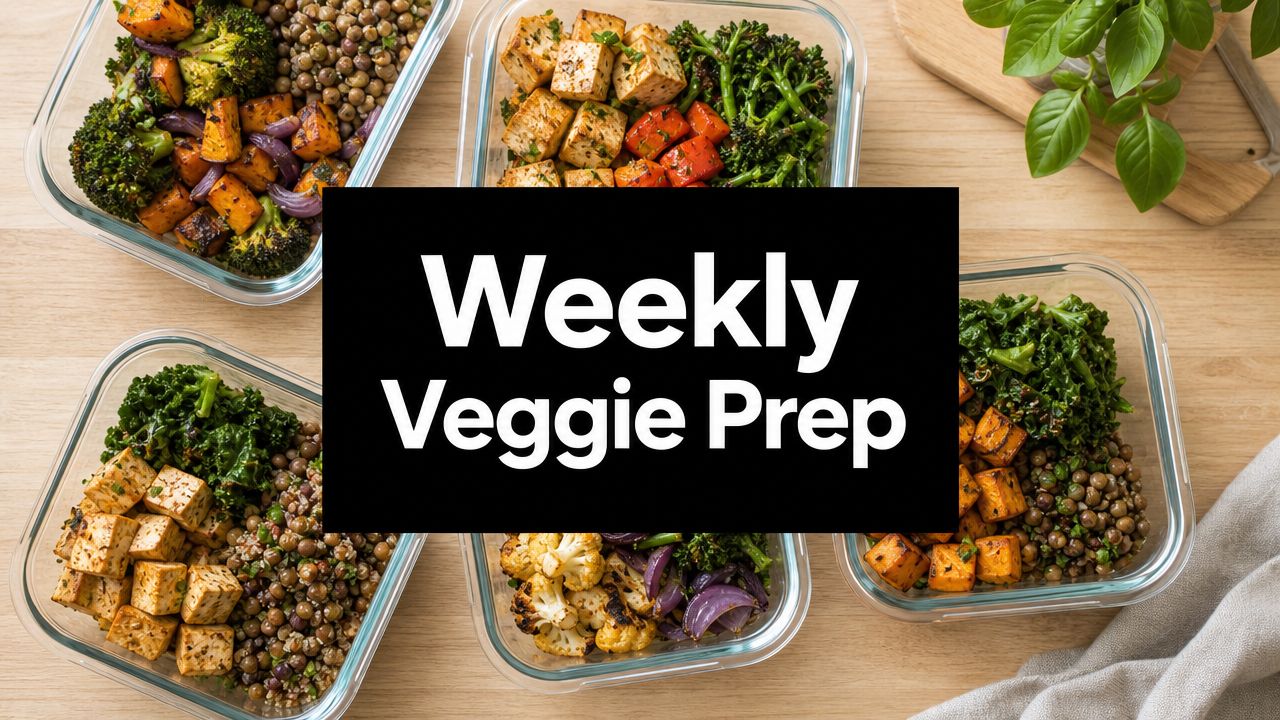
The cleanest format is grain bowls, soups, stir-fries, and breakfast jars. Those hold quality for 3 to 4 days in the fridge, which lines up with the practical meal-prep guidance and reduces the chance that food spoils before you get to it. One breakfast, one lunch base, one dinner base, and a planned snack are enough to cover the week without creating kitchen fatigue.
| Day | Breakfast | Lunch | Dinner | Snack | Approx kcal | Approx protein |
|---|---|---|---|---|---|---|
| Monday | Overnight oats with soy milk, chia, and berries | Lentil bowl with roasted vegetables and quinoa | Tofu stir-fry with brown rice | Plain Greek yogurt or soy yogurt with seeds | 1,700 | 95 g |
| Tuesday | Overnight oats with soy milk, chia, and berries | Lentil bowl with roasted vegetables and quinoa | Tofu stir-fry with brown rice | Apple with measured peanut butter | 1,650 | 90 g |
| Wednesday | Savory oats with egg or tofu scramble | Chickpea salad bowl with greens and cucumber | Lentil soup with whole-grain toast | Cottage cheese or edamame | 1,700 | 92 g |
| Thursday | Protein smoothie pack blended with soy milk | Lentil bowl with roasted vegetables and quinoa | Tofu stir-fry with brown rice | Carrots with hummus | 1,650 | 88 g |
| Friday | Savory oats with egg or tofu scramble | Chickpea salad bowl with greens and cucumber | Tempeh grain bowl with vegetables | Yogurt or edamame | 1,700 | 94 g |
| Saturday | Freezer smoothie pack or overnight oats | Leftover soup and toast | Frittata with side salad | Fruit and measured nuts | 1,600 | 85 g |
| Sunday | Repeat the easiest breakfast | Flexible leftovers bowl | Batch cook for the new week | Optional protein snack | 1,650 | 85 g |
The exact calories and protein will shift based on your portions, but the structure matters more than perfection. If a lunch comes in light, add beans, tofu, eggs, or yogurt before you add another handful of nuts. If you prefer a different macro target, this 7-day muscle gain and fat loss meal plan can give you another format to compare against.
The most useful meal-prep question isn't “What sounds good?”, it's “What can I repeat on Thursday without breaking the plan?”
The smartest way to reuse ingredients is to cook once and recombine twice. A tray of roasted vegetables can become lunch on Monday, dinner on Wednesday, and a soup topper on Saturday. That's how vegetarian meal prep stays efficient without turning into the same bowl every day.
Building an Optimized Vegetarian Grocery List
A grocery list should come from the plan, not from mood. If you shop aisle by aisle after the meals are set, you buy fewer extras, waste less food, and keep the week aligned with the calorie target.
Shop by function, not by “healthy” labels
Start with produce, because high-volume vegetables are what make the plan satisfying. Then move to grains, legumes, and protein staples that carry the week. The core grocery list usually includes rolled oats, lentils, chickpeas, tofu, tempeh, leafy greens, frozen berries, and a measured fat source like olive oil, tahini, or nuts.
That's also where the budget advantage shows up. A 2023 randomized controlled trial analysis found that a low-fat vegan diet reduced total food costs by about 16% per day versus no significant change in a control group, with the biggest savings coming from meat and dairy purchases (JAMA Network Open). That doesn't mean vegetarian food is automatically cheap, but it does mean the grocery bill can stay reasonable when the cart is built around legumes, grains, and vegetables instead of specialty products.
Here's the practical filter I use with clients. If an item is easy to snack on, pour freely, or eat without noticing portion size, it needs a measured serving plan before it goes in the cart.
- Produce: spinach, broccoli, peppers, onions, tomatoes, cucumbers, carrots, frozen berries.
- Grains and starches: brown rice, quinoa, oats, whole-grain bread, whole-grain wraps.
- Legumes and soy foods: lentils, chickpeas, black beans, tofu, tempeh, edamame.
- Dairy or plant alternatives: plain yogurt, cottage cheese, soy yogurt, soy milk, milk, eggs if included.
- Fats and flavor: olive oil, tahini, nuts, seeds, salsa, mustard, vinegar, spices.
For a tighter shopping workflow, the grocery list generator can convert a weekly structure into a clean aisle-sorted cart. If you're looking for a simple pantry-based template, the flavor approach used in Daniel Fast recipes and expert tips is also useful as a model for keeping meals simple and repeatable.
The Sunday and Midweek Batch Cooking Schedule
The mistake many individuals make is trying to cook the whole week in one tired stretch and then wondering why Thursday food feels old. A split schedule works better because it protects texture, keeps the fridge lineup fresh, and makes the week feel manageable.
What to cook first on Sunday
Start with the longest-cooking items. That usually means lentils, grains, roasted vegetables, and a soup or stew. While those run, mix sauces, wash greens, portion snacks, and build breakfast components like oats or smoothie packs.
A clean Sunday flow looks like this:
- Put grains and lentils on first.
- Roast two trays of vegetables.
- Cook one soup or stew for later in the week.
- Portion breakfasts and snacks.
- Assemble three days of containers.
The most useful container formats are bowls, soups, stir-fries, and stews, because they hold their quality for 3 to 4 days and portion cleanly. That matters for adherence more than many realize. Food that tastes fine but looks boring on day 4 gets skipped, and skipped food turns into takeout.
Keep the first prep session about utility, not variety.
What the midweek touch-up should do
The second session doesn't need to be a full cook. A 30-minute midweek touch-up is enough to refresh produce, cook one quick protein, or assemble a new sauce. That's also the right moment to rotate leftovers into new combinations, such as turning lentils into soup or using roasted vegetables in a wrap.
Freezer backup is worth planning, especially if your schedule is unpredictable. Extra lentil mixture, smoothie packs, or portioned soups give you a buffer when a meeting runs late. I'd rather see a client freeze two portions than throw out four portions that got ignored by Friday.

Five Prep-Friendly Vegetarian Recipes With Portions
The best weight-loss recipes are the ones that survive real life. They're easy to portion, easy to repeat, and built around one main protein instead of a long list of ingredients that explode the calorie count.
Use one protein anchor per meal
For each meal, center the plate on tofu, tempeh, lentils, chickpeas, or eggs, then add vegetables and a measured fat source. That keeps calories visible and protein intentional. The meal planning guidance below also reflects the practical protein pattern many meal-prep systems use, which is the same logic behind recipe nutrition calculator tools that help you audit portions.
- Lentil and roasted vegetable bowl: 1 cup cooked lentils, 2 cups roasted vegetables, 1/2 cup cooked quinoa, 1 tsp olive oil. Roughly 430 kcal and 23 g protein.
- Tofu and brown rice stir-fry: 150 g tofu, 1 cup brown rice, 2 cups stir-fry vegetables, 1 tsp sesame oil, soy-ginger sauce. Roughly 500 kcal and 26 g protein.
- Chickpea and tahini power salad: 1 cup chickpeas, 2 to 3 cups greens, cucumber, tomato, 1 tbsp tahini, lemon, herbs. Roughly 400 kcal and 18 g protein.
- Tempeh grain bowl: 100 g tempeh, 3/4 cup cooked quinoa, 2 cups broccoli and peppers, light vinaigrette. Roughly 470 kcal and 24 g protein.
- Frittata or savory oats breakfast: 2 eggs or tofu equivalent, spinach, mushrooms, and a slice of whole-grain toast or 1/2 cup oats. Roughly 350 to 450 kcal and 20 to 25 g protein.
Keep the same base, change the flavor
That's the easiest way to stay interested without rebuilding the week from scratch. A bowl can taste Mediterranean on Monday, taco-style on Wednesday, and curry-inspired on Friday if the protein and portion stay the same. The structure is what drives fat loss, not novelty.
Variety should come from spices, sauces, and toppings, not from accidental portion creep.
Repeating breakfast all week, batching lunch and dinner, and keeping one flexible slot for leftovers creates a rhythm that reduces decisions and stops the fridge from filling with half-used ingredients that never make it into a meal.
Common Pitfalls and How to Fix Them
Most vegetarian meal prep fails for three boring reasons. The good news is that each one has a simple correction, and none of them require a brand-new diet.
Under-proteining leaves meals technically healthy but not filling
A plate of grains, vegetables, and a drizzle of dressing can look polished and still leave you hungry an hour later. The fix is to audit the meal and make sure it contains a clear protein anchor, then bring the meal up to roughly 25 to 30 g per main meal if your day is built that way. The source guidance also notes that plant-based plans often work better when protein is spread across the day instead of clustered in one meal.
Hidden calories from fats are the silent problem
Nuts, seeds, cheese, oils, and creamy sauces are easy to underestimate. That's especially true in vegetarian plans, where the food can be nutrient-dense but still calorie-dense if portions go unmeasured. Weigh nut servings, measure oils, and treat tahini or avocado like planned ingredients, not free additions.
Monotony shows up late in the week
By Thursday or Friday, even a good meal can feel stale. That's where freezer smoothie packs, a second shorter prep session, and a single rotating sauce help more than another “new recipe” ever will. A Thai-style sauce, salsa verde, or lemon-herb dressing can change the experience without changing the calorie math.

Tracking Progress and Tweaking the Plan
Meal prep works best when it behaves like a feedback loop. You set the plan, run it for a couple of weeks, then adjust based on what your body and schedule do.
Use simple weekly and biweekly checks
Weigh in or take measurements once a week under the same conditions, then look at the trend rather than one noisy day. Track adherence on a simple 1 to 7 scale if that keeps you honest, and review your protein and fiber averages every two weeks instead of reacting to every meal.
If weight is stalled for two weeks, the first question isn't whether the plan failed. The more common issue is that calories drifted upward through snacks, pours, bites, or oversized portions. Trim about 100 kcal from snacks, swap one refined grain for a legume, or add a second protein source at breakfast before you overhaul the whole week.
Let the system do the repetitive work
One source notes that a single meal-prep session can save roughly 10 to 15 hours of cooking time across a week, and pre-portioned meals make calorie and macro tracking more precise (One Health Assist). This is the key value here. It's not perfection, it's reducing friction enough that the plan survives a normal workweek.

When you're ready to stop rebuilding the week by hand, use AI Meal Planner to generate a vegetarian weight-loss menu, a grocery list sorted by aisle, and macro-calculated meals from a quick onboarding. It's a practical way to turn the system into something you can repeat.
If you want a vegetarian meal-prep routine that fits your schedule instead of fighting it, start with the weekly structure above, then set up your next plan at AI Meal Planner.
AI-powered nutrition
Get Your Personalized Meal Plan
AI creates the perfect meals for your goals, lifestyle, and taste.
Start Your Journej