
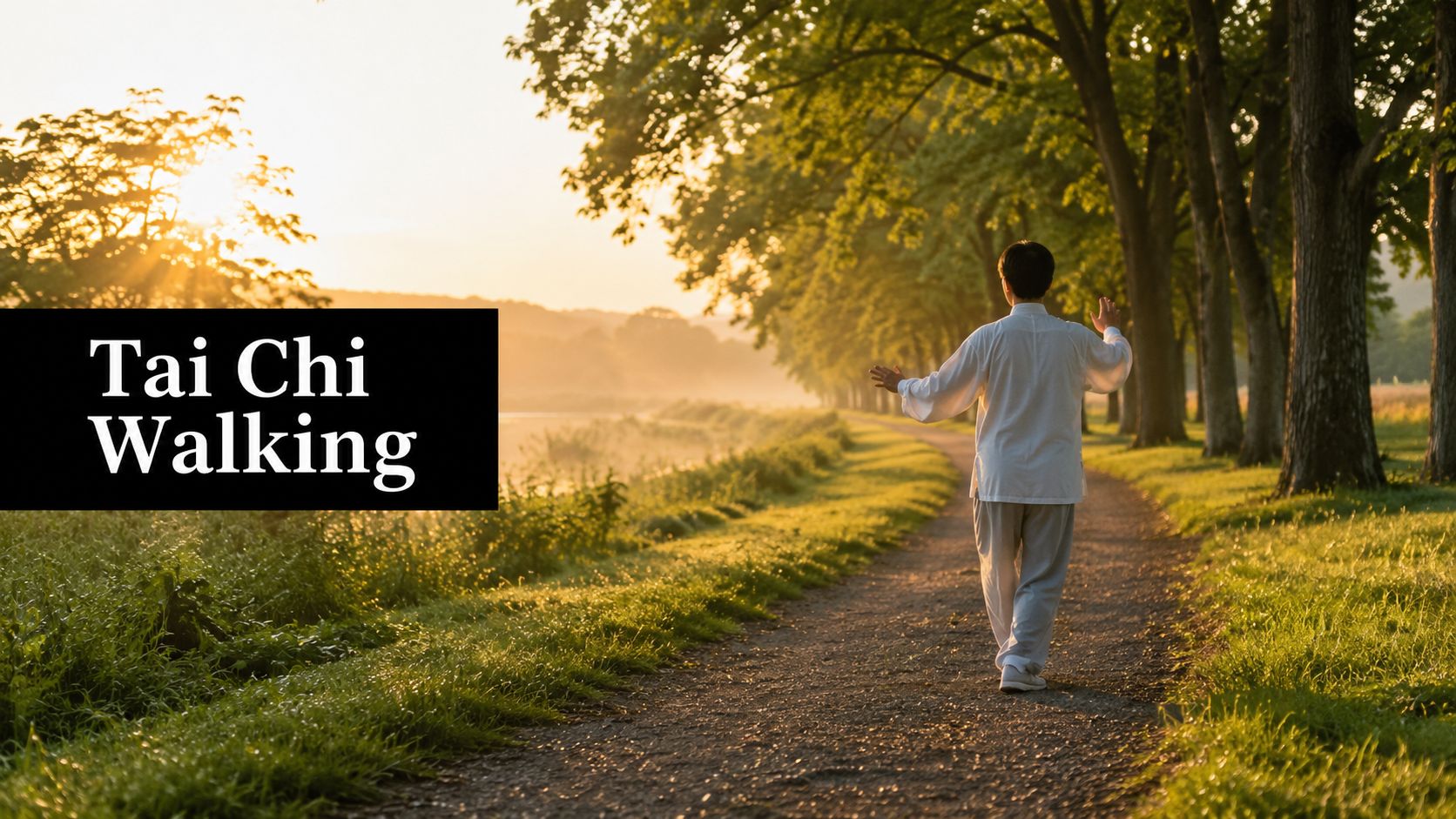
A common starting point is this. Someone wants a daily walk that supports long-term health, but regular brisk walking feels rushed, a little jarring, or hard to control on sore knees and stiff hips.
Tai Chi Walking changes the mechanics of a step. Instead of rolling forward on momentum, you slow the transfer of body weight, settle fully over one leg, and place the next foot with intention. That slower pattern works like balance training hidden inside walking practice. Your ankles, hips, and core have more time to organize each shift, and your joints get clearer feedback about alignment.
The result is a form of movement that feels gentle while still asking for skill. It trains steadiness, posture, and body awareness in a way ordinary walking often does not, because ordinary walking usually moves too quickly for you to notice where your weight is going.
It also stays accessible. You do not need much space, special equipment, or a high fitness level to begin. A few careful minutes can be enough to learn the rhythm and feel how each step becomes practice, not just travel.
What Is Tai Chi Walking and Its Core Benefits?
A lot of people arrive at Tai Chi Walking after getting stuck between two bad options. Fast exercise may feel too hard on the knees, hips, or back. Gentle exercise may feel too light to matter.
Tai Chi Walking sits in a useful middle ground. It's slow enough to be joint-friendly and demanding enough to train balance, body awareness, and control. The practice comes from Tai Chi training, where stepping isn't just a way to get from one place to another. It's a way to teach the body how to organize itself.
The first thing to understand is that this isn't “just slow walking.” The slowness has a purpose. You remove the usual push-and-catch rhythm of ordinary walking and replace it with deliberate placement.
That changes the experience in three practical ways:
- Balance gets challenged: You spend more time clearly supported by one leg at a time.
- Joints get better feedback: The body has time to notice alignment instead of rushing past it.
- Attention sharpens: You can feel where your weight is, where your knee tracks, and whether you're stable.
Tai Chi Walking works best when you treat each step as practice, not travel.
People also get drawn to it because it feels accessible. You don't need a treadmill, a class full of advanced choreography, or a high fitness level to begin. You need a small amount of space, steady breathing, and the willingness to slow down enough to notice what your body is doing.
For many beginners, that last part is the hardest and the most valuable.
Understanding the Unique Movement of Tai Chi Walking
The defining feature of Tai Chi Walking is its weight transfer. In regular walking, movement typically involves momentum. One leg pushes, the body glides, and the next foot catches the forward motion.
In Tai Chi Walking, you interrupt that automatic pattern.
What does heel-empty-toe-empty-shift mean?
Traditional instruction often describes a rhythm of “heel-empty-toe-empty-shift.” That means you shift 100% of your weight to one leg before the other foot becomes “empty” and lifts without effort, then place the heel first and move into the step with control rather than a push from momentum (Tai Chi for Health Institute).

A simple way to picture it is this: instead of stomping ahead, you're painting the floor with your feet. The foot lands softly. The body settles. Then the weight moves.
This creates a very different demand on the body:
- Your standing leg stabilizes more actively
- Your core has to organize posture without rushing
- Your feet and ankles provide more sensory feedback
- Your brain pays closer attention to center of gravity
That's why people often feel that Tai Chi Walking is harder than it looks. The challenge isn't speed. The challenge is precision.
Why does that improve balance?
Because you can't hide poor balance inside a fast step. Slow stepping exposes wobble, uneven loading, and rushed transitions.
A few form cues help:
- Soft knees: Don't lock them.
- Smaller steps: Keep the front knee from moving past the toes.
- Upright spine: Think tall, not rigid.
- Quiet landing: Place the heel gently before the rest of the foot settles.
If posture is a weak point for you, this comprehensive guide to posture health gives useful background on how alignment supports stable movement.
Practical rule: If the “empty” foot still feels heavy, you probably haven't fully transferred weight to the standing leg yet.
Beginners also tend to overstride. That usually makes the movement less stable, not more. A shorter step gives you more control and less strain.
If you're pairing this practice with broader nutrition goals, a protein intake calculator can help you match recovery and muscle support to your activity level.
How Does It Compare to Regular Brisk Walking
Brisk walking and Tai Chi Walking overlap in one important way. Both are legitimate forms of movement, and both can support long-term health. They do different jobs.
Brisk walking is usually better when your main goal is straightforward aerobic activity. Tai Chi Walking is better when your main goal is balance training inside the act of walking itself.
A landmark study found that practicing tai chi, including Tai Chi Walking, was associated with a 20% reduction in total mortality, compared with 23% for walking and 27% for jogging in the same analysis, which challenges the idea that only higher-intensity exercise matters for longevity (American Journal of Epidemiology study).
Tai Chi Walking vs. Regular Walking at a Glance
| Attribute | Tai Chi Walking | Regular Walking |
|---|---|---|
| Main focus | Balance, control, body awareness | Distance, pace, cardiovascular rhythm |
| Movement style | Slow, deliberate, full weight shift | Continuous, momentum-driven stride |
| Joint loading feel | Gentler and more controlled | Varies with speed, surface, and stride |
| Stabilizer demand | Higher during each step | Lower in typical casual walking |
| Mental focus | High | Often automatic |
| Best use case | Balance practice, mindful movement, joint-conscious exercise | Daily activity, aerobic conditioning, convenient exercise |
Which one should you choose?
For many people, the smartest answer isn't either-or.
Choose regular brisk walking when you want:
- Simple consistency: It's easy to do almost anywhere
- A stronger pace: Useful when you want a more conventional cardio session
- Less technical focus: Good for days when you don't want to think about mechanics
Choose Tai Chi Walking when you want:
- Better balance training: Each step asks for control
- Lower-impact movement: Helpful for people who dislike pounding
- More body awareness: Useful if your posture, knee tracking, or stability need attention
Brisk walking moves you through space. Tai Chi Walking teaches you how you move through space.
A useful way to combine them is to keep your regular walk and add a short block of Tai Chi Walking before or after it. That preserves the convenience of walking while giving you a focused drill for coordination and stability.
What Are the Proven Health Benefits
A missed step on a curb or a shaky turn in the kitchen usually happens during weight transfer, not while standing still. Tai Chi Walking practices that exact moment slowly and on purpose, which helps explain why its benefits show up so clearly in balance research.

What does the research say about balance and falls?
An AARP summary of tai chi research reports that practice is linked with up to 50% fewer falls in some groups (AARP review summary). That headline result fits the mechanics of Tai Chi Walking. Each slow step asks you to control the ankle, knee, hip, and trunk while your body moves from one base of support to the next.
A review summarized by the National Center for Complementary and Integrative Health found high-certainty evidence that tai chi reduced the number of people experiencing falls by 20% across 2,677 participants in 8 studies. The same review found low-certainty evidence of a 19% reduction in the rate of falls, as noted in this PMC review article on tai chi and fall prevention.
That matters in daily life. Better control during weight shift can make turning, stepping over uneven ground, and catching yourself after a small wobble feel more manageable.
If you're helping an older family member build steadier movement habits, this guide on how to improve balance in elderly adds practical ideas beyond tai chi.
What about waistline, blood sugar, and knees?
The same PMC review also highlighted a 12-week intervention in middle-aged Hong Kong adults. Participants in a Tai Chi Walking group showed average reductions of 0.50 kg in body weight, 0.47 kg in fat mass, 3.7 cm in waist circumference, and 0.18 mmol/L in fasting blood glucose compared with the control group.
Those changes help put Tai Chi Walking in the right category. It is not built around speed or high impact. It works more like a low-load repetition drill for posture, leg control, and muscular endurance, and that steady demand can still support metabolic health over time.
There is also joint-specific evidence. A 14-week Chen-style Tai Chi intervention improved knee joint biomechanics in people with knee osteoarthritis by reducing maximum knee extension moments and improving gait mechanics, according to this Scientific Reports article). For readers with sensitive knees, that is a useful distinction. The slow step gives you more time to align the knee over the foot and accept load gradually instead of dropping into the joint.
If blood sugar support is part of your plan, pairing movement with a structured diabetic meal plan can make healthy routines easier to maintain.
How to Start Your Tai Chi Walking Practice Safely
The safest way to begin is to think small. You're not trying to cover distance. You're trying to make one clean step, then another.
Start with a firm, flat surface and enough room for a few slow steps forward.

Your first basic sequence
A basic Tai Chi Walking step begins by softening the knees, shifting weight fully onto one leg, lifting the other leg, placing the heel first, and then shifting forward without relying on momentum (New York Times explanation of the basic step).
Use this sequence:
Stand tall with soft knees
Let your knees bend slightly. Keep the chest easy and the spine upright.Shift fully onto one leg
Don't rush this. Wait until the free foot feels light.Gently lift the empty foot If you have to yank it up, your weight is probably still divided.
Place the heel first
Reach only a short distance. Think gentle contact, not stepping out hard.Roll and settle
Let the foot receive weight gradually. Keep the front knee aligned with the toes.
A moving example can help you see the tempo more clearly:
What mistakes cause knee discomfort?
The most common beginner error is taking too long a step. Another is dropping weight into the front leg too abruptly.
Incorrectly practiced Tai Chi Walking can cause knee discomfort if the step is too long or the weight shift is abrupt. Proper form requires the knee to track over the toes and never extend past them, while correctly taught practice can support people with knee osteoarthritis rather than aggravate it (step-by-step knee alignment guidance).
Keep the stride modest. Smooth control protects the knee better than reaching farther.
A few safety reminders:
- If your knee feels pinched: Shorten the step immediately.
- If you wobble: Narrow your ambition, not your stance. Slower is better.
- If your shoulders tense up: Exhale and let the arms stay natural.
Footwear matters too, especially if foot pain changes how you load the ground. This 2026 plantar fasciitis shoe guide can help if you need a more supportive walking shoe.
If you're building a broader routine for aging well, an elderly female meal plan may help support daily energy and recovery.
Integrating Tai Chi Walking Into a Wellness Lifestyle
Tai Chi Walking works best as a regular practice, not a once-in-a-while experiment. Traditional guidance for beginners suggests 2 to 4 minutes daily to learn the weight-sensitive rhythm before building from there, as noted earlier from the Tai Chi for Health Institute.
That short duration makes it easy to slot into real life. You can do it before breakfast, after work, or as a reset between long stretches of sitting. It pairs especially well with routines that need less stress and more steadiness.
One point often confuses readers: Tai Chi Walking isn't a dramatic weight-loss workout. A 2026 YouTube analysis argued that its role in weight management is more indirect. It may help by reducing cortisol and improving interoception, which can make it easier to notice hunger and fullness cues, rather than by burning large amounts of calories (2026 discussion of weight-management nuance).
That makes it a useful bridge habit. You move the body, calm the pace of the day, and become more aware of signals that affect eating, recovery, and consistency.
If you want your food choices to support that same steady approach, an anti-inflammatory meal plan can fit alongside a low-impact movement routine.
Frequently Asked Questions About Tai Chi Walking
Do I need special equipment for Tai Chi Walking?
No. You only need a small flat space and comfortable clothing. Supportive shoes can help if your feet are sensitive.
Is Tai Chi Walking good for older adults?
Yes. It's commonly used as a gentle balance practice and is especially appealing for people who want lower-impact exercise.
Can beginners learn it at home?
Yes, if you start slowly and keep your steps short. Watching a clear demonstration also helps you avoid rushing the weight shift.
Should my knees stay straight?
No. Keep them soft, not locked. A slight bend helps absorb force and improves control.
Can Tai Chi Walking help sore knees?
It may, when form is correct. If pain increases, shorten the step and check that the knee is tracking over the toes.
Is it better than regular walking?
Not in every way. It's better for focused balance and body awareness, while regular walking is often simpler for steady aerobic activity.
If you want your nutrition to feel as structured and manageable as your movement practice, AI Meal Planner can help. It builds personalized meal plans, smart grocery lists, and simple weekly structure around your goals, and you can get started through the onboarding page.
AI-powered nutrition
Get Your Personalized Meal Plan
AI creates the perfect meals for your goals, lifestyle, and taste.
Start Your Journej