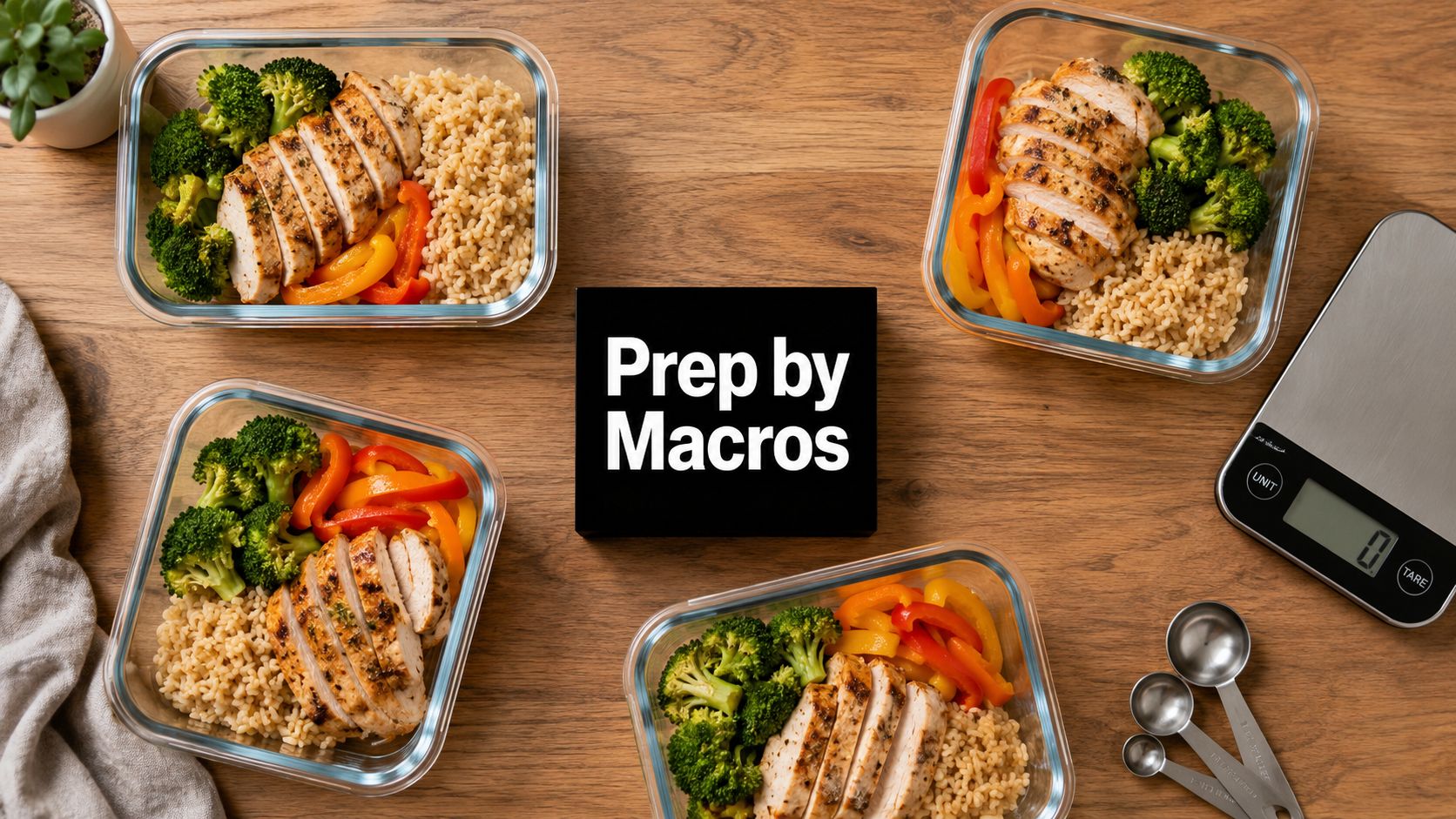
Meal prep by macros works best when you start with calories, then split them into a macro ratio such as 40% carbs, 30% protein, and 30% fat. Convert those calories with 4 calories per gram for protein and carbs and 9 calories per gram for fat, then divide the totals into 3 to 5 meals and cook in 3 to 4 day batches.
You don't need a perfect spreadsheet to make this work. You do need a repeatable system that turns a calorie target into containers you can eat, store, and repeat without guessing.
Meal prep has already moved well beyond niche bodybuilding habits. A widely cited U.S. consumer survey found that nearly 9 in 10 Americans have meal prepped at least once, and 44% do it regularly, which is why macro-based prep now fits busy professionals, families, and lifters instead of a tiny fitness crowd (survey context). The core advantage is that the food stops being abstract. You're no longer asking whether a bowl “looks right,” you're building each meal to a known target.
How Macro Meal Prep Actually Works
The engine is simple. Start with your daily calories, split them into macro percentages, then convert each macro into grams using the standard energy values, 4 calories per gram for protein and carbohydrates, 9 calories per gram for fat (meal prep overview). That math matters because it turns portioning into an objective task instead of a visual guess.
For example, if someone uses a common starting split of 40% carbohydrates, 30% protein, and 30% fat (macro planning guide), the calories assigned to each macro are easy to calculate. From there, you divide each macro calorie total by its gram value. That gives you the daily gram target you'll spread across meals.
Why the math beats eyeballing
The point isn't to be clever. It's to make the same breakfast, lunch, and dinner repeatable without wondering whether a serving was a little heavy or a little light. Macro planning works especially well for weight loss, muscle gain, and performance because it uses food math, not kitchen intuition.
Practical rule: if you can write down the calorie target, you can build the week.
That's also why macro meal prep became mainstream. The habit of prepping food is already common, and meal planning is associated with better adherence to nutritional guidelines and greater food variety, with the strongest association seen in the top quartile of diet quality, OR 1.13 with a 95% CI of 1.07 to 1.20 (population-based study context). Macro prep just gives that habit a measuring system.

The cleanest way to think about it is this. Calories set the budget, macros set the categories, and containers set the daily execution. Once those three line up, meal prep stops being a series of individual choices and becomes a weekly operating system.
Picking Proteins, Carbs, and Fats That Hit Your Targets
Protein comes first because it anchors the meal. In practice, that usually means building around one clear protein source, then filling the plate with carbs and fats that support the day's target. For a lot of people, the most efficient approach is to choose foods that are easy to weigh, easy to batch, and easy to repeat.
Common protein choices include chicken breast, lean ground turkey, cottage cheese, Greek yogurt, tofu, and eggs. A cooked protein portion can be very different from its raw weight after water loss, so the exact numbers matter more than the food label on the package. A simple way to keep yourself honest is to think in cooked portions only after you've already logged the raw ingredient batch.
Foods that do the heavy lifting
Carb staples tend to be rice, oats, sweet potato, whole-grain pasta, and legumes. Fat sources usually come from olive oil, avocado, nuts, and seeds. Those foods aren't glamorous, but they're reliable, and reliability is what keeps macro prep from turning into a science project.
A few practical portions make the system easier to shop and cook:
- Chicken breast: a cooked portion around 150 g can land near 45 g protein, depending on how it's prepared and trimmed.
- Greek yogurt or cottage cheese: useful when you need a high-protein breakfast or snack without cooking.
- Rice or oats: easy carb bases when you need a predictable gram count.
- Olive oil, avocado, nuts, seeds: better used deliberately, since fats raise calories quickly.
The order matters. Hit the protein target first, then use carbs and fats to finish the day's calories. That keeps meals balanced without forcing every plate to look identical.
If you want a fast way to estimate protein needs before you build meals, use the Strive Workout Log macro calculator as a reference point, then translate the result into food portions. For more detailed portion planning, the protein intake calculator can help you map the target to actual servings.
Calculating Per-Container Macros the Right Way
Most plans get sloppy. If you want containers that match the tracker, weigh every ingredient raw, log the full batch, then divide the total macros by the exact number of portions. That workflow is the difference between a real macro plan and a guess with a label on it.
The common mistake is mixing cooked weights with raw database entries. Cooked chicken can weigh about 30% less than raw after water loss, so logging the cooked weight against a raw food entry undercounts intake (raw-versus-cooked guidance). For mixed dishes, that error gets worse because pasta, rice, vegetables, and proteins all change texture and mass differently during cooking.
The clean batch workflow
A correct recipe-level method looks like this:
- Weigh every ingredient raw.
- Log the full batch in your tracker.
- Split the total macros by the exact number of containers.
That's the model that keeps a curry, stir-fry, chili, or burrito bowl honest from batch to plate. Once the batch is saved as a custom recipe, every container inherits a fixed macro value per serving, which is exactly what you want when you're repeating meals through the week.
Save the batch once, then stop re-calculating every bowl.
For a practical calculation tool, the Calorie Macro Calculator can handle the arithmetic before you cook. If you want another reference point for the same workflow, the Recipe Nutrition Calculator fits well when you're building mixed meals and need the full batch broken down before portioning.

The reason this matters is simple. When you save the recipe correctly, the container becomes the unit of truth. You don't have to second-guess whether lunch was 30 grams off, because the batch math already handled that before the fridge ever opened.
Designing a Weekly Prep Cycle That Actually Fits Your Life
A sustainable macro system usually works better in 3 to 4 day cycles than in a giant Sunday marathon. Cook enough for the early part of the week, then keep frozen backups for later so freshness doesn't disappear by Thursday. That's the balance between accuracy, food safety, and not hating your own fridge.
A practical setup uses 1 to 2 proteins, 1 to 2 carbohydrate sources, and 1 to 2 vegetables per cycle (weekly prep guide). The smaller the ingredient list, the easier it is to shop, batch, and repeat. It also makes leftovers more useful, because one protein can shift from bowls to wraps without forcing a new grocery run.
How the fridge window shapes the week
Cooked proteins usually keep 3 to 4 days in the refrigerator, cooked grains keep 4 to 5 days, and anything beyond 4 days should be frozen and thawed in the fridge the night before (storage guidance). That means a Sunday prep can cover Monday through Wednesday comfortably, then a smaller Wednesday refresh can bridge the rest of the week.
A grocery list works best when it's organized by aisle, not by meal. Group proteins together, then produce, then dry goods, then sauces. That cuts backtracking and makes batch cooking feel less like a scavenger hunt.
The leftover trick is underrated. A roast chicken can become two lunch formats if you pair it once with rice and once with salad greens. Same protein, same prep session, different experience, less waste.
If you want to speed up the list-building part, the grocery list generator can help sort ingredients into a usable weekly shop. The meal structure still needs judgment, but the list stops turning into a mess of one-off items.

The strongest weekly prep plans don't try to impress anyone. They just make Monday easy, keep Thursday edible, and leave enough flexibility that you'll cook again next week.
Flexing Macros Around Training Days and Rest Days
Static containers are convenient, but they're not always smart. Hard training days usually call for more carbs around workouts, while easier days can lean lighter on carbohydrates and heavier on protein or vegetables. The food can stay the same, but the assembly changes.
That approach lines up with current sports nutrition thinking, where carbohydrate timing matters around training and protein doesn't need to be forced into identical meal slots every day. The mistake is treating every lunch as interchangeable when training load, appetite, and schedule are changing underneath the plan.
A smarter way to allocate the same batch
Use the same batch-cooked foods, then shift the proportions by day:
- Training day: front-load carbs near the workout and keep protein steady.
- Rest day: reduce the carb-heavy portions and lean on vegetables, protein, and moderate fats.
- Mixed day: keep the meal flexible and let hunger tell you which container to use first.
That doesn't mean rebuilding the grocery list every week. It means assembling the same ingredients in a different order. A rice bowl can become a higher-carb pre-workout meal, while the same chicken and vegetables can become a lower-carb dinner on a rest day.
Practical rule: keep the batch fixed, flex the plate.
If your schedule changes often, leave some room in the plan. A modest weekly buffer helps you absorb a social meal, a late workout, or a day when appetite is off. For people who want their training to drive the food plan more cleanly, the Athlemove AI workout generator is a useful example of how training structure and meal structure can work together without starting from scratch every week.
The key idea is that meal prep by macros doesn't need identical containers to be consistent. Consistency comes from repeating the system, not from eating the exact same arrangement every day.
Tracking, Adjusting, and Avoiding Tracking Burnout
Macro tracking usually fails from friction, not from bad math. A systematic review summarized in a nutrition article found food diary completion rates of 80% to 90% in the first two weeks of a weight-management program, then 30% to 50% by 3 months (adherence review). That drop is why rigid daily logging burns people out.
A better approach is to use weekly-average thinking. You don't need every meal to be perfect if the week itself stays close to target. That's especially useful when meal prep already gives you a fixed lunch or dinner, because the containers remove most of the daily decision noise.
What to change when progress stalls
Adjust only after enough data has accumulated. A common practical window is every 4 to 6 weeks, or after a visible 5 to 10 lb body composition shift, though the exact threshold depends on the person. If fat loss stalls, the first move is usually to check adherence, then tighten calories slightly if the logs and portions are already consistent.
If hunger spikes, don't reach for random snacks first. Increase protein, add volume from vegetables, and review whether the current calorie target is too aggressive. If energy is flat in training, the carb allocation may be too low for the work you're doing.
The simplest burnout fix is to make the tracker serve the food, not the other way around. A pre-portioned container already does part of the logging for you, which is why meal prep is itself an adherence tool. For recipe-level checking and batch nutrition totals, the Recipe Nutrition Calculator keeps the numbers visible without forcing you to do every calculation by hand.

The system works when it stays livable. If the process gets so rigid that you avoid logging entirely, you've lost the benefit you were trying to protect.
A Sample Week and Common Adjustment Questions
A solid sample week doesn't need exotic ingredients. It needs one batch of protein, one reliable carb, and one or two vegetable sides that can be rearranged into different meals. The same food can look different across the week if you vary the assembly.
| Day | Breakfast | Lunch | Dinner | Daily Protein |
|---|---|---|---|---|
| Monday | Greek yogurt with oats | Chicken, rice, vegetables | Chicken, sweet potato, vegetables | 150 g |
| Tuesday | Eggs and oats | Chicken rice bowl | Chicken and vegetables | 150 g |
| Wednesday | Cottage cheese and fruit | Chicken, rice, vegetables | Protein-forward bowl | 150 g |
| Thursday | Greek yogurt with oats | Chicken salad bowl | Chicken, rice, vegetables | 150 g |
| Friday | Eggs and oats | Chicken, rice, vegetables | Flexible meal from leftovers | 150 g |
That structure fits a rough 2,000 calorie day with about 150 g protein if the portions are built to match the individual target. For vegan, keto, or gluten-free eating, the framework stays the same, only the ingredients change. Tofu or legumes can replace chicken, lower-carb vegetables can replace rice, and gluten-free grains can replace standard pasta or bread.
A few common questions come up every week:
- What if weight stalls? Check adherence first, then reduce calories slightly or adjust carb portions if the food log is already accurate.
- What if hunger spikes mid-week? Add protein and volume before adding random snacks.
- Do snacks need to be perfect? No. Keep them close to target, but don't let snack tracking wreck the entire plan.
If you want the whole system built for you, AI Meal Planner creates weekly meal plans, recipes, and grocery lists around your calorie and macro targets, then adjusts the plan around your preferences and schedule.
If you want meal prep by macros without spreadsheet fatigue, use AI Meal Planner to turn your calorie target into a weekly plan, grocery list, and container-ready recipes. It's a practical way to keep the numbers accurate while making the routine easier to repeat.
AI-powered nutrition
Get Your Personalized Meal Plan
AI creates the perfect meals for your goals, lifestyle, and taste.
Start Your Journej