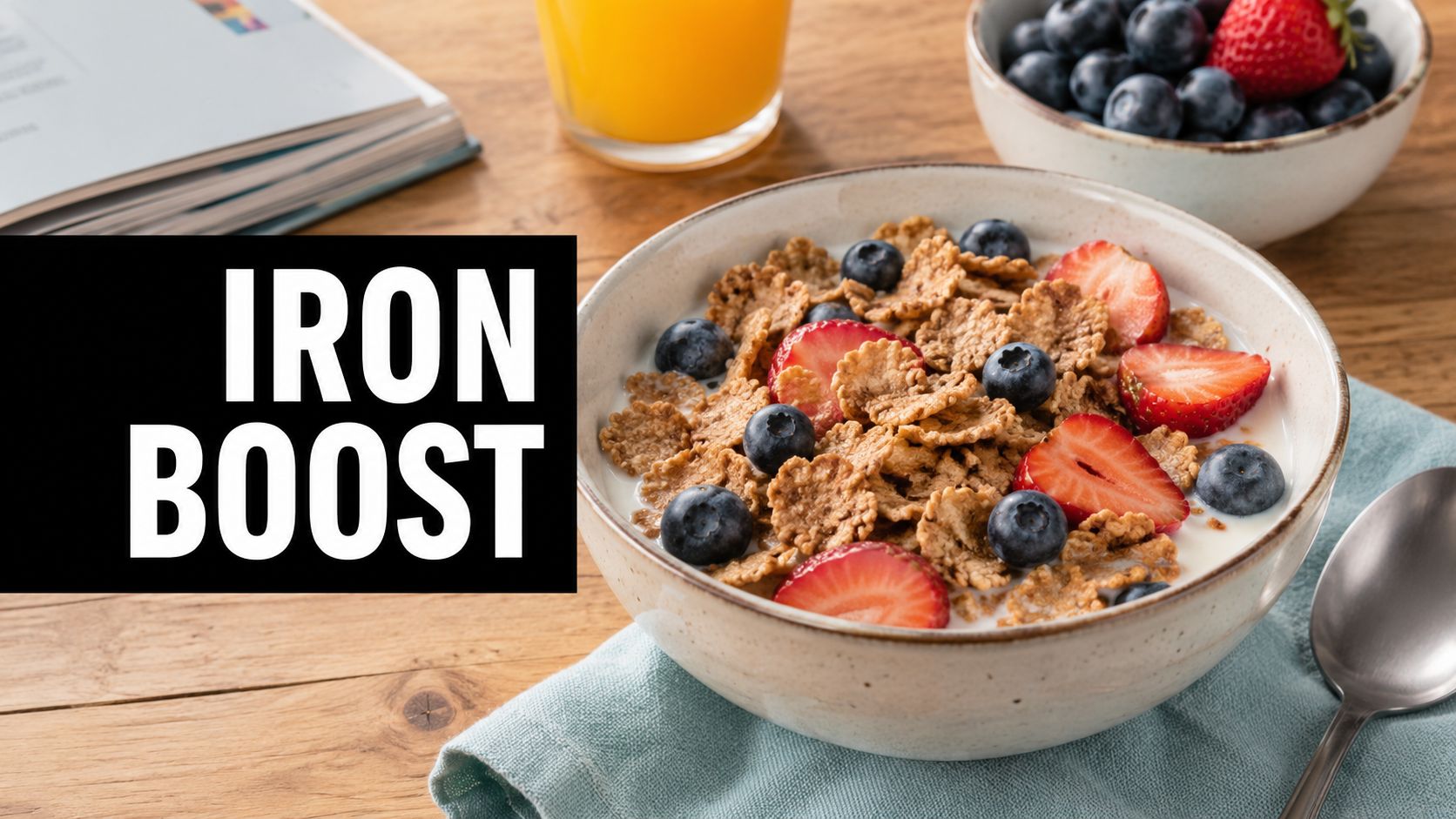
The best iron fortified cereal is usually the one that gives a high amount of iron per serving and that you'll eat consistently. In U.S. ready-to-eat cereals, iron fortification typically ranges from 10% to 100% of the U.S. RDA per serving, while most products average 25% to 45%, and WIC-approved cereals must provide at least 45% per serving according to the National Academies review on cereal fortification.
You're probably standing in the cereal aisle trying to answer a simple question that labels make oddly hard. Which box helps with iron intake, which one is mostly marketing, and which one fits your budget and mornings.
That's where a practical list helps more than a generic “healthy cereals” roundup. Iron fortified cereal has been part of public health nutrition for a long time. Nestlé notes that iron was added to cereals beginning in the 1920s, and in the U.S. fortification spread rapidly enough that by the end of 1942, 75% of white bread on the market was fortified with thiamin, niacin, iron, and riboflavin, as described in its history of iron fortification in cereals.
The practical catch is absorption. A box can look impressive on paper, but what matters at breakfast is the iron form, portion you pour, and what you eat with it. Older assay work also found that adults often eat about 200% of the labeled serving size, which is one reason label math and real intake don't always match, as noted in this PubMed summary on fortified cereal intake and absorption questions.
Practical rule: If you want an iron fortified cereal to pull its weight, pair it with fruit instead of relying on the cereal alone to do everything.
1. General Mills Total Whole Grain Cereal
General Mills Total Whole Grain Cereal is one of the easiest mainstream picks when iron is the top priority. It's the cereal I think of for people who want a no-fuss bowl that still feels familiar, not like a specialty “health food” compromise.
This is a wheat-based flake cereal with broad fortification and a neutral taste. That neutral flavor matters because it's easier to keep in regular rotation if you can eat it plain, with berries, or mixed into yogurt without getting tired of it.
Why it stands out in practice
The biggest strength here is concentration. You get a lot of iron in a simple serving, so it works well for busy mornings, travel breakfasts, or the days when cooking eggs, beans, or a full breakfast isn't happening.
It's also easy to track if you're intentionally building more iron into your diet. If you're already planning around higher-need life stages, a structured approach like an AI pregnancy meal plan can help you fit cereal into a broader routine instead of treating breakfast as a random decision.
- Best for consistency: The taste is mild enough that most adults can eat it regularly.
- Best budget use: It's widely available, so you usually don't need a special store.
- Main drawback: It contains wheat and added sugars, so it won't work for gluten-free shoppers or anyone trying to keep sweetness very low.
What works best with this cereal
This cereal does well with strawberries, kiwi, orange segments, or another vitamin C-rich fruit. That's the easiest way to make a fortified cereal breakfast more practical from an iron standpoint.
What doesn't work as well is assuming the label solves everything. If you pour a bowl and add a lot of calcium-rich milk without any fruit, you're still eating a fortified product, but you're not building the most iron-friendly meal pattern.
Total Whole Grain is a “make breakfast happen” cereal. It's not exciting, but that's often why people stick with it.
2. General Mills Total Raisin Bran
If you want your iron fortified cereal to feel more like a classic comfort cereal, Total Raisin Bran is the better fit. It gives you strong fortification with a sweeter, more familiar profile than a plain flake cereal.
This one makes sense for people who won't stick with a very plain cereal. That's an important trade-off. The “best” cereal on paper doesn't help if the box sits untouched for weeks.
Where it earns its place
The raisins make it easier to eat straight from the box or as a simple desk breakfast. You also get the practical benefit of a bran-and-raisin format that feels more substantial than lighter flakes.
There's another advantage that's easy to overlook. If someone is trying to improve diet quality without changing everything at once, switching from a lower-iron sweet cereal to a fortified bran cereal is often a realistic first move.
- Strong point: Good mix of iron fortification and a familiar taste.
- Useful for: Adults who want more texture and a cereal that feels filling.
- Watch for: It's sweeter than plain bran cereals and still wheat-based.
Who should skip it
Skip this one if you dislike raisins or if you need gluten-free options. Also skip it if sugar is your top filter and you're willing to tolerate a blander cereal to lower sweetness.
For many people, though, this is the compromise pick that survives beyond week one. It tastes recognizable, it stores well, and it doesn't require prep.
3. Quaker Oatmeal Squares Brown Sugar
Quaker Oatmeal Squares Brown Sugar is a strong middle ground. It's crunchy, fortified, and more satisfying than a delicate flake cereal, which makes it a good fit for people who want breakfast to hold them over.

The texture is the main selling point and the main complaint. Some people love the crunch. Some people find it too hard and abandon the box halfway through.
Why it works for busy households
Oatmeal Squares is one of those cereals that can do double duty. It works as breakfast, but it also works as a dry snack in a container for work, school, or commuting.
That versatility matters if your mornings are chaotic. A cereal you can also use as a snack tends to create less waste, and that's part of what makes a pantry staple worth buying. If you want a breakfast routine that also leans into fullness and fiber, a high-fiber meal plan approach pairs well with this style of cereal.
Trade-offs to know before you buy
The brown sugar flavor is pleasant without tasting like dessert, but it's still a sweetened cereal. It also contains wheat, so it isn't appropriate for gluten-free diets despite the oat-forward branding.
- Good fit: People who want a crunchier cereal with meaningful fortification.
- Less ideal: Anyone with sensitive teeth or who prefers softer cereals.
- Best use: Dry snack, yogurt topper, or a cereal bowl with fruit.
This is a practical buy when you want something sturdier than flakes but don't want the density of Grape-Nuts.
4. Post Grape-Nuts The Original
Grape-Nuts is the cereal for people who care less about sweetness and more about density, fiber, and staying power. It's one of the most utilitarian cereals on this list, and that's exactly why some shoppers swear by it.

This isn't a fluffy bowl. It's compact, crunchy, and better treated like a serious pantry ingredient than a casual sugary cereal.
Best ways to eat it without regretting the purchase
A lot of people buy Grape-Nuts and then realize they don't enjoy a full dry bowl. The workaround is simple. Use smaller portions and think mix-in, not only stand-alone cereal.
It's especially useful stirred into yogurt, used as a crunchy topping, or softened a bit before eating. For vegetarian eaters trying to build practical iron-aware meals across the day, this cereal can fit nicely into a broader vegetarian meal plan structure.
Grape-Nuts is excellent on paper and very effective in the pantry, but texture tolerance decides whether it's a winner.
Who gets the most from it
- Best for: Adults who want a less sugary cereal with firm texture.
- Not great for: Kids, sensitive teeth, or anyone wanting a soft breakfast.
- Smart use: Mix with a softer cereal or yogurt instead of eating a full bowl alone.
If you like dense, old-school cereals, this is a very solid pick. If you don't, no nutrition label will make you enjoy it.
5. Kellogg's Frosted Mini-Wheats Little Bites
Kellogg's Frosted Mini-Wheats Little Bites earns its spot because it's one of the easiest “family compromise” cereals to keep around. It gives you meaningful fortification in a format that feels approachable for both adults and older kids.

The smaller biscuit size helps. Large shredded wheat pieces can be messy and polarizing. The little bites are easier to portion and easier to eat quickly.
Why families often stick with it
This cereal solves a common household problem. One person wants a more nutritious cereal, another wants something sweeter, and no one wants three different boxes open at once.
Mini-Wheats tends to meet in the middle. You get a whole-grain wheat base and a texture that feels substantial, but the frosting makes it more acceptable than a plain shredded wheat cereal.
- Strong point: Easier sell for mixed households than plainer fortified cereals.
- Limitation: Added sugar is part of the appeal, so it's not the best low-sugar option.
- Best pairing: Fresh fruit on the side rather than making the bowl sweeter with flavored yogurt.
This is one of the better choices if compliance matters more than purity. In practical nutrition, the cereal your family eats is usually the right one.
6. Cream of Wheat Original 1-Minute
If you want a hot iron fortified cereal instead of another crunchy box, Cream of Wheat Original 1-Minute is the clear contender. It's quick, mild, and much easier for people who don't enjoy cold cereal textures.

This is also a useful option for anyone recovering from appetite fatigue with breakfast. Sometimes a warm, soft cereal is easier to tolerate first thing in the morning.
Why hot cereal can be the better choice
Cold cereals are convenient, but they're not automatically better. Some people digest and enjoy a warm cereal breakfast more consistently, and consistency matters far more than chasing a perfect label.
Cream of Wheat is flexible too. You can keep it simple or build it up with berries, nut butter, or seeds depending on your preferences and budget.
What to keep in mind
The main downside is obvious. You do have to prepare it, even if it's quick. It's also wheat-based, so it's not gluten-free.
A hot fortified cereal can be easier to stick with during colder months or for anyone who's tired of crunchy breakfasts.
This is one of the best reliably useful cereals in the category. It won't win on novelty, but it often wins on repeat use.
7. Post Great Grains Red Berry Almond Crunch
Post Great Grains Red Berry Almond Crunch is the most flavor-forward cereal on this list. If you want your iron fortified cereal to feel like an enjoyable breakfast and snack, this one does that better than most.

You get a more complex texture with flakes, fruit pieces, and almonds. That makes it more interesting, but it also means it won't fit every household because of nut allergies.
Best use for this cereal
Great Grains works especially well for people who snack on cereal dry. It feels more like a snack mix than a plain breakfast cereal, which can make it easier to use up the box.
It also fits nicely into a broader balanced meal plan if you're trying to stop breakfast from swinging between “nothing” and “pastry plus coffee.”
Real trade-offs
- Why buy it: Better flavor and texture variety than plain fortified cereals.
- Why skip it: Nuts, added sugars, and wheat limit who can use it.
- Who it suits: Adults who want one cereal that works for breakfast and desk snacking.
This is the cereal for people who get bored easily. It's less stripped-down than Total or Grape-Nuts, but that's exactly the point.
Top 7 Iron‑Fortified Cereals Comparison
| Product | 🔄 Prep & Complexity | ⚡ Availability & Cost | 📊 Expected Outcomes (Iron & Nutrients) | Ideal Use Cases | 💡 Key Advantages |
|---|---|---|---|---|---|
| General Mills Total Whole Grain Cereal | Ready‑to‑eat, no cooking; very low complexity | Widely available; budget‑friendly | ⭐ ~18–24 mg Fe (≈100% DV); fortified B‑vitamins & zinc | Quick daily iron boost, pair with fruit/yogurt | High iron density per serving; neutral flavor; easy tracking |
| General Mills Total Raisin Bran | Ready‑to‑eat; no cooking | Widely available; standard price | ⭐ ~18 mg Fe (≈100% DV); ~5 g fiber per cup | High‑iron + fiber breakfast or pantry staple | Combines iron with fiber and potassium from raisins |
| Quaker Oatmeal Squares (Brown Sugar) | Ready‑to‑eat; crunchy texture may need milk | Broad retail distribution; mid price | ⭐ ~16–16.5 mg Fe (≈80–90% DV); ~5–6 g protein | Higher‑protein cold cereal; family boxes | Good iron with higher protein and whole‑grain oats |
| Post Grape‑Nuts (The Original) | Ready‑to‑eat; very dense, often soaked or used as topping | Widely available; moderate price per portion | ⭐ ~16 mg Fe per serving; ~7 g fiber; very high whole‑grain | Topping for yogurt/baking, very filling breakfasts | Very high whole‑grain and fiber with minimal added sugar |
| Kellogg's Frosted Mini‑Wheats Little Bites | Ready‑to‑eat; kid‑friendly bite size | Widely available; multiple pack sizes | ⭐ ~18 mg Fe (≈100% DV); substantial fiber | Kid breakfasts, satiety‑focused meals | Excellent iron+fiber combo in a convenient form |
| Cream of Wheat Original 1‑Minute | Quick cooking (instant/stovetop); low‑moderate complexity | Widely available; instant packets & cups | ⭐ ~8–9.3 mg Fe (≈45–50% DV); enriched with calcium & B‑vitamins | Hot cereal for sensitive palates or added mix‑ins | Hot, smooth base that accepts fortification and mix‑ins |
| Post Great Grains Red Berry Almond Crunch | Ready‑to‑eat; simple serve | Available in many retailers; mid price | ⭐ ~18 mg Fe (≈100% DV); multi‑grain with nuts/fruit | Flavorful breakfast or snack; more varied texture | High iron with nuts/fruit for varied flavor and texture |
How do you build a budget-friendly iron fortified cereal routine that actually lasts
Buying one good box is useful. Building a repeatable breakfast system is better. The easiest way to make iron fortified cereal work is to stop thinking in single products and start thinking in grocery patterns.
Budget grocery list under your strict basics budget
Choose one cereal from the lower-cost end of your local shelf, then build around inexpensive pairings.
- Cereal aisle: One box of Total Whole Grain, Total Raisin Bran, or Cream of Wheat
- Produce aisle: Bananas plus one vitamin C-rich fruit such as oranges, kiwi, or strawberries
- Dairy or alt-dairy aisle: Milk or a tolerated alternative
- Pantry aisle: Peanut butter or sunflower seed butter
Meal prep guide:
- Weekday breakfast: Cereal plus fruit
- Snack backup: Dry cereal portioned into containers
- Upgrade option: Spoon peanut butter on toast on higher-hunger mornings
Mid-range grocery list for better variety
This tier gives you more flexibility without getting expensive fast.
- Cereal aisle: Quaker Oatmeal Squares plus one second cereal for texture variety
- Produce aisle: Berries, oranges, apples
- Fridge aisle: Yogurt
- Pantry aisle: Pumpkin seeds, nut butter
Meal prep guide:
- Two cold breakfast options: Cereal with fruit, yogurt bowl topped with cereal
- One snack option: Dry cereal mixed with seeds
- One fast dinner helper: Use cereal as a crunchy topping for yogurt or fruit bowls when meals are rushed
Higher-flex budget list for a family or heavy cereal users
This works best if several people eat breakfast at home or you like keeping options on hand.
- Cereal aisle: Total Whole Grain, Mini-Wheats, and Great Grains or Grape-Nuts
- Produce aisle: Mix of fresh citrus, berries, and easy grab fruit
- Fridge aisle: Yogurt and milk
- Pantry aisle: Nuts or seeds, nut butter, dried fruit if tolerated
Meal prep guide:
- Set up a breakfast station: Keep fruit washed and visible
- Use texture strategically: Softer cereal for kids, denser cereal for adults
- Reduce waste: Mix cereals instead of leaving half-finished boxes ignored
Automate Your Nutrition: Put Your High-Iron Plan on Autopilot
Building a high-iron, budget-friendly meal plan is absolutely doable, and iron fortified cereal can play a useful role in that. The products in this guide work best when you match them to your real eating habits, not to an idealized version of your routine. If you hate hard cereal, don't buy Grape-Nuts. If your household needs a compromise cereal, Mini-Wheats or Total Raisin Bran may be more realistic.
The bigger lesson is that “iron fortified” isn't the whole story. Meal pairing matters. Portion habits matter. Consistency matters. For infants, the strongest consumer-facing evidence is much clearer than it is for adults. A modeling study cited by the American Society for Nutrition found that adding one daily serving of iron-fortified infant cereal, 18 g providing 6.2 mg of iron, raised median iron intakes from 4.3 mg per day to 9.8 mg per day and reduced inadequacy from 75% to 5% among Australian infants, according to this American Society for Nutrition summary. For adults and families, the practical question is still how your actual breakfast pattern adds up over time.
That's why planning helps. If you want a system that builds grocery lists, organizes meals by your preferences, and makes it easier to include foods like fortified cereal in a consistent routine, AI Meal Planner onboarding is one relevant option. It can be useful for people who want structure without manually planning every breakfast, lunch, and snack.
If you're also discussing iron support with a clinician, some people look at supplement options such as Fisiogen Iron Ft, but cereal and overall diet pattern still matter because supplements don't replace regular eating habits.
The goal isn't to find a magical box. The goal is to choose one or two cereals you'll keep buying, pair them well, and make breakfast easier to repeat on ordinary mornings.
If you want your iron intake plan to be easier to follow week after week, AI Meal Planner can help you build personalized meals and aisle-organized grocery lists around the foods you eat, including iron-fortified cereal.
AI-powered nutrition
Get Your Personalized Meal Plan
AI creates the perfect meals for your goals, lifestyle, and taste.
Start Your Journej