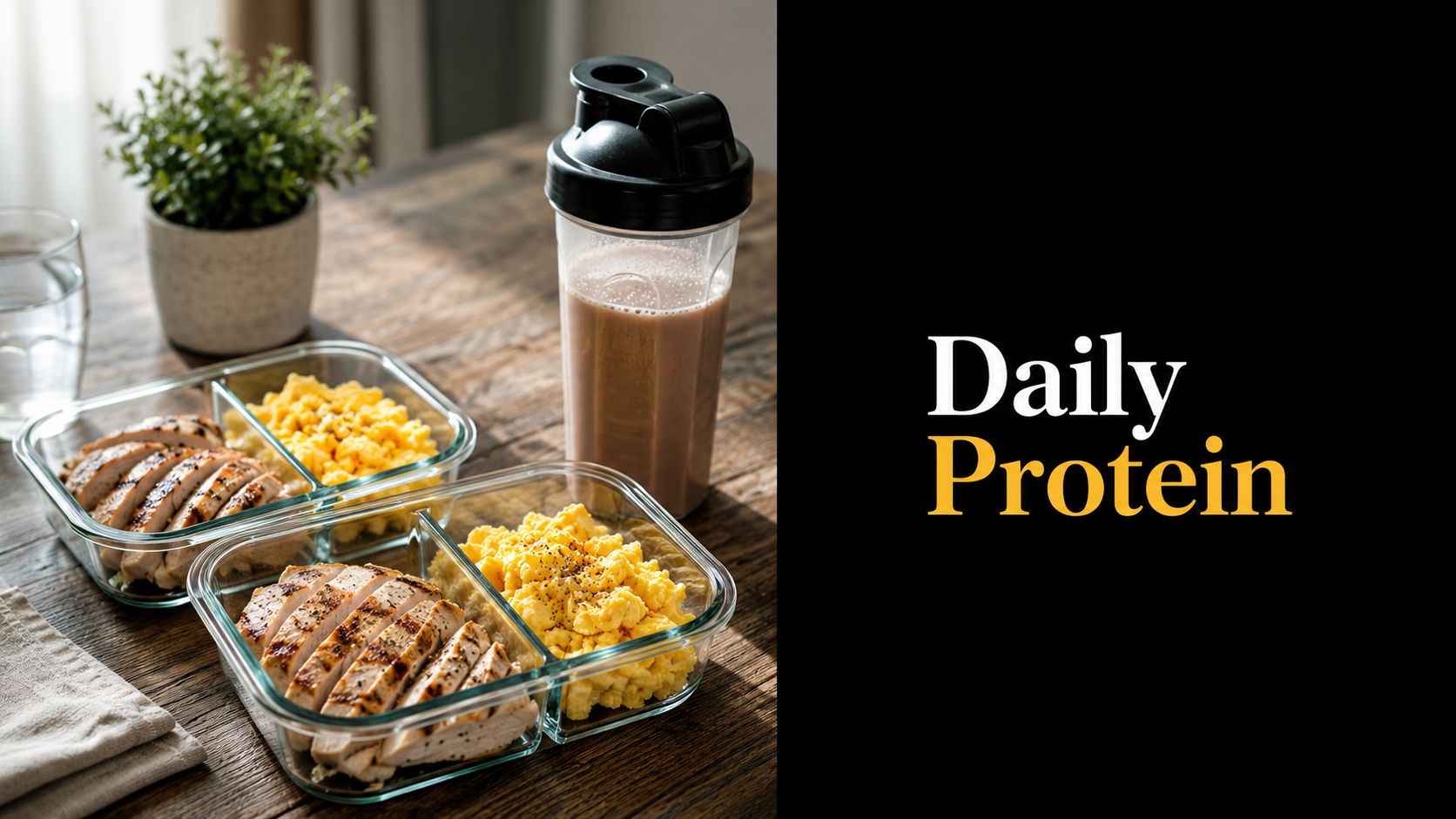
A bodybuilding protein target is 1.6 to 2.2 g per kilogram of body weight per day. A 90 kg lifter therefore needs roughly 145 to 198 g daily, usually divided across 3 to 5 meals with about 0.3 to 0.4 g/kg per meal.
That range answers the basic question, but the useful answer is more precise than a single number. Your target should reflect whether you're gaining or cutting, how much lean mass you carry, your age, and how easily you can meet the goal with normal meals. The research also gives a reassuring message for busy lifters: consistent daily intake matters more than forcing protein into a rigid schedule.
How Much Protein Per Day Bodybuilding Actually Requires
For most resistance-trained adults, 1.6 to 2.2 g/kg/day is the practical bodybuilding range. The lower end is a strong evidence-based target, while the upper end gives more flexibility for athletes who are dieting, very lean, or prefer a larger safety margin. The 2018 systematic review and meta-analysis in the British Journal of Sports Medicine examined 49 studies and about 1,800 participants and found that the maximal hypertrophic response occurred at roughly 1.62 g/kg/day, with a 95% confidence interval of 1.03 to 2.20 g/kg/day.
The result doesn't mean that every lifter must hit exactly 1.62 g/kg. It means muscle gains generally rose as intake increased, then showed little additional benefit above that point in the pooled data. That plateau is why coaches commonly use a range rather than claim that one “magic” protein number works for everyone.

A worked example for a 90 kg lifter
Multiply body weight in kilograms by your chosen protein factor:
- 90 kg × 1.6 g/kg = 144 g/day, commonly rounded to roughly 145 g
- 90 kg × 2.2 g/kg = 198 g/day
That gives the requested practical range of roughly 145 to 198 g per day. A lifter who is gaining weight and eating enough calories may sit nearer the middle, while someone dieting or carrying substantial lean mass may choose the upper portion.
The contrast with general nutrition explains why bodybuilding advice sounds higher. The British Heart Foundation lists 0.75 g/kg/day as the standard recommendation for a healthy-weight adult, while intense strength training can raise needs to around 1.2 to 2.0 g/kg/day. General health guidance isn't designed specifically to maximize adaptation to repeated resistance training.
Practical rule: Set a daily target first, then make your meals fit it. Don't chase extra protein while neglecting progressive training, adequate calories, sleep, or recovery.
Body composition can also change how you think about the result. Protein targets based on body weight are simple and useful, but athletes with unusually high lean mass or those pursuing non-surgical body contouring may want broader body-composition guidance rather than relying on scale weight alone.
Calculating Your Daily Protein Target in Grams
The simplest calculation uses body weight in kilograms:
Body weight in kg × chosen protein target in g/kg = daily protein in grams
Suppose you weigh 80 kg and choose a middle target of 1.8 g/kg/day:
80 × 1.8 = 144 g of protein per day
That number becomes your planning anchor. You don't need every day to land on the exact gram, but a consistent target makes it easier to judge whether your meals are doing enough work.
Choosing the right point in the range
Use 1.6 g/kg/day when you want a strong baseline and your calorie intake, training, and recovery are well controlled. Use 1.8 g/kg/day as a practical middle setting when you want a little more room for individual variation. Choose 2.2 g/kg/day when cutting, carrying high lean mass, or finding that the upper end helps control hunger without displacing important carbohydrates and fats.
If you track pounds, divide body weight in pounds by 2.205 to estimate kilograms, or use a calculator that performs the conversion. The AI Meal Planner protein intake calculator can help turn body weight and goal selection into a daily figure, but you should still check whether the result fits your phase and body composition.
| Body Weight (kg) | At 1.6 g/kg | At 1.8 g/kg | At 2.2 g/kg |
|---|---|---|---|
| 60 | 96 g | 108 g | 132 g |
| 70 | 112 g | 126 g | 154 g |
| 80 | 128 g | 144 g | 176 g |
| 90 | 144 g | 162 g | 198 g |
| 100 | 160 g | 180 g | 220 g |
| 110 | 176 g | 198 g | 242 g |
The table gives you a usable starting point, not a reason to treat protein as the only important macro. Once you have the number, distribute it across meals you can repeat, then adjust calories through carbohydrates and fats according to your training phase.
Adjusting Protein for Bulking vs Cutting and Body Composition
A bulk and a cut can use the same body weight but still justify different protein decisions. During a calorie surplus, reaching the standard resistance-training target is usually the priority. During a deficit, preserving lean tissue becomes more urgent because reduced energy availability makes muscle retention harder.
What changes during a cut?
Newer reviews summarized in this 2025 review of protein needs during resistance training and energy restriction suggest that resistance-trained athletes often use 1.6 to 2.2 g/kg/day in energy balance, while caloric restriction may call for 2.3 to 3.1 g/kg of fat-free mass per day to help preserve muscle.
That calculation uses fat-free mass, not total body weight. If you know your lean mass, multiply it by the chosen factor. If you don't, body weight remains a workable practical proxy, but it may be less precise for people carrying considerable body fat.
An 80 kg lifter might use about 128 to 176 g/day from the standard body-weight range. A cutting plan could reasonably sit near the upper end, while a lean bulk may not need the same emphasis if calories and training are supporting growth. The difference isn't that protein suddenly becomes more anabolic during a cut. The priority shifts toward protecting existing muscle while energy intake is lower.
Older lifters and anabolic resistance
Age introduces another consideration. The 2025 review notes that older lifters may benefit from roughly 0.3 to 0.4 g/kg per meal across 3 to 6 meals, reflecting anabolic resistance, a reduced muscle-building response to a given protein dose. This doesn't automatically require an extreme daily intake, but it makes adequate servings and consistent distribution more important.
Very lean bodybuilders with substantial muscle mass also have a reason to favor the higher end of the ordinary range. Scale weight may understate the importance of lean tissue in people with low body fat, so fat-free-mass guidance can provide a better framework during a cut.
For meal structure and calorie targets, a bodybuilding bulking meal plan can help translate the daily figure into repeatable meals. The key is to adjust the target for the phase, not to keep increasing protein without limit.
Meal Timing, Frequency, and Per-Meal Dosing
You don't need to eat protein every two or three hours to build muscle. A 2025 trial found that consuming protein three or five times per day produced equal resistance-training gains in muscle mass and strength when total intake and the per-meal amount were matched, as reported in the PubMed record for the trial.
That finding challenges the rigid clock-watching rule, but it doesn't make meal distribution irrelevant. A practical target remains about 0.25 g/kg per meal, or approximately 20 to 40 g of high-quality protein per serving, according to the evidence-based review on protein distribution and muscle protein synthesis.
For an 80 kg lifter, 0.3 to 0.4 g/kg works out to 24 to 32 g per meal. Three meals at that level, plus a shake or snack, can cover a substantial daily target without turning eating into a full-time job.
A busy professional could use this structure:
- Breakfast: eggs with Greek yogurt, or tofu with a high-protein side
- Lunch: chicken, lean beef, salmon, or tempeh with a carbohydrate source
- Post-workout: whey or a plant-based protein blend when a full meal isn't convenient
- Dinner: a complete protein serving with vegetables and the rest of the day's macros
The post-workout shake is a convenience tool, not a compulsory deadline. If you already have a protein-rich meal planned, you don't need to add a shake just because training ended.
The priority order is simple: reach the daily target, use practical meal servings, and choose a frequency you can sustain.
Best Protein Sources and Supplements for Bodybuilding
Protein numbers become easier to hit when each meal has a clear anchor. Whole foods offer protein alongside other nutrients, while supplements solve specific convenience problems. Neither category deserves a blanket label as “better” without considering preparation time, calories, dietary preferences, and budget.

Whole foods for reliable meals
- Chicken breast and lean beef: Dense, familiar options for lunch or dinner. They work well when you want substantial protein without building the meal around a liquid supplement.
- Eggs: Convenient and versatile, especially at breakfast. Combine them with another protein source when the meal needs a larger serving.
- Greek yogurt and cottage cheese: Useful for breakfast, snacks, or a pre-bed meal. They require little preparation and pair easily with fruit or oats.
- Salmon: A protein-rich fish that also contributes dietary fat, so account for that when setting calories.
- Tofu, tempeh, and legumes: Practical plant-based choices. Combining varied plant foods across the day can make a vegan plan easier to execute.
- Tuna: A quick option for sandwiches, salads, or bowls when cooking time is limited.
The AI Meal Planner food library can help you compare foods while building meals around your own dietary pattern. The most useful source is the one you can buy, prepare, digest, and eat consistently.
Where supplements fit
Whey isolate works well when you need a fast, portable serving with little preparation. Casein can suit people who prefer a slower-digesting dairy option in a snack or evening meal. Plant-based blends can make the amino-acid profile and texture more practical for people avoiding dairy, especially when a blend tastes better than a single plant protein.
Supplements shouldn't replace every meal. Use them to close a gap, such as a rushed commute, a missed cooking window, or a meal that falls short of your planned grams. Check the label and count the actual protein listed, not the total scoop weight.
For broader guidance on products used around training, consult an athlete recovery supplement guide 2026 3, then separate recovery claims from the basic job of meeting your daily protein target.
Sample Meal Plans With Protein Grams Per Meal
The same 80 kg lifter can organize protein differently depending on the phase. The examples below use four eating occasions, simple recipes, and explicit per-meal targets. The calorie totals are planning examples, not universal prescriptions.
Cutting day at roughly 1,800 kcal
This day targets 180 g of protein. It favors leaner protein choices so the lifter can preserve room for vegetables, carbohydrates, and dietary fats within a lower calorie budget.
| Meal | Example plate | Protein target |
|---|---|---|
| Breakfast | Greek yogurt with oats and berries, plus eggs | 45 g |
| Lunch | Chicken breast, rice, and vegetables | 50 g |
| Snack | Whey shake with fruit | 30 g |
| Dinner | Lean beef, potatoes, and salad | 55 g |
| Daily total | 180 g |
Prepare the chicken and beef in batches, then assemble meals quickly. Keep the snack portable so the protein target doesn't depend on finding a suitable meal during a busy workday.
The higher cutting target provides a straightforward structure, but it doesn't guarantee muscle retention by itself. The lifter still needs resistance training and a calorie deficit that remains appropriate for the goal.
Lean-bulk day at roughly 2,800 kcal
This day targets 160 g of protein, leaving more calories for carbohydrates and fats that support training and overall energy intake. The meal portions can be larger without forcing protein to occupy the entire plate.
| Meal | Example plate | Protein target |
|---|---|---|
| Breakfast | Eggs, Greek yogurt, toast, and fruit | 40 g |
| Lunch | Salmon, rice, and vegetables | 40 g |
| Snack | Cottage cheese with oats and fruit | 30 g |
| Dinner | Tofu and tempeh stir-fry with noodles | 50 g |
| Daily total | 160 g |
These meals are designed around straightforward preparation and can be adapted through ingredient swaps. A high-protein meal plan provides another way to organize recipes around a daily target, particularly when you want a repeatable weekly structure.
Don't treat the calorie labels as inseparable from the protein numbers. You can raise or lower meal calories with rice, oats, oils, potatoes, fruit, or other foods while keeping the protein anchors stable.
Common Mistakes and a Quick Daily Protein Checklist
Most protein plans fail through execution, not through a lack of advanced nutrition knowledge. Lifters often forget to count the protein in shakes, assume a large target can compensate for poor training, or let low-calorie meals become too small to support recovery.

Save this checklist
- Write down the target: Multiply body weight in kilograms by your chosen daily factor.
- Plan the servings: Aim for roughly 0.3 to 0.4 g/kg per meal, adjusted to your daily total.
- Use a sustainable pattern: Three or four protein-focused meals can work without rigid clock-watching.
- Count shakes accurately: Record the label's actual protein contribution.
- Keep training challenging: More protein won't replace progressive resistance training.
- Prioritize whole foods: Use chicken, eggs, dairy, fish, tofu, tempeh, and legumes as practical anchors.
- Adjust for the phase: Consider the upper range during a cut, and use fat-free-mass guidance when body composition makes scale weight misleading.
AI Meal Planner creates personalized weekly menus and grocery lists after onboarding around goals, dietary preferences, and allergies, with macros and calories calculated for the plan. Visit AI Meal Planner to build a practical high-protein week, choose meals you'll eat, and organize the shopping needed to reach your bodybuilding target.
AI-powered nutrition
Get Your Personalized Meal Plan
AI creates the perfect meals for your goals, lifestyle, and taste.
Start Your Journej