You scoop it into a shaker, add water or milk, and move on with your day. But if you've ever looked at the tub and wondered what that powder went through before it reached your kitchen, you're asking the right question.
How Protein Powder Is Made (The Direct Answer)
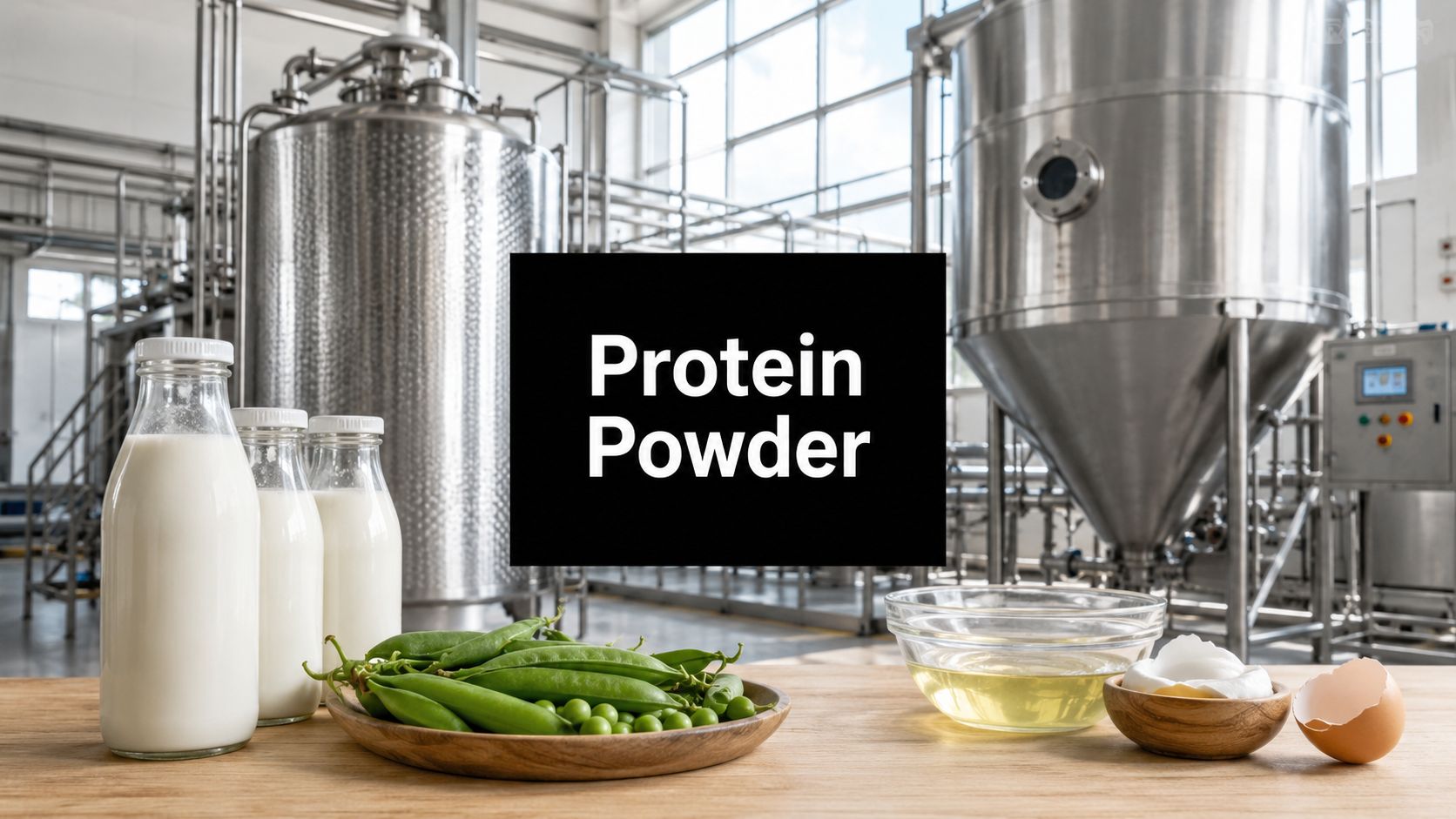
Protein powder is made by taking a protein-rich raw material, separating the protein from the parts you do not want as much of, concentrating it, and drying it into a shelf-stable powder. The starting material might be dairy or a plant crop, but the basic goal stays the same: keep more protein, remove more water and other components, then turn the result into a powder that stores well and mixes into food or drinks.
A useful way to picture it is as a refining process, more like making juice concentrate than grinding food into dust. Manufacturers usually do not just pulverize milk, peas, or rice and pour the result into a tub. They use filtering, washing, settling, or enzymatic steps to pull protein away from water, starch, fat, fiber, or lactose. After that, the concentrated protein is dried and blended.
That manufacturing method affects more than texture. It changes how much protein you get per scoop, how the powder behaves in a shaker bottle, and what companies may need to add later to improve taste, thickness, sweetness, or mixability.
That last part is easy to miss. The powder in the tub is often only part of the story. Many products also contain flavor systems, sweeteners, gums, anti-caking agents, oils, or extra vitamins and minerals. If you already track whole-food ingredients in a food database for meal planning, it helps to bring that same label-reading habit to supplements.
For a shopper, the key question is not merely how protein powder is made. It is how the production method shapes the final ingredient list. A more heavily processed powder may be lower in lactose or higher in protein, but it may also rely more on added flavors and texture agents to make it pleasant to drink. If you want to compare Australian protein powders, looking at both the protein type and the non-protein ingredients will give you a much clearer picture of what you are truly purchasing.
Where Does Protein Powder Actually Start?
Protein powder can begin in two very different places. One starts in a dairy system. The other starts in a field.

If you think of manufacturing like building a house, the starting material matters. Building with brick leads to different steps than building with wood. Protein powder works the same way. Milk behaves differently from peas, soy, rice, or hemp, so the production line has to change too.
Dairy powders start with milk
Dairy-based powders usually come from cow's milk. Milk contains two main protein families: casein and whey. In food manufacturing, those proteins can be separated and processed into different products.
Whey has a particularly important place in protein powder history. Colorado State University notes that whey protein powder comes from liquid whey, a byproduct of cheese making, which can then be processed into concentrate or isolate forms. That shift, from a liquid dairy stream to a standardized powder, is what helped protein supplements become practical for large-scale use.
A dairy powder doesn't begin as dry dust. It begins as a liquid system that has to be filtered, concentrated, and dried.
Plant powders start with harvested crops
Plant-based powders start much earlier in the food chain. The raw materials are crops such as peas, soy, rice, and hemp. Those ingredients contain protein, but they also contain starch, fiber, oils, and natural plant compounds.
That means the manufacturer has a separation problem to solve. The goal isn't to preserve the whole plant in its original form. The goal is to isolate or concentrate the protein portion.
A simple way to understand it:
- Milk is already a liquid mixture. The job is to split and refine its protein parts.
- Plants start as solid materials. The job is to mill them and separate protein from the rest of the seed or legume.
- Both routes aim for concentration. A scoopable powder needs more protein density and less moisture than the original ingredient.
Practical rule: The ingredient at the very top of the label usually tells you which manufacturing path the product took.
If you're planning meals around your preferred protein source, a searchable food database like AI Meal Planner's foods library can help you compare common options by type before you ever buy a tub.
How Is Whey Protein Manufactured?
Whey protein starts its life in a cheese vat, not in a supplement factory. When milk is turned into cheese, it separates into solid curds and a pale liquid called whey. That liquid still carries useful proteins, so manufacturers collect it and refine it into a concentrated ingredient that can later become powder.

It starts as liquid whey from cheese production
A common point of confusion is the difference between cheese, whey, and whey protein powder. Whey protein powder comes from the liquid portion left behind after curds form. Manufacturers are recovering and concentrating proteins from that liquid stream.
Before the protein is concentrated, the whey is handled like any other dairy ingredient. That usually includes food safety steps such as pasteurization and controlled storage, because the quality of the final powder depends heavily on how the liquid whey is handled at the start.
For a quick visual overview, this video shows the process in a very accessible way.
Filtration creates concentrate and isolate
The most important manufacturing step is filtration. It works like running a mixed liquid through finer and finer strainers. Small components such as some sugars and minerals can pass through more easily, while larger protein structures are retained and concentrated.
That is how whey splits into products with different levels of refinement. Whey concentrate keeps more of the original milk solids, while whey isolate goes through more processing to remove more lactose, fat, and other non-protein material. On a label, those terms tell you something real about the ingredient, not just the marketing.
A simple comparison helps:
| Type | What processing does | What that usually means for buyers |
|---|---|---|
| Whey concentrate | Removes part of the non-protein material | Often creamier, less processed, and usually contains more lactose than isolate |
| Whey isolate | Removes more fat, lactose, and other non-protein components | Usually leaner in protein-focused meal plans and often easier for people who want less lactose |
Microfiltration can sound highly technical, but the logic is simple. The manufacturer is narrowing the mixture so more of what remains is protein. The farther that refinement goes, the more the finished powder shifts from a general dairy ingredient toward a targeted protein ingredient.
That matters when you buy a tub. If your goal is calories and convenience, concentrate may fit well. If you want more protein per scoop with fewer extras from dairy, isolate may make more sense. If you're building shakes around higher-calorie training phases, a structured bulking meal plan can help you decide where each type fits.
Spray drying turns liquid into powder
After filtration, the whey is still a liquid. To make it stable, easy to ship, and easy to scoop, manufacturers remove most of the water. The standard method is spray drying, where the liquid is dispersed into tiny droplets and exposed to hot air so moisture leaves quickly and a dry powder remains.
This step changes the form more than the purpose. The protein is still the goal. Drying turns a perishable liquid dairy ingredient into something that can sit in a sealed tub on a shelf.
The same principle appears in other dried dairy products used in drinks and food manufacturing. If you've ever read about tips for consistent coffee taste, you've seen how drying changes storage, mixing behavior, and texture in a finished beverage.
The last stage is where the label can change a lot
Pure whey powder is rarely the full story. After drying, manufacturers often blend in cocoa, vanilla, sweeteners, gums, lecithin, salt, or thickeners to improve taste, texture, and mixability. Some products stay fairly simple. Others become more like flavored food formulations built around whey as the main ingredient.
That is why two whey powders can both say "whey protein" on the front yet behave very differently in your diet. One may be mostly whey with a short ingredient list. Another may include sweeteners, fillers, or texture agents that change calories, digestion, flavor, and how well the product fits your goals.
What Is the Process for Plant-Based Powders?
Plant protein doesn't begin as a ready-made liquid stream, so the first challenge is separation. The manufacturer has to get the protein out of a crop that also contains starch, fiber, and sometimes oil.

The first job is milling and separation
One source on manufacturing explains that protein powder production is usually a multi-step purification process. For plant proteins, ingredients such as peas or soy are first ground and then separated from starch and fiber using wet or dry fractionation methods, and for all types, spray drying is a key milestone that turns concentrated liquid protein into a stable powder by atomizing it into hot air. You can read that breakdown in this guide on how protein powder is made at Vivolife.
That description clears up a common misconception. Plant protein powder is not usually just powdered peas or powdered rice. It is a refined fraction of the original ingredient.
Dry fractionation and wet fractionation aren't the same
These two terms sound technical, but the core idea is simple.
Dry fractionation begins with milling the raw plant into a fine flour or meal. Then the manufacturer separates lighter and heavier components, trying to enrich the protein portion without turning everything into a liquid slurry.
Wet fractionation adds water and uses separation steps to pull protein away from starch and fiber more aggressively. The result is a protein-rich liquid or slurry that can then be concentrated further.
A side-by-side view makes this easier:
| Method | How it feels in plain language | Main goal |
|---|---|---|
| Dry fractionation | Sort the dry flour into richer and poorer protein portions | Increase protein concentration with less liquid processing |
| Wet fractionation | Wash and separate the protein from the rest using water | Create a more purified protein stream |
This is one reason plant powders can vary so much in texture and taste. Two pea proteins can come from the same crop but still behave differently in a shaker bottle depending on how far the manufacturer refined them.
Spray drying brings it to the finish line
Even for plant proteins, the endgame is often the same as whey. Once the protein is concentrated enough, manufacturers use spray drying to remove moisture and create a free-flowing powder.
That final drying step explains why the tub feels so uniform even though the starting ingredient was a whole food. You're holding the dried result of several separation and concentration steps, not merely a ground-up seed.
If you're building meals around vegan or dairy-free options, a structured plant-based meal plan can help you fit these powders into a full day of eating instead of treating them like a stand-alone fix.
What Else Is Added During Manufacturing?
For many shoppers, this is the part that matters most. The protein source tells you where the powder began. The ingredient panel tells you what ended up in the tub.

A 2024 review summarized by Healthline notes that many protein powders contain added sweeteners, flavors, thickeners, and vitamins, and that for many consumers, understanding these additives can matter more than the protein source itself, especially for people with allergies, glucose concerns, or digestive sensitivity. Healthline also notes that the ingredient panel can be more relevant than the protein type when choosing a powder for a specific meal plan or health goal. That discussion appears in this article on how protein powder is made and what may be added.
Why manufacturers add more than protein
Pure protein doesn't always taste good, mix well, or feel pleasant to drink. Manufacturers often add ingredients to fix those problems.
Common categories include:
- Flavorings help a plain protein base taste like vanilla, chocolate, or cookies-and-cream.
- Sweeteners make the product more enjoyable without relying only on sugar.
- Emulsifiers help the powder disperse better in liquid, reducing clumps.
- Thickeners change mouthfeel so the shake seems creamier rather than watery.
- Vitamins and minerals may be added to position a powder as more meal-like or more fortified.
A label can therefore describe two very different products that both look like "protein powder." One may be a short ingredient list with minimal extras. Another may be a highly flavored formulation with several functional additives.
What this means for your body and your goals
Additives aren't automatically good or bad. Their usefulness depends on what you're trying to do.
If you want a dessert-like shake after training, flavor systems and texture aids may improve compliance. If you have a sensitive stomach, those same additions may be the first place to investigate when a product doesn't sit well.
Label-reading shortcut: Look at the ingredient list immediately after the protein source. That's often where you see whether the product is relatively plain or heavily formulated.
A practical way to read the label:
- Identify the protein base. Whey isolate, whey concentrate, pea protein, soy protein, or a blend.
- Scan the next few ingredients. That's usually where sweeteners, gums, emulsifiers, and flavors show up.
- Match the formula to your goal. A simpler product may suit elimination-style eating better. A more flavored product may suit convenience and taste.
- Check for personal triggers. If you react poorly to certain additives, the ingredient panel matters more than the front label.
The hidden question isn't hidden at all
Most confusion comes from looking only at the tub's headline claim. "Plant protein" or "whey isolate" doesn't tell the full story. The rest of the formula can change sweetness, digestibility, texture, and how the powder fits into your day.
That's why shoppers often make better decisions when they stop asking only "What protein is this?" and start asking "What else came along with it?"
How to Use This Knowledge in Your Meal Plan
Knowing how protein powder is made helps you buy with more precision. It lets you connect the manufacturing process to what matters in daily eating: digestion, convenience, taste, and how well the product fits your goals.
Read the label in the right order
Start with the protein source. If the label says whey isolate, that signals a more filtered dairy product than whey concentrate. If it says pea or soy protein, you're looking at a plant-based manufacturing path.
Then move to the rest of the ingredient list. That's where you'll see whether the product is relatively straightforward or built into a flavored supplement formula with sweeteners, thickeners, and other additions.
A quick screening checklist works well:
- Match the source to your diet: Dairy-free, plant-based, or milk-based.
- Notice the form: Terms like isolate and concentrate tell you something about refinement.
- Scan for extras: Flavor systems, sweeteners, gums, and vitamin blends can affect tolerability and use case.
- Think about meal context: A shake used as a quick snack may need different features than one mixed into oats or smoothies.
Buy for the job, not the hype
A good protein powder for muscle gain might not be the best one for a simple breakfast smoothie. A heavily flavored formula may be convenient on busy workdays but less useful if you want to control every ingredient in your meals.
If your goal is clean, simple meal planning, choose a product with an ingredient panel you understand. If your goal is convenience and taste, a more blended product may still be a smart fit.
The best powder is the one that fits your eating pattern consistently, not the one with the loudest label.
If you're trying to estimate how much protein you need from food versus supplements, a protein intake calculator can help you set the target before you decide how often to use powder.
Frequently Asked Questions About Protein Powder
Does making protein powder damage the protein?
Manufacturing changes the form of the protein from raw ingredient to concentrated powder. The main goal is to separate, refine, and dry it into a stable product.
Why do some protein powders taste chalky?
Texture often reflects the source material and the degree of processing. Plant powders in particular can feel more earthy or gritty, and additives can either improve or worsen that mouthfeel.
Is whey isolate always better than whey concentrate?
Not always. Isolate is more filtered, while concentrate is less refined. Which one is better depends on your preferences, tolerance, and how you use it in meals.
Is plant protein powder just ground-up peas or rice?
Usually not. Manufacturers typically grind the plant first and then separate protein from starch and fiber before drying the concentrated material into powder.
Why do some powders mix smoothly and others clump?
Mixability often comes down to formulation. Emulsifiers and processing choices can make a powder disperse more easily in water or milk.
Should I focus more on the protein source or the ingredient panel?
Both matter, but the ingredient panel can be especially important if you have allergies, glucose concerns, or digestive sensitivity.
Are expensive protein powders always higher quality?
Price alone doesn't tell you much. Two products can have very different formulas, and the more useful comparison is source, processing style, and what else is included.
If you want help turning all of this into real meals, AI Meal Planner can build a personalized plan around your goals, dietary preferences, and protein needs without the usual spreadsheet work. It gives you structured meals, macros, and grocery lists so you can decide when protein powder helps and when regular food does the job better.
AI-powered nutrition
Get Your Personalized Meal Plan
AI creates the perfect meals for your goals, lifestyle, and taste.
Start Your Journej