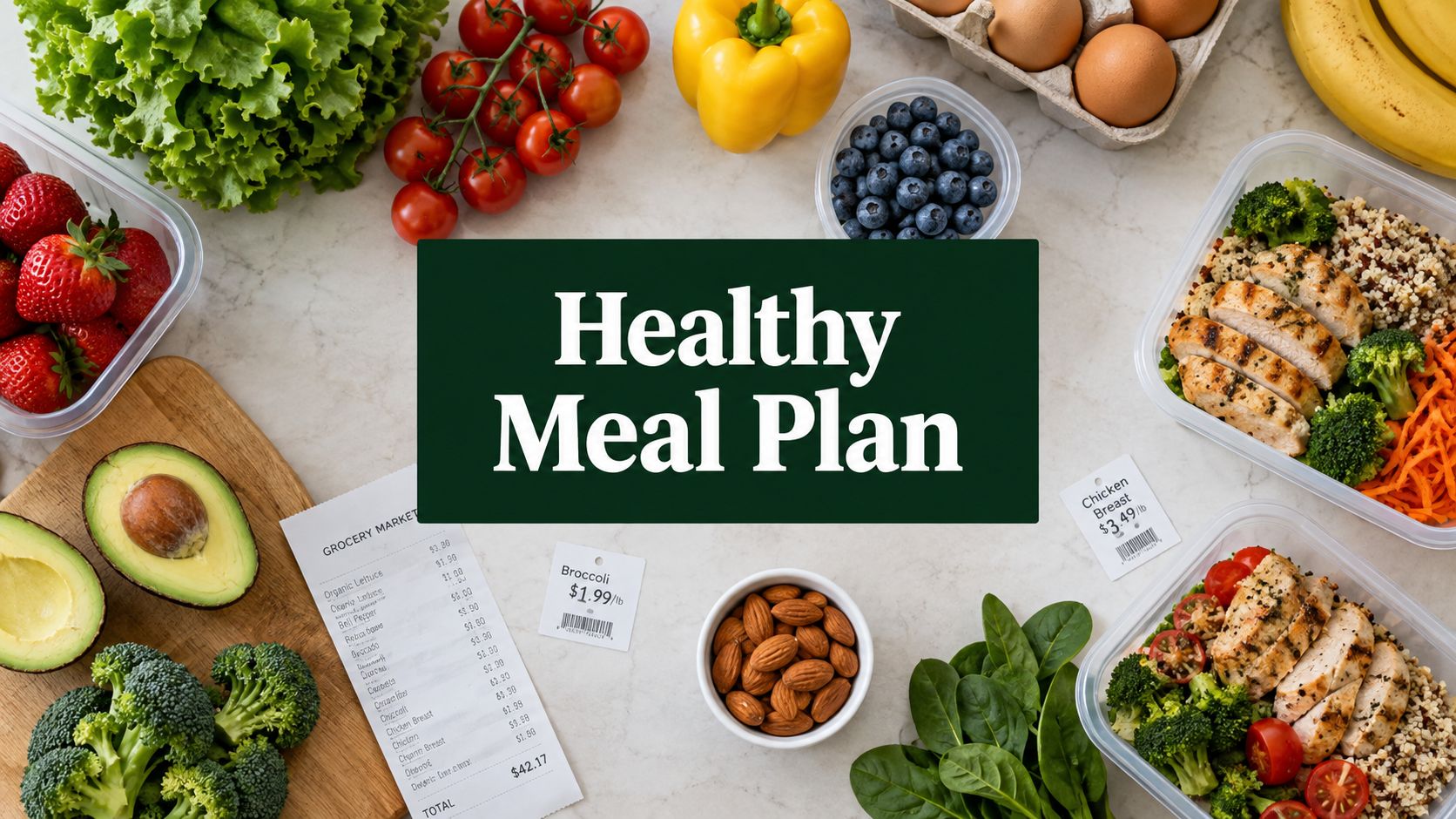
You're standing in the grocery aisle with a full cart, a vague promise to “eat healthier,” and no clear idea how those ingredients become meals. A cheap healthy meal plan works when you budget for food you'll eat, reuse ingredients across several dishes, and measure the cost of edible servings after spoilage.
For a realistic starting point, use a weekly grocery ceiling, build meals around affordable proteins, grains, legumes, eggs, and frozen vegetables, and plan leftovers before you shop. A structured plan can reduce grocery spending by 15% to 25% according to this meal-planning cost analysis, but the savings disappear when food sits unused in the fridge.
Healthy eating is also an affordability problem, not merely a matter of knowing which foods are nutritious. The Food and Agriculture Organization and World Bank report that the average healthy diet cost USD 3.54 per person per day in 2020, rising to USD 3.96 in 2022 and USD 4.28 in 2025, measured in purchasing-power-parity terms. Nearly 3.1 billion people couldn't afford a healthy diet in 2020, and about 2.7 billion still couldn't afford one in 2025, according to the FAO and World Bank healthy-diet affordability data.
The right question isn't “What has the lowest price tag?” It's “What gives me the lowest spoilage-adjusted cost per edible serving?”
Setting a Realistic Budget and Macro Target
“Eat cheap and healthy” is too vague to guide a Sunday shop. Before opening a grocery app, decide how many people you're feeding, which meals the budget covers, and what your body needs.
The USDA Food Plans provide a useful cost framework because they model diet costs by household composition and update prices monthly using CPI-U. For a reference family of four, the low-cost plan is about $236.50 per week or $1,024.90 per month. For a child aged six to eight, the comparable figure is about $60.70 per week or $262.80 per month. Those aren't universal grocery targets, but they show why household size matters.
Set four inputs before making the menu
Household size: Count adults, children, and anyone eating elsewhere regularly. A family that shares dinners but buys work lunches needs a different plan from a household eating every meal at home.
Meals covered: List breakfast, lunch, dinner, snacks, and planned leftovers. Don't buy seven lunches if several lunches will be eaten at work or school.
Calorie window: Use activity and appetite rather than an arbitrary target. A sedentary adult may fall around 1,800 to 2,000 calories per day, while an active adult may need 2,400 to 2,800 calories. Treat those as planning ranges, not medical prescriptions.
Protein and exclusions: An active adult may use a protein target near 1.6 grams per kilogram of bodyweight. Write down allergies, dietary restrictions, and two or three ingredients nobody will eat before choosing recipes.
| Household Type | Weekly Grocery Budget (USD) | Daily Calorie Target | Protein (g/day) | Protein Share of Calories |
|---|---|---|---|---|
| One sedentary adult | $40–$55 | 1,800–2,000 | Set from bodyweight and activity | About 30% |
| One active adult | $40–$55, adjusted upward if needed | 2,400–2,800 | About 1.6 g/kg | Higher than sedentary target |
| Family of four | $80–$110 as a starting ceiling, adjusted locally | Household-specific | Household-specific | Household-specific |
| Teen | $25–$30 as an individual starting allocation | Household-specific | Household-specific | Household-specific |
Use the grocery budget calculator to turn the weekly ceiling into a per-person figure. Then divide the weekly total by the number of meals covered. If one adult has a $50 weekly budget covering 21 main meals, the average ceiling is about $2.38 per meal. That number makes an expensive impulse purchase visible immediately.
Practical rule: Set the budget per person and per week, then check every recipe against the number of edible servings it produces.
Choosing the Planning Method That Actually Saves Money
The planning method matters less than whether it forces ingredient reuse. A beautiful spreadsheet that nobody opens on Saturday night is more expensive than a plain paper menu that gets followed.
Rank systems by spoilage-adjusted cost per edible serving, not by the sticker price of the groceries. A no-plan shop may capture an attractive sale, then lose money when fresh produce, herbs, or half-used packages are discarded. A paper template works better when every dinner shares at least one ingredient. A spreadsheet adds value when it tracks duplicates and substitutions. An AI tool helps when it turns nutrition targets into a practical list, but it can still fail if it recommends awkward bulk packages or single-use produce.
The specific waste rates and savings figures in the table below come from the planning notes for this comparison, not from the general affordability sources above.
| Planning Method | Average Fresh-Produce Waste | Spoilage-Adjusted Cost per Serving | Time to Build Weekly Plan | Best For |
|---|---|---|---|---|
| No plan | 25%–30% | Highest | Minimal upfront time | Spontaneous shoppers willing to accept waste |
| Paper or whiteboard template | About 15% | Lower when ingredients overlap | Short | Households that prefer visual planning |
| Linked-recipe spreadsheet | Near 10% | Low and easy to audit | Moderate | Detail-oriented shoppers and families |
| AI meal-planning tool | 6%–8% | Potentially lowest when package sizes fit | Short once preferences are entered | Busy households tracking macros and waste |
Use a decision rule you can follow
Choose the system you'll use when you're tired, hungry, and trying to finish the shop. A paper template beats an unused app. A spreadsheet beats memory when several people request substitutions. An AI system is useful when it produces meals, macros, and a grocery list without making you manually reconcile every ingredient.
Price-conscious households may also benefit from resources that focus on practical everyday pricing, such as Simply Hospitality's low-price alternative, especially when comparing routine purchases rather than chasing isolated bargains.
The winning method has one essential feature: it shows where each perishable ingredient gets used. If spinach appears in only one recipe, replace that recipe or give the spinach a second job.
Your Sunday Prep Rhythm in 90 Minutes
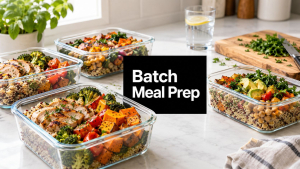
A cheap plan fails when Sunday prep becomes an all-day cooking project. Use a compact sequence with four cooked anchors and two raw assemblies, then finish meals during the week in short sessions.

Follow the clock instead of improvising
Minutes 0–15: Pull out the grocery bags, check the pantry, set out containers, and preheat the oven to 425°F. Put the most perishable foods where you'll see them first.
Minutes 15–35: Roast two sheet pans together. Put sweet potato cubes and chicken thighs on one, and chickpeas and cauliflower on the other. Use the same spice blend so one seasoning mix serves several meals.
Minutes 35–55: Start brown rice and lentils on the back burners. While they cook, shred a full head of cabbage. Reserve part for a cold slaw-style assembly and part for Thursday's stir-fry.
Minutes 55–80: Hard-boil two eggs, slice deli extras into stir-fry portions, and assemble two jarred grain bowls for Monday and Tuesday lunch. Layer dressing at the bottom so greens don't turn soggy.
Minutes 80–90: Label, stack, and clean the prep area. Labels should identify the meal and prep date, not just the ingredient.
For households packing snacks or sharing containers, InchBug snack labels offer a simple way to keep food assigned to the right person. That prevents the familiar problem of one family member opening several containers and leaving partial portions behind.
Wednesday is a deliberate reuse day. Turn Tuesday's roasted vegetables into a frittata, combine leftover roast and cabbage in a Thursday stir-fry, and remix the grain bowls on Friday. The sequence keeps cooked components from drifting beyond four days in the fridge.
The meal-prep recipe collection can supply additional combinations, but keep the same operating principle: cook versatile components, not seven unrelated recipes.
A short visual guide can reinforce the workflow:
Two Sample Weekly Menus With Costs and Macros
The most useful budget menu isn't a list of unrelated recipes. It's a chain. One anchor appears in several meals, leftovers become ingredients, and repeated dishes prevent a long list of partial packages.
The first example is for one adult aiming for roughly $50 per week, about 2,000 calories per day, and 130 grams of protein per day. The second is a family-of-four structure aiming for $160 per week. These figures are planning examples based on the requested bulk-priced menu assumptions, not universal store prices. Local prices, brands, portions, and dietary needs will change the totals.
Week one for one adult
Start with a whole chicken, a slow-cooker bean batch, roasted vegetables, brown rice, oats, eggs, cabbage, and fruit. Sunday dinner is roast chicken with sweet potatoes and cabbage. On Monday, shred the remaining chicken into tacos with beans and rice. Wednesday's chicken soup uses the carcass or remaining meat with lentils and cabbage. The same roasted vegetables appear in lunch bowls and Tuesday's omelet.
Breakfast rotates between overnight oats, eggs with roasted vegetables, and Greek yogurt with oats. Lunches are grain bowls, bean chili, and chicken soup. Dinner repeats are intentional, because repetition is what lets one package serve multiple meals.
Week two for a family of four
Use a larger whole chicken, a pot of beans, a sheet-pan vegetable roast, rice, oats, eggs, cabbage, onions, carrots, and frozen vegetables. Sunday roast becomes Monday fajita filling and Wednesday fried rice. The bean batch appears in chili, burrito bowls, and Friday stuffed potatoes. Thursday is a clean-out dinner using remaining vegetables, rice, and eggs.
A family menu should not pretend every person needs the same portion. Serve the same base meal, then adjust rice, protein, vegetables, or toppings for age and appetite. That keeps the grocery list unified while respecting different calorie needs.
The table shows the structure. It doesn't claim laboratory-level macro precision, because exact nutrition depends on brands, cooked weights, and portion sizes. Weigh portions if macro tracking is important.
| Day | Meal | Single Adult ($) | Family of Four ($) | Calories | Protein (g) | Carbs (g) | Fat (g) |
|---|---|---|---|---|---|---|---|
| Sunday | Roast chicken, sweet potatoes, cabbage | $3.25 | $11.00 | 650 | 42 | 62 | 24 |
| Monday | Chicken tacos, beans, rice | $2.40 | $9.00 | 620 | 39 | 78 | 16 |
| Tuesday | Bean chili with eggs | $2.10 | $8.00 | 590 | 34 | 70 | 18 |
| Wednesday | Chicken and lentil soup | $2.20 | $8.50 | 540 | 41 | 58 | 14 |
| Thursday | Vegetable frittata and roasted potatoes | $1.90 | $7.50 | 510 | 30 | 49 | 22 |
| Friday | Fried rice with chicken and cabbage | $2.35 | $9.50 | 640 | 38 | 76 | 18 |
| Saturday | Grain bowl leftovers with yogurt and fruit | $2.05 | $8.00 | 560 | 33 | 68 | 15 |
The single-adult plan averages about $2.32 per listed meal, while the family plan averages about $8.79 per family meal, or roughly $2.20 per serving. The advantage comes from using the same chicken, onions, cabbage, beans, and rice repeatedly rather than buying ingredients for seven separate menus.
Building the Grocery List Around Overlapping Ingredients
Build the grocery list from the menu backward. Don't start with a collection of cheap-looking foods and hope they form dinners.
Take the sample menu's whole chicken. It has at least three jobs: Sunday roast, Monday tacos, and Wednesday soup. One bag of onions works in chili, fajitas, and fried rice. Cabbage can become a raw side, soup ingredient, and stir-fry base. This is how a short list creates variety without creating spoilage.
Shop by aisle and assign every item a purpose
Produce: Buy onions, garlic, cabbage, carrots, sweet potatoes, and one flexible green. These ingredients tolerate several cooking methods and can cross from raw assemblies into cooked meals.
Dry goods: Choose rice, oats, lentils, and dried or canned beans. They provide the base for bowls, soups, chili, and breakfast without demanding delicate storage.
Dairy and eggs: Eggs can anchor breakfast, frittata, and fried rice. Plain Greek yogurt can serve as breakfast, sauce, or a topping instead of individual flavored cups.
Frozen: Frozen vegetables protect the budget when fresh produce would sit unused. Add them to fried rice, soup, or sheet-pan meals.
Pantry staples: Keep rice, oats, canned beans, frozen vegetables, eggs, garlic, onions, olive oil, and basic spices available. Canned tomatoes and broth expand the same ingredients into soups and chili.
Apply the two-meal rule
Before adding an item, write the meals that use it. If an ingredient appears once, replace the recipe, buy a smaller amount, or assign it to a clean-out meal. Package size matters as much as unit price. Research from Wageningen University describes meal planning models that balance cost, nutrition, perishability, environmental impact, and food waste, including the effect of retail package sizes in this household food-waste optimization research.
Use the grocery list generator to convert the final menu into an aisle-organized list, then check it against your pantry before buying anything.
Swapping the Plan for Vegan, Gluten-Free, and High-Protein Diets
Don't rebuild the entire menu when one dietary requirement changes. Replace one or two anchors per day and preserve the ingredient overlap that makes the plan affordable.

Vegan adjustments
Replace chicken and eggs with lentils, tofu, tempeh, and chickpeas. Use lentil chili, tofu fried rice, and chickpea grain bowls so the same legumes appear in several meals. Plant-based alternatives can cost more, so beans, lentils, and bulk tofu generally keep the plan closer to its original structure than relying on vegan meat analogues.
Gluten-free adjustments
Replace wheat pasta with rice noodles or rice, and use corn tortillas instead of flour tortillas. Choose tamari instead of standard soy sauce, and check packaged sauces for hidden gluten. The cheapest swap is usually a naturally gluten-free staple that already appears elsewhere in the menu, not a specialty replacement.
High-protein adjustments
Increase portions of chicken, eggs, and Greek yogurt, then add cottage cheese or whey-friendly oats where suitable. A protein shake can fill a snack gap, but extra beans, eggs, or yogurt may integrate more smoothly with the existing grocery list.
Individual Greek yogurt cups, gluten-free pasta, and vegan meat substitutes can inflate the bill. Buy larger containers where spoilage is manageable, use rice and potatoes as flexible bases, and choose legumes before premium substitutes.
For a ready-made vegan variation, the vegan meal-plan option can help map preferences into a reusable menu. Still check package sizes and serving counts before shopping.
Cutting Waste to Cut Your Real Food Bill
Coupons and sale prices matter only after you stop paying for food that never reaches a plate. In the United States, households account for about 39% of all food waste, and commonly cited estimates put the average family's loss from uneaten food at about $1,500 per year, or roughly $125 per month, according to this meal-planning and food-waste summary. Broader estimates place uneaten food at 30% to 40% of the U.S. food supply, so waste is a household issue and a national one.
Track your real cost for two weeks. Record what you paid, then separate food eaten from food discarded, including spoiled produce, forgotten leftovers, and trimming waste. The target is not the cheapest ingredient. It's the cheapest edible serving.
Four moves that work in ordinary kitchens
First in, first out: Move older containers to the front of the fridge and place new food behind them.
Leftovers night: Make Thursday a planned clean-out meal. Turn remaining chicken, rice, cabbage, and vegetables into bowls, soup, fried rice, or a frittata.
Freeze portions: Date single-serve containers of chili, soup, cooked grains, and extra protein before they become fridge clutter.
Save trimmings: Keep a freezer bag for suitable vegetable trimmings, then use the contents for stock when enough accumulates.
If a household reduces waste from 25% to 8%, the grocery bill can effectively fall by the same percentage without changing the shopping list. That comparison is arithmetic, not a promise of identical results for every household.
| Metric | Household A, 25% Waste | Household B, 8% Waste |
|---|---|---|
| Food purchased | 100% of grocery basket | 100% of grocery basket |
| Food eaten | 75% of purchased food | 92% of purchased food |
| Food discarded | 25% | 8% |
| Effective edible-food retention | Lower | Higher |
| Main intervention | Reactive use of leftovers | FIFO storage, freezing, and planned clean-out meals |
For more ideas on reducing kitchen waste, including sustainable coffee accessories for sustainability, focus on reusable storage and repeatable routines rather than buying more equipment.
The cheapest healthy meal plan is the one your household finishes. Track edible servings, reuse ingredients across meals, and adjust portions before adding more recipes.
AI Meal Planner creates personalized weekly menus and aisle-organized grocery lists around your goals, allergies, dietary preferences, calories, and macros. It also plans leftovers and ingredient reuse, helping you build a healthy meal plan with less spoilage and less spreadsheet work. Visit AI Meal Planner and create your next budget-conscious week before your next grocery trip.
AI-powered nutrition
Get Your Personalized Meal Plan
AI creates the perfect meals for your goals, lifestyle, and taste.
Start Your Journej