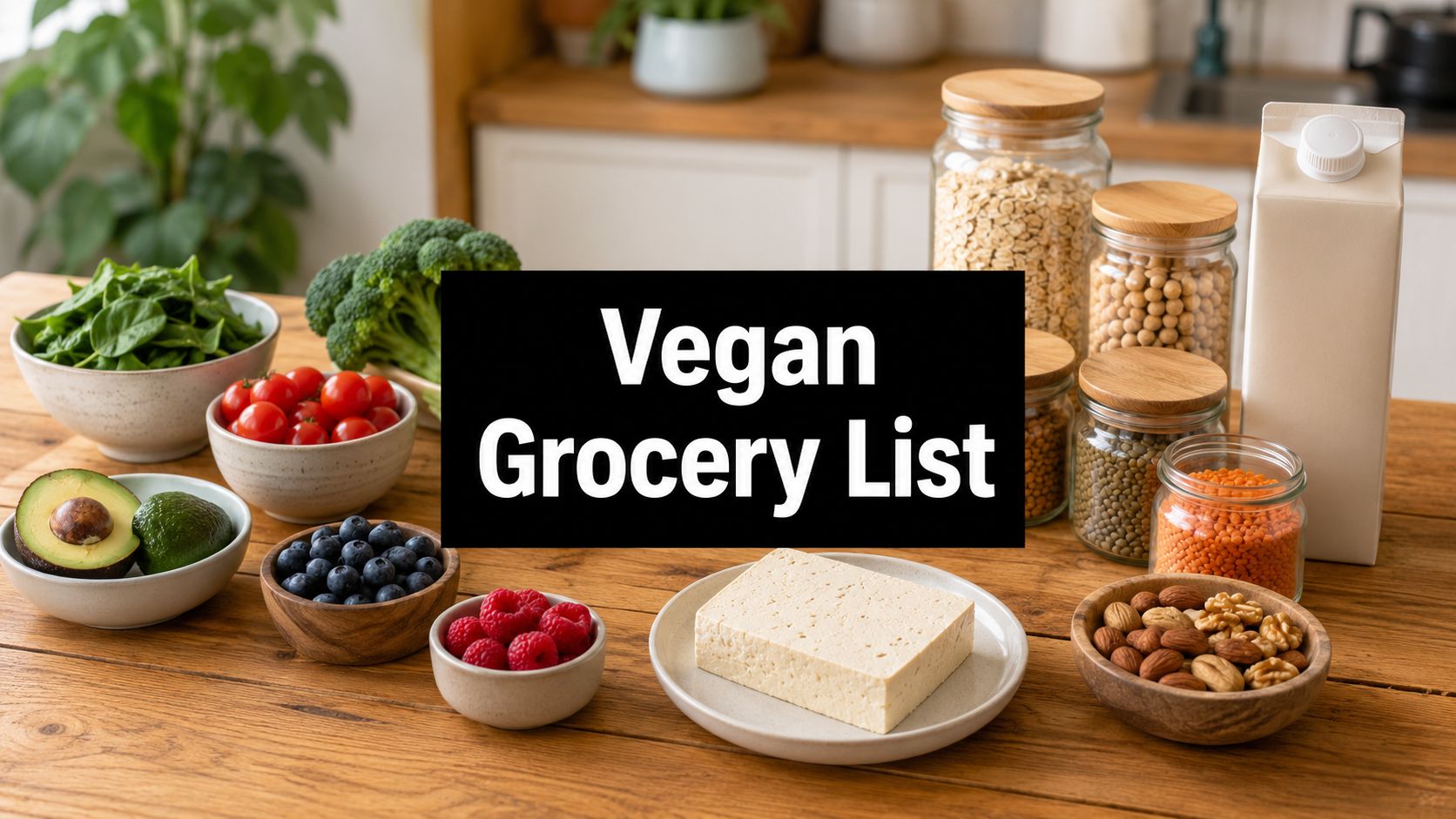
A practical grocery list for vegans starts with 10 core groups: legumes, whole grains, plant-based proteins, nuts and seeds, leafy greens, cruciferous vegetables, fortified plant-based milk, colorful vegetables, healthy fats, and pantry staples. Build each weekly list around those categories first, then add meals, quantities, and convenience items based on your schedule.
You're probably doing one of two things right now. You're either staring into the fridge trying to turn random produce, half a carton of oat milk, and one can of chickpeas into a week of meals, or you're opening a notes app before a grocery run and realizing your list has no structure.
That's why a good grocery list for vegans can't just be a long inventory of “allowed foods.” It needs to work like a meal-planning system. You need foods that cover protein, fiber, energy, micronutrients, and convenience, but you also need ingredients that overlap well enough to keep waste low and weeknight cooking realistic.
A lot of people also need this list to fit a budget. That matters more than ever because a third of shoppers in the UK are cutting down or eliminating animal products from their grocery lists, driven primarily by cost of living pressures rather than preference, according to The Vegan Society's statistics page. In practice, that means a smart vegan cart leans heavily on staples like frozen vegetables, canned beans, whole grains, tofu, and plant milks.
If you need help matching your list to a realistic weekly spend, this grocery budget action plan is a useful companion.
The list below is built for actual eating, not pantry perfection. It's organized by function, includes sample buying guidance, and shows what tends to work well for one person, a couple, or a family trying to eat more plant-based meals consistently.
1. Legumes (Beans, Lentils, Chickpeas)
If I had to cut a vegan grocery list down to one foundation, it would be legumes. Lentils, black beans, chickpeas, split peas, and white beans carry an enormous amount of the daily workload. They fit breakfast scrambles, lunch bowls, soups, stews, pasta, tacos, and snack prep.
No Meat Athlete's athlete grocery guide treats legumes such as lentils, chickpeas, and black beans as the primary protein source, and it also notes that dry beans are the cheaper alternative to canned versions in many routines built around staple foods like greens, grains, tofu, almond milk, and tahini in a vegetarian athlete grocery list. That's a useful real-world rule even if you're not training for anything.

Which legumes deserve a permanent spot
Black beans work best when you need fast texture and flavor in taco bowls, burritos, and chili. Chickpeas handle the most roles. Roast them for snacks, blend them into hummus, or fold them into curry and sheet-pan dinners. Lentils are the weeknight workhorse because they cook faster than most dried beans and fit soups, dal, bolognese, and warm salads.
Practical rule: Keep at least three forms on hand. One fast option, one bulk dry option, and one recipe-specific favorite.
What works and what doesn't
Canned beans work when time is tight. Dried beans work when you want lower cost, longer storage, and better batch prep. What usually doesn't work is buying only one type and trying to force it into every meal.
- For one person: 2 to 3 cans plus 1 bag of dried lentils usually covers a basic week.
- For two people: 4 to 6 cans or a mix of 2 dried bags and a few cans keeps lunches and dinners flexible.
- For families: Batch-cook larger pots and freeze in meal-size containers so burrito night, soup night, and pasta night don't all start from scratch.
For meal planning, I like assigning a role to each legume before shopping. One for bowls, one for soup, one for snacks, one for spreads. If your goal is protein-heavy meals, a high-protein vegan meal plan makes it easier to use the same base ingredients across multiple days.
2. Whole Grains (Quinoa, Brown Rice, Oats, Farro)
Whole grains give your list structure. Without them, meals feel incomplete and snacking tends to creep up because the plate never quite satisfies. Brown rice, quinoa, oats, barley, farro, and whole grain pasta all solve slightly different problems.
Some grains are for speed. Others are for meal prep. Oats handle breakfast better than almost any other staple because they can become hot cereal, overnight oats, baked oatmeal, or a smoothie booster without much planning.
How to choose grains that actually get used
Quinoa works well when you want a fast-cooking base for grain bowls and lunch containers. Brown rice is more neutral and better for stir-fries, curries, and burrito bowls. Farro has a chewy bite that holds up well in salads. Steel-cut oats are excellent if you like a less processed breakfast staple.
No Meat Athlete specifically highlights non-wheat grains such as quinoa and steel-cut oats as useful staples, with quinoa noted as technically a seed but nutritionally used as a grain in a balanced plant-based shopping routine. That's a practical reminder not to rely on one grain all the time.
Rotate grains by function, not by novelty. Keep one breakfast grain, one neutral dinner grain, and one grain that improves lunch leftovers.
Quantity guidance for a weekly list
A lot of waste comes from buying grains aspirationally instead of operationally. If no meal is assigned to the grain, it sits.
- For one person: 1 breakfast grain and 1 dinner grain is usually enough.
- For two people: 2 to 3 grain types works well if one is oats.
- For families: Cook a larger pot of one neutral grain and add one backup option for variety.
Rinse quinoa before cooking so it doesn't taste bitter. Cook extra rice while you're already in the kitchen. Refrigerated cooked grains save weeknights.
If digestive health and fullness are priorities, a high-fiber meal plan can help you pair grains with legumes and vegetables in a way that's easier to repeat.
3. Plant-Based Proteins (Tofu, Tempeh, Seitan)
Tofu, tempeh, and seitan solve a different problem than beans. They give you concentrated protein with a clearer center-of-plate role. That matters when you want meals to feel more complete or when you're feeding people who are used to building dinner around a defined main protein.

The broader vegan food category keeps expanding. Grand View Research projects the global vegan food market will grow from USD 22.14 billion in 2025 to USD 52.56 billion by 2033, with an 11.5% CAGR from 2026 to 2033 in its vegan food market outlook. In day-to-day shopping, that bigger market shows up as more tofu cuts, flavored tempeh, and ready-to-cook plant proteins in regular supermarkets.
Which one should you buy first
Extra-firm tofu is the most versatile starting point. Press it if you want crisp edges, cube it for stir-fries, crumble it for tacos, or blend silken tofu into sauces and dressings. Tempeh has a firmer texture and a nuttier flavor that works well in sandwiches, grain bowls, and skillet meals. Seitan is useful for chew and protein density, but it's less universal because it doesn't work for anyone avoiding gluten.
What doesn't work is buying pre-seasoned products you don't have a plan for. They often lock you into one flavor profile and one meal type.
Smart shopping and prep
- For one person: 2 blocks of tofu or 1 tofu plus 1 tempeh is a solid weekly base.
- For two people: 3 to 4 total protein packs supports lunches and dinners.
- For families: Buy plain versions and season at home so one batch can become different meals.
Buy plain tofu more often than flavored tofu. It gives you curry one night, stir-fry the next, and a sandwich filling after that.
This quick demo is useful if tofu texture is where your meals keep falling apart:
For people trying to center more meals around these foods, a plant-based meal plan can simplify how often to buy tofu, tempeh, and soy-based staples without overbuying.
4. Nuts and Seeds (Almonds, Chia, Flax, Pumpkin)
Nuts and seeds are where many vegan diets either become balanced or become strangely low in staying power. A meal with grains and vegetables but no meaningful fat source often looks healthy and eats poorly. Almonds, walnuts, chia seeds, ground flax, pumpkin seeds, hemp seeds, and nut butters help meals satisfy.
The mistake I see most often is treating nuts only as snacks. They're much more useful when they show up across the week in multiple forms. Chia turns into pudding. Flax disappears into oats and smoothies. Pumpkin seeds add crunch to bowls and soup. Tahini becomes a dressing, sauce, or quick savory finish.
How to stock them without overspending
Start with function, not variety. One snack nut, one omega-focused seed, one topping seed, and one spreadable fat usually covers the basics. For many people, that means almonds, ground flax, pumpkin seeds, and almond butter or peanut butter.
If your kitchen runs warm, refrigerate opened nut butters and delicate seeds. Flax and chia last better when stored airtight and away from light. Buying giant bags only makes sense if you use them weekly.
- For one person: 3 to 4 nut and seed products is usually enough.
- For two people: Add one extra option for variety, often a second nut butter or topping seed.
- For families: Keep one budget nut, one premium seed, and one practical butter kids will eat.
What works in real meals
Ground flax in oatmeal is one of the easiest daily habits to keep. Chia pudding works when breakfast has to be ready before you wake up. Pumpkin seeds are excellent on grain bowls because they add texture without more prep.
A vegan list gets better when one ingredient can serve two jobs. Pumpkin seeds can be a snack and a salad topper. Almond butter can be a smoothie ingredient and a toast spread.
5. Leafy Greens (Spinach, Kale, Arugula, Collards)
Leafy greens are the category people buy with the best intentions and waste most often. The fix isn't buying less produce. The fix is assigning each green a role before you shop.
Running on Real Food describes a complete vegan grocery list as covering eight core groups that include fresh or frozen fruits and vegetables, legumes and soy foods, herbs and spices, condiments, dairy alternatives, whole grains, and nutrient-dense packaged staples in its vegan grocery list guide. Leafy greens deserve a standing place inside that structure because they're one of the fastest ways to increase nutrient density without changing the rest of the meal much.

Which greens to buy for which jobs
Spinach is the easiest all-purpose choice. It works raw, wilted, blended, and folded into pasta or soup. Kale is stronger in texture and better for salads that need to last. Arugula gives quick flavor to sandwiches and bowls. Collards are better if you like cooked greens as a side dish.
If you keep buying giant tubs of mixed greens and throwing half away, switch to one tender green and one sturdy green. That usually solves the problem.
Practical quantity guidance
- For one person: 1 clamshell or bag of spinach plus 1 bunch or bag of kale is a practical week.
- For two people: Double that if lunches are salad-heavy.
- For families: Use more frozen spinach and chopped kale for cooked meals, and keep fresh greens for salads and wraps.
Massage kale with oil and lemon if you want it raw. Store washed greens with a paper towel to reduce moisture buildup. Frozen spinach is one of the smartest backup purchases in any grocery list for vegans because it prevents the all-too-common “I bought greens, then got busy” problem.
6. Cruciferous Vegetables (Broccoli, Cauliflower, Brussels Sprouts, Cabbage)
Cruciferous vegetables do a lot of heavy lifting in vegan meal planning because they add bulk, texture, and real dinner energy. Broccoli and cauliflower roast well, cabbage stretches meals, and Brussels sprouts can turn a simple grain-and-protein bowl into something much more satisfying.
This category also matters for budget shoppers. The Vegan Society data earlier points toward staple-driven plant-based shopping, and frozen broccoli, frozen green beans, and cabbage fit that pattern well because they're useful, filling, and less fragile than many tender vegetables.
Best uses by vegetable
Broccoli is the easiest place to start. Roast it, steam it, stir-fry it, or blend it into soup. Cauliflower is useful if you want variety in texture because it can be roasted, mashed, or chopped small into a rice-like base. Cabbage is one of the most underrated budget vegetables for vegans because it lasts well and works raw or cooked. Brussels sprouts are worth buying when you're willing to roast them properly.
- Broccoli: Best for sheet-pan meals and pasta add-ins
- Cauliflower: Best for curries, roasting, and blended soups
- Cabbage: Best for slaws, stir-fries, and sautéed sides
- Brussels sprouts: Best when halved, oiled, and roasted until well browned
What usually goes wrong
People often under-season cruciferous vegetables or crowd the pan, then decide they don't like them. Roast with enough space and enough heat. Cabbage also gets overlooked because it seems plain, but it's one of the best “stretch” ingredients when groceries need to cover more meals.
Roast broccoli and cauliflower until the edges brown. If they come out pale and damp, the pan was crowded or the oven wasn't hot enough.
For one person, two cruciferous vegetables per week is enough. For families, cabbage plus one frozen option usually gives the best mix of shelf life and convenience.
7. Fortified Plant-Based Milk (Soy, Oat, Almond)
Plant milk isn't just a coffee add-on. In vegan meal planning, it often fills a nutrition and convenience role at the same time. It goes into cereal, smoothies, sauces, soups, baking, overnight oats, and quick breakfasts.
The most useful rule here is simple. Buy fortified versions and check the label. Unsweetened fortified soy milk is usually the most practical all-purpose option because it works in both sweet and savory uses. Oat milk is popular for texture, especially in coffee, while almond milk works well if you want a lighter base for smoothies and baking.
Choosing the right milk for your week
Soy milk is the strongest everyday pick when you want more nutrition per carton. Oat milk tends to perform best in drinks and creamy applications. Almond milk is often the easiest flavor to blend into desserts and lighter breakfasts.
It is often unnecessary to have all three at once. One everyday carton and one “preference” carton is usually enough.
The hidden ingredient check that matters
This is one category where label reading matters more than people expect. Vegan shopping has an ingredient-verification problem that many beginner lists ignore. Vegan Anj's grocery list discussion highlights an “invisible ingredient trap” in mass-market products and points to the need to decode labels carefully when specialty options are less available in its vegan grocery list article.
That's especially relevant with fortified foods and convenience products. Check whether the fortification source and additives line up with your standards, and don't assume “plant-based” always means straightforward.
- For one person: 1 to 2 cartons is typical depending on smoothie and cereal use.
- For two people: 2 to 3 cartons disappears quickly if coffee and breakfasts both use it.
- For families: Buy shelf-stable backups so you don't run out midweek.
Shake fortified cartons before pouring because nutrients settle. Unsweetened options are easier to use across more recipes.
8. Colorful Vegetables (Bell Peppers, Carrots, Tomatoes, Zucchini)
This is the category that keeps meals from becoming beige, repetitive, and nutritionally narrow. Bell peppers, carrots, tomatoes, zucchini, eggplant, cucumbers, and seasonal produce make the rest of the list livable. You can eat rice, beans, tofu, and oats every week. You probably should not eat them with the exact same vegetables every day.
Colorful vegetables also help the meal-planning system work. If a list has one crunchy raw vegetable, one roasting vegetable, one sauce vegetable, and one snack vegetable, the week feels easier. Carrots and cucumbers handle snack duty. Peppers and zucchini are flexible for sautéing. Tomatoes become sauces, soups, salads, and sandwich layers.
Build this category by kitchen job
Think in terms of meal roles instead of produce aisle categories.
- Snack vegetables: carrots, cucumbers, mini peppers
- Cooked dinner vegetables: zucchini, bell peppers, mushrooms
- Sauce and soup vegetables: tomatoes, onions, carrots
- Lunch texture vegetables: cabbage, cucumber, radish, shredded carrot
Frozen vegetables also belong here. They're one of the best tools for reducing waste, especially if your schedule changes often.
Sample quantity guidance
For one person, four to five colorful vegetables is enough if one or two are frozen. For two people, aim for enough variety to cover salads, cooked meals, and snack boxes. For families, prioritize overlap. Bell peppers can go in fajitas, pasta, lunch boxes, and sheet-pan dinners.
What tends not to work is buying a big range of highly perishable vegetables with no clear meal assignment. What does work is repeating a few versatile ones often and rotating one seasonal extra for interest.
9. Healthy Fats and Oils (Olive, Coconut, Tahini)
Healthy fats make vegan food taste finished. They also help with fullness and with turning vegetables and grains into meals people want to eat more than once.
Olive oil is the best default for dressings, finishing, and much everyday cooking. Tahini is one of the most useful ingredients in a vegan kitchen because it behaves like both a fat and a sauce base. Coconut oil has a place, especially where you want a firmer fat or a distinct flavor, but it shouldn't be your only option.
The short list that covers most kitchens
You don't need an entire shelf of specialty oils. For most households, extra virgin olive oil, tahini, and one neutral or high-heat option cover the basics. If you like nutty finishes, walnut oil can be a nice cold-use extra, but it's not essential.
- Extra virgin olive oil: dressings, roasting, drizzling
- Tahini: sauces, dressings, smoothies, grain bowl finish
- Coconut oil or another cooking fat: baking or specific texture needs
The cost trade-off most lists skip
Budget vegan advice often says rice and beans are cheap, which is true. The complication is the convenience tier. GenV's vegan budget discussion points to a cost paradox where processed plant-based meats and cheeses can run above whole-food staples and make weekly planning harder when convenience foods take over in its vegan on a budget guide.
That's why I prefer using fats and sauces to make staple foods feel better, instead of relying on expensive processed replacements to carry flavor. A bowl of lentils, rice, roasted broccoli, and tahini dressing usually stretches the budget far better than building the week around premium meat analogs.
If your vegan meals taste flat, the problem is often sauce, acid, salt, or fat. It usually isn't the grain or bean itself.
10. Pantry Staples for Quick Meals (Pasta, Canned Tomatoes, Broth, Vinegars)
This category determines whether your vegan grocery list works on your busiest day. Fresh produce and proteins matter, but pantry staples are what keep dinner from becoming delivery when the day runs long.
Canned tomatoes, broth, pasta, coconut milk, tomato paste, vinegars, soy sauce, mustard, salsa, and basic spices create meals fast. They also help tie leftovers together. Roasted vegetables can become pasta. Beans can become soup. Tofu can become a stir-fry if the pantry already has sauces and grains.
What to keep stocked at all times
A good pantry doesn't need to be huge. It needs to remove friction. Whole grain pasta, canned tomatoes, broth, garlic, onions, a few vinegars, and a couple of reliable condiments are enough to build a lot of dinners.
In the U.S., plant-based shopping is also no longer limited to fully vegan households. GFI reports that in 2025, 60% of U.S. households purchased plant-based foods, 78% of those households were repeat purchasers, and 96% of households that bought plant-based meat also bought conventional meat, according to its plant-based market research. That mixed-shopping reality is one reason pantry-based vegan meals matter so much. They need to fit normal households, shared kitchens, and practical weeknights.
How pantry staples support the whole week
- Pasta night: whole grain pasta, canned tomatoes, garlic, greens
- Soup night: broth, beans, frozen vegetables, herbs
- Bowl night: grain, canned beans, tahini, vinegar, roasted vegetables
- Emergency dinner: pasta plus olive oil, chili flakes, chickpeas, spinach
A strong pantry is what turns a grocery list from a shopping document into an actual eating system. If you want meal ideas that match pantry staples to produce and proteins already in the house, this collection of vegan-friendly recipes is a practical place to start.
10-Item Vegan Grocery Comparison
| Item | 🔄 Implementation Complexity | 📦 Resource Requirements | ⭐ Expected Outcomes | ⚡ Ideal Use Cases | 📊 Key Advantages |
|---|---|---|---|---|---|
| Legumes (Beans, Lentils, Chickpeas) | Low–Medium (canned ready; dried require soaking/cooking) | Very low cost; long pantry life (dried); minimal equipment | High protein & fiber; stable blood sugar; mineral-dense | Batch cooking, soups, dips, burritos; budget meal prep | Affordable, versatile, long shelf life, complements grains |
| Whole Grains (Quinoa, Brown Rice, Oats, Farro) | Low–Medium (longer cook times; bulk cooking) | Low cost; pantry storage; stovetop or rice cooker | Sustained energy, fiber, B‑vitamins | Base for bowls, breakfasts, bulk meal prep | Satiety, micronutrient variety, pairs with legumes |
| Plant-Based Proteins (Tofu, Tempeh, Seitan) | Medium (pressing, marinating, quick cook) | Moderate cost; refrigeration/freezing; basic prep tools | Complete amino acids; high protein per serving | Quick mains, muscle-focused meal-prep, varied cuisines | Complete proteins, texture variety, quick-cooking options |
| Nuts and Seeds (Almonds, Chia, Flax, Pumpkin) | Low (ready-to-eat; optional soaking/toasting) | Higher cost per calorie; cool, airtight storage recommended | Calorie-dense fats, moderate protein; micronutrient-rich | Snacks, toppings, smoothies, energy-dense meals | Portable, nutrient-dense, supports satiety and heart health |
| Leafy Greens (Spinach, Kale, Arugula, Collards) | Low (washing, short prep; perishable) | Very low cost; short refrigerated life or freezing for some | Very high micronutrient density; low calories | Salads, smoothies, side dishes for volume and micronutrients | High nutrient-to-calorie ratio; supports weight management |
| Cruciferous Vegetables (Broccoli, Cauliflower, Brussels Sprouts, Cabbage) | Low–Medium (chop, roast/steam; can freeze) | Low cost; perishable but freezable | Sulforaphane and fiber; vitamin C and K benefits | Roasts, riced alternatives, meal-prep sides | Chemopreventive phytonutrients; filling and budget-friendly |
| Fortified Plant-Based Milk (Soy, Oat, Almond) | Very Low (ready-to-drink; refrigerate after opening) | Moderate cost; shelf-stable unopened; choose fortified brands | Provides calcium, vitamin D, B12; supports bone health | Smoothies, cereals, cooking, dairy replacement | Micronutrient fortification; dairy-free option; varying protein levels |
| Colorful Vegetables (Bell Peppers, Carrots, Tomatoes, Zucchini) | Low (wash/chop; seasonality affects prep) | Low–moderate cost; perishable or frozen alternatives | Diverse phytonutrients (lycopene, beta‑carotene); vitamin C | Stir-fries, roasting, salads; visual/float variety in meals | Enhances nutrient diversity, palatability, and meal appeal |
| Healthy Fats and Oils (Olive, Coconut, Tahini) | Low (measure and apply; match oil to heat) | Moderate cost; store cool/dark to prevent rancidity | Essential fatty acids; improved nutrient absorption; satiety | Dressings, sautés, high-heat cooking (oil-dependent) | Supports fat-soluble vitamin uptake; improves flavor and satiety |
| Pantry Staples (Pasta, Canned Tomatoes, Broth, Vinegars) | Very Low (shelf-stable, quick assembly) | Low cost; long shelf life; organized pantry optimizes use | Fast, consistent meals; reduces reliance on takeout | Weeknight dinners, emergency meal prep, minimal‑fresh recipes | Convenience, affordability, reduces waste and time-to-meal |
Final Thoughts
A useful grocery list for vegans isn't a giant catalog. It's a repeatable structure. When the list is organized by function, shopping gets faster, meals get easier, and you stop ending every week with three unrelated leftovers and nothing that feels like dinner.
The strongest vegan lists usually follow a simple rhythm. Pick a few proteins you'll really use. Add grains that match your breakfast and dinner habits. Choose vegetables based on role, not just color or good intentions. Keep fats and pantry staples in place so the same ingredients can turn into bowls, soups, pasta, wraps, salads, and quick breakfasts.
That functional approach matters even more now because plant-based shopping has become mainstream in a broader, more mixed way. Some households are fully vegan. Many aren't. Some people buy tofu, beans, and oat milk alongside conventional products. Others want mostly whole-food staples because they're more affordable and more dependable than heavily processed substitutes. A grocery list that supports those realities works better than a list built around idealized eating.
If you're planning for one person, simplicity wins. Keep one legume, one tofu-style protein, one breakfast grain, one dinner grain, two greens or green-adjacent vegetables, a few colorful vegetables, one fortified milk, and a short pantry backup list. If you're planning for two people or a family, scale by meals, not just by appetite. It's better to double ingredients that cross over into multiple dishes than to buy a larger number of unique items that only fit one recipe.
The other big shift is to stop treating the grocery list as separate from the meal plan. They should be the same system. A strong list answers practical questions before you leave the store. Which protein is for lunch versus dinner? Which greens need to be eaten first? Which vegetables are raw, roasted, or frozen backup options? Which pantry items can rescue the week if your schedule gets messy?
That's also where many people save money without feeling restricted. Whole-food staples usually do more work per purchase than convenience products. Beans become bowls, soups, dips, and wraps. Oats become breakfast and snacks. Tofu becomes stir-fry, sandwiches, and rice bowls. Tahini becomes dressing, sauce, and flavor insurance. When ingredients carry multiple jobs, your grocery list becomes tighter and your food waste drops.
A final point that's easy to overlook. Label reading matters more than many beginner lists admit. As more mass-market products use plant-based branding, ingredient lists can get less intuitive. If a product matters to you ethically or nutritionally, check it. Don't outsource that judgment to front-of-package language.
For people who want that grocery-list-to-meal-plan connection built in, AI Meal Planner is one relevant option. It creates personalized meal plans and sorted grocery lists based on dietary preferences, including vegan eating, which can make weekly planning more structured and reduce guesswork.
If you want a vegan grocery list that turns directly into a weekly menu, AI Meal Planner can help you build one based on your preferences, schedule, and nutrition goals.
AI-powered nutrition
Get Your Personalized Meal Plan
AI creates the perfect meals for your goals, lifestyle, and taste.
Start Your Journej