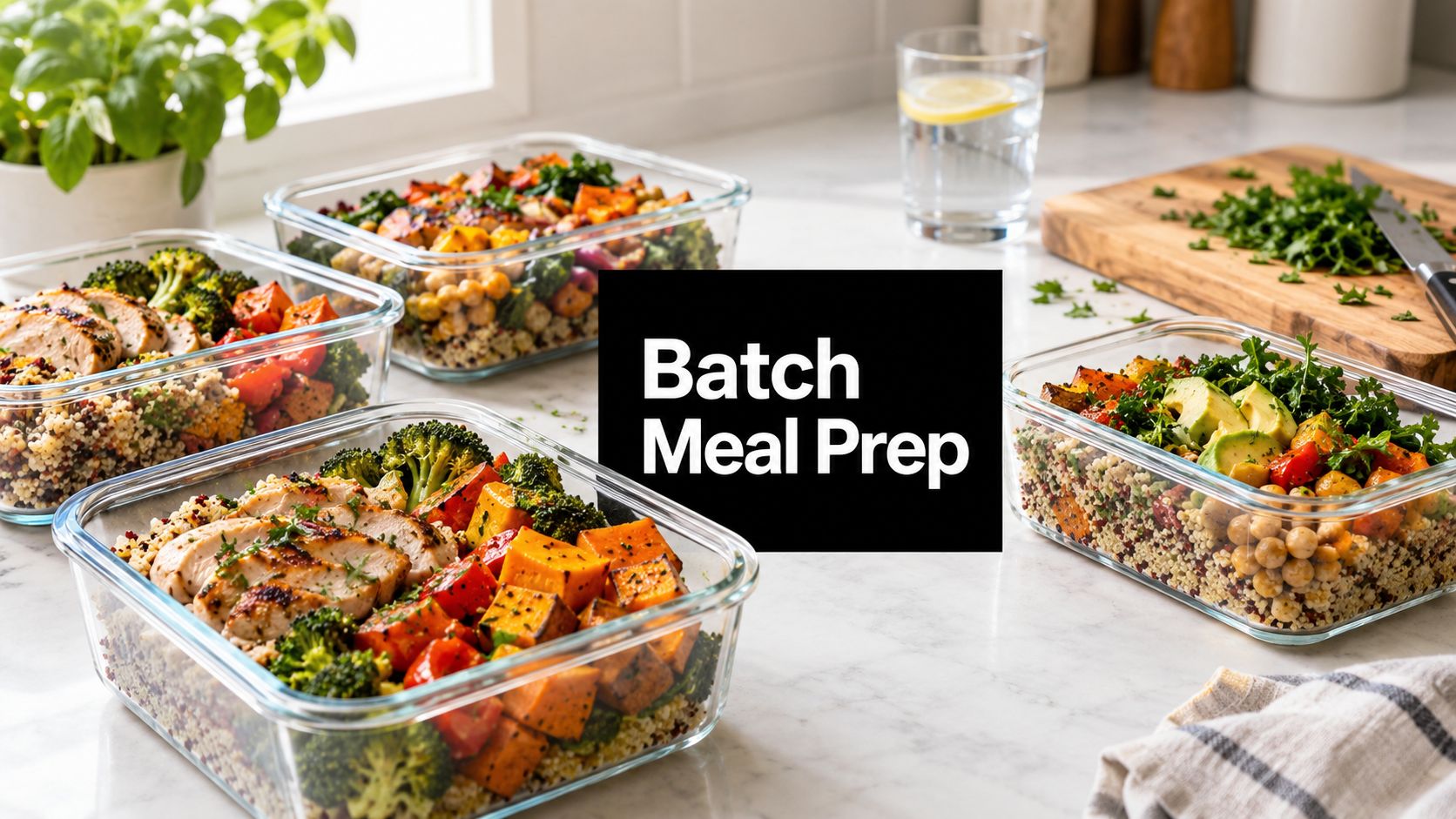
You've bought groceries with good intentions, but by Wednesday you're tired, hungry, and deciding between takeout and another rushed meal. Batch cooking meal prep solves that problem when you treat it as a repeatable workflow, not a Sunday ritual built around cooking one enormous recipe.
How Do You Start a Batch Cooking Meal Prep Routine
Start by planning meals around your schedule, batch-cooking durable components, portioning them into suitable containers, cooling them quickly, and reheating only what you'll eat. Cooked leftovers generally belong in the refrigerator for 3 to 4 days, and reheated food should reach 165°F/74°C throughout according to food-safety guidance for batch cooking.
By Wednesday evening, the problem usually isn't a lack of recipes. It's decision fatigue. You've finished work, the kitchen is still messy from breakfast, and the easiest option looks like ordering food. A well-designed batch cooking meal prep routine removes that daily negotiation before hunger makes the decision for you.
The broader case is practical. The Food Waste Index Report 2024 estimates that the world wasted 1.05 billion tonnes of food in 2022, households waste at least one billion meals every day, and each person wastes 79 kg of food annually. Planning overlapping ingredients and cooking them deliberately gives food a better chance of being eaten before it spoils.
The method I use is simple:
- Map the week. Mark late workdays, training sessions, travel, social meals, and evenings when you can cook. Don't prep meals for nights when you already know you'll eat elsewhere.
- Choose components before recipes. Pick a protein, a carbohydrate, vegetables, and two flavor profiles. This gives you variety without requiring a separate dish for every day.
- Shop from the plan. A grocery list generator for meal prep can turn planned batch-cooked meals and serving quantities into a more organized list.
- Cook in parallel. Use the oven, stovetop, and chopping board at the same time instead of completing one recipe from start to finish.
- Portion with purpose. Weigh food if you're tracking macros, keep sauces separate when texture matters, and label anything you won't eat soon.
- Build in flexibility. Keep at least one unassembled protein, grain, or vegetable component so an unexpected dinner out doesn't leave a sealed stack of unwanted meals.
Families who batch cook report saving an average of 10 hours per week on meal preparation and cutting grocery spending by 20% to 30%, while meal prepping has been reported to reduce household food waste by 47% compared with daily cooking in the cited summary from FoodSight. Those figures aren't a promise for every household, but they explain why the workflow has practical value beyond convenience.
The best system also supports your nutrition target. For muscle gain, increase the planned protein component. For weight loss, portion calorie-dense ingredients deliberately rather than relying on visual estimates. For general health, use the structure to make vegetables and satisfying meals easier to reach than snacks or delivery food.
Which Recipes Actually Survive the Fridge
A recipe earns a place in batch cooking meal prep when it remains safe, appealing, and adaptable after storage. Those standards are different. A meal can be perfectly safe yet unpleasant because the greens have wilted, the coating has gone soft, or the sauce has split.

Choose foods with structural staying power
Braised meats, bean stews, curries, chili, roasted root vegetables, and hearty grains usually handle refrigeration well. Moist cooking methods protect lean proteins from drying out, while dense vegetables retain their shape better than delicate leaves. Rice, barley, quinoa, and similar grains can serve as neutral bases for several meals, provided they're cooled and stored safely.
Roasted vegetables work best when you avoid crowding the tray. Excess moisture creates steaming, which produces soft vegetables before storage even begins. Root vegetables, broccoli, cauliflower, peppers, and onions usually tolerate reheating better than fragile greens.
| Prep-friendly choice | Why it holds up | Best finishing touch |
|---|---|---|
| Braised chicken or beef | Moisture protects texture | Fresh herbs or citrus |
| Lentil or bean stew | Flavors settle and combine | Yogurt, herbs, or pickles |
| Roasted root vegetables | Dense flesh resists collapse | Add a crisp topping at serving |
| Cooked grains | Neutral base for multiple meals | Sauce or dressing added later |
| Tender greens | Lose firmness quickly | Add raw or sauté fresh |
Keep fragile elements out of the container
Crispy coatings, dressed lettuce, cut avocado, toasted nuts, and thin emulsified sauces are poor candidates for full assembly. Store them separately, or prepare them close to serving time. A grain bowl can be batch-friendly if the grain, protein, and roasted vegetables share a container while dressing, herbs, and crunchy toppings stay apart.
This is also where many attractive social-media meal-prep ideas fail. Five identical containers look efficient, but they can create five identical texture problems. A better arrangement uses one or two cooked bases and changes the final assembly with salsa, curry sauce, lemon dressing, fresh cabbage, or herbs.
Scale recipes without flattening the flavor
Doubling a recipe usually works better than multiplying every seasoning mechanically. Salt, acid, chili, and strong dried spices can become unbalanced when scaled without tasting. Scale the main ingredients first, then adjust seasoning near the end after the liquid has reduced.
Adapt family favorites by separating components. Turn taco night into seasoned meat, cooked rice, beans, and fresh toppings. Convert a pasta bake into sauce, protein, and pasta stored separately if the noodles become soft in your refrigerator. The meal-prep recipe collection is useful for finding dishes designed around storage rather than merely shrinking a dinner recipe into containers.
Texture rule: Cook the parts that improve with time, and add the parts that depend on freshness just before eating.
How to Sequence a Three Hour Cook Day
A three-hour cook day works when you assign every appliance a job. The oven should roast while the stove simmers, and your hands should handle chopping, mixing, labeling, or washing during passive cooking time.

Start with a kitchen reset
Before turning on the heat, clear the counters, check containers, sharpen your knife, and pull out the ingredients. Group vegetables together, place proteins near the cutting board, and set out labels. This small reset prevents the common mistake of starting to cook and then discovering you're missing a lid, tray, or key ingredient.
Sort the grocery list by store area rather than recipe. Produce, proteins, grains, canned goods, dairy, and pantry items make shopping faster and reduce duplicate purchases. The plan should also show which ingredients appear in multiple meals, such as spinach used in breakfast and dinner or rice used in bowls and fried rice.
Use the three-hour sequence
| Time | Main task | What happens in parallel |
|---|---|---|
| 0:00–0:30 | Prep and chop | Wash vegetables, chop produce, and marinate proteins |
| 0:30–1:15 | Oven and grains | Roast vegetables and cook hearty grains |
| 1:15–2:15 | Braise and simmer | Cook stews, sauces, or braised proteins |
| 2:15–2:45 | Assemble | Portion meals and separate toppings |
| 2:45–3:00 | Clean and cool | Wash equipment and begin safe cooling |
At the start, preheat the oven, start the grain, and prepare the protein marinade. While vegetables roast, chop ingredients for the pot. Once the stew or braise begins simmering, use that quieter period to wash the cutting board, prepare sauces, and set containers on the counter.
Don't leave assembly until the last minute without a plan. Arrange containers in a row, place the carbohydrate in each first, then the protein and vegetables, and keep wet sauces separate when needed. If you're tracking macros, this is the point where a scale saves repeated guessing.
A clean-as-you-go approach matters because a crowded sink slows the final portioning stage. Wash the knife and board after raw protein, wipe spills immediately, and reserve one clear area for cooled food. Begin cooling as soon as cooking finishes rather than allowing the full batch to sit in a hot pot.
This video can help you visualize the movement between prep, cooking, assembly, and cleanup:
What Are the Rules for Safe Food Storage
Food safety determines whether batch cooking is useful or risky. Large volumes cool slowly, especially in deep pots, and the center can remain warm while the surface feels ready for refrigeration.

Cool quickly instead of waiting on the counter
The safe cooling sequence is specific. Cool cooked food from 140°F to 70°F within 2 hours, then from 70°F to 40°F within the next 4 hours, using meal-prep food-safety guidance. Refrigerate food within 2 hours, and don't leave a finished batch out overnight.
Use shallow containers no deeper than 2 inches when possible. Divide soup, rice, stew, and cooked meat into smaller portions rather than placing a deep, steaming pot directly into the refrigerator. Shallow containers expose more surface area, allowing heat to escape faster.
Cooling is part of cooking. Portioning hot food into shallow containers isn't extra organization, it's the step that makes storage safer.
Store for the short window
Cooked leftovers kept at or below 40°F/4°C generally have a refrigerated storage window of 3 to 4 days, according to USDA food-safety research guidance. Put the earliest meals at the front of the refrigerator and label containers with the preparation date.
Freeze portions that won't fit inside that window. Freezing immediately is more sensible than hoping you'll feel like eating the same dish later in the week. Use leak-resistant containers or freezer bags, leave room for expansion, and record the contents on the label.
Keep raw proteins below ready-to-eat food, use clean utensils for cooked food, and avoid repeatedly opening every container while deciding what to eat. A consistent refrigerator layout reduces spills and cross-contamination.
Reheat the entire portion
Microwaves can leave cold centers, so stir food where possible, rotate the container, and check the thickest portion. Reheat leftovers to 165°F/74°C throughout before eating, as outlined in the batch-cooking food-safety review.
The common failure isn't always the recipe. It's leaving food warm too long, cooling a deep container slowly, or heating only the surface. Treat timing, container depth, and internal temperature as part of the recipe itself.
How to Portion and Reheat for Macro Tracking
A batch can be nutritionally consistent only when the portions are consistent. I've found that estimating by sight works for rough eating, but it breaks down when the goal is to repeat a protein target or manage calorie intake across the week.
Cook the full recipe, then weigh the finished components separately when practical. If the cooked protein is divided into equal portions by weight, each container gets a more reliable share than if you scoop until the containers look similar. The same applies to rice, pasta, potatoes, oils, nuts, and sauces, which can shift the meal's energy density quickly.
For a muscle-focused plan, portion the protein first, then add the carbohydrate and vegetables around it. For weight loss, use the scale to keep calorie-dense additions visible rather than eliminating them automatically. For a family meal, consistent containers also make it easier to adjust one person's serving without changing the entire recipe.
The recipe nutrition calculator can help estimate nutrition for a recipe before you divide it, but the result is only as useful as the ingredient quantities and serving assumptions you enter. Weighing ingredients during cooking and recording substitutions keeps the estimate closer to the meal you consume.
Reheat according to texture
Lean chicken often needs moisture. Add a small splash of water or broth, cover it loosely, and heat in stages. Rice also benefits from a little moisture and a covered container, while roasted vegetables usually reheat better uncovered so they don't become soggy.
A stovetop skillet works well for grains, stews, and stir-fries. Add a little liquid, cover briefly, then uncover near the end. The oven is useful for larger portions and foods that benefit from dry heat, such as roasted potatoes or casseroles.
| Food Type | Best Method | Pro Tip |
|---|---|---|
| Braised meat | Covered microwave or stovetop | Add broth before heating |
| Rice and grains | Covered microwave | Add a splash of water and stir |
| Roasted vegetables | Oven or air fryer | Reheat uncovered for better texture |
| Stews and chili | Stovetop or microwave | Stir from the center outward |
| Lean chicken | Covered microwave | Use broth and avoid overheating |
| Crispy toppings | Oven or air fryer | Store separately until serving |
Container shape matters too. Wide, shallow containers heat more evenly than tightly packed deep ones. If you're choosing containers for portion consistency, this guide to choosing portion control sizes from Monopack ltd. provides a useful reference for matching container capacity to your serving system.
Don't confuse precise portions with joyless eating. Keep sauces, herbs, pickles, and crunchy toppings separate so the same base can become a different meal. A neutral chicken and grain container can take on a Mediterranean profile with lemon and herbs, or a spicy profile with salsa and cabbage.
Why Do People Quit Meal Prep and How to Fix It
Many people don't quit because cooking is impossible. They quit because the system demands too much repetition, assumes every weekday will go according to plan, or turns one missed meal into a refrigerator full of waste.
Replace identical meals with modular prep
Full meal prep means assembling every serving in advance. Ingredient prep means cooking components and deciding the final combination later. The second approach usually creates more flexibility.
Cook a neutral protein, a grain, and two vegetables. Store three sauces or finishing combinations separately, such as tomato-based sauce, yogurt and herbs, and a spicy dressing. That gives you different meals without requiring three separate cooking projects.
Palate fatigue often comes from repeating flavor, not repeating ingredients. The same roasted chicken can work in a bowl, wrap, salad, or soup when the texture and seasoning change at assembly.
Design around the week you actually have
Rigid schedules cause trouble when work runs late, plans change, or you eat out unexpectedly. Reserve some portions in the freezer, keep one meal unassembled, and plan a flexible use-up meal near the end of the refrigerator window.
A simple variable-schedule system might look like this:
- Predictable nights: Use fully portioned meals that only need reheating.
- Late nights: Keep a frozen portion or a quick component meal available.
- Social evenings: Don't pre-assemble food you're unlikely to eat.
- End-of-week meals: Turn remaining grains, vegetables, and protein into soup, fried rice, tacos, or a salad.
- Low-energy weeks: Use a lighter lazy girl meal plan structure with fewer cooked components and more assembly.
The waste question deserves honesty. Planning can reduce unused ingredients, but oversized servings create plate waste, and a meal nobody wants to eat is still a failed prep. One study summarized in the supplied evidence found meal-box style cooking reduced household food waste by 38% overall while increasing plate leftovers by 15%, so portion sizing and repurposing matter as much as cooking ahead.
Money is also a major reason people adopt the system. A UK consumer survey reported that 42% of people plan meals in advance to save money and one-quarter cook in batches, according to Immediate's survey coverage. That makes batch cooking less about perfect productivity and more about protecting the household food budget under pressure.
Start with a routine you can repeat, not the largest menu you can survive once. If your week changes often, prep components. If your macros need tight consistency, assemble measured meals. If waste is the main concern, plan flexible leftovers and freeze what you won't eat soon.
AI Meal Planner creates personalized weekly meal plans, calculates macros and calories, adapts to dietary preferences and allergies, and builds aisle-sorted grocery lists with leftover planning. Visit AI Meal Planner to turn your batch cooking meal prep routine into a schedule that fits your goals, tastes, and changing week.
AI-powered nutrition
Get Your Personalized Meal Plan
AI creates the perfect meals for your goals, lifestyle, and taste.
Start Your Journej