A 2015 meta-analysis found that vegan diets produced about 2.5 kg more weight loss than non-vegetarian controls overall, but removing animal products alone doesn't guarantee fat loss. A practical vegan meal plan for weight loss combines a calorie deficit with low-energy-density foods, roughly 0.8 to 1.0 g of protein per kilogram of body weight, and repeatable meals you can prepare in 30 minutes. The meta-analysis also found that the advantage tended to be stronger in shorter interventions and diminish over time, which makes adherence central.
For busy professionals, the most useful approach isn't a menu built around expensive “diet” products. It's a system that fills the plate with vegetables, legumes, intact grains, and appropriately portioned plant proteins, then turns those ingredients into fast breakfasts, lunches, dinners, and snacks. The framework below connects clinical evidence with grocery planning, meal swaps, protein distribution, and energy-density control.
Why Choose a Vegan Meal Plan for Weight Loss
The strongest case for a vegan meal plan for weight loss is not that every vegan food is low in calories. Vegan cookies, oils, nut butters, fried foods, and many meat alternatives can still make a calorie deficit difficult. The more useful advantage is that a well-built vegan pattern can lower energy density, meaning you can eat a larger, more filling volume of food for fewer calories.
Vegetables, fruit, legumes, potatoes, and intact grains bring water, fiber, and texture to meals. Those qualities help you build satisfying portions without making every meal feel small. In a recent trial summarized by Frontiers in Nutrition, a vegan group achieved the largest mean weight reduction among the compared eating patterns during the intervention, while the broader evidence also supports reductions in body weight, waist circumference, fat mass, and energy intake when plant-based meals are structured carefully.
What makes the pattern work
A useful vegan plan has three jobs:
- Control energy intake: Use portions and meal structure instead of relying on the word “vegan” to create a deficit.
- Protect nutrient adequacy: Include protein at every meal, fortified foods where appropriate, and varied legumes, grains, vegetables, fruit, and seeds.
- Reduce daily friction: Repeat a few breakfasts and lunches, batch-cook core ingredients, and keep emergency meals available.
The 2015 meta-analysis included 12 randomized trials and 1,151 participants. Vegetarian diets produced about 2.0 kg more weight loss than non-vegetarian diets overall, while vegan diets produced an average difference of 2.5 kg versus controls. The finding supports the pattern, but it doesn't justify a short-term crash diet. The same review noted that the advantage tended to diminish over time, so your plan must be enjoyable enough to repeat.
Practical rule: Build meals around foods that provide high satiety per calorie, not foods that merely carry a vegan label.
The trade-off busy people need to understand
Whole-food vegan meals can take planning, while packaged vegan foods offer convenience. The solution isn't to ban convenience foods. Use tofu, tempeh, canned beans, frozen vegetables, microwaveable grains, and fortified plant milks as tools, while keeping calorie-dense additions such as oils, nuts, creamy sauces, and large portions of avocado measured.
For a ready-made plant-based starting point, use this plant-based meal plan as a template, then adjust servings to your calorie and protein needs. The winning pattern is the one you can shop for, cook quickly, and follow on an ordinary workday.
Setting Calorie and Macro Targets
Weight loss requires a calorie deficit, but the most practical starting point is your current intake and trend, not an arbitrary number. Track your usual meals for several days, note your body-weight trend, and make a modest adjustment rather than cutting portions aggressively. If you're pregnant, breastfeeding, managing diabetes, or taking medication affected by food intake, work with a qualified clinician before changing calories.
A simple plate formula makes the deficit easier to apply without weighing every vegetable. On an 8- to 9-inch plate, fill half with non-starchy vegetables, one quarter with plant protein, and one quarter with whole grains or starchy vegetables, following the Ohio State plate-method guide.
Start with the plate, then refine portions
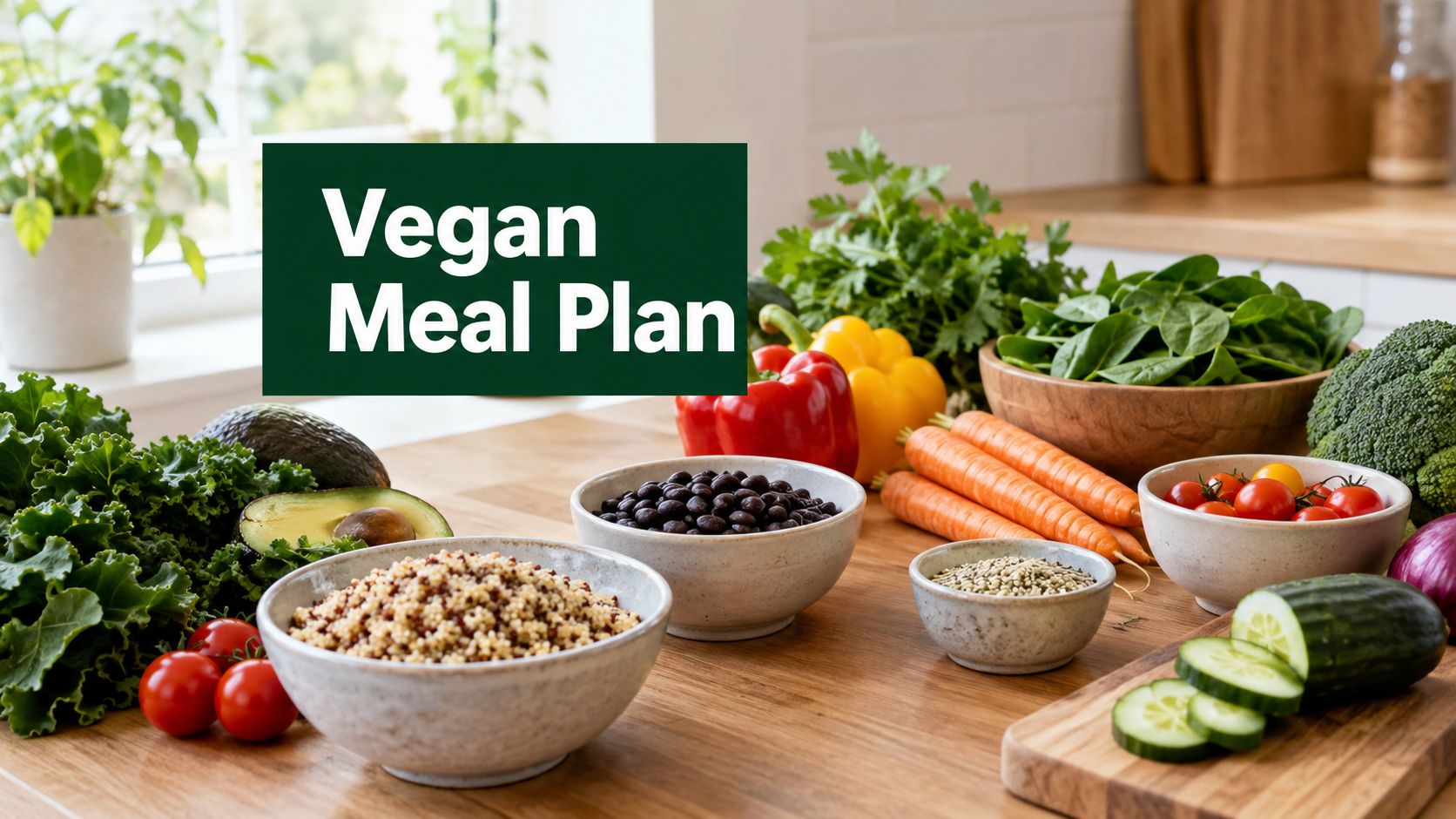
Use tofu, tempeh, lentils, beans, edamame, seitan, or a fortified high-protein product in the protein quarter. Use broccoli, mushrooms, greens, peppers, zucchini, cabbage, or cauliflower for volume. Finish with oats, quinoa, brown rice, potatoes, corn, or whole-grain bread.
Protein targets for vegans are commonly set around 0.8 g per kilogram, with some vegan-focused guidance recommending about 1.0 g per kilogram because plant proteins can be slightly less digestible. Michigan State University Extension translates a practical rule into about 0.41 g per pound, which equals roughly 52 g per day for a 126-pound vegan female and 63 g per day for a 154-pound vegan male.
The table below gives planning examples, not universal prescriptions. The calorie figures are useful menu-design bands, while carbohydrate and fat values should be adjusted around your total calorie target and preferences.
| Weight Loss Goal | Calories per Day | Protein (g) | Carbs (g) | Fat (g) |
|---|---|---|---|---|
| Gentle deficit | 1,500 | 60 | 210 | 50 |
| Moderate deficit | 1,350 | 65 | 185 | 45 |
| More structured deficit | 1,200 | 60 | 165 | 40 |
Use the calorie and macro calculator to personalize the starting point rather than treating the table as a fixed prescription. Distribute calories across breakfast, lunch, dinner, and one or two planned snacks so hunger doesn't force unplanned grazing later.
Protein target: If you aim for about 20 to 30 grams at each main meal, then add protein-rich snacks when needed, you'll create a more reliable structure than chasing a daily number at dinner.
Building a Sample Weekly Menu
A useful week has enough repetition to save time, but enough variation to prevent menu fatigue. Choose two breakfasts, two lunches, three dinners, and a small snack rotation. Cook grains and legumes in batches, then change the sauces and vegetables so the same base ingredients don't taste identical.

A seven-day structure for a busy schedule
The following menu is designed around fast assembly and cooking. Keep portions adjustable so the meals fit the calorie and protein targets established above.
- Day one: Tofu scramble with spinach and whole-grain toast, a quinoa and chickpea vegetable bowl, lentil chili with broccoli, and an apple with measured peanut butter.
- Day two: Overnight oats with fortified soy milk and berries, a hummus and roasted-vegetable wrap with edamame, tofu stir-fry with brown rice, and roasted chickpeas.
- Day three: Smoothie with fortified soy milk, berries, spinach, and a protein-rich addition, a lentil salad with cucumber and tomatoes, black bean chili with corn and peppers, and carrots with white-bean dip.
- Day four: Oatmeal with berries and chia, a leftover chili bowl with greens, tempeh with cauliflower and quinoa, and edamame.
- Day five: Tofu scramble in a whole-grain tortilla, a chickpea salad sandwich with vegetables, red lentil pasta with tomato sauce and mushrooms, and fruit with soy yogurt.
- Day six: Overnight oats with banana and cinnamon, a quinoa, bean, and vegetable bowl, seitan or tofu tacos with cabbage and salsa, and a small serving of hummus with raw vegetables.
- Day seven: Whole-grain toast with mashed beans and tomatoes, leftover grain and vegetable bowl, three-bean vegetable soup with a side salad, and fortified soy milk.
Cornell recommends spreading protein through the day, with a general target of 20 to 30 g or more per meal and protein included at snacks. Cornell Health's vegan nutrition guidance supports that distribution strategy.
For practical preparation, use meal-prep recipes that share ingredients across meals. A 30-minute workflow might look like this: start quinoa or rice, drain and season tofu, chop vegetables, simmer canned beans with tomatoes and spices, then portion everything into containers. Swap tofu for tempeh, chickpeas for lentils, quinoa for brown rice, or a cooked grain for a potato when preferences or allergies require it.
Use the video below for additional meal-preparation inspiration, but keep the portion framework consistent even when the recipes change.
Creating Smart Grocery Lists and Meal Swaps
Build the grocery list around meals you will prepare. Group items by store section, then prioritize ingredients that work across several recipes. Cooked quinoa can become grain bowls, stuffed peppers, or a quick breakfast bowl. Roasted vegetables can fill wraps, salads, and tofu plates. This approach lowers waste and makes a 30-minute cooking window more realistic.
Use an aisle-based checklist
- Produce: Spinach, broccoli, cabbage, peppers, mushrooms, zucchini, tomatoes, cucumbers, carrots, berries, bananas, apples, and lemons.
- Protein: Extra-firm tofu, tempeh, edamame, lentils, canned chickpeas, black beans, white beans, seitan, and unsweetened soy yogurt.
- Grains and starches: Oats, quinoa, brown rice, potatoes, whole-grain wraps, and whole-grain bread.
- Pantry: Canned tomatoes, salsa, low-sodium vegetable broth, spices, vinegar, mustard, nutritional yeast, chia seeds, and ground flax.
- Fortified foods: Fortified soy milk and other products that provide nutrients such as vitamin B12 or vitamin D.
Adjust the list to your working schedule. A late meeting justifies freezer-friendly bean chili or frozen vegetables, rather than ingredients that require extensive preparation. For items used in only one meal, consider canned, frozen, or shelf-stable substitutes to limit waste.
Swap for the result you need
Use substitutions that preserve the meal's purpose:
- Lower energy density: Replace a large oil-based dressing with lemon, vinegar, salsa, or blended white beans.
- More protein: Replace part of a grain portion with tofu, tempeh, edamame, or lentils.
- Less preparation: Choose frozen vegetables, canned beans, microwaveable grains, or pre-washed greens.
- Allergy adjustment: Replace soy with lentils, chickpeas, beans, or seitan when appropriate, and check labels for cross-contact.
- More volume: Replace part of a rice portion with cauliflower rice or extra non-starchy vegetables.
AI Meal Planner can generate personalized weekly meals, calculate calories and macros, create aisle-organized grocery lists, and reuse ingredients across recipes. Use the generated plan as a starting point, then check labels and adjust portions to match your needs. A list that combines lower-energy-density produce, reliable protein foods, and quick staples supports weight-loss goals without turning meal preparation into a second job.
Ensuring Nutrient Adequacy and Portion Control
A lower-calorie vegan diet must still deliver enough protein and micronutrients. The practical challenge is balancing three competing needs: meals should be filling, nutrients should be covered, and preparation should fit a working schedule. Recent review evidence emphasizes planning protein, micronutrients, and satiety together, rather than presenting convenience foods and nutrient quality as separate decisions. Frontiers in Nutrition's review addresses that gap.
Cover the basics without overcomplicating the menu
Include a protein anchor at breakfast, lunch, and dinner. Rotate legumes, soy foods, seitan, and fortified products instead of depending on one source. Whole grains and legumes complement one another across the overall diet, while vegetables and fruit add variety, potassium, vitamin C, folate, and other nutrients.
Vitamin B12 deserves particular attention on a vegan diet. Use a reliable supplement or fortified foods according to professional guidance. Fortified plant milks can also help with nutrients such as calcium and vitamin D, but check the product label because fortification varies. Iron-rich choices include lentils, beans, tofu, tempeh, and fortified cereals, while vitamin-C-rich vegetables and fruit can accompany those meals.
Omega-3 planning can include ground flax, chia, walnuts, or an algae-based supplement when appropriate. If you have a diagnosed deficiency, digestive condition, or health condition that affects nutrient absorption, ask a registered dietitian or clinician for individualized guidance.
Portion check: Measure oils, nuts, seeds, nut butters, and creamy sauces. These foods can fit a vegan diet, but their calorie density makes casual handfuls and unmeasured pours easy to underestimate.
Use energy density as the daily filter
Start lunch and dinner with vegetables or broth-based soup, then add legumes or soy protein and a measured grain or starchy vegetable. This keeps the plate generous without allowing oils, nuts, or processed substitutes to dominate the calorie budget.
You don't need to eliminate convenience foods. A frozen vegetable blend with canned beans and microwaveable brown rice can be more useful than an elaborate recipe you never make. The better question is whether the meal delivers enough protein and volume for its calories, and whether you can prepare it consistently.
Track a few nutrients at first, especially calories, protein, B12 sources, calcium sources, and iron-rich foods. Once your meals repeat reliably, you can reduce the amount of daily tracking and review your weekly pattern instead.
Staying on Track with Adherence Strategies
Adherence is the deciding factor in a vegan weight-loss program. A 24-month randomized trial found that adherent vegans lost 5% of body weight, while non-adherent vegans lost negligible weight. The same study reported that adherent vegans lost 3.32 kg at six months and 4.00 kg more than adherent omnivores, showing why meal planning must remove friction rather than depend on motivation. The trial report provides the clearest practical lesson: a good plan only works when people can follow it.
Design the week around your busiest days
Batch-cook one grain, one legume dish, one tofu or tempeh preparation, and a tray of vegetables. Freeze extra portions in labeled containers. Keep a short emergency list for days when cooking is impossible, such as canned beans with microwaveable rice, frozen vegetables with tofu, or whole-grain toast with a bean spread.
Use habit stacking to make preparation automatic:
- After grocery shopping: Wash produce, portion snacks, and place the first two meals at eye level.
- After dinner: Pack tomorrow's lunch and set out breakfast ingredients.
- At the start of the workweek: Review your menu and identify the meals most likely to fail.
- At the end of the week: Compare your planned meals with what you ate, then adjust the next grocery list.
Track trends instead of reacting to one day
Record weight and waist trends weekly under similar conditions. If progress stalls, first check portions of oils, nuts, dressings, snacks, drinks, and weekend meals. Next, review whether protein and vegetables are present consistently. Change one variable at a time so you can identify what improves adherence.
Accountability can come from a meal-prep partner, a shared grocery list, a group challenge, or a scheduled weekly review. The goal isn't perfection. It's making the next useful action obvious when work, travel, or fatigue disrupts the plan.
If you have a medical condition, a history of disordered eating, or significant dietary restrictions, get individual advice before setting a calorie deficit. Otherwise, start with one week of repeatable meals, monitor your response for at least three months, and refine portions based on your trend rather than chasing rapid changes.
AI Meal Planner creates personalized vegan meal plans with calories and macros, quick recipes designed for busy schedules, meal swaps, and grocery lists organized by aisle. Visit AI Meal Planner to build a plan around your calorie target, allergies, preferred foods, and available cooking time.
AI-powered nutrition
Get Your Personalized Meal Plan
AI creates the perfect meals for your goals, lifestyle, and taste.
Start Your Journej