Optimal protein intake is 1.6 g/kg/day for muscle growth, with potential benefit up to 2.2 g/kg/day, and it works best when split into roughly 0.25 to 0.4 g/kg per meal across four meals. For individuals who lift weights, that means aiming above the basic 0.8 g/kg/day RDA, because that baseline is meant to prevent deficiency, not maximize muscle gain.
How much protein intake for muscle growth should you aim for?
Aim for 1.6 grams of protein per kilogram of body weight per day, with benefits extending up to 2.2 g/kg/day for some people. Split that across four meals at about 0.4 g/kg per meal to support muscle protein synthesis. Protein works best for muscle growth when it's paired with resistance training.
Protein confuses people because they often hear three different messages at once. One says the RDA is enough. Another says you need endless shakes. A third says timing matters more than anything else.
The evidence points to a simpler middle ground. Your body needs enough total protein, spread sensibly across the day, and backed by resistance training. Once you understand those three pieces, protein intake for muscle growth becomes much easier to plan in real life.
Why Protein Matters for Muscle Growth
Muscle is made from protein, but eating more protein does not automatically create more muscle. The process works more like a two-part instruction system. Resistance training gives your body a reason to adapt, and protein supplies the amino acids needed to carry out that repair and rebuilding.
That distinction clears up a common point of confusion. The basic RDA is designed to cover general health needs in minimally active adults. Muscle growth asks more from the body. You are not only maintaining tissue. You are trying to recover from training and build new tissue over time.
Why lifting and protein have to work together
Protein provides the building materials for muscle growth, while resistance training provides the construction plan. If you eat plenty of protein but do not challenge the muscle, your body has little reason to direct those materials toward bigger, stronger muscle fibers. If you train hard but under-eat protein, the signal is there, but the raw materials are limited.
This is why muscle gain is rarely a supplement problem. It is usually a coordination problem. Training, total intake, and meal pattern need to line up often enough to support adaptation week after week.
For busy professionals, that matters more than perfection. A solid plan beats a heroic day of eating followed by three inconsistent ones.
What busy professionals usually get wrong
The usual breakdown happens in the daily schedule.
- Breakfast is protein-poor: Coffee, toast, or a rushed commute leaves the first part of the day short on amino acids.
- Lunch is built for convenience, not recovery: Many desk meals are easy to eat but light on protein.
- Dinner carries too much of the load: One large serving helps, but it does not fully fix a day that was underfed.
- Training and intake are disconnected: People follow a lifting plan but never turn protein into a repeatable habit.
A better approach is to make protein visible at each meal, not just at dinner or after workouts. That is where individualized planning becomes practical. Your target should fit your body size, your goal, and in some cases your body composition. Your meals should also fit your calendar. An AI Meal Planner protein intake calculator can turn that target into repeatable meals and portions, which is far more useful than knowing a number and hoping your day somehow matches it.
Food choice matters too, especially if you eat mostly plants or mix plant and animal proteins. If that applies to you, this practical guide for plant-based protein needs can help you choose options that make your daily total easier to reach consistently.
Practical rule: Ask two questions together. “Am I giving my muscles a training signal?” and “Am I giving my body enough protein across the day to respond?”
Setting Your Daily Protein Target
Research reviews on muscle growth consistently place a useful daily protein range at about 1.6 to 2.2 g/kg/day. For busy professionals, that range matters because it turns a vague goal into a number you can plan around.

A daily target works like a budget. If your calorie budget tells you how much energy you can spend, your protein budget tells you how much building material you are giving your muscles across the day. Without that number, “eat more protein” is too fuzzy to guide grocery shopping, meal prep, or restaurant choices.
Start with body weight in kilograms.
- Baseline muscle-growth target: body weight in kg × 1.6
- Higher target for added support: body weight in kg × 2.2
- General-health benchmark: body weight in kg × 0.8
Here is what that looks like in practice. A person who weighs 81.8 kg would aim for about 131 grams per day at the baseline end and about 180 grams per day at the higher end. That gives you a workable range rather than a single perfect number.
Body weight is the simplest starting point, but it is not the only way to personalize intake. If you carry more body fat, using lean body mass can give you a tighter estimate. If you are already lean and training hard, total body weight is usually a practical guide. The goal is accuracy you can use, not math that slows you down.
A good next step is to turn the daily total into meal-sized targets. If your goal is 160 grams per day and you usually eat four times, you are looking at about 40 grams per meal. That approach is far more practical than chasing a big total at dinner and hoping it balances out by itself. The protein intake calculator for daily targets helps automate that math and turn it into meal ideas that fit your schedule.
The higher end of the range tends to make more sense in a few situations.
- Hard-training lifters: More training volume usually means more recovery demand.
- People in a calorie deficit: Higher protein can help preserve lean mass while calories are lower.
- Older adults: Aging muscle often responds better to a stronger protein intake plan.
- Plant-based eaters: Hitting the total may take more planning because protein density and amino acid profiles vary across foods.
If you eat mostly plants, this practical guide for plant-based protein needs can help you choose foods and portions that make your daily target easier to reach.
The big idea is simple. Set a daily protein target that fits your body size, adjust it for body composition and training demands if needed, then break it into repeatable meals you can consistently eat on a workday.
Timing and Distribution of Protein Intake
Hitting your daily total matters, but distribution helps turn that total into something your body can use repeatedly during the day. Research from the International Society of Sports Nutrition indicates that 20 to 30 grams of high-quality protein per meal can maximally stimulate muscle protein synthesis in younger adults, and that spreading protein as 20 to 25 grams every three hours can support stronger MPS responses than larger, less frequent servings, as outlined in the ISSN position stand.

In practical terms, this is why many lifters do better with four protein-containing meals than with one light breakfast, one weak lunch, and one giant dinner.
A simple way to spread protein across the day
Think in feeding opportunities, not perfect meal timing.
- Breakfast: Start the day with a real protein anchor.
- Lunch: Make this a full meal, not a placeholder.
- Post-workout or afternoon meal: Use this slot to keep the day balanced.
- Dinner: Finish the day with another substantial serving.
For many busy people, that pattern is easier to sustain than obsessing over the clock.
Later in the day, a visual walkthrough can help:
Do you need protein right after your workout
Not in the rigid way social media often suggests.
Recent evidence indicates that protein timing within a narrow post-exercise window is less important than your total daily intake and distribution, according to this 2024 review on the anabolic window. That doesn't mean post-workout meals are useless. It means they're one part of the day, not a magic switch.
Missing the shake right after training usually isn't the problem. Under-eating protein across the whole day usually is.
Adjusting Intake for Goals and Training Status
Your protein target should match your situation, not just your body weight. Someone trying to preserve muscle while losing fat faces a different nutrition problem than someone eating at maintenance and pushing hard in the gym.
A helpful evidence-based anchor is this: intakes above 1.3 g/kg/day help preserve muscle in weight loss, and 1.4 to 2.0 g/kg/day best supports most exercising individuals for growth and maintenance, based on this review of protein intake in exercise and weight management.

If your goal is muscle gain
If you're eating enough calories and training consistently, your job is mainly to support recovery and repeated muscle protein synthesis. Most exercising people do well in the 1.4 to 2.0 g/kg/day range, with some individuals using the higher end when they want tighter control over intake.
If your goal is fat loss with muscle retention
Fat loss changes the picture because your body has fewer calories available. In that setting, protein becomes protective. Going above 1.3 g/kg/day helps preserve muscle better than lower intakes during weight reduction.
If that's your current phase, this article on maintaining muscle during rapid weight loss gives practical context for what to prioritize when body weight is dropping.
If you're older or more advanced
Training age and biological age matter. The ISSN position stand notes that older adults may need different targets, and recommendations discussed there include 1.0 to 1.5 g/kg/day from the PROT-AGE study group and 1.2 to 1.4 g/kg/day in Nordic guidance for healthy older adults, all covered in the earlier ISSN-linked section.
Advanced lifters also tend to benefit from more precision. Their gains often depend less on broad habits and more on consistent execution across meals, training weeks, and recovery.
Choosing Protein Sources for Different Diets
Once your target is set, the next question is simple: what foods make it easiest to hit? The best protein source is the one you can eat consistently, digest well, and fit into your usual routine.
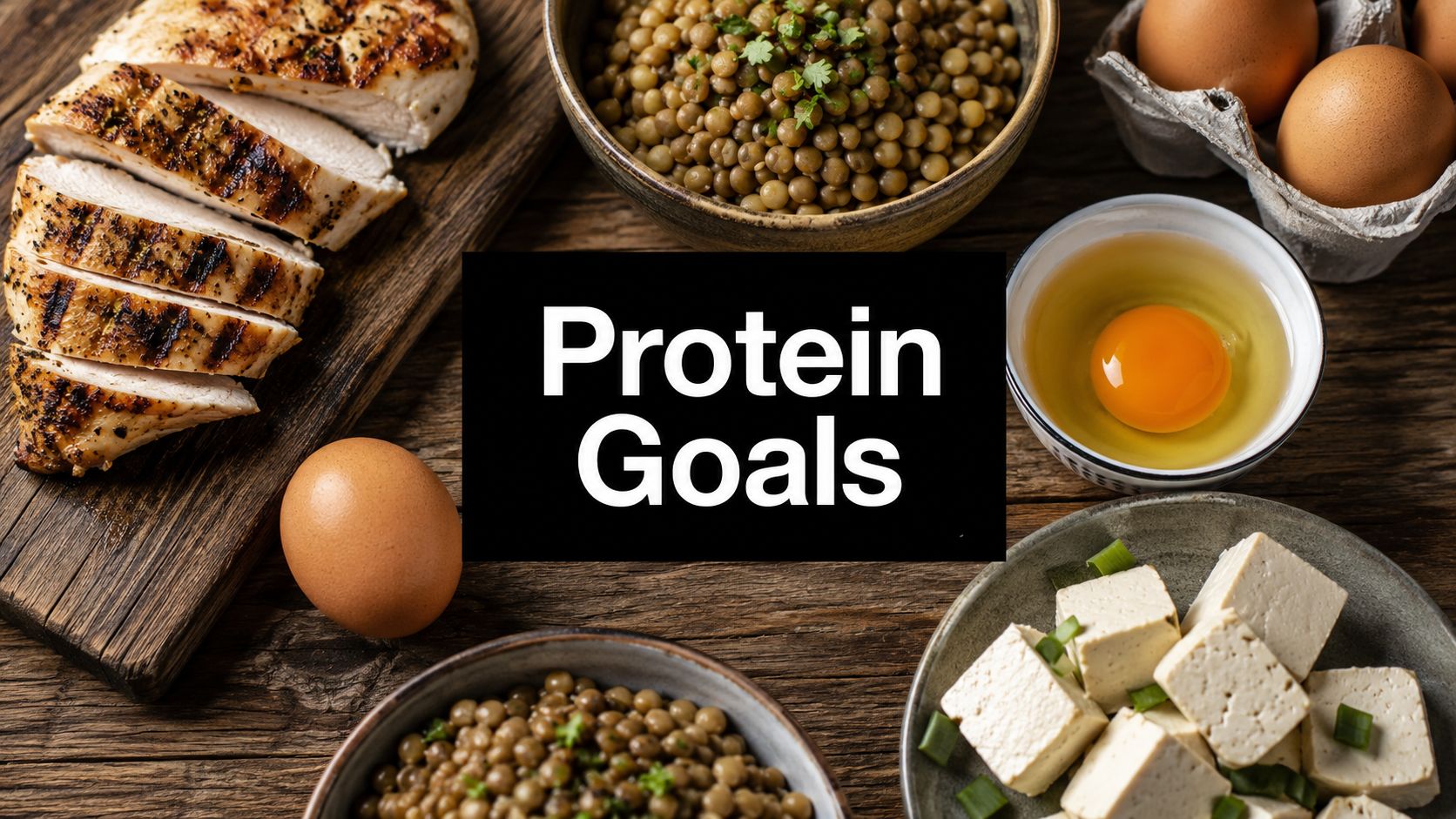
Animal proteins are often the most straightforward. Foods like eggs, dairy, fish, poultry, and meat usually provide a complete amino acid profile in a compact serving. They're practical for people who want fewer moving parts.
How animal, plant, and supplemental options compare
| Protein source | What it's good for | Common challenge |
|---|---|---|
| Animal foods | Dense, complete protein with simple meal building | Some people want less meat or have budget concerns |
| Plant foods | Fits vegan and vegetarian diets, often adds fiber and variety | You may need more planning across meals |
| Protein powders | Convenient when work or travel compresses eating time | Easy to over-rely on if meals are poorly structured |
Plant-based diets can still support muscle growth well, but they usually reward planning. Instead of thinking about one perfect vegan protein food, think in combinations and daily consistency. Soy foods are often practical, and blends such as pea plus rice can help fill gaps in amino acid balance.
How to make a plant-based approach easier
- Use repeatable anchors: Tofu, tempeh, soy yogurt, edamame, lentils, and protein-fortified foods can give structure to your week.
- Pair foods strategically: A mix of legumes, grains, soy foods, and plant protein blends can make meals more substantial.
- Keep convenience options ready: Powders, high-protein snacks, and batch-cooked staples prevent missed meals on busy days.
If you follow a vegan diet and want done-for-you meal ideas, a vegan meal plan built around your preferences can make the day-to-day side much easier.
You don't need a perfect protein source at every meal. You need a pattern of meals that makes your target realistic.
Supplements can help, especially around work schedules, commuting, or travel. They're most useful when they solve a logistics problem, not when they replace basic meal planning.
Sample Calculations and Meal Templates
The easiest way to understand protein intake for muscle growth is to see the math on paper. A practical benchmark from this review on meal distribution and adaptive changes is 1.6 g/kg/day, split into four meals of 0.4 g/kg each.
That gives you a clean rule. Multiply body weight by 1.6 for the day, then divide by four for each meal.
Protein Calculation and Meal Template Table
| Body Weight (kg) | Daily Protein Target (g) | Per-Meal Protein (g) | Example Meal |
|---|---|---|---|
| 60 | 96 | 24 | Greek yogurt bowl with fruit and seeds, chicken rice bowl, tofu stir-fry, cottage cheese snack |
| 80 | 128 | 32 | Eggs with yogurt, turkey grain bowl, salmon with potatoes, protein smoothie |
| 100 | 160 | 40 | Omelet with dairy side, beef or tofu lunch bowl, chicken or tempeh dinner plate, shake plus snack combo |
How to use these numbers without overcomplicating food
The table isn't telling you to eat identical meals. It's showing the size of each protein “slot.” Once you know the size, you can swap foods based on preference.
For example, an 80 kg person aiming for 128 g per day doesn't need a perfect menu. They need four meals that each land near 32 g. One day that could be eggs and yogurt at breakfast. Another day it could be a smoothie plus toast and a side of skyr.
A practical template for busy weekdays
- Breakfast slot: Choose a dairy-based meal, eggs, tofu, or a shake plus a side.
- Lunch slot: Build around one clear protein center, then add carbs and produce.
- Afternoon or post-workout slot: Keep this easy to assemble.
- Dinner slot: Repeat the same formula as lunch.
If your goal is especially high daily intake, a 200g protein meal plan example can help you visualize how a higher-protein day is structured.
Common Myths About Protein Intake
Protein advice gets distorted fast online. The most common myths sound scientific, but they usually collapse once you ask a simple question: does this help someone eat enough protein consistently over a full week?
Myth one says the post-workout window is tiny
This myth survives because it feels urgent and actionable. But urgency and importance aren't the same thing.
As noted earlier, recent evidence shows that a narrow post-exercise window matters less than overall daily intake and distribution. If your schedule shifts and you eat later, you haven't ruined the session. The bigger problem is ending the day far below your target.
Myth two says anything above a certain amount per meal is wasted
People often hear that more than a fixed amount of protein in one sitting is useless. That turns a useful guideline into a false ceiling.
Per-meal targets are better seen as planning tools, not hard cutoffs. They help you spread intake well. They don't mean your body throws away the rest of your meal if you eat more than one benchmark amount.
Reality check: Good protein planning is about repeatable meal structure, not fear of eating “too much” at one sitting.
Myth three says plant protein can't support muscle growth
That's too simplistic. Plant-based eating can work for muscle gain if total intake, food choice, and consistency are handled well. The challenge is usually logistics and meal composition, not impossibility.
Myth four says protein alone builds muscle
Protein supports growth, but lifting supplies the signal. If someone raises protein while skipping progressive resistance training, muscle gain will still be limited. Nutrition supports adaptation. It doesn't replace it.
Practical Tips for Busy Professionals
Busy schedules don't usually destroy nutrition because people lack discipline. They create friction. Meetings run long, commutes shift meals, and grocery shopping gets pushed to the weekend that never quite arrives.
The fix is to lower friction until high-protein eating becomes the default.
Build a workweek system, not a perfect menu
Start with a short list of repeatable meals. You don't need endless variety on Monday through Friday. You need meals you can buy, prep, and eat without decision fatigue.
A practical setup looks like this:
- Pick two breakfasts: Rotate them all week.
- Choose two lunches: Batch-cook one, buy one.
- Keep one emergency backup: A shelf-stable or freezer option can save a missed target.
- Pre-decide snacks: Don't leave this to office vending machines.
Use tools that remove the math and shopping friction
For some people, a spreadsheet works. Others do better with a simple note on their phone. If you want automation, AI Meal Planner can generate weekly meal plans based on your protein target, food preferences, and schedule, and pair them with a smart grocery list generator so shopping matches the plan.
That matters because the hard part usually isn't knowing protein is important. It's turning a target into breakfasts, lunches, dinners, snacks, and groceries that fit a normal workweek.
Keep these three habits in place
- Front-load protein: Don't wait until dinner to catch up.
- Make lunch count: This meal often decides whether the day stays on track.
- Treat convenience as a tool: Protein powder, yogurt, prepared tofu, canned fish, or pre-cooked chicken can all be useful if they help you stay consistent.
A strong plan should survive late meetings, travel days, and low-energy evenings. If it only works on your most organized day, it's too fragile.
FAQ
Is 0.8 g/kg/day enough for muscle growth
No. 0.8 g/kg/day is the RDA meant to prevent deficiency in minimally active adults, not to maximize hypertrophy.
How much protein should I eat per meal to build muscle
A practical target is about 0.4 g/kg per meal across four meals. ISSN research also notes 20 to 30 g of high-quality protein per meal as a useful benchmark for younger adults.
Do I need protein immediately after lifting
Not necessarily. Total daily intake and meal distribution matter more than hitting a narrow post-workout window.
Can I build muscle with plant protein
Yes, if your total daily intake is high enough and your meals are planned well. Plant-based diets usually need more deliberate food choices.
Should I increase protein when cutting fat
Usually yes. Intakes above 1.3 g/kg/day help preserve muscle during weight loss.
Do older adults need a different protein target
Often yes. Guidance discussed in ISSN materials suggests older adults may benefit from higher protein intakes than the basic RDA.
If you want a simpler way to hit your protein target without manually planning every meal, AI Meal Planner can build a personalized weekly plan from your goal, diet style, allergies, and schedule, then turn it into a matching grocery list. You can start with the onboarding flow and set up a muscle-gain approach that fits your routine rather than fighting it.
AI-powered nutrition
Get Your Personalized Meal Plan
AI creates the perfect meals for your goals, lifestyle, and taste.
Start Your Journej