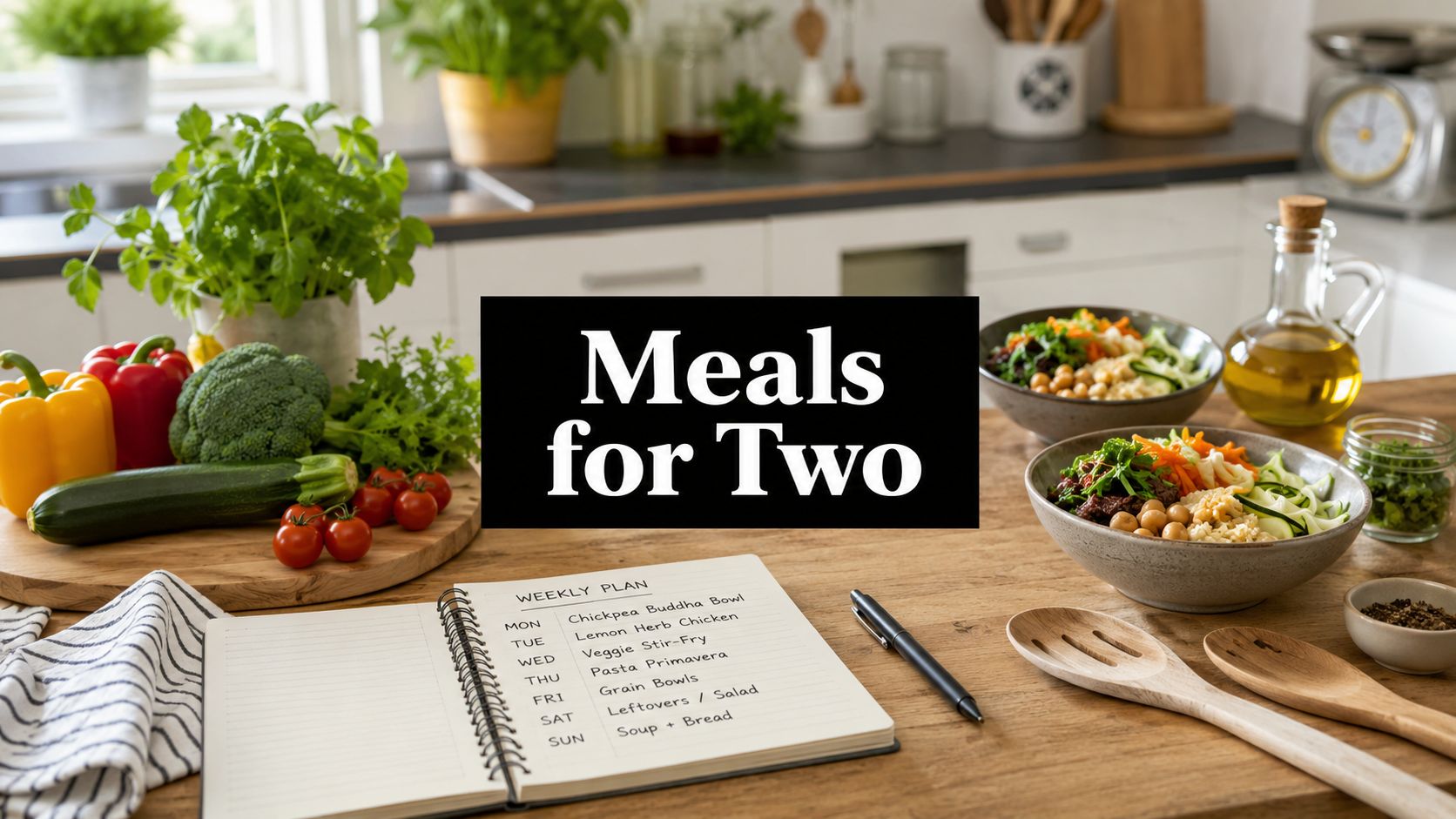
You've bought ingredients for seven dinners, but by midweek you're tired of cooking, one partner has evening plans, and the cilantro is already wilting. Meal planning for two works better when you plan four or five intentional dinners, then reserve the remaining nights for leftovers, pantry meals, takeout, or flexible “fridge cleanup” plates. Build the week around shared ingredients, cook enough for planned leftovers, and portion each plate separately when your nutrition goals differ.
The smaller household is where inefficient planning becomes especially visible. One duplicated bag of greens, an unused sauce, or an extra store trip can represent a meaningful share of the week's food. Historical U.S. benchmarks show that two-person households spent $5,635 on food at home in 2022, compared with $5,145 in 2021, an increase of $490, as reported in this grocery spending reference for two-person households. A flexible plan gives you control without turning dinner into a spreadsheet.
Why Planning Four or Five Dinners Beats a Rigid Seven-Day Schedule
Start with four or five dinners, not seven separate recipes. Choose meals that share ingredients, prepare at least one dinner with intentional leftovers, and leave the remaining nights open for food already in the kitchen, a quick assembly meal, takeout, or an unexpected social plan.
That structure matches how couples eat. A rigid seven-day schedule assumes both people will be home, equally motivated, and happy with the planned meal every night. One late meeting or change of appetite can throw the entire sequence off, leaving perishable ingredients stranded and planned recipes competing for attention.

How to build the flexible model
Use this order:
- Inventory first. Check the fridge, freezer, and pantry before choosing recipes. Put food that needs attention near the front of your list.
- Choose anchor meals. An anchor uses a substantial ingredient in more than one way. Roast chicken can become a dinner with vegetables, then tacos or grain bowls later.
- Schedule by shelf life. Cook delicate greens, herbs, and seafood earlier. Save sturdy vegetables, frozen foods, and pantry staples for later.
- Reserve open nights deliberately. An open night isn't a failure in the plan. It protects the plan from real life.
- Write quantities for actual use. The U.S. EPA recommends planning meals before shopping, buying only what those meals require, and tying quantities to the number of meals eaten at home. Its example, “salad greens - enough for two lunches,” is a useful model for a couple's list in this food-waste planning guidance.
Ingredient bridging makes the approach efficient. Buy one bunch of herbs and use it in two meals. Cook one grain and serve it with different sauces. Roast vegetables once, then change the protein and seasoning so the second meal doesn't feel like a repeat.
Practical rule: Plan the ingredient before you plan the recipe. The ingredient tells you how to shop, store, and reuse; the recipe only tells you what to do once.
The trade-off is obvious. You'll get less novelty than seven entirely different dinners, but you'll gain a higher chance of cooking what you bought. Flexible recipe planning has produced meaningful waste reductions in randomized field studies, with reported reductions of 33% in Canada and 46% in the United States compared with baseline in one intervention, as documented in this study of flexible recipes and household food waste. A separate leftover-focused intervention required at least two leftover-based dinners per week and reported a short-term total-waste reduction of 39% compared with 22% in the control group, with dinner waste still reduced by 29% at week 52, according to the same research source.
For a simpler starting point, a flexible meal plan for two can help you think in terms of repeatable meals, ingredient overlap, and lower decision load rather than perfect execution.
Calibrating Portions and Macros for Two Different Goals
Two people can eat the same dinner without needing the same plate. The practical solution is a shared base with adjustable components, not two separate cooking sessions.
Cook one protein, one vegetable, and one starch or alternative. Then vary the ratios. The partner maintaining weight may take a larger grain serving or add olive oil, avocado, cheese, or another calorie-dense topping. The partner pursuing fat loss may use more vegetables, a smaller starch serving, and the same or a deliberately measured protein portion.
A useful everyday starting point is visual calibration. The Mayo Clinic Health System describes vegetables as roughly the size of a baseball, fruit as a tennis ball, grains or carbohydrates as a hockey puck, protein as a deck of cards, and fats as one or two dice in its portion guidance for cooking for one or two. These cues aren't a substitute for clinical nutrition advice, but they make shared meals easier to portion without weighing every ingredient at the table.
A modular plate keeps the kitchen shared
| Meal Component | Partner A (Maintenance) | Partner B (Fat Loss) | Adjustment Strategy |
|---|---|---|---|
| Protein | Standard serving | Protein-centered serving | Cook one protein, divide portions before adding sauces |
| Grains or starches | Larger serving as needed | Smaller serving or extra vegetables | Cook the same grain, portion separately |
| Vegetables | Generous serving | Larger share of the plate | Use one roasted or sautéed vegetable for both |
| Fats and toppings | Add avocado, cheese, oil, or nuts | Use a measured amount | Put toppings on the table instead of mixing them into the whole dish |
| Sauce | Full serving if it fits the plan | Smaller or side-served amount | Serve sauce separately so each person controls intake |
Pre-portion energy-dense foods before cooking or storing them. A systematic review found strong evidence that larger portions increase food and energy intake in adults and older adults, while smaller pre-portioned servings reduce energy intake with moderate evidence, according to this portion-size review. The same source reports that increasing portions by 50% raised daily energy intake by 16%, while doubling portions raised it by 26%. Those findings matter for meal planning because a recipe's yield can become the household's default serving size.
Divide leftovers into two containers immediately rather than storing one large dish and serving it casually later. This makes tomorrow's portions visible, protects the planned lunch or dinner, and prevents one partner from taking most of the higher-energy components without noticing.
For people tracking protein, carbohydrates, and fat more closely, calculate the shared recipe first, then adjust the plate with modular ingredients. A practical discussion of sleep, macro tracking, and nutrition planning is available in these Jason Sani fitness and nutrition tips. For a more exact starting point, use a calorie and macro calculator, then treat the result as a planning reference rather than a medical prescription.
Building a Balanced Weekly Menu With Built-In Flexibility
A balanced week doesn't require seven unique dinners. It requires enough structure to cover the meals you'll eat and enough flexibility to prevent the plan from collapsing when schedules change.
Start by selecting two batch-cooked proteins, three quick-cook dinners, and modular breakfast and lunch components. Keep dinner variety through sauces, seasonings, and formats rather than buying a completely new set of ingredients for every meal.

A practical seven-day framework
| Day | Dinner structure | Ingredient logic |
|---|---|---|
| Day 1 | Batch-cooked protein with roasted vegetables and grains | Cook enough protein and grain to support another meal |
| Day 2 | Quick curry, stir-fry, or skillet meal | Use remaining vegetables and herbs while fresh |
| Day 3 | Leftover-based dinner or grain bowl | Recombine prepared components with a new sauce |
| Day 4 | Quick-cook vegetarian or seafood meal | Use the most perishable produce |
| Day 5 | Flexible night, takeout, or pantry dinner | Avoid buying ingredients for a meal you may not cook |
| Day 6 | Second batch protein with a different side | Create variety through seasoning and format |
| Day 7 | Fridge cleanup, leftovers, or simple assembly meal | Finish small quantities before the next shop |
Suppose Tuesday's curry uses cilantro. Split the bunch when you unpack groceries. Use part in the curry and reserve the rest for a Thursday grain bowl, salsa, or yogurt sauce. The same principle applies to spinach, cooked rice, roasted peppers, and shredded chicken. Assign each perishable ingredient a first use and a second use before it enters the refrigerator.
Breakfast and lunch can rotate from components. Eggs, oats, fruit, yogurt, toast, cooked grains, beans, chopped vegetables, and leftover proteins can combine in different ways without requiring a separate recipe for each day. Keep one backup lunch, such as sandwiches, eggs, or a simple snack plate, so an unexpectedly small leftover portion doesn't force an extra restaurant meal.
Dietary swaps work best when you change components rather than rebuilding the whole menu. Use gluten-free grains or tortillas for one partner, dairy-free sauce on the side, or beans and tofu in place of meat while keeping the vegetables and seasoning compatible. A balanced weekly meal plan can provide a starting framework, but the household still needs to check portions, preferences, and perishability.
A flexible slot works only when you name its job. “Use leftovers” is vague. “Grain bowls with remaining chicken, greens, and sauce” gives both people a real dinner.
Smart Grocery Lists and Meal Prep Timing That Actually Work
A grocery list organized by recipe encourages duplicate purchases. A list organized by store section and total quantity makes the plan visible while you shop.
Before adding anything, check the inventory. Then combine every dinner, breakfast, lunch, and snack into one list. Group produce, proteins, dairy, frozen foods, and pantry staples in the order you usually move through the store. Record the total amount needed, not the amount listed on each individual recipe.
The 90-minute preparation rhythm
A focused Sunday session can prepare the components that appear repeatedly without fully cooking every meal.
- First 30 minutes: Wash and cut vegetables, start a grain or beans, and place the first protein in the oven or pan.
- Next 30 minutes: Finish the protein, roast vegetables, cool cooked food promptly, and portion tomorrow's meal.
- Final 30 minutes: Mix a sauce, marinate the second protein, label containers, and place the oldest perishables where you'll see them.
Prep ingredients according to how they'll be used. Cook grains and roast sturdy vegetables in advance. Leave delicate greens, herbs, cucumbers, and ingredients that lose texture better raw until cooking night. Marinate proteins ahead, but avoid assembling wet salads or fully dressing bowls before serving.
Monday's roasted chicken might become Wednesday's grain bowls, but don't shred all of it if one partner prefers a larger dinner portion. Store the components separately when texture or portion control matters. A small midweek refresh can replace leafy greens, herbs, or other delicate produce without turning the trip into a second full grocery shop.

For busy professionals, grocery planning works best when it supports the wider routine rather than demanding perfect discipline. A practical guide to slim down fast can add context around fitting weight-management habits into a busy schedule, while the meal plan itself should remain realistic enough to follow on a work night.
Use an aisle-sorted grocery list generator when you want the consolidation step handled automatically. The important result isn't a prettier list. It's one shared source of truth that prevents each partner from buying the same perishable ingredient independently.
Here's a short visual guide to connect the shopping list with preparation timing:
Solving Common Meal Planning Friction for Couples
Most meal plans assume that both people want the same food, the same portion, and the same nutritional outcome. That assumption creates more conflict than the recipes do.
A couple doesn't need identical plates. It needs a dinner architecture that lets each person finish the meal differently without doubling the work.
| Friction Point | Compromise Strategy | Example |
|---|---|---|
| Picky eater | Keep the base plain and serve toppings separately | Roast chicken, rice, and vegetables, with salsa, herbs, hot sauce, or cheese on the side |
| Different nutrition goals | Adjust ratios after cooking | One plate gets more grains, while the other gets more vegetables and a separately portioned protein |
| Budget pressure | Use affordable staples as anchors and reserve premium ingredients for feature meals | Eggs, beans, grains, frozen vegetables, and one stretched meat meal carry the week |
| Different schedules | Cook components that reheat well and leave one open night | One partner assembles a bowl while the other eats the planned leftover |
| Disagreement about variety | Alternate familiar meals with one new recipe | Keep three reliable dinners and test a new preparation when the calendar is calmer |
Picky preferences don't require separate dinners
Build a neutral base, then customize the finish. A sheet-pan meal can include a plain protein and vegetables, while one person adds a spicy sauce and the other uses lemon or yogurt. Tacos, grain bowls, baked potatoes, and omelets work especially well because each person can assemble a preferred combination.
For mismatched goals, change portion ratios instead of labeling one meal “healthy” and the other “diet food.” Put higher-calorie additions on the table, portion protein before serving, and let each person choose the amount of starch or fat that fits their plan.
Budget pressure needs sequencing, not blandness. Current grocery guidance for couples emphasizes anchor meals built around eggs, pantry proteins, and one stretched beef meal, because duplicate purchases and unused fresh items can matter more in a small household. That approach creates room for one or two more distinctive meals without asking every dinner to carry a separate shopping list.
The U.S. EPA also warns that buying in large quantities saves money only when the household uses the food before it spoils, and it presents bulk-bin shopping as useful when the amount purchased matches actual use, as outlined in its meal-planning and food-waste guidance.
The compromise isn't lowering standards. It's cooking one flexible meal and giving each person control over the final plate.
Your First Week of Streamlined Meal Planning
Treat the first week as a calibration exercise, not a performance test. On Friday night, check the fridge and pantry, choose four or five dinners, assign one leftover night, and leave another night open. Build one shared list with quantities for both people.
Shop on Saturday morning. On Sunday afternoon, prepare a grain, one protein, sturdy vegetables, and one sauce. Keep delicate herbs and greens for later in the week, then make a short Wednesday refresh trip only if those perishables need replacing.

At the end of the week, write down three observations:
- Leftovers: Which dinner produced the right amount for two?
- Waste: Which ingredient went unused or spoiled?
- Timing: Which preparation step made a busy evening easier?
Repeat the process for another week before making major changes. You're looking for a workable rhythm, not a flawless menu. If building the menu, calculating portions, and consolidating the list takes more time than you have, the Omev AI Meal Planner can generate personalized meals, macros, and aisle-sorted grocery lists from your preferences, dietary needs, and household goals.
AI Meal Planner can help couples turn shared preferences and nutrition goals into a weekly menu, recipes, macro information, and an organized grocery list with leftover reuse in mind. Visit AI Meal Planner to set up your household plan and replace weekly guesswork with a practical starting point.
AI-powered nutrition
Get Your Personalized Meal Plan
AI creates the perfect meals for your goals, lifestyle, and taste.
Start Your Journej