You're staring at a protein bar label with one hand and your phone with the other, trying to decide whether “30 grams of protein” means the bar is a smart choice or a calorie trap. To count macros, record the grams of protein, carbohydrates, and fat in everything you eat, then compare the daily totals with targets suited to your calorie goal. Use 4 calories per gram for protein and carbohydrates, and 9 calories per gram for fat to convert those grams into calories.
The practical challenge isn't learning multiplication. It's keeping the numbers reasonably honest when you cook a large batch, eat at a restaurant, forget to log a sauce, or reach Friday with no patience left for spreadsheets. The method below uses the 4-4-9 rule and adult Acceptable Macronutrient Distribution Ranges as guardrails, then adapts them to real kitchens and busy weeks.
What Counting Macros Actually Means
Macronutrients, usually shortened to macros, are protein, carbohydrates, and fat. Counting them means adding their gram totals across the day instead of looking only at one calorie number. A meal can match another meal's calories while delivering a very different balance of protein, carbohydrates, and fat, which changes how well it fits your hunger, training, recovery, and personal preferences.
The mechanical foundation is simple. Protein supplies 4 kilocalories per gram, carbohydrates supply 4 kilocalories per gram, and fat supplies 9 kilocalories per gram, a framework documented by the USDA Food and Nutrition Information Center. The calculation is:
Total calories = (protein grams × 4) + (carbohydrate grams × 4) + (fat grams × 9)
That's why 10 grams of fat contributes about 90 calories, while 10 grams each of protein and carbohydrates contribute about 40 calories apiece. A product such as Bulletproof collagen powder in chocolate still needs to be logged by its actual serving label, not by its marketing description or the assumption that every protein product has the same macro profile.
Use percentage ranges as guardrails
For adults, the AMDR framework places carbohydrates at 45% to 65% of calories, fat at 20% to 35%, and protein at 10% to 35%, according to the National Academies' Dietary Reference Intake framework. These ranges aren't mandatory meal-by-meal quotas. They're a useful boundary for checking whether a plan has drifted toward an extreme distribution without a clear reason.
Fiber is included within total carbohydrate on US Nutrition Facts labels, so don't add fiber on top of total carbs. Sugar alcohols require more careful treatment because products and tracking systems handle them differently. If you're tracking for blood-glucose impact, many practitioners subtract half of the listed sugar alcohols from carbohydrates, then keep the label's total carbohydrate visible for transparency.
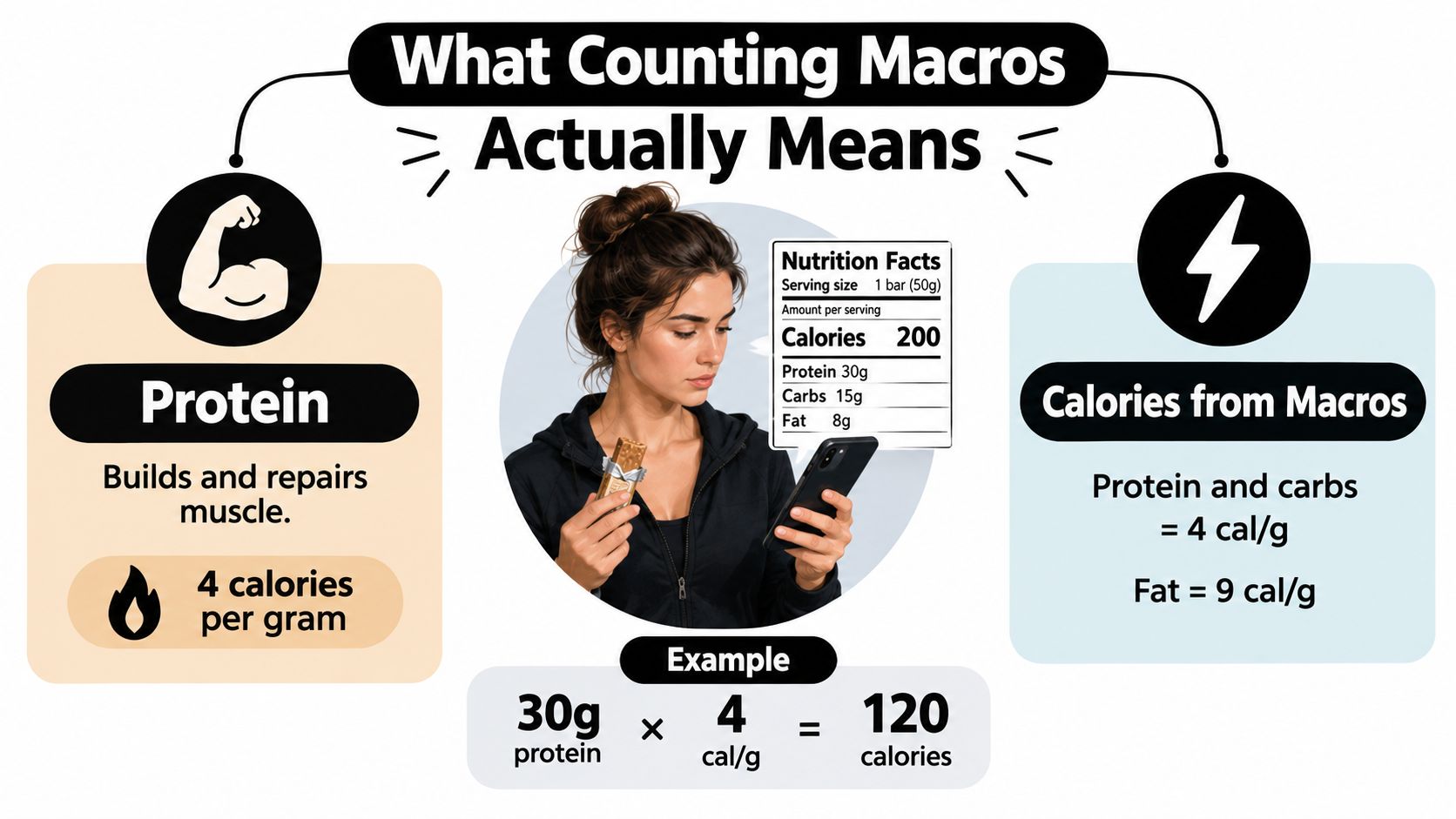
The working definition is worth remembering: macros are the lever, calories are the outcome. Once you know the three gram values and the 4-4-9 conversion, the math is straightforward. The difficult part is recording portions consistently enough that the math describes what you ate.
Calculating Your Daily Calorie and Macro Targets
Start with a calorie target, then convert that target into grams. A calorie number without macro guidance can leave you eating very little protein or overlooking how quickly oils, sauces, and other fat sources raise the total.
For a worked example, consider a 32-year-old, 175-pound, 5-foot-10 moderately active male. A Mifflin-St Jeor estimate places his maintenance intake at around 2,650 calories. Treat that as a starting estimate, not a laboratory measurement. Daily movement, training, sleep, appetite, and body-weight trends can all make the maintenance level different.
Convert the target into grams
Choose a percentage split that stays within the adult AMDR ranges, convert each percentage into calories, then divide protein and carbohydrates by 4 and fat by 9. The following examples use the requested goal-based splits:
| Goal | Calories | Protein (g) | Fat (g) | Carbs (g) | Split P/F/C |
|---|---|---|---|---|---|
| Fat loss | ~2,150 | ~160 | ~70 | ~215 | 30/30/40 |
| Maintenance | 2,650 | ~165 | ~90 | ~300 | 25/30/45 |
| Lean muscle gain | ~2,900 | ~180 | ~80 | ~365 | 25/25/50 |
For example, the fat-loss plan assigns 30% of calories to protein, 30% to fat, and 40% to carbohydrates. The percentages are converted into calories first, then into grams using the 4-4-9 rule. Small differences can appear because rounded gram targets don't always reproduce the original calorie total exactly.
Protein shouldn't automatically rise or fall just because calories change. Protein is better considered alongside body size, lean mass, training, appetite, and recovery, rather than treated as a leftover percentage. A nutrition review presents the adult protein AMDR as 10% to 35% of calories and translates it to roughly 1.05 to 3.67 grams per kilogram of body weight per day in a reference context, while also identifying a 30-gram minimal fat reference in one review context, as detailed in NCBI Bookshelf's nutrition reference.
Review the plan against real data
Run the target for about two weeks of honest tracking before making a major adjustment. The AI Meal Planner calorie and macro calculator can help turn a calorie goal into a starting split, while a guide such as Yuve's 1800-calorie planning resource can provide context for how calorie totals are organized across a day.
After the trial period, ask whether your body-weight direction, gym performance, hunger, and food routine match the goal. Adjust the distribution by preference and response, while keeping the AMDR ranges as guardrails rather than forcing every day into a rigid spreadsheet.
Converting Food Labels Into Macro Totals
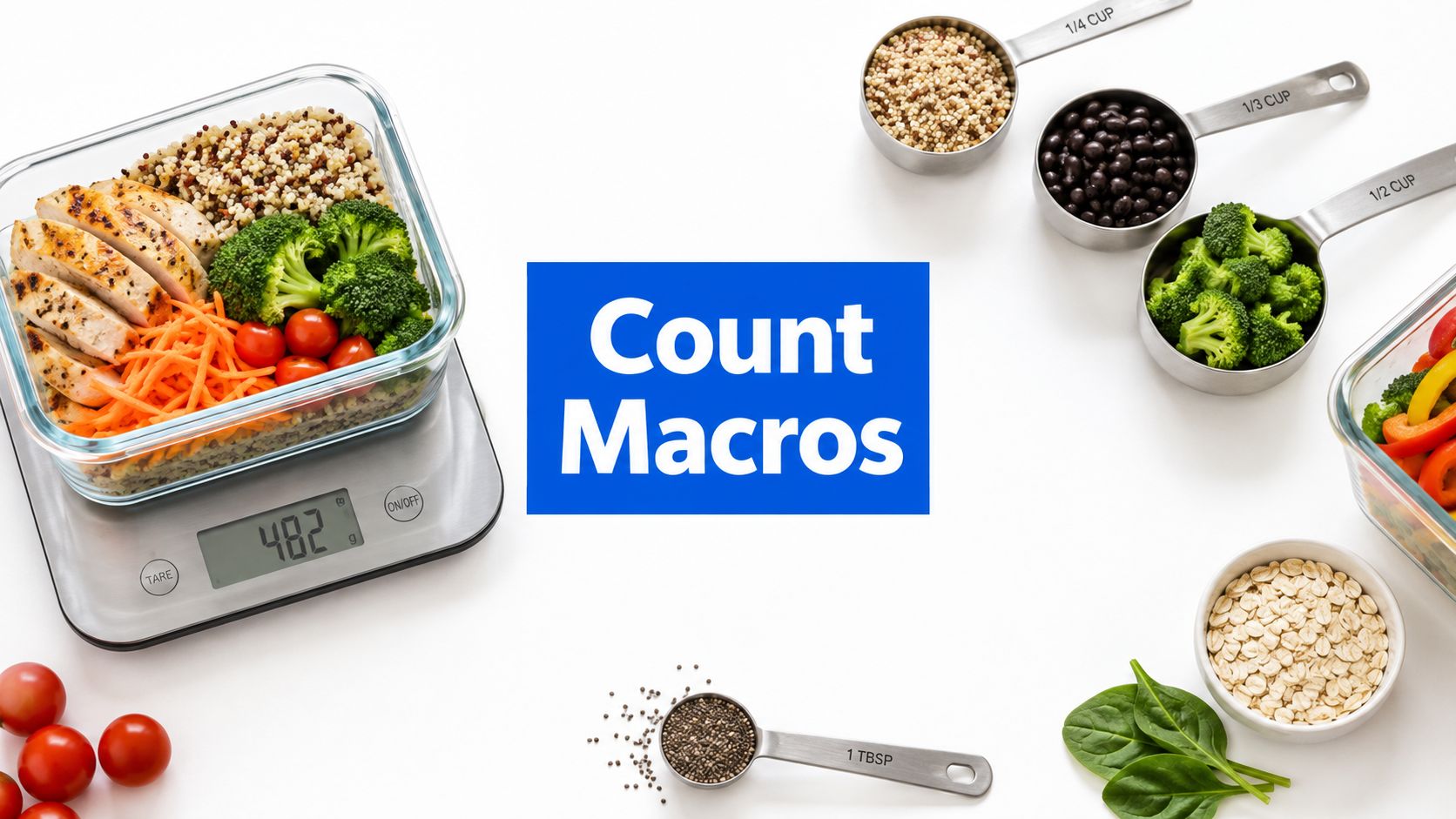
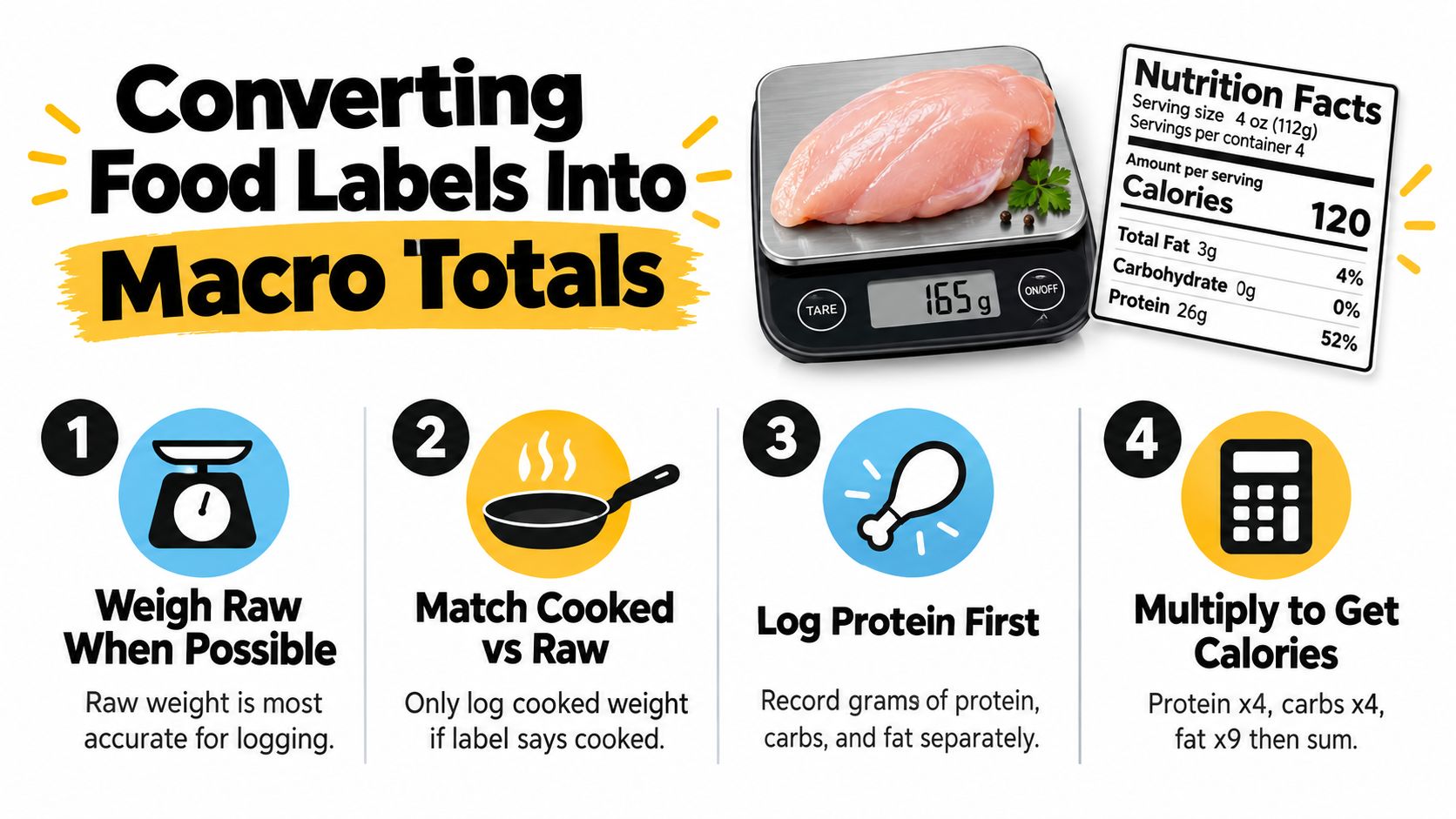
The most reliable workflow begins before food reaches the pan. Weigh portions raw when possible, especially meat, rice, pasta, and other ingredients whose water content changes during cooking. Log cooked weight only when the database or label specifically describes the food as cooked, because raw and cooked entries can represent different amounts of water and therefore different grams per portion.
Start with the serving size, then scale every macro to the amount you eat. Don't record only calories. Enter protein, total carbohydrates, and total fat separately so the daily totals show where your energy is coming from.
Read the label in a fixed order
Use this sequence:
- Confirm the serving size: Check whether the label describes a cup, package, slice, or specific gram weight.
- Scale the portion: If you eat more or less than the listed serving, multiply each macro by the same portion factor.
- Record the three macros: Use total carbohydrate, total fat, and protein, not only the calorie line.
- Check the arithmetic: Apply protein × 4, carbohydrates × 4, and fat × 9.
Take a Greek yogurt cup labeled as 150 grams, with 15 grams of protein, 7 grams of carbohydrates, and 0 grams of fat. The macro calculation is 15 × 4 + 7 × 4 + 0 × 9 = 88 calories. If the package states 90 calories, that small difference can result from rounding and label conventions. The 4-4-9 calculation is a checking tool, not a demand that every printed calorie number match perfectly.
Practical rule: Weigh the ingredients that are easy to underestimate, especially oils, spreads, cereal, rice, pasta, nuts, and cheese.
FoodData Central is useful when you're logging homemade or bulk ingredients without a commercial label. For additional label-reading context, Pep Tea Australia's food-labelling resources offer a practical reference point for interpreting packaged-food information. You can also compare standard food entries through the AI Meal Planner food database, particularly when a package label isn't available.
Copy this daily template
A simple day might look like this:
- Breakfast: 35 grams protein, 40 grams carbohydrates, 12 grams fat
- Lunch: 45 grams protein, 55 grams carbohydrates, 18 grams fat
- Snack: 20 grams protein, 30 grams carbohydrates, 8 grams fat
- Dinner: 50 grams protein, 60 grams carbohydrates, 25 grams fat
The daily sum is 150 grams of protein, 185 grams of carbohydrates, and 63 grams of fat. Compare those totals with your targets before deciding what to eat next. If protein is short, the next meal can include a protein-rich ingredient. If fat is already high, measure cooking oil and choose a lower-fat preparation rather than trying to “fix” the entire day at dinner.
A video can reinforce the label workflow visually:
Handling Mixed Meals, Leftovers, and Restaurant Food
Mixed meals are where tidy macro math meets messy cooking. A casserole may contain several meats, grains, oils, cheese, and sauces, while a restaurant dish can hide butter or dressing beneath an otherwise reasonable-looking plate. The issue isn't that these meals are impossible to track. It's that the margin of error increases when you don't separate the ingredients before serving.
Use the recipe-divide method
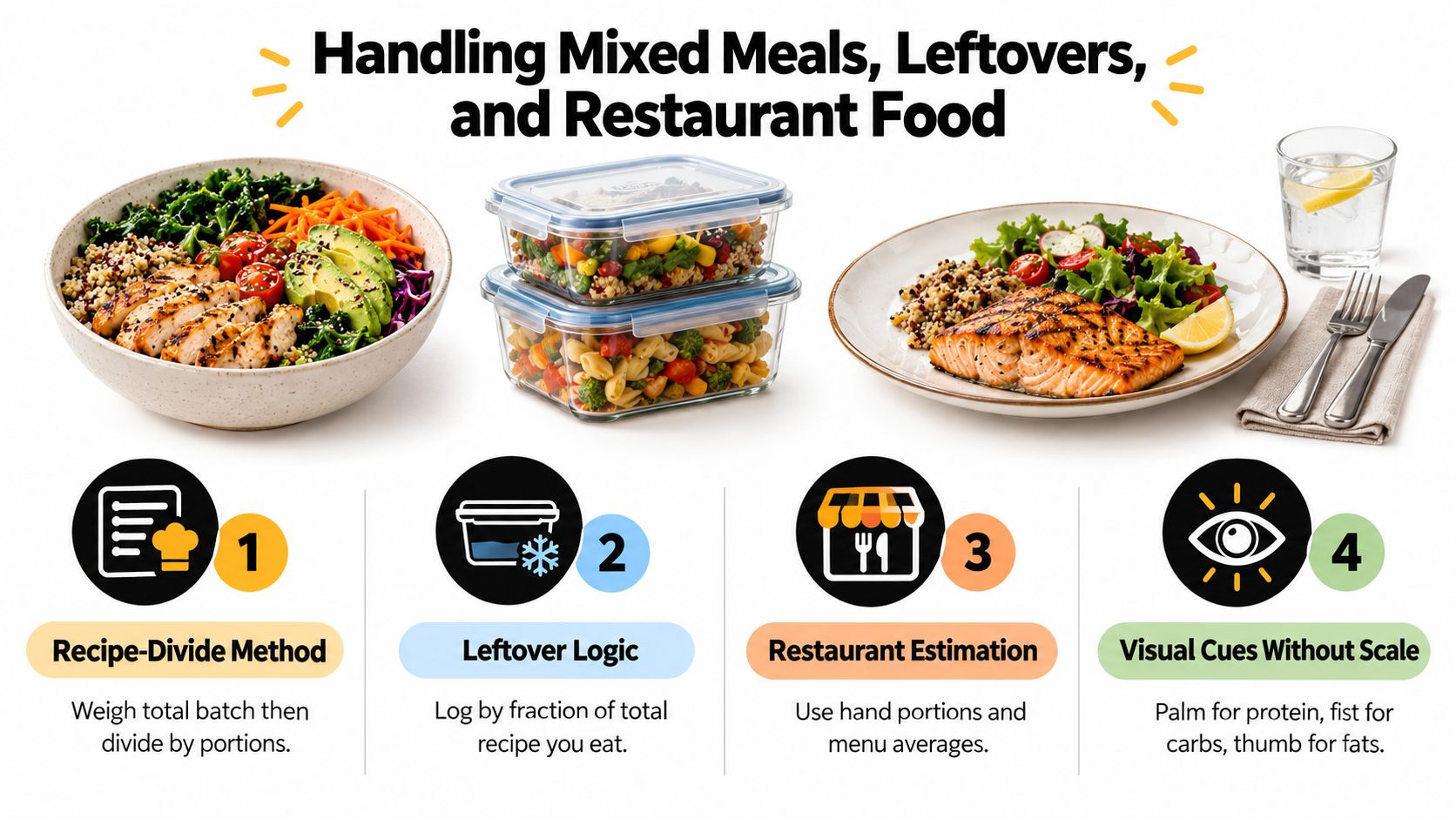
For a casserole, stir-fry, pasta bake, or soup, enter every ingredient into one recipe. Weigh the finished batch, record the total cooked weight, and divide the total macros by the number of equal portions or by the portion weight. If the finished dish is divided into identical containers, log one container and reuse that entry for the remaining meals.
For leftovers, weigh the full batch once and decide how you'll portion it. If you eat a quarter of the recipe, log a quarter of its total macros. If you eat by container weight, save the recipe per gram so a different serving can be recorded without rebuilding the meal.
Estimate restaurant meals deliberately
Without a scale, use visual proxies:
- Protein: Estimate a portion around the size of your palm.
- Carbohydrates: Use a cupped hand for rice, pasta, potatoes, or similar foods.
- Fats: Use a thumb as a visual guide for oils, spreads, or dense additions.
- Sauces: Add a separate estimate rather than assuming the entrée entry includes every dressing or topping.
Pre-log a common menu choice from the restaurant's nutrition guide when that information is available. This won't make the meal exact, but it prevents the most common failure, waiting until after eating and then choosing an entry that looks convenient rather than one that resembles the actual plate.
Use a quick sanity check when labels and scales are missing:
- Identify the visible protein, carbohydrate, and fat sources.
- Look for cooking oil, butter, cheese, dressing, cream, and sweetened drinks.
- Compare the portion with a familiar meal you've weighed before.
- Record the estimate immediately, including what you're uncertain about.
Cream sauces and nut-based dishes deserve extra scrutiny. Their calories can hide in a relatively small volume, so a bowl that looks moderate may contain more fat than the visible ingredients suggest. Record the meal, move on, and use the estimate consistently if you order it again.
Making Macro Tracking Stick Week After Week
Macro counting usually fails because of adherence, not because someone can't multiply by 4 or 9. A mobile self-monitoring study defined adherence as logging at least 3 eating events or at least 50% of the daily caloric goal on a study day. Observed adherence was 32% in the control arm, 37.9% in the app arm, and 27.5% in the paper arm, as reported in the PMC study on mobile self-monitoring adherence.
Another study found that logging at least two eating occasions per day was a practical benchmark for sufficient tracking, and that counting the days meeting that minimum may assess adherence better than asking whether someone tracks macros. The implication is practical: a partial but repeated record can be more useful than a perfect system abandoned after a demanding week.
Build a weekly system
Pin this checklist somewhere visible:
- Weigh breakfast staples once: Measure the foods you repeat, then save the entries.
- Batch-log recurring meals: Create recipes for lunches, dinners, and snacks that appear often.
- Review weekly patterns: Look at averages and repeated gaps instead of punishing one unusual day.
- Schedule a Sunday reset: Use a short planning session to prepare the next week's staples and saved meals.
A 2025 study reported mean adherence rates of 0.55 in a self-management group, 0.72 with personal feedback, and 0.83 with intensive support, according to the JMIR dietary self-monitoring research. That pattern supports a coaching principle I've seen repeatedly: reducing decisions and adding feedback often matters more than making the tracker more elaborate.
Missing a day is a logging event, not a verdict about your diet.
After a restaurant meal or skipped day, don't compensate with an extreme restriction. Log the next meal normally and return to the routine within the next day. Pair logging with an existing cue, such as entering breakfast after brushing your teeth or recording dinner while your morning coffee brews. The cue should be stable enough that the habit doesn't depend on motivation.
The AI Meal Planner grocery list generator can support this approach by turning recurring meals into a more organized shopping routine, which reduces the number of decisions between choosing a target and eating a trackable meal.
How AI Meal Planner Handles the Math for You
Manual tracking teaches you what the numbers mean. Automation removes much of the repetitive work that makes the system difficult to maintain. The useful distinction is not whether the math matters. It's whether you want to perform the same calculations and ingredient checks every week.
A practical automated workflow looks like this:
- Enter your inputs: Add weight, goal, activity level, dietary preferences, and relevant restrictions.
- Set the energy target: The system estimates a daily calorie goal based on those inputs.
- Apply the macro split: Protein, carbohydrates, and fat are converted from calorie percentages into grams using the 4-4-9 rule.
- Generate meals: Breakfast, lunch, dinner, and snacks are assembled around the daily targets.
- Review each recipe: The macro breakdown remains visible for individual meals and recipes.
- Create the shopping plan: Ingredients are consolidated into a grocery list, grouped by aisle, with quantities calculated for the week.
AI Meal Planner's stated workflow aims to keep generated daily meals within a 5-gram tolerance of the assigned macro targets. It also presents an estimated saving of roughly two hours per week compared with manual tracking. Those figures describe the product's workflow, not a guaranteed result for every user, because time savings depend on how often you repeat meals, how accurately your food database reflects ingredients, and how much you customize.
The biggest practical benefit is continuity. A plan that already includes recipes, portions, macro breakdowns, and a grocery list removes the daily loop of weighing every ingredient, searching labels, and deciding what can fill the remaining gap. You can still inspect the calculations and adjust meals, but you're starting with a structured day instead of an empty tracker.
The AI Meal Planner AI nutritionist can serve as an automated option for users who want meal suggestions aligned with their calorie and macro goals. New users can start with a free meal plan through AI Meal Planner onboarding to review the generated macros before planning a full week.
Troubleshooting When Your Macros Stop Working
When progress stalls, separate math errors from adherence errors. First, re-weigh a few foods you eat repeatedly. Then audit two random days in your tracker, looking for cooking oils, drinks, sauces, package servings, raw-versus-cooked mismatches, and snacks entered from memory.
Next, compare the logged intake with actual body-weight trends over a 7-to-14-day window. A single weigh-in can be noisy, so use the broader pattern to decide whether the calorie target is producing the intended direction. If the logged numbers and physical trend disagree, check recording accuracy before changing the entire macro split.
Use a decision path
- If portions were estimated: Weigh the batch-cooked foods and the calorie-dense additions first.
- If logging was incomplete: Repeat familiar meals and record them immediately after eating.
- If protein is low: Correct protein before cutting more food elsewhere.
- If adherence is solid but progress is flat: Adjust the calorie target modestly and observe another tracking window.
For plateaus, some plans cycle carbohydrates or fat by 10% to 15% while keeping protein stable. A nutrition review identifies 0.7 grams of protein per pound of body weight as a lower boundary in the context described by the source material, so dropping protein casually can work against recovery and lean-mass retention. Use a qualified clinician or registered dietitian for individualized targets, especially with medical conditions, pregnancy, medication changes, or eating-disorder history.
Common drift often comes from ordinary details:
- Weekend alcohol: Drinks and accompanying food can go unrecorded.
- Cooking oil: One tablespoon adds 120 calories, according to the provided nutrition guidance.
- Healthy snacks: Nuts, granola, nut butter, dried fruit, and energy bites are easy to underestimate because small portions can be calorie-dense.
A useful reset is to repeat the same meal templates for two weeks, weigh batch-cooked portions at the start of the week, and reintroduce variety once your weight and measurements confirm the direction. The highest-leverage fix is usually not more software. It's measuring the foods that create repeated drift, then saving those portions so you don't need to repeat the effort every day.
AI Meal Planner turns your calorie and macro targets into structured meals, visible recipe nutrition, and a consolidated grocery list, so you can spend less time calculating and more time cooking. Visit AI Meal Planner to generate a free plan, review the macro breakdown, and build a week that fits your schedule.
AI-powered nutrition
Get Your Personalized Meal Plan
AI creates the perfect meals for your goals, lifestyle, and taste.
Start Your Journej