How to Calculate Macros for Weight Loss: A Practical Guide
To figure out your macros for weight loss, you'll first pin down your total daily calorie needs, create a manageable deficit, and then break those calories down into specific gram targets for protein, fat, and carbohydrates. This whole process is about shifting your focus from just how much you eat to what you're eating. It gives you far more control over your energy and body composition.
Why Counting Macros Is More Than Just Numbers
Graduating from simple calorie counting can feel like a big step, but learning to manage your macronutrients—your "macros"—is what unlocks a smarter, more sustainable path to weight loss. Instead of viewing all calories as the same, this approach recognizes that protein, fats, and carbs each have a unique and critical job in your body.
Here's a simple way to think about it: 100 calories from a chicken breast and 100 calories from a cookie are technically equal in energy, but they trigger completely different responses in your body. One supports muscle and keeps you full, while the other can spike your blood sugar and leave you hungry for more. This is the whole idea behind tracking macros.
The Role of Each Macronutrient
Each macro brings something different to the table, which is why balancing them correctly is so effective for changing your body composition—not just the number on the scale.
Protein: This is your best friend when you're in a deficit. Protein is essential for building and repairing tissue, and getting enough of it helps you hold onto precious muscle mass while you lose fat. That muscle is what keeps your metabolism firing. Plus, it's incredibly satiating, so it helps you feel fuller for longer and keeps cravings at bay.
Fats: Healthy fats are far from the enemy! They are absolutely crucial for producing hormones that regulate everything from your appetite to your metabolism. They also support brain health and are necessary for absorbing certain vitamins.
Carbohydrates: As your body's preferred fuel source, carbs give you the energy you need to crush your workouts and just get through a busy day. The key is to focus on complex carbs from whole foods, which provide a steady stream of energy without the dramatic highs and lows you get from simple sugars.
A macro-based plan isn't about restriction; it's about making deliberate food choices that align with your goals. You're fueling your body for health and performance, not just starving it to lose weight.
This entire process is built on a foundation of your personal energy needs. It all starts with your Total Daily Energy Expenditure (TDEE), which is a fancy term for how many calories you burn in a day, factoring in both your baseline metabolism (BMR) and your activity level. From there, weight loss is a matter of creating a consistent energy deficit by setting a calorie target that’s typically 10-20% below your TDEE. For a deeper dive, you can learn more about the science behind these nutrition calculations from industry experts.
Before we get into the nitty-gritty of the formulas, let's lay out the roadmap. This simple overview will give you a clear picture of the entire journey from start to finish.
Your Macro Calculation Roadmap
Here's a high-level look at the core steps we'll follow. Think of this as your game plan for creating a personalized and effective macro strategy.
| Phase | What You'll Do | The Main Goal |
|---|---|---|
| Phase 1: Estimation | Calculate your BMR and TDEE. | Find your personal daily calorie maintenance level. |
| Phase 2: Deficit | Set a sustainable calorie deficit. | Create a calorie goal for consistent weight loss. |
| Phase 3: Allocation | Convert calories into macro grams. | Define your protein, fat, and carb targets. |
| Phase 4: Adjustment | Monitor progress and fine-tune. | Adapt your plan as your body changes over time. |
With this framework in mind, you're ready to start building a plan that truly works for you. Let's get started.
Finding Your Personal Calorie Starting Point

Nailing down your personal calorie requirement means you’re not shooting in the dark. In this section, you’ll calculate your Basal Metabolic Rate (BMR) with the Mifflin-St Jeor formula. Then we’ll translate that number into Total Daily Energy Expenditure (TDEE) using an activity factor that matches your day-to-day life.
Before diving into macros, get a solid foundation by exploring how to calculate daily calorie needs. That walkthrough includes examples for different ages, genders, and activity levels.
Calculating Your Basal Metabolic Rate
BMR represents the calories your body burns at rest. It factors in your weight, height, age, and a sex-specific constant. Compared to generic online calculators, this approach gives you a more precise starting point.
Gather these details:
- Weight in kilograms (kg)
- Height in centimeters (cm)
- Age in years
- Sex-specific constant (men +5, women −161)
For instance, take Emma, a 35-year-old who weighs 70 kg at 165 cm tall. Her calculation breaks down like this:
- 10 × 70 kg = 700
- 6.25 × 165 cm = 1031.25
- 5 × 35 years = 175
- Female constant = −161
Adding those up gives Emma a BMR of 1395.25 calories. In a similar case, Mark—a 40-year-old teacher at 65 kg and 170 cm—lands near 1423 calories.
Estimating Total Daily Energy Expenditure
Your BMR is just the baseline. Everything from your morning walk to evening workout bumps up your total needs. Apply an activity multiplier that reflects your routine:
- Sedentary (desk job) = BMR × 1.2
- Lightly Active (regular walking) = BMR × 1.375
- Moderately Active (gym sessions 3× weekly) = BMR × 1.55
- Very Active (physical labor or intense training) = BMR × 1.725
Imagine Alex, who works remotely but hits 8,000 steps daily. He chooses the 1.375 multiplier:
- 1395.25 × 1.375 = 1919 calories TDEE
Knowing your actual TDEE helps you avoid drastic cuts that burn you out.
Real-World Adjustment Tips
- Keep a food log for 7 days, then compare your weight changes.
- If progress stalls or swings wildly, tweak your multiplier by 0.05.
- Experiment with different multipliers on weekends versus weekdays.
| Activity Level | Multiplier | Sample TDEE |
|---|---|---|
| Sedentary | 1.2 | 1674 calories |
| Lightly Active | 1.375 | 1919 calories |
| Moderately Active | 1.55 | 2163 calories |
| Very Active | 1.725 | 2408 calories |
That TDEE figure becomes the anchor for your calorie deficit. It keeps your cuts moderate so you preserve performance and muscle mass.
Applying Your Calorie Baseline
With your TDEE in hand, meal planning turns from guesswork into strategy. You can set achievable calorie targets for each day based on your activity level.
Here are a couple of real-life scenarios:
Case Study: Teacher Sarah
• BMR 1423 × 1.55 = 2206 calories maintenance
• Gym days: ~2200 calories, Rest days: ~2000 caloriesCase Study: Remote Worker Alex
• BMR 1395.25 × 1.375 = 1919 calories maintenance
• Targets 1700 calories on all days, focusing on balanced meals and regular walks
These slight adjustments keep energy levels steady while maintaining a manageable deficit. Track intake for two weeks, then add or subtract 50–100 calories if your weight trends don’t match expectations.
Key Takeaways
Consistency with your calorie baseline trumps perfection.
Your BMR and chosen activity multiplier are the foundation of any effective weight-loss macro plan.
Having a clear TDEE number removes guesswork, reduces extreme dieting risks, and guides smart macro distributions.
How AI Meal Planner Helps
AI Meal Planner turns your TDEE into daily meal suggestions so you can focus on life, not math.
- Builds weekly menus that hit your calorie and macro targets.
- Provides exact portion sizes to keep you on track.
- Automatically updates recommendations as you log progress.
Log daily meals, watch your data, and let the planner handle the calculations.
Creating a Smart and Sustainable Calorie Deficit
Once you've figured out your Total Daily Energy Expenditure (TDEE), you have your magic number—the amount of energy your body uses every day. To start losing fat, we need to create a calorie deficit, which just means eating slightly less than this maintenance number.
The goal here isn't to slash calories drastically. That’s a classic mistake that leads to burnout, muscle loss, and a sluggish metabolism. Instead, think of it as a strategic, gentle nudge that encourages your body to start using its fat stores for energy. This is the foundation of any effective weight loss plan.
Choosing Your Deficit Percentage
For most people, a deficit of 15-25% below your TDEE is the sweet spot. It’s a moderate enough drop to kickstart fat loss without making you feel hungry, tired, or weak during your workouts.
Let’s break down what those numbers look like in the real world:
- A Gentle Deficit (15%): Perfect if you have a smaller amount of weight to lose, you're very active and want to protect your performance, or you're tired of yo-yo dieting. The weight loss will be slow but incredibly steady.
- A Moderate Deficit (20%): This is the go-to starting point for a reason. It delivers noticeable progress without feeling overly restrictive, making it a great balance for most people.
- A More Ambitious Deficit (25%): This can work well if you have a lot of weight to lose, but you have to be honest with yourself. It demands close attention to your energy levels and hunger signals.
The best deficit is the one you can actually stick with, not the one that promises the fastest results on paper. Consistency will always win out over short-term intensity.
Real-World Deficit Scenarios
A deficit that’s manageable for a 22-year-old athlete might feel completely impossible for a 40-year-old parent juggling a career and family. Your life dictates what's realistic.
Scenario 1: The Busy Professional Meet Sarah, a 40-year-old with a TDEE of 2,200 calories. If she tried an aggressive 30% deficit, she’d be down to 1,540 calories—a recipe for exhaustion and poor focus at work. A much smarter 20% deficit puts her at 1,760 calories, giving her enough fuel to feel good while still making progress.
Scenario 2: The College Student Now, let's look at Ben. He's 22 and his TDEE is 2,800 calories. He has more wiggle room. A 25% deficit for him is 2,100 calories, which is still plenty of food to support his active lifestyle and promote steady fat loss without feeling deprived.
While getting your macros right is crucial for feeling full and preserving muscle, the calorie deficit is what ultimately drives the number on the scale down. Study after study confirms that an energy deficit is the most critical factor for weight loss. For instance, one major meta-analysis showed that while different diets worked initially, the results often disappeared by the one-year mark simply because people couldn't stick with them. You can read the full research on diet adherence and calorie deficits if you want to dive deeper.
To make sticking to your new calorie target a whole lot easier, incorporating practical meal prep ideas for weight loss is a game-changer. When you have delicious, macro-friendly meals ready to go, you eliminate guesswork and decision fatigue.
Turning Your Calorie Goal Into Daily Macros
Alright, you've got your daily calorie target. That's a huge first step, but it's only half the battle. Now, we need to translate that single number into a language your body understands: protein, fats, and carbohydrates. This is where the magic really happens.
Think of it like a budget. Your calories are the total amount you can spend, and macros are the different spending categories. How you allocate that budget determines the quality of your results.
We'll start with the most important one.
First, Nail Your Protein Intake
Protein is the cornerstone of any successful fat loss plan. It’s not just for bodybuilders. Getting enough protein keeps you feeling full and satisfied, which is a lifesaver when you're in a calorie deficit. More importantly, it helps protect your hard-earned muscle from being broken down for energy.
The goal is to lose fat, not just "weight." Preserving muscle is key to keeping your metabolism fired up.
For fat loss, a solid target is 1.6 to 2.2 grams of protein per kilogram of your body weight (or about 0.7 to 1.0 grams per pound). If you're very active or find yourself constantly hungry, lean toward the higher end of that range.
Let’s say you weigh 70 kg (about 154 lbs). Your daily protein target would be between 112 and 154 grams. It’s a simple multiplication that sets the foundation for everything else.
Second, Set Your Healthy Fats
Fats often get a bad rap, but they are absolutely essential. They play a crucial role in hormone production, brain function, and absorbing certain vitamins. Cutting them too low is a recipe for feeling run down and miserable.
A sensible range for fats is 20-30% of your total daily calories. This provides enough for your body's needs without taking up too much of your calorie budget.
Here’s how to figure it out for a 2,000-calorie target, aiming for 25% from fat:
- Step 1: Calculate your fat calories: 2000 calories × 0.25 = 500 calories from fat.
- Step 2: Convert those calories to grams. Since fat has 9 calories per gram, you just divide: 500 ÷ 9 = ~56 grams of fat per day.
Easy enough, right? Stick to sources like avocado, nuts, seeds, olive oil, and fatty fish.
Third, Fill the Rest With Carbs
Once your protein and fat targets are locked in, the rest of your calories are allocated to carbohydrates. Carbs are your body's preferred source of fuel, especially for your brain and your workouts. They give you the energy to perform well in the gym and get through your day without feeling sluggish.
Calculating your carb target is just a matter of figuring out what's left over.
The infographic below gives a great visual of how a calorie deficit works—it's about strategically reducing your energy intake to encourage your body to use stored fat for fuel, all while keeping protein high to protect muscle.
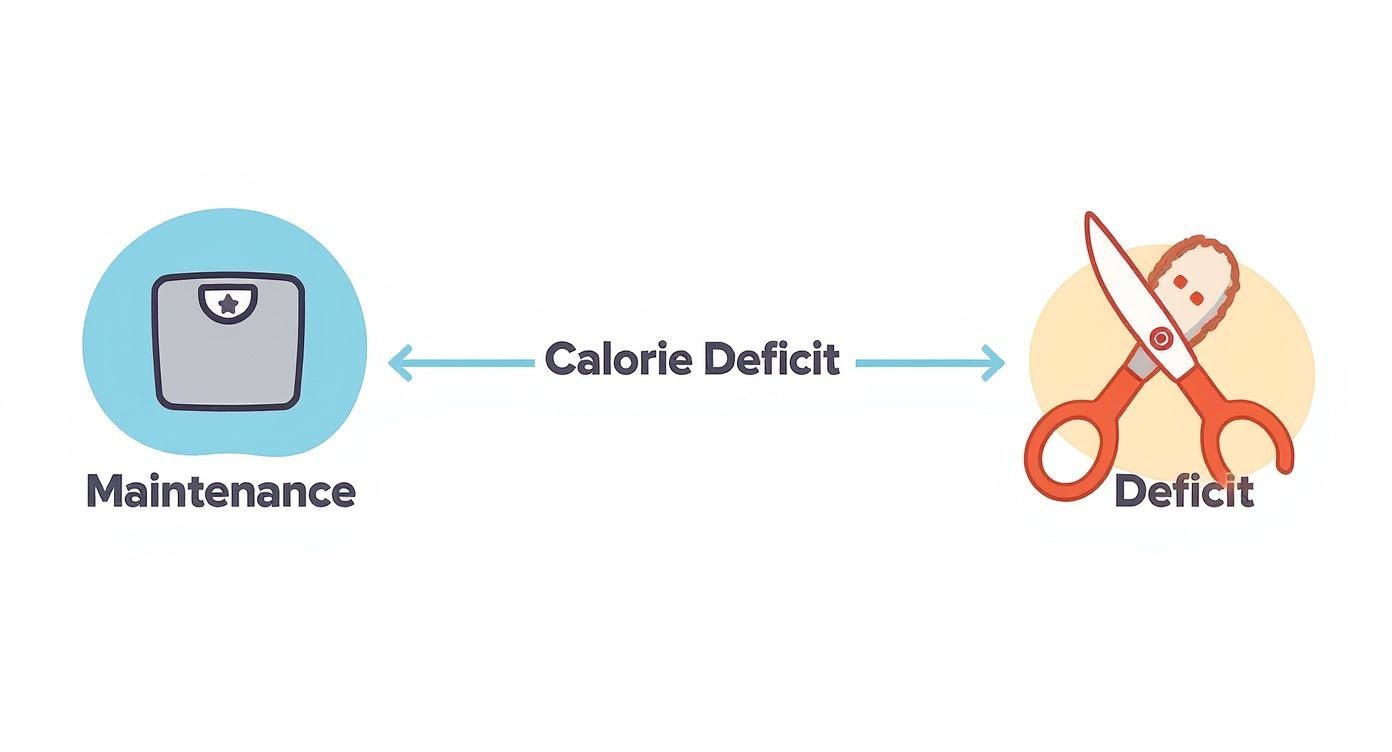
This shows exactly why we prioritize protein and then fill in the gaps—it ensures the weight you lose is primarily fat.
Putting It All Together: Sample Macro Splits
To show you how this plays out, let's look at how different dietary preferences might change the numbers, all while sticking to the same 2,000-calorie goal.
Sample Macro Splits for a 2000-Calorie Target
This table shows how different dietary approaches change your daily protein, fat, and carb grams, all based on the same 2000-calorie goal.
| Diet Style | Protein (g) | Fat (g) | Carbs (g) |
|---|---|---|---|
| Balanced | 150 | 56 | 225 |
| Lower-Carb | 150 | 78 | 175 |
| Higher-Protein | 200 | 56 | 175 |
As you can see, there's no single "perfect" split. The best one is the one that you can stick to consistently, feels good for your body, and supports your energy levels. A "balanced" approach is a fantastic starting point for most people.
Making It Easy with Automation
Manually calculating and planning all this can feel like a chore. That's where technology can lend a hand. Instead of staring at a spreadsheet, you can let an algorithm do the heavy lifting.
The AI Meal Planner is designed to do just that. It takes your personal calorie and macro targets and instantly generates a full day of meals that hit your numbers perfectly.
It's a game-changer for consistency. It removes the guesswork and decision fatigue, so all you have to do is follow the plan. You can learn more about how it works and get started with our smart Meal Plan Generator.
What to Do When Progress Stalls
Sooner or later, you'll likely hit a plateau. It happens to everyone. When your weight hasn't budged for two solid weeks, it's time to make a small adjustment. Don't panic and slash your calories in half.
Instead, make a small tweak:
- Reduce your total daily calories by 50-100. This can be done by trimming a little fat or a few carbs.
- If your workouts feel sluggish, try adding 10-20 grams of carbs around your training time.
- Feeling overly hungry? A small increase in fat or protein can often help with satiety.
Also, be honest with your tracking. Hidden calories are a common culprit. A splash of creamer here, a little too much cooking oil there—it all adds up. Measure things like oils and sauces instead of just eyeballing them.
Common Pitfalls to Sidestep
I see the same mistakes trip people up time and time again. Avoid these common blunders:
- Fear of Fats: Cutting fats too low (below 20%) can mess with your hormones and leave you feeling awful.
- Forgetting Liquid Calories: That nightly glass of wine or weekend cocktail has calories that count. Be sure to track them.
- Going Too Low-Carb: Unless you're specifically following a ketogenic diet, slashing carbs too aggressively will likely tank your gym performance.
Your macros are a powerful tool. By setting them intelligently and adjusting as you go, you’re not just dieting—you’re giving your body a precise blueprint for success.
Focusing On Food Quality Not Just Grams
Tracking macros lays out a solid blueprint for weight loss, but the story only finishes when you decide what foods fill those numbers. After all, 150 grams of carbs could mean a bowl of steel-cut oats or a sleeve of cookies—and those choices send your body down very different paths. Let’s dive into why quality matters just as much as quantity.
The Real-World Impact Of Your Food Choices
When you swap nutrient-poor options for whole foods, day-to-day life shifts in subtle yet powerful ways. You’ll notice fewer energy crashes, more stable hunger levels, and workouts that feel more productive.
- Protein Sources: A chicken breast delivers pure protein without the sodium, nitrates, and fats lurking in many processed varieties.
- Fat Sources: Avocado’s monounsaturated fats keep hormones humming and support heart health, while the trans fats from fried snacks ignite inflammation.
Whole, nutrient-rich foods do more than tally up macros. They flood your body with vitamins, minerals, and fiber—helping digestion, taming cravings, and dialing down inflammation. Ultimately, this makes your weight-loss plan feel less like a struggle and more like sustainable living.
Choosing high-quality, whole foods is how you make your macros work for you. It’s about fueling your body with the best possible ingredients to support your fat loss goals and long-term well-being.
A 20-year U.S. study backs this up. Diets low in refined carbs but rich in plant-based proteins and fats led to less weight gain over time than those heavy on animal products or processed foods. You can read the full study on macro quality and weight outcomes here.
Practical Tips For Prioritizing Quality
Upgrading your nutrition doesn’t require a kitchen overhaul. Start with small swaps and build momentum.
Simple Food Swaps For Better Macros
| Instead Of This... | Try This... | The Benefit |
|---|---|---|
| White Rice | Quinoa or Brown Rice | More fiber and a slower energy release. |
| Sugary Cereal | Oatmeal With Berries | Sustained fuel plus antioxidants. |
| Creamy Dressings | Olive Oil & Vinegar | Clean fats without added sugars. |
| Processed Meats | Grilled Chicken Or Fish | Top-notch protein without excess sodium. |
Mastering how to calculate macros for weight loss sets the stage. Filling those macros with nutrient-dense choices brings it home. For anyone focused on muscle retention and keeping hunger at bay, a high-protein meal plan offers practical, flavorful ideas that fit this approach perfectly. By pairing precise numbers with smart ingredients, you’ll craft a plan that’s both effective and enjoyable.
How to Adjust Your Macros as You Progress
Your starting macro numbers are a great baseline, but they're not written in stone. Think of them as your launchpad, not the final destination. As you lose weight, get stronger, and your body adapts, your energy needs will naturally change. To keep seeing results, you’ll have to fine-tune your approach along the way.
First things first, you need to track more than just the number on the scale. Weight can be a tricky metric because it doesn't tell you the whole story about what's happening with your body composition.
To get a much clearer picture, you should also be tracking:
- Body Measurements: Grab a tape measure and log your waist, hips, chest, and thigh measurements every few weeks. It's not uncommon to see your weight stall while you're still losing inches—a classic sign you're shedding fat and building muscle.
- Progress Photos: Snap photos from the front, side, and back every month. Try to use the same lighting and outfit. The visual changes you see in photos often reveal progress the scale completely misses.
- How You Feel: Pay close attention to your energy levels and performance in the gym. Are you getting stronger? Is your energy steady throughout the day? These are huge clues that your body is well-fueled and responding positively.
Knowing When to Make a Change
The most obvious sign you need to adjust your macros is hitting a plateau. If your weight and measurements haven't budged for at least two or three weeks straight—and you've been truly consistent—it’s time for a small adjustment.
A sensible move is to reduce your daily calories by just 50-100, usually by cutting back a little on carbs or fats. This small, strategic drop is often all it takes to kickstart progress again without feeling like you're suddenly starving. Resist the urge to make drastic cuts; that can crush your energy and slow your metabolism.
Your body is incredibly adaptive. As it gets used to a certain intake, you need to make small, smart adjustments to keep it guessing and ensure your progress continues.
Are You Really in a Plateau?
Before you slash your calories, take an honest look at your tracking. More often than not, a "plateau" is actually just a case of hidden calories creeping back in. It happens to everyone.
- Cooking Oils and Sauces: Are you measuring the olive oil you cook with, or just pouring it from the bottle? A single tablespoon has over 100 calories.
- "Just a Handful" of Nuts: Calorie-dense foods like nuts and seeds are fantastic for you, but portion sizes are deceivingly small. A food scale is your best friend here.
- Liquid Calories: The creamer in your coffee, that glass of wine on Friday night... it all adds up. If you drink it and it has calories, it needs to be logged.
Having a solid plan is the best way to stay consistent. Tools like our weekly meal planner can do the heavy lifting for you by generating recipes and portion sizes that match your specific macro targets. It takes the guesswork out of the equation and makes staying on track almost effortless.
Answering Your Top Macro Questions
Once you start tracking macros, a few common questions always seem to pop up. Let's clear the air on some of the biggest ones so you can feel confident in your approach.
Do I Have to Hit My Macros Perfectly Every Single Day?
Absolutely not. Chasing perfection is a recipe for frustration. Instead, aim for consistency.
A good rule of thumb is to land within 5-10 grams of your protein and carb goals and within 2-5 grams of your fat target. Some days you'll be a little over on one macro and under on another—that’s just life. What truly matters is your weekly average.
As long as you’re consistently hitting your overall calorie deficit and getting enough protein, those minor daily shifts won't throw you off course.
The best macro plan is the one you can actually follow long-term. Don't let a quest for daily perfection sabotage your consistency.
What Happens If I Go Over My Calories for a Day?
First, don't panic. One day of eating more than you planned won't ruin weeks of hard work. The worst thing you can do is try to "punish" yourself by severely restricting your food the next day. This often kicks off a nasty cycle of binging and restricting.
The solution is simple: just get back on track with your very next meal. A single day is just one data point; weight loss is all about the long-term trend.
How Often Should I Recalculate My Macros?
Great question. As you lose weight, your body's energy needs change. A good milestone is to recalculate your macros after every 10-15 pounds of weight loss.
Your Total Daily Energy Expenditure (TDEE) will decrease as your body gets smaller, so your original calorie target might stop being a deficit. A quick recalculation ensures your plan stays effective and keeps your progress from stalling. Think of it as a tune-up for your nutrition plan.
Tired of the guesswork? Let AI Meal Planner handle the numbers for you. It builds delicious, personalized meal plans that hit your exact macro targets, day in and day out. Get your custom plan at https://ai-mealplan.com.
AI-powered nutrition
Get Your Personalized Meal Plan
AI creates the perfect meals for your goals, lifestyle, and taste.
Start Your Journej