What if one affordable vegetable could make weekly meals easier to plan while also supporting weight management, steadier energy, and better diet quality?
Butternut squash earns a regular place in my kitchen because it solves practical problems. It adds bulk without many calories, brings enough natural sweetness to make balanced meals more appealing, and works across soups, grain bowls, curries, sheet-pan dinners, and blended sauces. That range matters more than people think. A food only helps if you will buy it, cook it, and eat it consistently.
The bigger benefit is meal structure. Butternut squash helps build plates that feel satisfying instead of sparse, which is useful for fat loss phases, family dinners, and training weeks when appetite and recovery needs change. Pair it with protein and a source of fat, and you get a meal that is usually easier to stick with than a lighter, less planned option built around refined starches alone.
It also fits a modern meal planning system. If you use an AI meal planner, a macro tracker, or even a simple batch-cooking routine, butternut squash is easy to slot in because the ingredient is flexible, repeatable, and available in fresh, pre-cubed, and frozen forms. That makes it useful for goal-based planning, whether you are trying to control portions, smooth out blood sugar swings, stretch a grocery budget, or fuel training without relying on ultra-processed convenience foods.
Convenience matters here. Analysts at Market Research Future's butternut squash market report describe rising demand tied to health-conscious buying and easy-prep formats like cubed and frozen products. I see the same pattern in real kitchens. People use healthy ingredients more often when prep friction is low.
The practical value of butternut squash comes from how well it fits real life. It supports nutrition goals, but it equally helps reduce weeknight decision fatigue.
1. How does butternut squash help with immune support and eye health?
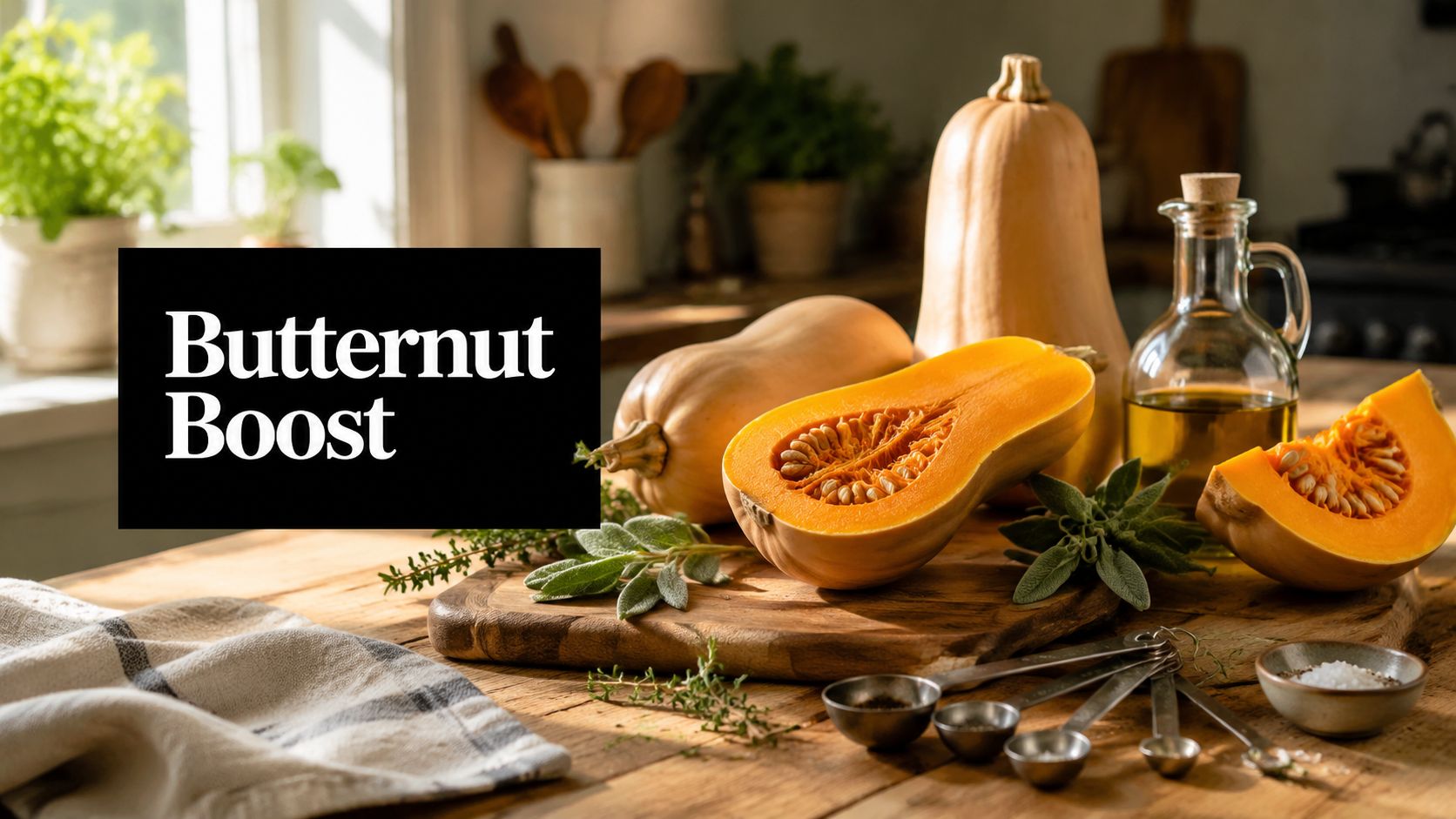
The first thing I look at with butternut squash isn't its sweetness. It's the color. Deep orange vegetables usually signal carotenoids, and butternut squash is naturally rich in them, especially beta-carotene. That matters because carotenoid-rich foods support the body systems people care about most in everyday life, especially vision and immune resilience.
A useful bonus is that you don't have to build a complicated meal around it. Roasted cubes alongside salmon, pureed into soup, or blended into a sauce all work.
Why this matters in real meals
Cleveland Clinic describes butternut squash as high in vitamin A, antioxidants, fiber, and potassium, and notes a low glycemic index profile with 63 calories per serving in its review of butternut squash health benefits. In practice, that makes it one of the easiest vegetables to use when you want nutrient density without making the plate feel “diet” food.
If you cook for a household, this is one reason squash works so well in colder months. Kids tend to accept its naturally sweet flavor. Adults usually like it roasted with olive oil, sage, or chili flakes. And if someone doesn't love chunks of squash, puree changes the texture completely.
Kitchen rule: Pair butternut squash with some fat. Olive oil, tahini, nuts, seeds, or avocado make the meal more satisfying and suit a carotenoid-rich food well.
A few ways I've seen work consistently:
- For dinner plates: Roast cubes with olive oil and serve them next to chicken thighs or baked cod.
- For soups: Blend cooked squash with garlic, onion, and broth for a smoother texture than pumpkin soup.
- For breakfast prep: Stir a spoonful of puree into oats with cinnamon if you want extra body without much effort.

The trade-off is preparation time. Whole squash can be awkward to peel and cut, so if knife work is what stops you from using it, buy it pre-cubed. A “healthy” ingredient you never cook doesn't help anybody.
2. Why is butternut squash good for digestion and staying full?
Butternut squash earns its place in a meal plan because it adds bulk, texture, and fiber without making the meal heavy. For clients who want better appetite control, that matters more than a vague “healthy” label. A lunch built around squash usually holds up better than a lunch built around crackers, granola bars, or a sweet coffee.
It also tends to be easier on the gut than some higher-fiber foods that cause problems when people increase them too fast. In practice, I use squash often for people who need more fiber but do not want the bloating that can come from jumping straight into very large servings of bran, raw cruciferous vegetables, or big bean-heavy meals.
How to make it more satisfying in real meals
As noted earlier, butternut squash contributes a meaningful amount of fiber. That helps with bowel regularity and satiety, but the result depends on the whole plate. A thin pureed soup can be comforting, yet it often wears off fast if it is mostly squash and cream. A thicker bowl with squash plus lentils, chicken, Greek yogurt, or white beans usually works better.
Meal planning becomes practical. If you use an AI-assisted meal planning system or even a simple template, squash fits well as the fiber-rich carbohydrate in meals built for appetite control. The pattern is straightforward: squash for volume and fiber, protein for staying power, and fat for pacing digestion and improving flavor.
If digestion is the goal, serve enough squash to matter and pair it with protein. A few cubes scattered on top of a salad will not do much.
A few combinations I recommend often:
- For lunch bowls: Roasted squash with lentils, arugula, pumpkin seeds, and lemon-tahini dressing.
- For soup nights: A thick squash soup with beans or shredded chicken, plus a side of plain yogurt or eggs.
- For gentler meals: Mashed squash with olive oil, salt, and herbs, served with baked fish or soft tofu.
- For athletes who need satiety without a heavy stomach: Squash, ground turkey, and cooked greens in a grain bowl.
Recipe style matters too. If a squash dish is loaded with sugar, the digestion and fullness benefits get diluted. For sweeter preparations, using brown rice syrup alternatives can help you keep the flavor profile you want without turning the dish into dessert.
Increase fiber gradually and drink enough fluid. That is the part people skip, then they blame the squash.
For readers focused on gut comfort, this guide on how to improve digestion naturally at home fits well with a meal pattern that uses more fiber-rich whole foods.

3. Can butternut squash support steadier energy and blood sugar?
Yes, and preparation and context matter more than the health halo. Butternut squash is often described as “low glycemic,” but that doesn't mean portion size stops mattering. It's still a carbohydrate-containing food, so the way you serve it changes the outcome.
For busy people, this matters most at lunch. A balanced squash-based lunch usually gives steadier energy than a meal built around refined bread or a sugary snack that fades fast.
How to use it more strategically
A practical source focused on glucose management notes that one cup cooked provides about 22 g carbohydrate, 6 to 7 g fiber, and about 80 to 82 calories, and that its effect depends on serving size, preparation method, and whether it's paired with protein and fat in a mixed meal, as explained in this piece on the benefits of butternut squash for blood sugar-aware eating. That's the kind of advice people need.
Roasted cubes usually give you a clearer sense of portion than pureed soup. Puree isn't bad, but it's easier to eat quickly and in larger amounts. If someone is managing diabetes or prediabetes, I'd rather see squash in a bowl with salmon, tofu, chicken, or beans than as a sweetened puree on its own.
A few examples that work better than the usual holiday-style preparation:
- For office lunches: Roasted squash, grilled chicken, cabbage slaw, and olive oil vinaigrette.
- For pre-workout meals: Squash with rice and lean protein if you want a softer, easier-to-digest carbohydrate mix.
- For glucose-aware dinners: Squash, turkey meatballs, and sauteed greens.
Practical rule: Chunked and roasted usually beats sweetened and pureed if your goal is slower eating and steadier blood sugar.
People who rely on syrups and sweeteners in sauces often cancel out the advantage of using squash in the first place. If you're reworking recipes, these brown rice syrup alternatives can help keep flavor balanced without leaning on the same sweetener every time.
4. What does butternut squash do for heart health and electrolyte balance?
Want a starchy side that pulls more weight nutritionally? Butternut squash earns a place in heart-conscious meal planning because it contributes potassium, along with fiber and carotenoids already covered earlier, while giving you a practical alternative to heavily salted processed sides.
One cup of cooked butternut squash provides about 582 mg of potassium, which is a meaningful amount for a food people will eat in a normal serving. Potassium helps balance sodium intake and supports normal muscle and nerve function, so this matters for both blood pressure goals and day-to-day hydration planning.
In practice, the benefit depends on the full plate. Roasted squash with olive oil, beans, salmon, chicken, or unsalted seeds fits a heart-supportive pattern far better than squash loaded with brown sugar, butter, and a heavy hand with salt. I see this often in meal plans. The ingredient is healthy, but the preparation can push it in the wrong direction.
That is also why butternut squash works well in a more structured meal planning system, including AI-assisted planning. If the goal is blood pressure support, recovery after training, or better sodium-potassium balance across the week, squash is easy to slot into lunches and dinners without relying on packaged convenience foods.
Here are the formats I use most often:
- Instead of salty frozen sides: Roasted squash wedges with rosemary, garlic, and olive oil.
- In grain bowls: Squash with farro, spinach, chickpeas, and a yogurt-lemon sauce.
- For post-training meals: Squash with grilled chicken, greens, and a mineral-rich add-on like pumpkin seeds or white beans.

There is a trade-off. Squash is naturally lower in sodium, which is useful, but low-sodium food still has to taste good or people stop eating it. The fix is not more sugar. Use acid, herbs, chili, cumin, garlic, pepper, tahini, citrus, or Parmesan in a measured amount. That keeps the dish satisfying while preserving the reason you chose squash in the first place.
5. Why is butternut squash so useful in everyday cooking?
A nutritious food only matters if it survives real life. Butternut squash does because it's one ingredient that can move across several cuisines without feeling repetitive. Roast it for an Italian-style tray bake, simmer it into a curry, blend it into soup, or fold it into tacos.
That flexibility is what makes it valuable in meal planning. You can buy one ingredient and use it in several completely different dinners.
How to avoid meal fatigue
The mild sweetness is the advantage here. It takes warm spices well, but it also works with savory profiles like sage, miso, garlic, cumin, chili, or Parmesan. If you cook for mixed preferences, that's a huge plus.
A simple week could look like this:
- Monday: Roasted squash with chicken sausage and Brussels sprouts
- Wednesday: Thai-style squash soup with coconut milk and lime
- Friday: Black bean and squash tacos with tahini drizzle
This video shows one practical way to prep and cook it:
What doesn't work is pretending every version belongs in every plan. Squash “noodles” can be fine, but they won't replace pasta for someone who wants pasta texture. Puree works beautifully in soup, but not everyone enjoys it as a side. Use the format that suits the meal instead of forcing the ingredient into a role it can't quite fill.
I also like pre-cubed or frozen squash for weeknight cooking. That convenience matters more than food purists admit. If the choice is frozen squash or no vegetables, frozen squash wins.
6. How can butternut squash help with weight loss?
Want a weight-loss food that earns its place in the plan? Butternut squash works well because it helps build meals that look substantial, taste satisfying, and stay reasonably controlled on calories.
In practice, that matters more than any single nutrient claim. People stick with a fat-loss plan when dinner feels generous, not sparse.
Butternut squash is especially useful as a replacement ingredient. Use it in place of part of the rice in a grain bowl, swap it in for a heavier side, or blend it into a soup that takes the edge off hunger before the main meal. The goal is not to treat squash like a magic food. The goal is to use it to lower the calorie density of the meal without making the meal feel skimpy.
That trade-off is where squash shines. You get bulk and natural sweetness, but you still need protein and some fat if you want the meal to hold you for hours. A bowl of plain squash soup is light. A bowl of squash soup with Greek yogurt, lentils, or shredded chicken works much better.
I use it in meal planning systems the same way I use other high-volume vegetables. Assign it a job. For weight management, that job is usually one of three things:
- Volume base: roasted squash under salmon, turkey meatballs, or tofu
- Appetite buffer: a starter soup or puree before a higher-calorie dinner
- Smart carb option: part of the carbohydrate in post-workout meals when someone wants fuel without a heavy, oversized plate
This is also where an AI-assisted meal plan can be helpful. If the target is weight loss with steady energy, squash fits best in meals that pair it with protein, fiber, and a clear portion of added fat. If the target is aggressive fat loss, it can replace some of the more calorie-dense starches. If the target is athletic performance with body-composition goals, it can sit alongside rice or potatoes rather than replacing them completely.
Preparation still decides the outcome. Roasted squash with olive oil, salt, and spices is easy to fit into a deficit. A casserole loaded with brown sugar, butter, and syrup is a different food in practical terms.
For readers who like planning from the garden forward, Seed Cellar heirloom seeds can also make sense if you want a reliable winter squash in your rotation. That approach takes more work up front, but for some households it supports long-term habits around cooking and produce use.
My rule is simple. If a weight-loss ingredient makes dinner feel small, it usually fails. Butternut squash has the opposite effect when you use it with intention.
7. Is butternut squash practical for budget-friendly meal planning?
Yes, especially if you think in terms of yield and waste. A single squash can stretch across several meals, and the ingredient works in forms that reduce prep burden. That includes whole squash, pre-cubed packs, and frozen cubes.
This is one reason the benefits of butternut squash go beyond nutrition. It's also a planning ingredient.
Where it saves effort
Market projections highlighted earlier point to growing demand for convenient formats such as cubed and frozen butternut squash, which matters because prep friction is one of the fastest ways healthy intentions collapse. If you're feeding a household or batch cooking for the week, convenience often matters more than idealized “from scratch” cooking.
A practical budget pattern looks like this:
- Batch roast once: Use one tray for dinner, one portion for lunch bowls, and another for soup.
- Freeze puree: Blend leftover cooked squash and freeze it for future sauces or soups.
- Use the seeds: Roast them if you want to get more from the ingredient.
Whole squash does keep better than many tender vegetables, but there's still a trade-off. If it sits untouched because peeling feels annoying, it isn't economical anymore. Busy households often do better with convenience cuts, even if the sticker price is higher.
If you like growing food or want to understand the ingredient from seed to plate, Seed Cellar heirloom seeds is a relevant stop for winter squash enthusiasts.
8. Does butternut squash fit different diets and training goals?
It does, and that versatility is one reason I keep recommending it. Butternut squash works for balanced diets, vegetarian eating, vegan meal structure, gluten-free cooking, dairy-free meals, and many athletic meal plans. It can be a side, a base, or part of a recovery meal.
That kind of flexibility matters in real households, where one person may want higher protein, another needs gluten-free meals, and another just wants dinner to taste good.
How to use it for different needs
For athletes, squash works well around training because it's easy to pair with protein and other carbohydrates depending on session length and intensity. For plant-based eaters, it adds body and satisfaction to meals that can otherwise feel too light. For families, it's a good “bridge” ingredient because it rarely causes the resistance that more bitter vegetables do.
Here are a few practical setups:
- For vegan meals: Squash with lentils, tahini, and greens
- For gluten-free eating: Roasted squash with salmon and rice
- For strength training: Squash, lean beef or tofu, and a second carb source when needed
- For dairy-free comfort food: Squash blended into pasta sauce with garlic and olive oil
One thing to keep honest is strict low-carb planning. Butternut squash is still a carbohydrate source, so it may fit some lower-carb approaches better than a very strict ketogenic setup. That's not a flaw. It just means the ingredient needs to match the diet instead of the other way around.
When families have mixed needs, squash helps because you can keep the base the same and change the add-ons. Beans for one plate, chicken for another, extra grains for the athlete, and more greens for the weight-loss plate. That's efficient cooking.
Butternut Squash: 8-Point Benefits Comparison
| Item | Implementation Complexity 🔄 | Resource Requirements & Efficiency ⚡ | Expected Outcomes 📊 | Ideal Use Cases 💡 | Key Advantages ⭐ |
|---|---|---|---|---|---|
| High in Vitamin A for Immune Support and Eye Health | Low, simple roasting, pureeing or steaming | Low time & cost; needs dietary fat for optimal absorption | Very high vitamin A intake (≈426% DV/cup); supports vision, immunity, skin | Micronutrient-focused meal plans; immune support during flu season | Extremely nutrient-dense source of vitamin A; low-calorie; heat-stable |
| Excellent Source of Fiber for Digestive Health and Satiety | Low, easy to include (roasts, soups); introduce gradually | Low cost; minimal equipment; requires adequate hydration | Improved satiety, gut regularity and blood sugar control (5.7g fiber/cup) | Weight-loss programs, diabetic-friendly meal prep, gut-health plans | High soluble+insoluble fiber; prebiotic effects; lowers glycemic impact |
| Low Glycemic Index Carbohydrates for Sustained Energy and Blood Sugar Management | Low to moderate, prep method affects GI (puree ↑ GI) | Moderate carbs per serving (22g/cup); pairs best with protein/fats | Sustained energy release; reduced post-meal glucose spikes (GI ~51) | Diabetes/prediabetes management, steady-workday energy, athlete fueling | Low-GI complex carbs that reduce energy crashes and cravings |
| Rich in Potassium for Heart Health and Electrolyte Balance | Low, standard cooking methods; no special skills required | Low cost; negligible sodium; stores/roasts well | Supports blood pressure regulation and muscle/electrolyte function (582mg K/cup) | Heart-healthy plans, post-workout recovery, DASH-style diets | Favorable potassium:sodium ratio; heat-stable mineral source |
| Versatile Culinary Applications Across Multiple Cuisines and Cooking Methods | Moderate, many techniques (roast, puree, spiralize) require prep/knife skills | Flexible time investment; batches/freezing improve efficiency | Greater meal variety and adherence; reduces menu fatigue | Meal-prep, multicultural recipes, diets needing texture/variety | Adapts to sweet & savory dishes; suits many dietary patterns |
| Supports Weight Loss Through Low Calorie Density and High Nutrient Density | Low, easy to feature as primary plate component; pairs with protein | Very low calories (82 kcal/cup); large portions possible for satiety | Promotes calorie deficit with high satiety and nutrient coverage | Calorie-restricted weight-loss programs, volumetrics-based plans | Low-calorie, high-nutrient and high-volume food that aids adherence |
| Budget-Friendly and Shelf-Stable for Sustainable Meal Planning and Waste Reduction | Low, initial prep time for whole squash; bulk prep advised | Very low cost per portion; long shelf life (2–3 months); freezes well | Reduced per-meal cost and food waste; reliable pantry ingredient | Budget meal planning, seasonal bulk buying, batch cooking | Low cost, long storage, high yield per squash; seeds usable |
| Adaptable to Multiple Dietary Restrictions and Lifestyle Approaches | Low, naturally compatible with many diets; may require protein pairing | Minimal special ingredients; easy to tag/label in plans | High compatibility across dietary needs; simplifies personalization | Vegan/gluten-free/dairy-free menus, family meals with mixed needs | Naturally gluten-free, dairy-free, low-FODMAP; versatile across diets |
Final Thoughts
The benefits of butternut squash are real, but they become most useful when you stop thinking of it as a seasonal side dish and start using it as a planning tool. It supports several goals at once. It can help create filling meals for weight management, gentler meals for digestion, more stable mixed meals for blood sugar awareness, and practical plates that fit heart-conscious eating.
It also solves a very ordinary problem. Many people know what healthy eating should look like, but they struggle to repeat it across a busy week. Butternut squash helps because it's adaptable. Roast it once and it can become a side dish, salad topper, soup base, curry ingredient, taco filling, or grain-bowl component. That kind of reuse is what makes healthy eating sustainable.
The ingredient isn't magic. If it's drenched in sugar, buried under heavy cream, or used in portions that don't match your goals, it won't automatically deliver better results. Preparation matters. Pairing matters. Portion awareness matters, especially if blood sugar management is part of the picture.
Still, compared with many “superfood” conversations, this one is refreshingly practical. Butternut squash is widely available, easy to fit into real dinners, and useful across multiple eating styles. It works for people trying to lose weight. It works for athletes who want a dependable whole-food carbohydrate in mixed meals. It works for families who need one ingredient to do more than one job.
If you want the most from it, keep the approach simple:
- Roast extra on purpose: Leftovers make the rest of the week easier.
- Pair it with protein: That improves satiety and makes the meal more complete.
- Use the right format: Cubes for bowls, puree for soup, wedges for sides.
- Don't oversweeten it: Let the squash stay a vegetable, not a dessert.
- Match it to the goal: Bigger portions for volume eating, more structured portions for glucose-aware meals.
That's really the takeaway. Butternut squash isn't valuable because it sounds healthy. It's valuable because it helps people build meals they can stick with.
If you want a faster way to turn ingredients like butternut squash into meals that match your goals, AI Meal Planner can build personalized weekly plans, smart grocery lists, and macro-aware recipes around your diet, schedule, and preferences.
AI-powered nutrition
Get Your Personalized Meal Plan
AI creates the perfect meals for your goals, lifestyle, and taste.
Start Your Journej