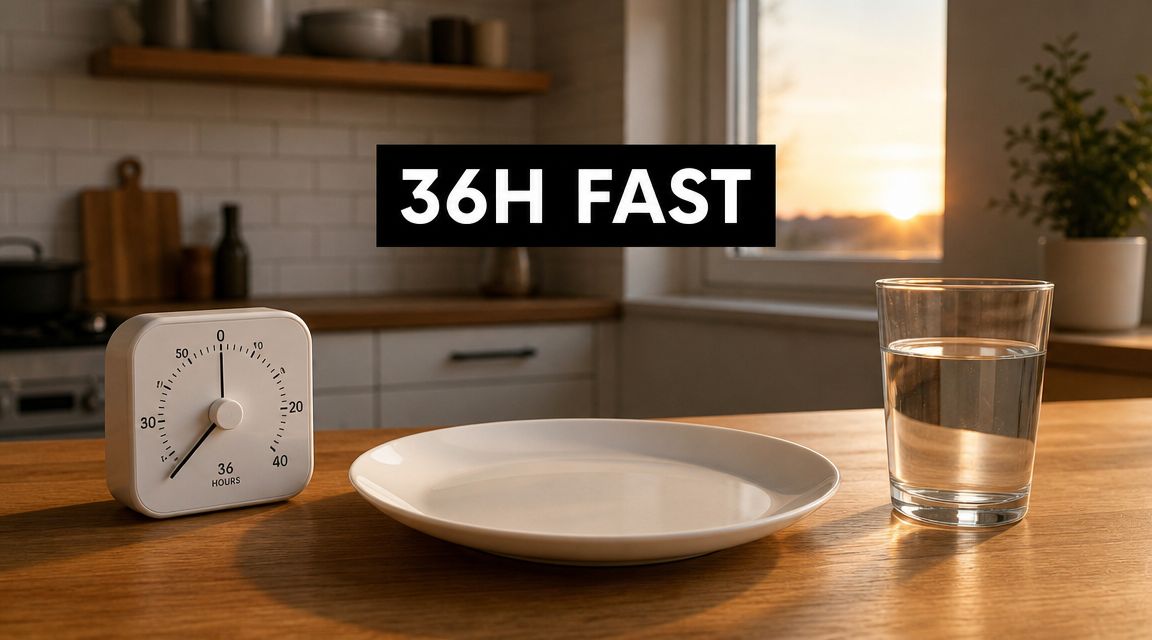
A 36-hour fast can meaningfully increase fat oxidation, raise ketones, and support short-term weight and fat loss when used in a structured way. Human research has reported about a 44% increase in fat oxidation versus a 12-hour fast, and one 4-week protocol using a strict 36-hour fast with a 12-hour eating window produced an average body-weight reduction of 4.5%, mainly from fat mass, especially trunk fat (clinical summary of the trial). It can also be hard on training, blood sugar management, and appetite control if you use it too often or refeed poorly.
Fasting is often thought of as just “not eating.” In practice, a 36-hour fast is a metabolic stressor with a distinct threshold effect. It's long enough for many people to move well beyond an overnight fast and into deeper fat-based fuel use, which helps explain why interest in 36 hour fasting benefits keeps growing.
The surprising part is that this isn't only a short-term experiment. One of the longest human datasets on this pattern followed twice-weekly near-absolute 36-hour fasts for 82 weeks and found maintained reduced body mass together with a 4.4-fold increase in beta-hydroxybutyrate, the main circulating ketone body, plus slight hunger reduction and no change in energy expenditure (long-term human fasting study). That doesn't make 36-hour fasting easy or universally smart. It does make it a real physiologic intervention, not a social-media gimmick.
As a practitioner, I see the best results when people use this kind of fast sparingly, attach it to a clear goal, and treat the refeed as part of the protocol. The fast itself creates the stress. The meal plan afterward determines whether that stress becomes progress or just another cycle of restriction and rebound.
1. How Does a 36-Hour Fast Enhance Cellular Autophagy and Protein Recycling?
Autophagy is the cellular cleanup system your body uses to break down damaged proteins and worn-out components. A 36-hour fast is often discussed because it likely places you inside the window where nutrient-sensing pathways shift away from growth and toward maintenance, recycling, and repair.
That doesn't mean you can claim a proven human “deep clean” on command. Human autophagy is difficult to measure directly in the tissues people care about most. Still, mechanistically, the fasting state lines up with lower nutrient signaling, greater AMPK activity, less mTOR signaling, and a stronger push toward intracellular housekeeping.
What likely changes inside the cell
SIRT1 and related stress-response pathways respond to lower energy availability. That matters because SIRT1 works upstream of many adaptations people want from fasting, including better cellular stress handling and tighter metabolic control.
PGC-1α also enters the conversation here, because the body isn't only breaking things down during a fast. It's also preparing to rebuild more efficiently after the fast. That repair-and-rebuild rhythm is where fasting becomes interesting for longevity-minded adults.
Practical rule: Use a 36-hour fast for periodic metabolic stress, not as a daily identity. Cellular cleanup is useful. Chronic underfeeding is not.
A practical example is the office worker who schedules a fast from Sunday dinner to Tuesday breakfast during a lower-stress week, then uses a structured refeed instead of celebratory junk food. That approach supports the biology people are trying to tap into.
To make it more manageable:
- Start after dinner: Sleeping through the first stretch makes compliance easier.
- Keep the fast simple: Water, black coffee, and unsweetened tea are the usual tools.
- Protect the refeed: Use a planned meal with protein, fiber, and minimally processed carbs instead of winging it.
2. Can a 36-Hour Fast Improve Insulin Sensitivity?
Yes, that's one of the clearest reasons people try it. During a longer fast, insulin drops because there's no incoming dietary carbohydrate to manage, and the body starts leaning more on stored fuel.
This can improve metabolic flexibility and make refeeding responses more controlled, especially in people who tend to graze, snack late, or stay in a constant fed state. But “improve insulin sensitivity” doesn't mean “safe for everyone.” People with prediabetes, type 2 diabetes, or medication-managed blood sugar need nuance, not hype.
Where it helps and where people get into trouble
The common win is better separation between fasting and feeding. When people stop eating around the clock, they often notice steadier appetite, less reactive hunger, and less of the afternoon crash that follows erratic meals.
The common mistake is assuming a hard fast cancels out a chaotic diet. It doesn't. If someone ends a 36-hour fast with a huge refined-carb binge, they've made glucose management harder, not easier.
A realistic use case is the professional with rising fasting glucose who already has a decent meal routine and wants a more structured intervention. In that case, the fast can be one tool. It shouldn't replace regular protein intake, strength training, sleep, or medical supervision.
For safer implementation:
- Get clearance first: This matters if you use insulin or glucose-lowering medication.
- Break the fast with balance: Protein, healthy fats, and a moderate portion of slower-digesting carbs work better than sugar-heavy foods.
- Track your response: If you have a CGM or finger-stick meter, use the data instead of guessing.
3. Why Does a 36-Hour Fast Increase Fat Oxidation So Much?
At 36 hours, the benefits of fasting become easier to feel. By that point, many people have moved far enough away from recent feeding that the body increases reliance on fat-based fuel. Controlled research summarized in a major overview reports about a 44% increase in fat oxidation after a 36-hour fast compared with a 12-hour fast, alongside a strong rise in ketones (36-hour fast metabolic summary).
That's why a 36-hour fast feels different from just skipping breakfast. The body isn't just “eating less.” It's changing fuel preference.
A simple visual helps people understand the shift:
What metabolic flexibility looks like in real life
Metabolic flexibility means you can move between carbohydrate use and fat use without feeling wrecked. Athletes often care about that because poor flexibility can show up as unstable energy, heavy hunger, and a constant need to snack.
Busy professionals care for a simpler reason. They want fewer energy dips and better appetite control. A 36-hour fast can sometimes reveal whether someone is highly dependent on constant feeding.
Use this well and it can support body-composition goals. Use it badly and you'll just end up under-recovered.
- Hydrate early: Extended fasts feel harder when sodium and fluids are low.
- Protect muscle on the back end: Your first meal should emphasize protein.
- Time it with lower-demand days: Don't schedule your first 36-hour fast before a long race, a brutal leg session, or an all-day travel schedule.
If you want help lining up the window with your eating schedule, an intermittent fasting calculator can make the timing easier.
Later in the same evidence base, repeated 36-hour fasting was associated with roughly 0.66 mmol/L circulating ketones, a concrete sign that the body had shifted deeper into fasting metabolism. That's useful because ketones aren't just fuel. They're also part of the signaling environment that changes how the brain and muscles experience fasting.
A practical explainer is useful here:
4. Can 36-Hour Fasting Help Lower Systemic Inflammation?
It may help indirectly, especially when it reduces overeating, improves body composition, and gives the gut a break from constant feeding. But this is an area where internet claims get ahead of the evidence.
The most responsible way to frame it is this: fasting can influence inflammatory tone through multiple pathways, including less frequent feeding, shifts in fuel use, and likely changes in gut-derived inflammatory load. Those mechanisms are plausible. The outcome in a specific person depends heavily on context.
When fasting calms things down and when it adds stress
For someone eating a highly processed diet and dealing with excess body fat, occasional fasting may reduce some of the metabolic noise that keeps inflammation high. For someone who is already lean, highly stressed, under-slept, and training hard, the same fast can feel more inflammatory than helpful.
That's why I don't treat fasting as an automatic anti-inflammatory fix. Recovery status matters.
A good real-world example is the recreational lifter with joint stiffness, poor sleep, and a snacking-heavy routine. If that person swaps one chaotic day of eating for one well-planned fasting window followed by whole-food refeeding, they may feel less puffy and more stable. If they add fasting on top of poor recovery, they usually feel worse.
Support the anti-inflammatory side of the equation with a better refeed:
- Lead with protein and plants: Fish, eggs, Greek yogurt, legumes, berries, and greens are practical choices.
- Avoid a processed rebound meal: Fried food and heavy desserts defeat the purpose.
- Use a repeatable plan: An anti-inflammatory meal plan is more useful than improvising when you're hungry.
Recovery improves when the fast reduces friction in the system. It backfires when the fast becomes another stressor on top of an overloaded week.
5. Does a 36-Hour Fast Raise Growth Hormone and Help Preserve Muscle?
Fasting is often paired with discussion of growth hormone because the body tries to defend lean tissue during periods without food. That's the theory people like, and it's part of why body-composition-focused adults use occasional extended fasts.
The practical reality is simpler. A 36-hour fast can be muscle-sparing if the rest of your week supports muscle retention. It becomes muscle-costly when you stack frequent fasting on top of low protein intake, poor sleep, and no resistance training.
Muscle preservation depends more on the full plan than the fast
The body doesn't preserve muscle because you admire fasting content online. It preserves muscle when you give it a reason to keep muscle. That reason is regular strength training and enough dietary protein on eating days.
This is why bodybuilders sometimes use an occasional longer fast during a cutting phase, but they don't rely on fasting alone. They train, refeed with intent, and monitor performance.
Use these rules:
- Lift regularly: Resistance training tells the body that lean mass is still needed.
- Refeed with protein first: Make your first substantial meal protein-centered.
- Don't overuse the tool: If performance is dropping and recovery is sliding, the protocol is too aggressive.
A 36-hour fast can fit into a body-composition plan. It cannot replace the fundamentals that keep muscle on your frame.
6. Why Do Some People Feel Mentally Clearer During a 36-Hour Fast?
Two things usually drive this. First, ketones rise and can serve as an efficient brain fuel during longer fasting windows. Second, fasting changes the neurochemical environment in ways that some people experience as sharper focus and less mental clutter.
There's also interest in BDNF, a protein linked to neuroplasticity and brain resilience. Mechanistically, fasting is often discussed as one stimulus that may support BDNF signaling. That's one reason cognitively demanding professionals sometimes schedule extended fasts around writing, strategy work, or deep-focus tasks.

Clarity isn't universal
Some people feel alert and calm during the second half of a fast. Others feel distracted, cold, or short-tempered. Both responses are normal.
The person who tends to do well is usually metabolically healthier, reasonably adapted to shorter fasts, and not trying to cram a fast into a sleep-deprived week. The person who struggles often jumps straight from constant snacking to a long fast and assumes the discomfort means they need more discipline. Usually they need a better setup.
For better cognitive results:
- Place demanding work later in the fasting window: That's when many people report the best focus.
- Keep electrolytes in mind: Mental fog is often hydration-related.
- Break the fast gently: A heavy, ultra-processed meal can wipe out the clarity people liked during the fast.
7. What About Heart Health and Blood Pressure?
This section needs balance. Intermittent fasting is often presented as universally heart-healthy, but the details matter. Neutral medical guidance notes that intermittent fasting may improve weight, insulin sensitivity, cholesterol, and blood pressure, while also emphasizing that it isn't for everyone and shouldn't be treated as a default intervention (pros and cons from Mass General Brigham).
That's the right frame. Cardiovascular benefit usually comes from the full pattern, not the dramatic act of skipping food.
The trade-off most people miss
If a 36-hour fast helps someone lose excess fat, reduce constant snacking, and clean up their overall diet, cardiovascular markers may improve over time. If that same person finishes each fast with sodium-heavy restaurant food and erratic overeating, the potential benefit gets diluted fast.
There's also a caution from the long-term 82-week fasting dataset mentioned earlier. That study reported modest increases in blood pressure, not improvements. So anyone claiming 36-hour fasting automatically lowers blood pressure is overstating the case.
If you have hypertension, cardiac disease, or take blood-pressure medication, treat a 36-hour fast like a medical decision, not a wellness dare.
A realistic heart-health use case is the middle-aged office worker with abdominal weight gain who needs less grazing, more structure, and better meal quality. In that setting, fasting can be supportive. It still works best alongside walking, strength training, sleep, and a consistently heart-supportive diet.
8. Can a 36-Hour Fast Speed Up Weight Loss and Improve Body Composition?
A 36-hour fast can accelerate fat loss, but only when it changes the weekly pattern of intake. The main advantage is not metabolic magic. It is that a full fasting window lowers insulin for long enough to push glycogen depletion, raise lipolysis, and increase fat oxidation, which can make calorie control easier and reduce abdominal fat over time.
Body composition improves most in people who pair fasting with enough protein, resistance training, and a controlled refeed. That matters because the goal is not just a lower scale weight. The better outcome is less fat mass, better waist measurements, and preserved lean tissue.

There is also a useful mechanistic angle here. Fasting activates AMPK and SIRT1 while reducing mTOR signaling during the fasted period. That shift favors stored fuel use over growth and storage. In plain terms, the body becomes more willing to burn fat. If the refeed is disciplined, PGC-1α signaling and improved metabolic flexibility can support better long-term body composition, not just a temporary drop from gut contents and water.
The trade-off is straightforward. A 36-hour fast creates a bigger margin for error, but it does not erase overeating on feeding days. People who finish the fast with high-calorie, low-protein meals often give back much of the deficit and feel worse the next day.
That is especially relevant for people trying to break your weight loss plateau. In practice, plateaus often come from calorie creep, reduced movement, and weaker adherence, not a damaged metabolism.
Use a few rules that keep the fast productive:
- Put the fast on a low-friction day: Fewer social meals and fewer food cues improve adherence.
- Protect muscle on eating days: Center meals around protein and keep lifting if recovery allows.
- Plan the refeed before the fast starts: A structured gut-friendly meal plan for refeeding helps prevent the usual rebound meal.
- Judge progress by trend, not one weigh-in: A lower average waistline and steadier weekly weight matter more than one dramatic drop.
I have seen 36-hour fasting work well for body recomposition in people who need structure more than novelty. It tends to fail in people who use it as compensation for chaotic eating. Consistency beats intensity here.
9. Can Fasting Give the Gut a Real Break?
It can. The gut has a constant workload in people who graze all day, eat late at night, or rely on highly processed food. A 36-hour fast removes incoming food for long enough that some people notice less bloating, less reflux, and a calmer digestive pattern afterward.
Mechanistically, this may relate to reduced digestive load, less post-meal irritation, and a cleaner reintroduction of foods. It can also help people notice which foods irritate them, because symptoms are easier to spot after a reset than during nonstop eating.
The refeed determines whether your gut likes the experience
People often say fasting “healed their gut” when what really happened is this: they stopped irritating it for a day and then reintroduced food more carefully. That's still useful, but it's not magic.
A practical example is someone with IBS-like bloating who ends a fast with broth, eggs, yogurt, oats, cooked fruit, or a simple rice-and-protein meal instead of pizza and alcohol. They often feel much better. The same person can undo that advantage in one evening.
Try this approach:
- Start gentle: Soups, yogurt, eggs, cooked vegetables, rice, and fruit are often easier than a giant mixed meal.
- Watch symptom signals: Reintroduce foods in a way that lets you notice patterns.
- Use structured meal planning: A gut health meal plan helps reduce random refeeding choices.
10. Does a 36-Hour Fast Support Immune Function?
Possibly, but this is another category where claims easily outrun the data. The mechanistic argument is reasonable. Fasting shifts resources away from digestion, changes stress-response pathways, and may support cellular cleanup processes that affect immune regulation.
What I tell people is simpler. An occasional well-tolerated fast might support immune resilience if the person is otherwise well-fed, sleeping adequately, and not overtrained. It is a poor choice when someone is already run down.
Timing matters more than enthusiasm
If you're exhausted, fighting off something, or deep in a heavy training block, extended fasting usually adds stress rather than resilience. Immune support comes from the total pattern of sleep, training load, diet quality, and recovery.
A good use case is the generally healthy adult who wants periodic dietary structure and notices they feel less inflamed and more stable after a carefully run fast. A bad use case is the person trying to “starve out” an active illness.
Keep it practical:
- Only fast when you're well: Don't begin during infection or severe stress.
- Refuel with micronutrient-dense foods: Protein, colorful produce, nuts, seeds, and fermented foods help.
- Respect recovery: Better sleep usually does more for immunity than another hard fast.
11. Can 36-Hour Fasting Help Reset Hunger Hormones and Eating Behavior?
This is one of the most practical benefits when it works. Not because fasting is mystical, but because it interrupts constant cue-driven eating. Many people discover they weren't hungry most of the time. They were reacting to routine, boredom, convenience, or stress.
In the long human fasting record discussed earlier, the participant reported a slight decrease in hunger over time, which matters because one of the biggest barriers to fasting is the assumption that hunger only gets worse. It doesn't always. Adaptation can happen.
Where fasting improves behavior
A 36-hour fast often reduces “food noise” for people who have been eating from early morning to late night. It can sharpen satiety awareness and make planned meals feel more satisfying.
That said, it doesn't reliably fix emotional eating. If someone uses food to regulate stress, a long fast may just intensify the rebound once the fast ends.
A realistic scenario is the professional who snacks through meetings, grazes after dinner, and never experiences a clean appetite cycle. After a few carefully used fasting windows, they often report that true hunger feels easier to recognize.
For better behavior outcomes:
- Don't break the fast with trigger foods: Hyper-palatable foods can restart the whole cycle.
- Use structure on feeding days: Regular meal timing usually beats random grazing.
- Notice your pattern: If every fast ends in overeating, the protocol is too aggressive for you right now.
For some people, the bigger reset also involves sleep and recovery support, because cravings often worsen when circadian rhythm is off. That's one reason broader work on restoring healthy hormonal rhythm can matter alongside nutrition.
12. Does It Improve Mitochondrial Function and Energy Production?
This is one of the more interesting mechanism-based arguments for fasting. Low-energy states activate pathways tied to mitochondrial adaptation, and PGC-1α is one of the key regulators in that process. In plain English, fasting may help cells become more efficient at generating energy from stored fuel.
That doesn't mean every fast makes you feel energetic. During the fast itself, some people feel sluggish. The potential gain is in the adaptation over time, especially when fasting is paired with regular movement and a solid refeed.
Best use for active people
Endurance-oriented adults often care about this because better mitochondrial function supports sustained work and improved fat use. Busy professionals care because they want steadier energy and fewer crashes.
The wrong way to chase this is to stack long fasts with high-intensity training and inadequate calories. The right way is to use occasional fasting with lower-intensity activity such as walking, mobility work, or easy cycling.
Try these habits:
- Move lightly during the fast: Easy movement can support the metabolic shift without digging a recovery hole.
- Keep high-intensity work for eating days: That usually preserves training quality.
- Refuel with quality nutrients: Protein, minerals, and whole-food carbohydrates support rebuilding.
13. What Longevity Pathways Does a 36-Hour Fast Activate?
SIRT1, AMPK, mTOR, and related signaling pathways matter. Fasting lowers nutrient availability, and that creates a biochemical environment associated with maintenance, stress resistance, and more efficient energy use.
People often hear this and jump straight to “fasting extends lifespan.” That's not a responsible human claim from this specific protocol. What we can say is that the pathway story is biologically coherent and one reason fasting keeps showing up in longevity conversations.
Why the signaling still matters
Even without making lifespan promises, these pathways influence how cells respond to stress. SIRT1 interacts with metabolic regulation. AMPK acts like a fuel gauge. mTOR falls when growth signals are lower. Together, they create a state that favors repair over constant intake.
That's why many longevity-focused adults use occasional 36-hour fasting as part of a larger system that also includes strength training, sleep, social connection, and a nutrient-dense diet. Fasting by itself isn't a longevity program. It's one stressor inside a broader pattern.
The people who benefit most from longevity practices are usually the ones who can stay consistent for years, not the ones who can tolerate the harshest protocol for two weeks.
14. Can a 36-Hour Fast Reduce Cravings?
For many people, yes. A full fasting day breaks the cycle of constant stimulation from sweet, salty, crunchy, ultra-palatable foods. That pause can make simpler meals taste better and reduce the urgency people feel around snacking.
This is partly hormonal and partly behavioral. Ghrelin and satiety signaling can become easier to read when eating isn't happening all day. The brain gets a break from repeated food reward cues.
The mistake that cancels the craving benefit
If the first meal after the fast is pastries, takeout, chips, or a “cheat meal” mindset, cravings often come roaring back. The post-fast meal teaches the brain what comes next. That's why structure matters.
A good example is the person who normally raids the pantry at night. After a planned fast and a protein-centered breakfast, they often notice less pull toward random snacking. The effect is much weaker when they end the fast with highly processed foods.
Three rules help:
- Plan meals before the fast ends: Don't negotiate with hunger.
- Start with whole foods: Protein and fiber lower the odds of a rebound.
- Repeat only if it helps: If cravings worsen after each fast, choose a shorter fasting window instead.
15. Can a 36-Hour Fast Improve Sleep Quality?
Sometimes, yes. Sometimes the opposite. Sleep is one of the clearest examples of fasting trade-offs.
People who stop late-night eating and reduce digestive load often sleep more cleanly. People who are caffeine-heavy, under-recovered, or very hungry by bedtime may sleep worse.
Who usually sleeps better and who doesn't
The person who benefits is often someone whose eating was drifting late into the evening. A fasting window can tighten circadian rhythm and reduce the heavy, fragmented sleep that follows large nighttime meals.
The person who struggles is usually doing too much at once. They keep caffeine high, train hard, fast long, and then wonder why sleep gets lighter. That isn't a fasting issue alone. It's an overall stress-load problem.
For better sleep during a 36-hour fast:
- Cut caffeine earlier than usual: You're more sensitive when fasting.
- Keep the day physically calm: A lower-stress fast tends to be a better-sleep fast.
- End with a normal evening routine: Light exposure, meal timing, and winding down still matter.
36-Hour Fasting: 15-Benefit Comparison
| Benefit | 🔄 Implementation Complexity | ⚡ Resource Requirements | ⭐ Expected Outcomes | 📊 Key Advantages | 💡 Ideal Use Cases |
|---|---|---|---|---|---|
| Enhanced Cellular Autophagy and Protein Recycling | 🔄 High, strict 36‑hr fast, timing critical | ⚡ Low, hydration, monitoring; medical oversight for some | ⭐⭐⭐⭐, increased cellular cleanup, reduced inflammation | 📊 Improves protein/organelle quality; longevity signal | 💡 Longevity seekers; monthly deep-clean fasts |
| Significant Insulin Sensitivity Improvement | 🔄 Moderate, manage meds and glucose monitoring | ⚡ Low‑Medium, glucose checks, provider consult if diabetic | ⭐⭐⭐⭐, notable insulin sensitivity gains (~20–30%) | 📊 Better glucose control, fewer cravings, metabolic flexibility | 💡 Prediabetes/T2D management; post-fast macro control |
| Accelerated Fat Oxidation and Metabolic Flexibility | 🔄 Moderate, glycogen depletion timing, electrolyte care | ⚡ Medium, hydration, electrolytes, protein planning | ⭐⭐⭐⭐, increased fat oxidation, ketone production | 📊 Enhanced fat loss, sustained energy, mental clarity | 💡 Weight loss phases, fat-adaptation training |
| Reduced Systemic Inflammation and IL-6 Markers | 🔄 Moderate, requires repeated cycles and proper refeed | ⚡ Medium, anti‑inflammatory foods, biomarker tracking | ⭐⭐⭐, reduced IL‑6/TNFα with cumulative fasting | 📊 Lower inflammation, better recovery and joint health | 💡 Autoimmune/inflammatory conditions adjunct therapy |
| Growth Hormone Elevation and Muscle Preservation | 🔄 Moderate, needs sleep and resistance training synergy | ⚡ Medium, timed protein refeed, training schedule | ⭐⭐⭐, GH surge aids muscle preservation (not hypertrophy) | 📊 Protects lean mass, improves fat loss during dieting | 💡 Body composition goals; combine with resistance work |
| Improved Brain Function and Enhanced Cognitive Clarity | 🔄 Low‑Moderate, timing to align with work tasks | ⚡ Low, hydration, electrolytes, brain‑healthy refeed | ⭐⭐⭐⭐, improved focus, BDNF increases, ketone fuel | 📊 Enhanced executive function and mental clarity | 💡 High‑focus work, exams, creative tasks during fast |
| Enhanced Cardiovascular Health and Blood Pressure Reduction | 🔄 Moderate, requires monitoring if on meds | ⚡ Medium, heart‑healthy refeed, electrolyte balance | ⭐⭐⭐, improved lipids, triglycerides, and BP with repetition | 📊 Reduced CVD risk markers, arterial benefits | 💡 Metabolic syndrome, hypertensive patients (with consult) |
| Accelerated Weight Loss and Improved Body Composition | 🔄 Moderate, discipline for refeeding and training | ⚡ Medium, meal planning, strength training, monitoring | ⭐⭐⭐⭐, rapid fat loss when combined with protein refeed | 📊 Large caloric deficit; preserves muscle with adequate protein | 💡 Busy professionals, competitors seeking fast reductions |
| Restored Gut Health and Improved Intestinal Barrier Function | 🔄 Moderate, refeed quality critical to maintain gains | ⚡ Medium, gut‑healing foods, probiotics, testing if needed | ⭐⭐⭐, reduced permeability, improved microbiota balance | 📊 Better nutrient absorption and reduced GI symptoms | 💡 IBS/food sensitivity management with careful refeed |
| Optimized Immune Function and Enhanced Pathogen Defense | 🔄 Moderate, avoid during acute illness; time for recovery | ⚡ Medium, nutrient‑dense refeed (zinc, C, selenium) | ⭐⭐⭐, immune reset, NK cell activity and autophagy benefits | 📊 Improved infection resistance and immune surveillance | 💡 Seasonal immune support; older adults and athletes |
| Hormone Balance Restoration and Improved Metabolic Signaling | 🔄 Moderate, requires proper refeeding and stress control | ⚡ Medium, adequate calories, sleep, stress management tools | ⭐⭐⭐, leptin/ghrelin normalization over weeks | 📊 Restores hunger signaling and metabolic rate recovery | 💡 Those recovering from chronic dieting or plateaus |
| Increased Mitochondrial Density and Improved Energy Production | 🔄 Moderate‑High, consistent schedule and exercise pairing | ⚡ Medium, antioxidant‑rich refeed, exercise integration | ⭐⭐⭐, cumulative mitochondrial biogenesis and endurance gains | 📊 Sustained energy, improved aerobic capacity | 💡 Endurance athletes; chronic fatigue recovery strategies |
| Enhanced Longevity Signaling and Telomere Protection | 🔄 High, long‑term consistency required (years) | ⚡ Medium, longevity‑focused nutrition, lifestyle tracking | ⭐⭐⭐, activation of SIRT/AMPK pathways; evidence evolving | 📊 Potential lifespan/healthspan benefits; anti‑aging biomarkers | 💡 Longevity‑focused individuals and biohackers |
| Reduced Cravings and Improved Eating Behavior Patterns | 🔄 Low‑Moderate, behavioral reinforcement needed post‑fast | ⚡ Low, structured meal plans, avoidance of triggers | ⭐⭐⭐⭐, decreased reward sensitivity and cravings | 📊 Better portion control and sustained healthy patterns | 💡 Food‑addiction, emotional eaters, habit restructuring |
| Improved Sleep Quality | 🔄 Low‑Moderate, timing relative to bedtime matters | ⚡ Low, sleep hygiene, avoid late stimulants and heavy refeeds | ⭐⭐⭐, deeper sleep stages, circadian alignment for many | 📊 Enhanced restoration, hormone regulation during sleep | 💡 Insomnia/fragmented sleep when combined with hygiene |
How Can You Integrate a 36-Hour Fast Into Your Life?
A 36-hour fast works best when you treat it as a deliberate tool, not a personality trait. The benefits people want are real enough to take seriously, but the downsides are real enough to plan around. If you're trying it for fat loss, metabolic flexibility, or appetite reset, the fast should fit your life and health status instead of forcing your body to adapt to an extreme schedule that you can't recover from.
Start with the simplest version. Finish dinner, skip the next full day, and eat breakfast the following morning. That format gives you two sleep periods inside the fasting window, which usually makes the process more manageable than waking up and deciding to white-knuckle your way through the day. It also makes scheduling easier for busy professionals.
Pick a low-stress stretch. Don't schedule your first 36-hour fast before an important presentation, a hard training day, travel, or a family event built around food. Fasting exposes weak points in sleep, hydration, stress handling, and meal structure. When those factors are already unstable, the fast usually feels much harder than it needs to.
Hydration matters more than generally assumed. Many complaints blamed on fasting are really a combination of low fluid intake, low sodium, and too much caffeine. Water is essential. Many individuals also do better with electrolyte support, especially if they're physically active or tend to get headaches during longer fasting windows.
The refeed is where a lot of good intentions fall apart. After a 36-hour fast, your digestive system usually responds better to a calm first meal than to a large celebratory one. Start with protein, some fiber, and easy-to-digest whole foods. Eggs, yogurt, oats, rice, potatoes, fruit, soup, fish, or a simple plate with lean protein and cooked vegetables usually works better than fast food, alcohol, or a dessert-heavy “reward.”
If your goal is fat loss, don't treat the fasting day like a license to overeat on feeding days. If your goal is metabolic health, don't use the fast to compensate for a poor overall diet. If your goal is longevity or cellular health, remember that sleep, training, stress management, and nutrient intake still carry most of the long-term load. Fasting can support those goals. It can't replace them.
This is also where planning tools earn their place. Many people don't need more motivation. They need a repeatable way to know what to eat after the fast ends. That's where a nutrition platform can help. AI Meal Planner is one option that generates personalized meal plans, recipes, macros, and grocery lists based on your goals and preferences, which is useful when you want your refeed to be intentional rather than impulsive. If you're unsure how long a fasting window should be, this fasting duration tool can also help you think through timing.
Use the smallest effective dose. You don't need to live in extended fasting mode to get value from it. For many people, occasional 36-hour fasting works better than frequent aggressive fasting because it preserves training quality, social flexibility, and consistency. If energy crashes, workouts decline, sleep worsens, or refeeding turns chaotic, shorten the fasting window and rebuild from there.
Start planning your post-fast meals today.
If you want structure after a 36-hour fast, AI Meal Planner can help you build balanced refeed meals, weekly meal plans, and grocery lists around your calorie target, macros, food preferences, and allergies.
AI-powered nutrition
Get Your Personalized Meal Plan
AI creates the perfect meals for your goals, lifestyle, and taste.
Start Your Journej