

How do I calculate my daily calorie needs?
To calculate your daily calorie needs, first find your Basal Metabolic Rate (BMR) using the Mifflin-St Jeor formula. Next, multiply your BMR by an activity multiplier (1.2 for sedentary, 1.55 for moderately active) to determine your Total Daily Energy Expenditure (TDEE). For weight loss, subtract 250-500 calories from your TDEE; for muscle gain, add 250-500 calories.
Understanding your daily calorie needs is the first, most crucial step in taking control of your nutrition. Without a clear, personalized target, you're just guessing—a terrible strategy for consistent, long-term results. Calculating your numbers moves you from a vague goal to an actionable, data-driven starting point.
This number becomes your North Star, helping you structure meals and make smarter choices every single day. This isn't about jumping into a restrictive diet; it's about gaining awareness and control over your body's energy balance.
Knowing your maintenance level is incredibly powerful, whether you want to:
- Lose body fat sustainably without feeling starved.
- Build lean muscle by making sure you have enough fuel for growth.
- Maintain your current weight and improve your overall body composition.
To get to that magic number, we follow a simple, logical process. It starts with your baseline metabolism and then layers on your daily activity and specific goals.
What are the three steps to find my daily calorie target?
Before we dive deep into the formulas, let's look at the big picture. Getting to your final calorie target really boils down to three essential steps, each one building on the last to create a number that's truly yours.
| Step | What It Is | How to Do It |
|---|---|---|
| 1. Find Your BMR | Basal Metabolic Rate: The calories your body burns at complete rest—just to keep the lights on. | Use a standard formula like Mifflin-St Jeor based on your age, sex, height, and weight. |
| 2. Calculate Your TDEE | Total Daily Energy Expenditure: Your BMR plus all the calories you burn from daily activities, including exercise. | Multiply your BMR by an activity multiplier that matches your lifestyle (from sedentary to very active). |
| 3. Adjust for Your Goal | Goal-Specific Target: Your final daily calorie number, adjusted to help you lose fat, gain muscle, or maintain. | Subtract 250-500 calories for fat loss, add 250-500 for muscle gain, or keep it the same for maintenance. |
This table gives you a bird's-eye view of the journey from a baseline number to a practical, goal-oriented target.
This flowchart breaks down that exact process visually, showing how we get from your basic metabolic rate to a final, actionable number.
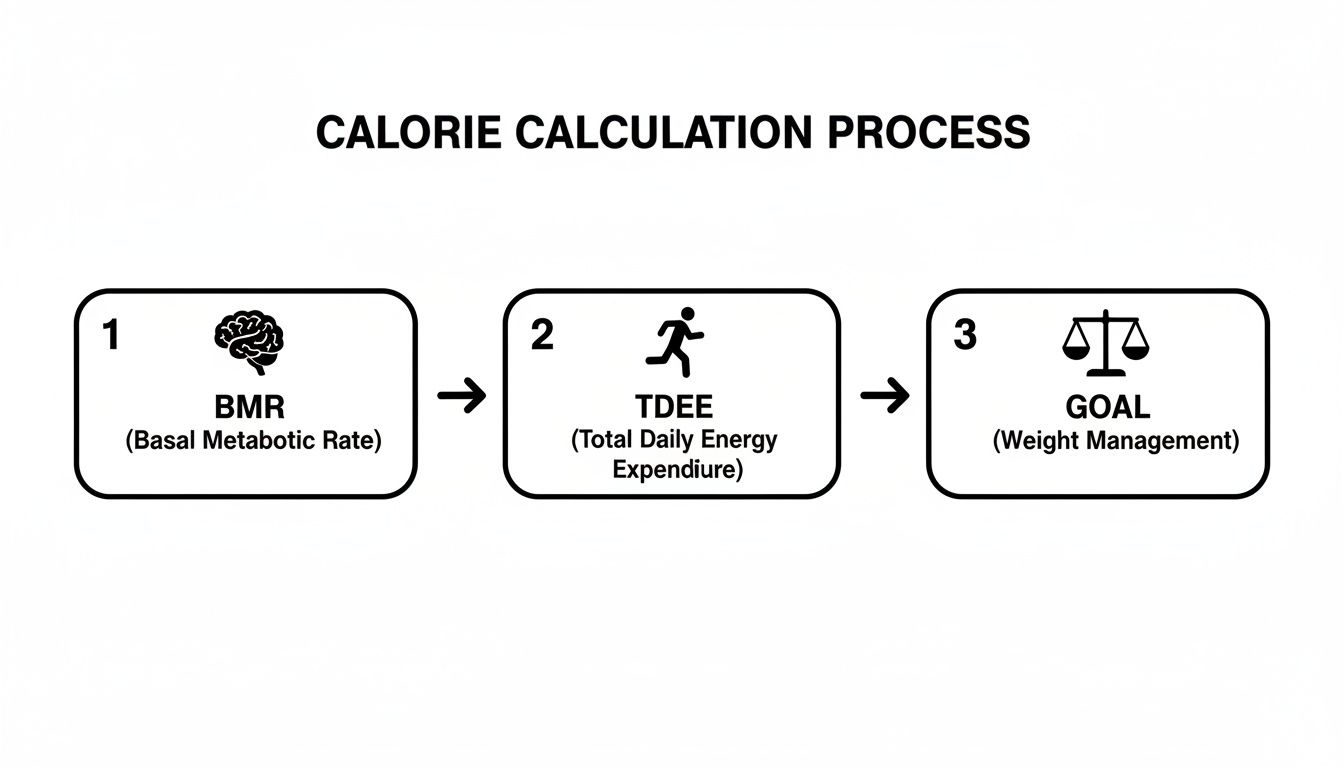
As you can see, each step logically builds on the one before it. We'll walk through these calculations manually in the next sections, but if you want a quick estimate right now, you can use our free online TDEE calculator to do the heavy lifting for you.
How do I calculate my Basal Metabolic Rate (BMR)?
Before you can figure out how many calories you need to eat each day, you have to know your body's baseline. This is your Basal Metabolic Rate (BMR)—the number of calories you burn just by being alive. Even if you stayed in bed all day, your body would still need this much energy for essential functions like breathing, circulating blood, and keeping your temperature stable.
Think of your BMR as the foundational number in your personal energy equation. It gives you a starting point that’s far more accurate than any generic advice. Once you know this figure, you can factor in your daily activities to get the full picture of your calorie needs.
Which BMR formula is the most accurate?
For decades, two main formulas have been the go-to for metabolic calculations: the Harris-Benedict equation and the more modern Mifflin-St Jeor equation. Most experts today lean heavily on one for its superior accuracy.
The Mifflin-St Jeor equation, developed in the 1990s, is now widely considered the gold standard for estimating BMR in healthy adults. It consistently proves to be more accurate for more people than the older formulas. It just needs your weight, height, and age to give you a solid metabolic baseline.
Here are the specific formulas you'll need:
- For Men: BMR = (10 × weight in kg) + (6.25 × height in cm) – (5 × age in years) + 5
- For Women: BMR = (10 × weight in kg) + (6.25 × height in cm) – (5 × age in years) – 161
Key Takeaway: The Mifflin-St Jeor formula is the most recommended method for calculating your BMR today. Its modern calibration makes it a more reliable starting point for the majority of individuals seeking to understand their daily calorie needs.
What about the Harris-Benedict Method?
While Mifflin-St Jeor gets top billing, it's worth knowing about the Harris-Benedict Method. Developed over a century ago, it was a pioneering formula that laid the groundwork for modern metabolic science. It calculates a person's Basal Metabolic Rate using the same four variables: height, weight, age, and gender. You can dig deeper into its history and application by exploring these insights on calorie intake calculation methods.
Can you show me a real-world BMR example?
Formulas can feel a bit abstract until you plug in some real numbers. Let's walk through a calculation for a fictional person to see exactly how it works.
Meet Alex:
- Gender: Male
- Age: 35 years old
- Weight: 80 kilograms (about 176 pounds)
- Height: 180 centimeters (about 5'11")
Using the Mifflin-St Jeor formula for men, we can calculate Alex's BMR.
The Calculation:
- Weight Component: 10 × 80 kg = 800
- Height Component: 6.25 × 180 cm = 1125
- Age Component: 5 × 35 years = 175
- Final Assembly: (800 + 1125) – 175 + 5
The result is 1,755 calories. This means if Alex did nothing but rest for 24 hours, his body would still burn roughly 1,755 calories. This number is his metabolic starting line.
Now, take a moment and run your own numbers through the formula. Grab a calculator and input your gender, age, weight in kilograms, and height in centimeters to find your personal BMR.
If you'd rather skip the manual math, our advanced AI tool can do it for you. Start building your plan with the AI Meal Planner.
How does my activity level affect my calorie needs?
Your Basal Metabolic Rate (BMR) is a fantastic starting point, but it only tells part of the story. Think of it as the energy your car burns while idling. To figure out your total fuel needs, you have to account for every mile you drive.
This is where your Total Daily Energy Expenditure (TDEE) comes in. The TDEE is the real-world number you need. It represents the total calories you burn over a full 24-hour period, factoring in everything from your morning workout to that walk to the coffee machine.
Getting from your BMR to your TDEE is simple: you just multiply your BMR by an "activity multiplier." This number is a straightforward way to estimate the energy cost of your unique lifestyle.
How do I find my activity multiplier?
Choosing the right multiplier is critical for getting an accurate TDEE. Be brutally honest with yourself. Overestimating your activity level is one of the most common mistakes and can stall progress before it even begins.
Below is a breakdown of each activity level and its multiplier to help you accurately estimate your Total Daily Energy Expenditure (TDEE).
Which activity multiplier fits my lifestyle?
| Activity Level | Description | Multiplier |
|---|---|---|
| Sedentary | You have a desk job and get little to no formal exercise. Your daily movement is limited to basic tasks like walking to your car or light chores. | 1.2 |
| Lightly Active | You have a desk job but exercise lightly 1-3 days per week, or you have a job with more movement (teacher, salesperson) but don't work out. | 1.375 |
| Moderately Active | You exercise with moderate intensity 3-5 days per week. This is a common level for people who are consistent with their gym routine. | 1.55 |
| Very Active | You engage in vigorous exercise 6-7 days per week, or you have a physically demanding job (construction worker, personal trainer) and also work out. | 1.725 |
| Extra Active | This is reserved for elite athletes with intense daily training (often twice a day) or people with extremely physical jobs who also train hard. | 1.9 |
Remember, this is an estimate. If you track your steps, you might find our guide on calculating calories based on daily steps provides an even sharper picture of your daily burn.
Why do different lifestyles create different calorie needs?
Let's see this in action. Imagine two women, Maria and Sarah. They are the same age, height, and weight, and both have a calculated BMR of 1,450 calories.
Meet Maria: The Sedentary Graphic Designer Maria works from home, spending long hours at her desk. She doesn't have a structured exercise routine.
- Her TDEE Calculation: 1,450 (BMR) × 1.2 (Sedentary Multiplier) = 1,740 calories
This is how many calories Maria needs each day just to maintain her current weight.
Meet Sarah: The Moderately Active Teacher Sarah is an elementary school teacher who is on her feet all day. On top of that, she hits the gym for a weightlifting session four times a week.
- Her TDEE Calculation: 1,450 (BMR) × 1.55 (Moderately Active Multiplier) = 2,247 calories
Even with the exact same BMR, Sarah needs over 500 more calories per day than Maria just to stay at her current weight. This stark difference shows why activity level is such a massive piece of the puzzle.
The Power of NEAT: Don't underestimate the small stuff. Non-Exercise Activity Thermogenesis (NEAT) includes all the calories you burn from activities that aren't formal exercise—things like fidgeting, taking the stairs, or even standing up from your desk. These little movements can add up to hundreds of extra calories burned each day, significantly impacting your TDEE.
Now it's your turn. Grab your BMR from the last section and multiply it by the activity level that truly reflects your life. That number is your TDEE—your daily maintenance calories. This is the foundation we'll use to build out your specific nutrition goals, which we're diving into next.
How do I set my calories for a specific goal?

Alright, you've calculated your Total Daily Energy Expenditure (TDEE). This number is your "maintenance" level—the amount of energy your body needs to stay exactly as it is right now. Think of it as your body's neutral gear.
But you're probably not here to stay in neutral. You want to make a change.
This is where the real strategy comes in. By making small, deliberate adjustments to that maintenance number, you can create the perfect environment for your body to either burn stored fat or build new muscle.
How many calories should I eat for fat loss?
To lose body fat, you need to consume fewer calories than you burn. This is called a caloric deficit, and it prompts your body to use its own fat stores for energy. The key is to do this smartly, not drastically.
A sensible, effective, and sustainable deficit is 250 to 500 calories below your TDEE. This range is the sweet spot for a few critical reasons:
- It’s Sustainable. A modest deficit helps you avoid the ravenous hunger and energy slumps that derail most aggressive diets.
- It Preserves Muscle. Cutting too hard can signal your body to break down precious muscle tissue for fuel. A smaller deficit protects muscle.
- It Protects Your Metabolism. Crash dieting often slows your metabolic rate. A gentle approach keeps your metabolism humming.
So, if your TDEE is 2,500 calories, a smart fat-loss target would be between 2,000 and 2,250 calories per day. You can use our calorie deficit calculator to set these targets quickly.
Common Mistake: The biggest error people make is slashing calories way too aggressively. A 1,000-calorie deficit might sound like a shortcut, but it almost always backfires, leading to burnout and metabolic slowdown.
How many calories should I eat for muscle growth?
Want to build muscle? The opposite principle applies. You need to give your body more energy than it burns. This caloric surplus provides the extra fuel required to repair muscle fibers and synthesize new, stronger tissue.
Just like with fat loss, moderation is key. Aim for a surplus of 250 to 500 calories above your TDEE. This provides enough energy for growth without packing on a ton of unnecessary body fat.
If your TDEE is 2,500 calories, your muscle-building target would be between 2,750 and 3,000 calories per day. Steer clear of the "dirty bulk" trap—eating everything in sight. A clean, controlled surplus is the most efficient way to build lean muscle.
Why do macros matter as much as calories?
Your total calorie count is only one part of the story. Where those calories come from—your macronutrients (protein, carbs, and fats)—is just as crucial for changing your body composition.
- Protein is Paramount for Muscle: Whether cutting fat or building muscle, getting enough protein is non-negotiable. Aim for 1.6 to 2.2 grams of protein per kilogram of body weight (or about 0.7 to 1.0 grams per pound).
- Carbohydrates Fuel Performance: Carbs are your body's go-to energy source, especially for tough workouts. They keep your energy high and your muscles full.
- Fats Support Hormones: Healthy fats are essential for producing key hormones, like testosterone, that are vital for muscle growth and overall health.
You can learn more about foundational dietary recommendations to see the bigger picture. Once you have your goal-specific calorie and macro targets, you've got a complete blueprint. If you want to skip the manual work, a tool like the AI Meal Planner can automatically create meal plans based on these precise calculations.
Are calorie calculations just an estimate?
Yes, the formulas we've used give you a highly educated guess, not a guarantee. Your calculated TDEE is the best possible starting line, but it's not the finish line. The human body is far too complex to be perfectly captured by a single, static number.
Think of your calorie target like a map. It gives you an excellent route, but it can’t predict unexpected traffic. Long-term success isn’t about hitting a 'perfect' number on day one; it's about using this initial calculation as a baseline and then learning to navigate from there.
This number is your anchor point. It lets you stop guessing and start making informed decisions.
What factors can make my calorie calculation inaccurate?
No matter how sophisticated, a formula operates in a vacuum. It has no idea about the intricate biological symphony happening inside you. Several real-world variables can throw off a purely mathematical estimate.
A few of the biggest factors include:
- Your Unique Genetics: Your genetic makeup influences your resting metabolic rate.
- Hormonal Fluctuations: Hormones are the master regulators of your metabolism. Shifts from stress, poor sleep, or a woman's menstrual cycle can alter your daily energy needs.
- Metabolic Adaptation: As you lose weight, your body often adapts by becoming more efficient, slightly reducing the number of calories it burns.
- Gut Health: The unique composition of your gut microbiome can impact how many calories you absorb from the food you eat.
This isn't meant to be discouraging. It's just a reminder of why the next step—listening to your body—is the most important one. You can read more about professional recommendations for calculating caloric needs.
How do I apply my calculated number in the real world?
The real skill is learning how to adjust your intake based on what’s actually happening. Your body provides the most important data.
Pay attention to your biofeedback. The scale is only one tool. Monitor your energy levels, workout performance, hunger cues, and even how your clothes fit. These are the true indicators of progress.
If you stick to your calculated target for a couple of weeks and the needle isn't moving, it’s time for a small adjustment. Trying to lose weight and the scale hasn’t budged? Try dropping your intake by another 100-150 calories. Aiming for muscle gain and not seeing progress? A slight increase might be all you need.
Can technology automate this process?
Manually tracking calories, monitoring progress, and making adjustments can feel like a part-time job. This is where modern tools can step in to automate the grunt work. For example, a platform like an AI Meal Planner is built on these very principles.
This screenshot from the AI Meal Planner onboarding shows how it gathers your personal data to create that tailored starting point.
By inputting your goals and metrics, the system calculates your initial targets and then generates a full meal plan to match, taking all the guesswork out of the equation. It handles the initial calculation and can help you adjust as you go, ensuring your plan evolves with your progress.
Questions About Calculating Calorie Needs
Do I have to count calories forever?
No, calorie counting is a short-term learning tool, not a life sentence. Use it to build intuitive eating habits by understanding portion sizes and the energy density of different foods.
What if I go over my calorie goal sometimes?
One day won't derail your progress. Consistency is more important than perfection, so just get back on track with your next meal without trying to "make up for it."
How often should I recalculate my calorie needs?
Recalculate your TDEE after a significant weight change (10-15 lbs), a major shift in your activity level, or if your progress stalls for several weeks.
Why do different calorie calculators give different results?
Calculators use different formulas (like Mifflin-St Jeor vs. Harris-Benedict) and have subjective definitions for activity levels, leading to slightly different estimates.
Can I eat whatever I want if it fits my calorie goal?
While possible, it's not optimal for health or satiety. Aim for 80-90% of your calories from whole, nutrient-dense foods to support energy, muscle retention, and overall well-being.
What's the best tool for calculating my calorie needs?
A reliable online calorie and macro calculator that uses the Mifflin-St Jeor formula is an excellent starting point for most people.
How many calories do I need to lose one pound?
A deficit of approximately 3,500 calories is needed to lose one pound of fat, which is typically achieved by reducing daily intake by 500 calories for one week.
Calculating your calorie needs is the first step, but turning those numbers into delicious, easy-to-make meals is where most people get stuck. The AI Meal Planner handles all of that for you. It takes your personal calorie and macro targets and instantly generates a weekly meal plan—complete with simple recipes and an organized grocery list—making it effortless to eat perfectly for your goals.
AI-powered nutrition
Get Your Personalized Meal Plan
AI creates the perfect meals for your goals, lifestyle, and taste.
Start Your Journej