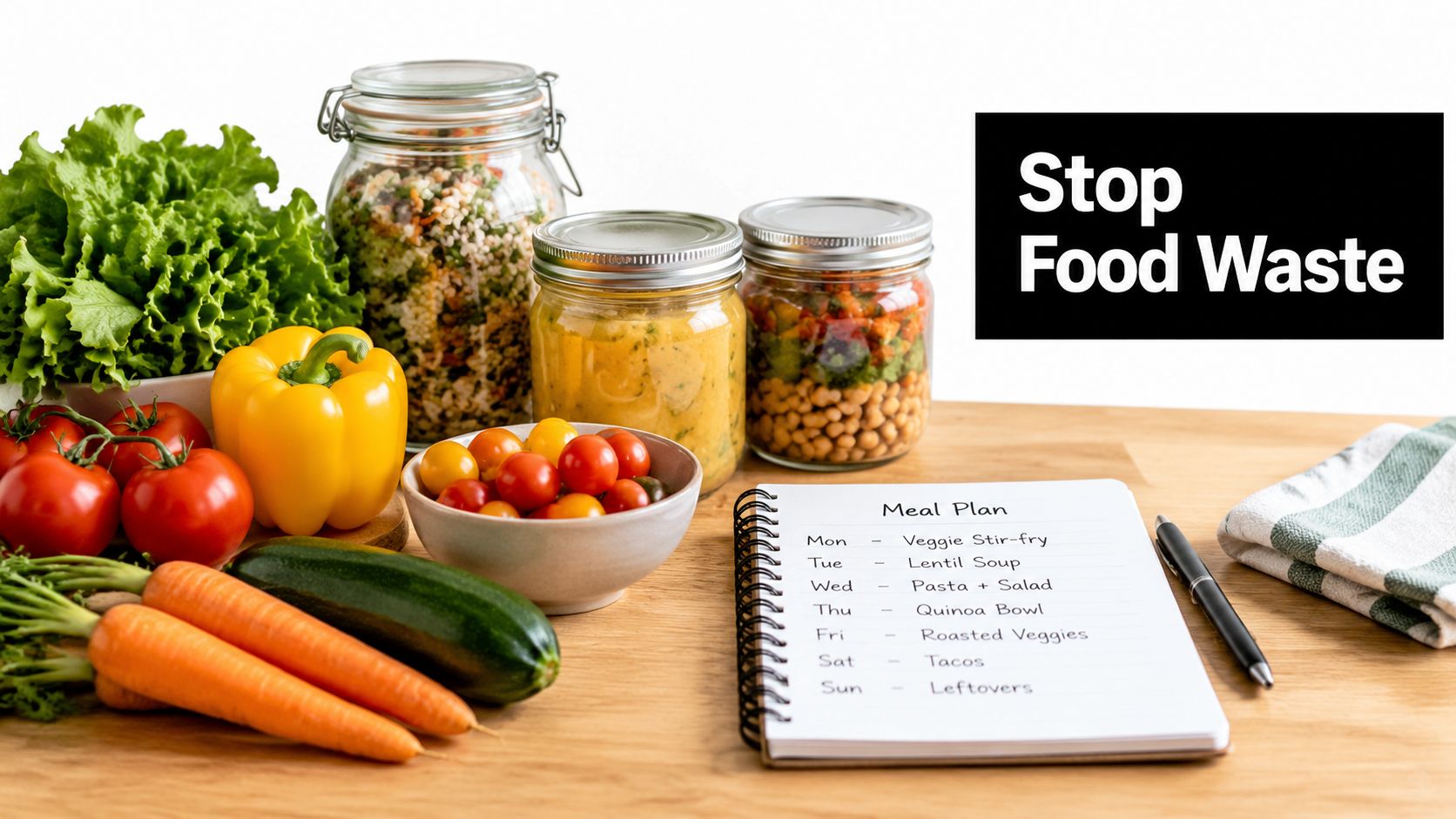
Households are the largest source of food waste globally, responsible for 631 million tonnes, or 60% of the 1.05 billion tonnes wasted at the consumer stage in 2022. The most effective food waste reduction strategies connect meal planning, precise shopping, storage, ingredient reuse, leftover transformation, preservation, and composting into one routine.
Most household waste can be prevented before food reaches the bin. The problem often starts earlier, with an unplanned shop, a duplicate purchase, an overlarge package, an invisible leftover, or a date label that gets treated as an automatic disposal order.
The practical framework below moves from prevention to recovery. It starts by planning demand, then buying only what the household can use, rotating and storing food visibly, preserving surplus, transforming leftovers, and composting scraps that can't be eaten. This sequence matters because composting is useful, but it shouldn't become an excuse to overbuy food that could have fed someone.
The scale makes household action especially important. UNEP reports that households waste at least one billion meals every day, while the average person wastes 79 kg of food annually. UNEP and FAO food-loss data show why the highest-impact solutions must address everyday behavior, not just farming, logistics, or retail.
AI Meal Planner can support the first stages by creating personalized menus, calculating grocery quantities, sorting lists by aisle, reusing ingredients across recipes, and planning around leftovers. After onboarding your goals, dietary preferences, and allergies at AI Meal Planner's onboarding page, review the generated plan rather than accepting it blindly. The best system is the one that fits your schedule, appetite, storage space, and actual cooking habits.
1. AI-Powered Meal Planning and Smart Grocery Lists
A meal plan becomes a waste-reduction tool when it reflects the food you already have and the meals you're realistically going to cook. A generic seven-day menu can still create waste if it requires a specialty ingredient for one recipe, assumes every evening is available for cooking, or ignores the half-used produce in the refrigerator.
AI Meal Planner is useful when you give it accurate information. Dietary restrictions, allergies, preferred cuisines, household size, cooking time, and available ingredients all affect whether a plan will be practical. The platform can generate meals for breakfast, lunch, dinner, and snacks, then help organize the ingredients into a grocery list designed for a real shopping trip.
Before leaving home, check the refrigerator, freezer, and pantry against the proposed list. Remove items you already own, adjust quantities for meals you expect to eat away from home, and swap dishes that don't suit the week ahead. A smart plan still needs human review because calendars change and appetites aren't perfectly predictable.
Make the grocery list operational
An aisle-sorted list reduces the chance that you'll buy duplicates while moving through the store. Use the AI grocery list generator to turn the selected meals into a structured list, then verify package sizes against the quantities you need.
Practical rule: A generated list is a starting point, not permission to buy every suggested item.
The strongest use case is ingredient coordination. If three meals use the same greens, herbs, or protein in different formats, the list can support one purchase and several planned uses. The weak use case is automation without review. If the system schedules delicate produce late in the week or creates more portions than your household eats, the technology hasn't solved the underlying problem.
2. Strategic Ingredient Reuse Across Multiple Recipes
Ingredient reuse changes the shopping question from “What does each recipe require?” to “How many meals can this purchase support?” That shift reduces orphan ingredients, the small amounts of food bought for one dish and then forgotten.
Choose a few flexible ingredients that can move across cuisines and meal formats. Chicken, broccoli, and rice might become a grain bowl, a stir-fry, and a soup. Spinach can appear in a breakfast smoothie, a lunch salad, and a cooked dinner side. Bell peppers can work in roasted vegetables, soup, salad, or a quick skillet meal.
The system works best when you plan the order of use. Delicate greens and berries should appear earlier, while onions, carrots, cabbage, frozen foods, and pantry staples can support later meals. Don't buy a large quantity because an ingredient appears in several recipes. Estimate whether those recipes will be cooked.
Build around ingredient families
Start with a small group of overlapping ingredients rather than forcing every meal to share the same flavor profile. A roasted vegetable base can support Mediterranean bowls one day and a spiced soup another day, especially when sauces, herbs, and grains change the final dish.
- Choose versatile foundations: Pick ingredients that work raw, cooked, blended, or frozen.
- Group related recipes: Use a shared protein or vegetable family to simplify preparation.
- Check existing staples: Rice, pasta, beans, spices, and sauces may already solve the “new ingredient” problem.
- Schedule perishables first: Put foods with the shortest useful window into the earliest meals.
Ingredient reuse isn't the same as eating identical meals all week. It means planning different outcomes from a coordinated set of purchases. That distinction protects variety while keeping the refrigerator manageable.
3. Portion Control and Right-Sizing Grocery Purchases
Overbuying often looks economical at the shelf and expensive in the bin. A larger package only saves money if the household uses the contents before quality declines. For a person who eats one sandwich a week, a full loaf may be less practical than a smaller loaf, freezing part of it, or choosing bread that fits several planned meals.
Track what your household consumes for a short period. Note how many servings of vegetables, fruit, proteins, dairy products, and bread disappear, then compare that pattern with the quantities in your shopping basket. The purpose isn't perfect accounting. It's to replace optimistic assumptions with evidence from your own kitchen.
Use the AI grocery budget calculator alongside portion planning, but still check the package sizes available in your store. A plan may calculate the required amount, while the shop may sell only a larger unit. Decide in advance whether the excess will be frozen, used in another meal, or left off the list.
Match quantity to perishability
A practical purchase decision considers three variables: how many people will eat the food, how often they'll eat it, and how quickly it deteriorates. Frozen individual portions can provide flexibility for proteins and vegetables. A butcher or deli may also provide a custom quantity instead of a standard package.
- Measure serving demand: Plan portions around meals you expect to eat, not meals you wish you had time to cook.
- Question bulk discounts: A discount isn't a saving if part of the food spoils.
- Use package leftovers deliberately: Assign the remaining ingredient to a sauce, soup, lunch, or freezer portion.
- Buy in stages when possible: A smaller first shop can be safer than one large shop for an uncertain week.
This approach also helps families with changing schedules. Right-sized purchasing is more adaptable than committing the household to a large quantity of food because the unit price looks attractive.
4. Inventory Management and First-In-First-Out System
A refrigerator can contain plenty of food and still feel empty if older items are hidden behind newer purchases. A first-in-first-out, or FIFO, system solves that visibility problem by moving older food forward and placing new items behind it.
Create a clear “use first” area at eye level. Put opened dairy, cut produce, cooked grains, prepared meals, and foods approaching their quality limit there. When you return from shopping, move the older items forward before loading the new ones. This takes less time than sorting a spoiled refrigerator later.
The same principle works in a pantry and freezer. Face labels outward, group similar foods together, and use baskets to prevent small packages from disappearing. Label frozen meals with contents and preparation dates, because an unidentified container is likely to remain untouched.
Make inventory checks short and repeatable
A weekly audit doesn't need to become a household project. Open the refrigerator, freezer, and pantry, then identify what must be eaten, frozen, or incorporated into the next plan. A phone reminder or a quick inventory photo can help households that repeatedly forget what they own.
Meal planning should begin with this check. Build at least one meal around a ripe vegetable, an opened package, or a cooked component before adding more ingredients to the shopping list. That makes the meal-prep recipe collection more useful because preparation follows the food already in the kitchen.
Put new food behind old food. Visibility is a stronger safeguard than good intentions.
Don't organize the refrigerator according to an ideal diagram if that layout makes food harder to see. The best FIFO system is the one every household member can understand and maintain.
5. Proper Food Storage and Preservation Techniques
Storage prevents waste only when it matches the food. A clear container can make leftovers visible, but it won't compensate for leaving perishable food at an unsafe temperature or packing a refrigerator so tightly that cold air can't circulate.
The FDA recommends planning meals, checking the refrigerator and pantry before shopping, avoiding impulse and bulk purchases of short-shelf-life foods, and refrigerating leftovers within two hours. It also advises storing refrigerated foods in covered containers or sealed bags while allowing cold air to circulate. Follow those food-safety practices before experimenting with shelf-life extension.
Visibility should guide container choices. Clear containers make cooked grains, chopped vegetables, sauces, and leftovers easier to assess. Label freezer containers with the contents and preparation date, and separate foods that need different storage conditions rather than treating the crisper drawer as a universal solution.
Use simple category rules
Keep foods that release ethylene away from produce that deteriorates in its presence. Store herbs in a way that protects their texture, and avoid leaving produce sealed in packaging that traps unwanted moisture. The exact method varies by food, so use storage guidance from reliable food-safety sources rather than relying on one universal trick.
- Cool leftovers promptly: Divide large quantities into shallow containers so they cool efficiently.
- Keep food visible: Place “eat first” items where they're easy to notice.
- Label prepared food: Write what it is and when you prepared or froze it.
- Protect texture: Choose containers and coverings that limit drying, crushing, or excess moisture.
Storage isn't a contest to make every ingredient last indefinitely. Its purpose is to create enough time for the household to use food safely and intentionally.
6. Creative Leftover Transformation and Recipe Adaptation
Leftovers become waste when they have no next destination. A container of cooked rice may be ignored as “yesterday's dinner,” yet it can become fried rice, a grain bowl, soup, or fritters if the household has a small set of transformation methods.
Build a personal repertoire rather than collecting endless recipes. A sauce can change the identity of roasted vegetables. A grain, protein, and dressing can become a bowl. Stale bread can become breadcrumbs or croutons, while ripe fruit can move into a smoothie, compote, or baked dish.
AI can help with the moment when the ingredients are clear but the idea isn't. Enter the foods you need to use into the recipe generator from ingredients, then evaluate the suggestions for time, safety, nutrition, and ingredients you already own. The best recommendation is one you'll cook before the food deteriorates.
Give every batch more than one role
Batch cooking works better when you prepare neutral components rather than one highly specific dish. Plain roasted vegetables, cooked grains, beans, or seasoned proteins can move into different meals with the help of sauces and spices.
- Reserve a planned portion: Decide before cooking which part becomes tomorrow's lunch.
- Keep transformation staples: Stock grains, pasta, eggs, sauces, spices, and broth.
- Change texture and format: Turn soft vegetables into soup, spread, filling, or sauce.
- Plan flavor variation: Use different herbs, dressings, or spice blends to avoid repetition.
Don't force unsafe or unappealing combinations to avoid waste. If a leftover has deteriorated, discard it. Waste reduction should improve kitchen decisions, not encourage risky eating.
7. Understanding Food Date Labels and Expiration Guidelines
Date labels create avoidable confusion because they can describe safety, quality, retail handling, or manufacturer guidance. “Best before” generally addresses quality, while “use by” is associated with safety. The exact rules vary by jurisdiction and food, so consumers should follow local guidance and product-specific instructions.
The European Commission estimates that date marking is linked to up to 10% of annual food waste in the European Union, measured against 88 million tonnes of annual EU food waste in the cited market study. The European Commission's date-labelling guidance explains why clearer terminology and more consistent practices matter.
Don't treat every printed date as a universal “bin now” instruction. First identify the label, consider whether the package has been opened, check storage history, and follow safety guidance for the specific food. Sensory checks can help with quality decisions for appropriate foods, but smell and appearance can't reliably detect every food-safety hazard.
Separate quality decisions from safety decisions
A dry pantry product past a quality date may be a different decision from refrigerated high-risk food carrying a use-by date. Frozen food can remain safe longer when it has been kept continuously frozen, although quality may decline.
A date label is information. It isn't a replacement for safe storage, product-specific guidance, or judgment.
When in doubt about safety, don't taste the food to test it. Use authoritative food-safety guidance, especially for meat, seafood, prepared foods, infant foods, and products that have been stored incorrectly.
8. Food Preservation Techniques
Freezing is usually the most accessible preservation method because it requires little equipment beyond suitable containers or bags and a functioning freezer. Freeze surplus berries, chopped vegetables, bread, cooked grains, or portions of a prepared meal before quality drops. Label each item so the freezer remains an inventory rather than a storage mystery.
Pickling, fermenting, dehydrating, and canning can also preserve surplus, but each method has different safety requirements. Acid levels, processing times, container sterilization, storage conditions, and ingredients matter. Canning isn't an appropriate area for improvisation, particularly when using pressure-canning methods.
Start with the method that fits your food and confidence level. Frozen portions are useful for a busy household, quick pickles suit some vegetables, dehydration suits herbs and certain produce, and tested canning recipes can preserve seasonal abundance when followed precisely.
Preserve with a rotation plan
Preservation doesn't eliminate waste if finished jars or freezer bags are forgotten. Mark contents and preservation dates, group items by type, and schedule them into future meals. A preserved ingredient should have a likely use before you preserve the next batch.
Freezing also changes meal planning. A surplus of herbs can become a sauce or frozen portion, while extra cooked protein can be divided into future lunches. That flexibility lets a household buy seasonal food without committing to consume everything immediately.
Use tested recipes and current food-safety instructions for canning and fermentation. If you're learning pressure canning, take an official course or use a recognized extension service rather than relying on an improvised online method.
9. Purchasing Imperfect or Surplus Produce
Appearance isn't the same as edibility. Odd shapes, small blemishes, and inconsistent sizes often matter to retail presentation more than they matter to a soup, sauce, stew, smoothie, or roasted tray.
Buy imperfect produce only when you have a use for it. A discounted crate of soft tomatoes isn't a saving for someone without time to cook them. Surplus buying works when the household has a preservation or processing plan, such as freezing berries, making sauce, roasting vegetables, or preparing a soup.
Farmers markets, farm stands, community-supported agriculture programs, and local surplus schemes may offer produce that doesn't fit standard retail presentation. Availability varies by region, so look for nearby programs rather than assuming a national delivery service operates where you live.
Match quality to the recipe
Use visually imperfect food where appearance isn't central. A bruised apple can be trimmed for compote, while firm vegetables can go into a stew or tray bake. Don't buy produce with signs of spoilage, unsafe damage, or contamination because it's cheap.
- Plan before purchasing: Assign surplus to a recipe, freezer space, or preservation session.
- Prioritize flexible foods: Choose produce that can be cooked in several ways.
- Inspect carefully: Cosmetic variation is acceptable, but spoilage isn't.
- Ask local sellers: Farm stands may know when surplus is available.
This strategy reduces pressure to buy only visually uniform food, but it isn't a license to purchase more than the kitchen can process. The same right-sizing discipline still applies.
10. Home Composting and Organic Waste Management
Composting belongs at the end of the hierarchy because it handles unavoidable scraps, not food that could have been eaten. Vegetable peels, coffee grounds, eggshells, and spoiled trimmings can become a soil amendment through an outdoor bin, vermicomposting, bokashi, or a local collection program.
Choose the method according to your living situation. An outdoor system may suit a garden, while a worm bin or bokashi bucket can work in a smaller home when maintained correctly. If home composting isn't practical, check whether a community garden, municipal program, or private collection service accepts food scraps.
A healthy system needs a balance of carbon-rich “brown” materials and nitrogen-rich “green” materials, adequate moisture, and airflow. Covering fresh scraps with dry material helps limit odors and pests. Chop large pieces when practical, and use finished compost in a garden or donate it to a community growing project.
Keep prevention ahead of composting
Before putting food into the compost stream, ask whether it could have been stored, frozen, reused, or transformed. This quick question keeps the hierarchy in the right order: prevent purchases that won't be used, feed people with purchased food, preserve surplus, and compost what remains.
For a practical starting point, follow this guide to starting a home compost system. It can help you select an approach and avoid common problems such as excess moisture, poor aeration, and pest access.
10-Point Food Waste Reduction Comparison
| Strategy | Implementation Complexity 🔄 | Resources & Cost ⚡ | Expected Impact 📊 | Ideal Use Cases 💡 | Key Advantages ⭐ |
|---|---|---|---|---|---|
| AI-Powered Meal Planning and Smart Grocery Lists | 🔄🔄 (moderate onboarding; ongoing engagement) | ⚡⚡ (app/device, subscription; 5–15 min/week) | 40–50% waste ↓; 5–8 h/week saved; $100–200/mo saved · ⭐⭐⭐⭐ | Busy households, dietary tracking, grocery delivery users | Personalized plans; optimized grocery lists; ingredient reuse |
| Strategic Ingredient Reuse Across Multiple Recipes | 🔄🔄 (planning weekly clusters) | ⚡ (planning time; no major equipment) | 30–40% waste ↓; $80–150/mo saved · ⭐⭐⭐ | Weekly planners, bulk buyers, meal-preppers | Simplifies shopping; bulk savings; minimizes spoilage |
| Portion Control and Right-Sizing Purchases | 🔄🔄 (data collection then routine) | ⚡ (measuring/tracking; low cost) | 20–30% waste ↓; $60–120/mo saved · ⭐⭐⭐ | Small households, variable eaters, budget-conscious shoppers | Precise purchasing; reduces impulse buys; saves money |
| Inventory Management & FIFO System | 🔄🔄 (2–3 hr setup; weekly audits) | ⚡ (labels, containers; minimal cost) | 15–25% waste ↓; $50–80/mo saved · ⭐⭐ | Households with pantry/freezer, meal planners | Prevents forgotten items; low-cost; works with any diet |
| Proper Food Storage & Preservation Techniques | 🔄🔄 (learning methods; some setup) | ⚡⚡ (containers, humidity control; one-time cost) | 25–35% waste ↓; shelf-life ↑50–100% · ⭐⭐⭐ | Batch cookers, bulk buyers, those with fridge/freezer space | Extends shelf life; enables bulk buying; supports meal prep |
| Creative Leftover Transformation & Recipe Adaptation | 🔄🔄🔄 (skill development required) | ⚡ (pantry staples; minimal cost) | 25–35% waste ↓; saves cooking time · ⭐⭐⭐ | Cooks, families, creative eaters, those minimizing prepared-food waste | Turns leftovers into varied meals; low incremental cost |
| Understanding Food Date Labels & Expiration Guidelines | 🔄 (low; education + habits) | ⚡ (time to learn; no equipment) | 15–20% waste ↓; $30–50/mo saved · ⭐⭐ | All consumers, risk-tolerant users, households wanting quick wins | Quick to implement; reduces premature disposal; widely applicable |
| Food Preservation Techniques (Freezing, Pickling, Canning, Dehydrating) | 🔄🔄🔄 (steep learning curve; safety procedures) | ⚡⚡⚡ (equipment + time; $30–500+ initial) | 60–80% waste ↓; long-term storage; $50–100/mo savings · ⭐⭐⭐⭐ | Gardeners, homesteads, seasonal buyers, emergency preppers | Massive shelf-life extension; captures seasonal abundance |
| Purchasing Imperfect/Surplus Produce & Cosmetic-Grade Items | 🔄 (low; sourcing effort) | ⚡⚡ (supplier relationships; variable turnover) | Diverts farm/retail waste; 20–50% produce cost savings · ⭐⭐⭐ | Budget shoppers, processors, those who can process soon after purchase | Large cost savings; supports farms; reduces upstream waste |
| Home Composting & Organic Waste Management | 🔄🔄 (setup + maintenance) | ⚡⚡ (bin/system; space; 2–4 hr setup) | 40–50% household waste diverted; produces soil amendment · ⭐⭐⭐ | Gardeners, households with outdoor space, sustainability-focused homes | Eliminates compostable waste from trash; creates free compost |
Build a Kitchen System That Uses More and Buys Less
The strongest food waste reduction strategies don't depend on one perfect habit. They create a connected kitchen system in which each decision supports the next one.
Start with an inventory check before planning. Look for food that needs attention, including opened packages, ripe produce, cooked components, and freezer items that have been ignored. Build several meals around those foods, then calculate portions and create a grocery list for the remaining ingredients.
Shop from the list, but review package sizes in the store. If the shop sells more than you need, decide immediately whether you'll freeze, preserve, or repurpose the excess. Don't let a bulk discount make the decision for you. The correct quantity is the amount your household can use safely and enjoyably.
When you unpack groceries, make food visible. Put older items in front, new items behind them, and label prepared food. Store leftovers promptly and place them in a designated “eat first” area. Visibility matters because people can't use what they can't find.
Schedule a leftover session before food starts to deteriorate. This might mean turning cooked vegetables into soup, using rice in a new dish, freezing extra portions, or preparing a sauce from herbs that are losing firmness. AI Meal Planner can help connect available ingredients to recipes, but you still need to approve the plan based on your time and appetite.
Measurement also supports better decisions. A practical program can combine measurement, staff or household engagement, overproduction control, purchasing changes, and surplus repurposing. Sites using that combination achieved an average 26% reduction in food waste by weight over 12 months, while 76% recovered their investment within one year, 89% within two years, and the average benefit-cost ratio was 7:1 over three years, according to the European Commission food-waste prevention report. Those figures come from site-based programs, so a household shouldn't assume it will reproduce the same outcome, but they show why measurement and coordinated action outperform isolated tips.
Start with three actions: check inventory weekly, reuse ingredients across meals, and shop from precise quantities. Add freezing, pickling, canning, or dehydration only after the basic system is working. Compost unavoidable scraps after prevention and reuse have done their work.
Frequently asked questions
How should I start reducing food waste if I'm busy?
Begin with a short inventory check, three planned meals, and a focused grocery list. Choose recipes that share ingredients and include at least one leftover meal.
What's the best way to use leftovers?
Give leftovers a specific next use before storing them. Transform cooked grains, proteins, and vegetables into bowls, soups, salads, fillings, sauces, or freezer portions.
How can I make food easier to manage in the refrigerator?
Use clear containers, keep older items in front, and create an eye-level “eat first” area. Label prepared food with its contents and preparation date.
Should I throw food away when it reaches a date on the package?
First identify whether the label concerns quality or safety, then follow local and product-specific food-safety guidance. Don't rely on smell or taste alone for high-risk foods.
Is composting enough to solve household food waste?
No. Composting is a recovery option for unavoidable scraps, while meal planning, precise purchasing, storage, and reuse prevent edible food from becoming waste.
Can AI Meal Planner help with ingredient reuse?
Yes. It can generate personalized menus, calculate grocery quantities, organize lists by aisle, reuse ingredients across recipes, and suggest ways to plan around leftovers.
What should I do if I don't have space for a compost bin?
Look for municipal collection, a community garden, a bokashi system, or a small vermicomposting setup. Choose the method that fits your home and local rules.
AI Meal Planner creates personalized weekly menus and smart aisle-sorted grocery lists around your goals, preferences, allergies, and available ingredients. Use it to coordinate quantities, reuse ingredients, and plan leftovers before they spoil, then visit AI Meal Planner to build a more organized, lower-waste kitchen routine.
AI-powered nutrition
Get Your Personalized Meal Plan
AI creates the perfect meals for your goals, lifestyle, and taste.
Start Your Journej