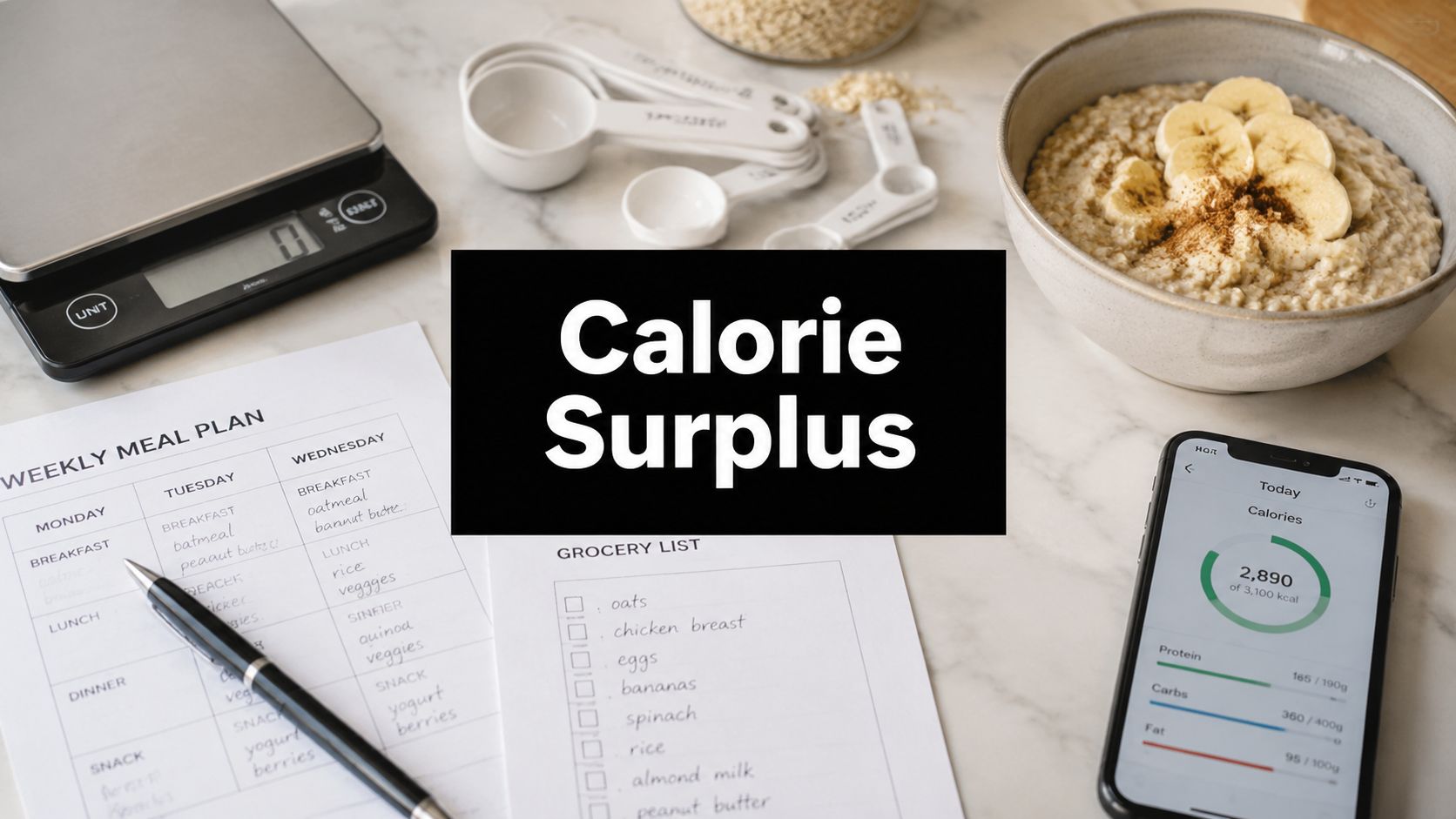
You do not need a perfect bulk to make progress. What you need is a starting point that matches your training load, appetite, and schedule, then a way to adjust before the surplus gets too large. A small calorie surplus is the more evidence-backed place to begin, usually 5% to 20% above maintenance or about 0.25% to 0.5% of body mass per week, because larger surpluses tend to add more fat than extra muscle (PMC review on resistance-training surpluses).
That setup becomes more useful when real life gets in the way. Training days vary, work runs long, and meals still need to be simple enough to repeat without much friction. Free calorie surplus tools help because the problem is not just knowing you should eat more, it is turning that target into meals, shopping habits, and tracking that fit an ordinary week.
A practical surplus system usually starts with a number, then adds structure around it. A review summarized in the evidence base recommended beginning around 1,500 to 2,000 kJ/day, which is roughly 350 to 480 kcal/day, above maintenance and then adjusting based on body composition and performance (Frontiers in Nutrition review summarized in the evidence base). That approach matters because lean-bulk planning is built around enough extra energy to support training, while avoiding a surplus that mostly turns into fat. It also explains why the most useful tools are not just calculators. They include meal plans, recipe collections, tracking apps, shopping lists, templates, research summaries, and integrated platforms, each with a different role depending on whether you need a starting estimate, a repeatable day of eating, or a way to check whether the surplus is working.
The tool that helps most depends on the bottleneck. If you need a target, a calculator is the first move. If you already know your intake but struggle to hit it consistently, a meal plan or template is more useful. If your calories drift because you do not track accurately, an app or integrated platform matters more. For someone who wants a low-effort starting point, this TDEE calculator can set the baseline before you decide how much to add.
1. Calorie Surplus Calculators That Set Your Starting Point
A calculator gives you a clean starting point because it turns a vague bulking goal into a number you can use. The better ones estimate your TDEE, then add a cautious surplus so you are not guessing at every meal.
The most practical way to use a calculator is to treat it as a first estimate, not a final answer. A common maintenance check is to track food intake and body weight for about 2 weeks and see whether weight stays stable, which usually gives a better read on maintenance than a formula alone (maintenance tracking guidance). If the estimate is off, adjust by ±300 calories and test again instead of making a large change.
Practical rule: if you are unsure which activity level to pick, start with the lower one. You can add calories later, but a surplus that is too high usually means extra fat that has to be reduced later.
For muscle gain, that conservative start matches the evidence base. The literature supports 5% to 20% above maintenance or a weekly gain rate of 0.25% to 0.5% of body mass, which helps explain why newer guidance moves away from very large bulks (PMC review). That review also found a stronger link between body-mass increases and skinfold thickness than between larger surpluses and extra muscle, so a bigger intake is not automatically a better one.
A calculator is most useful when it feeds the next step. For someone who needs structure after getting a baseline, the bulking meal plan tool can turn the target into real meals, snacks, and portions without requiring spreadsheet-level tracking. That matters for busy lifters, people returning to training, and anyone who wants a leaner bulk rather than a faster scale jump.
How to use calculator results without overfeeding
A simple comparison helps:
- Use the calculator estimate first if you are starting from scratch.
- Cross-check multiple calculators if your activity level changes a lot from week to week.
- Recalculate after meaningful weight change so the surplus stays tied to current maintenance.
- Choose the smaller surplus if your priority is limiting fat gain rather than seeing the scale move quickly.
The value is control. A calculator does not build the bulk for you, but it keeps the plan tied to numbers that can be measured, adjusted, and repeated.
2. Meal Plans That Translate Numbers Into Real Days of Eating
Meal plans matter because bulking usually fails from decision fatigue, not from a lack of information. A plan with fixed breakfasts, lunches, dinners, and snacks removes the daily question of what to cook next, which makes the surplus easier to repeat.
The strongest surplus plans start with your actual calorie target, not the intake you hope to maintain. That matters because practical guidance generally favors a small surplus rather than a large jump, and practical range summary places that range around 10% to 20% of TDEE. The range is wide enough to support training, but narrow enough to lower the chance that most of the gain comes from fat.
If you use a pre-built plan, match it to the intake your calculator produced. A meal plan that runs too high can be hard to sustain, especially since conservative surplus evidence links faster body-mass gain with more fat gain as noted earlier. A better workflow is to keep one plan in place for a few weeks, then adjust it based on actual weight trends rather than boredom or guesswork.
The AI Meal Planner bulking meal plan fits that use case because it gives structure without spreadsheet-level micromanagement. That makes it useful for people with repetitive weekday eating patterns, busy work schedules, or a preference for a leaner bulk instead of a rapid scale jump.
A plan only works if you can repeat it.
Meal plans also need swap flexibility. If identical lunches start to feel stale, rotate one or two meals each week and keep the calorie total stable. That protects adherence without breaking the surplus. A practical example is pairing standard lunches with homemade protein bread recipes with cheese, which can add calories and protein without forcing a full menu redesign.
When a meal plan beats improvising
Meal plans usually win when you need one or more of these:
- A fixed calorie target you can hit daily without thinking.
- Prebuilt grocery lists that reduce shopping friction.
- Macro counts by meal so protein is not left to chance.
- A short review window where you can see whether the surplus is working.
That comparison is what matters. A calculator gives you the number, but a meal plan turns that number into meals you can eat day after day, so the surplus shows up in your training and on the scale.
3. Recipe Collections That Make Higher Calories Easier to Eat
Recipe collections sit between a strict meal plan and fully improvised cooking. They let you keep variety while still steering toward calorie-dense, protein-forward meals that support a surplus.
That matters because the first weak point in many bulks is not motivation, it is friction. Appetite drops, prep time feels longer, and repeated decision-making gets tiring. A short list of reliable high-calorie meals lowers that friction and makes it easier to stay in surplus without redesigning every dinner.
The evidence still supports a modest surplus rather than a large one, so recipe choice should favor consistency over excess. Guidance around 5% to 20% above maintenance means you do not need every meal to be huge, you just need meals dense enough to close the gap (PMC review). Recipes with practical add-ons, such as olive oil, nut butters, or whole milk, help fill that gap without forcing a bigger plate.
A useful example is the high-protein recipe collection in AI Meal Planner, which helps keep meals aligned with a calorie target while still leaving room to vary ingredients. The value is less about novelty and more about repeatable execution.

Batch cooking makes that approach more practical. Cooking several portions on Sunday gives you ready-to-eat meals for the workweek, which helps when appetite dips or meetings run late. If you track intake closely, a kitchen scale makes portioning easier to measure accurately. For a lower-effort way to add calories and protein to recurring meals, homemade protein bread recipes with cheese can fit into breakfast, lunch, or snacks without requiring a full menu change.
A simple recipe rotation that works
A useful structure is a short rotation of meals, each serving a different role:
- One breakfast that is easy to repeat during the week.
- One lunch that reheats well and keeps protein high.
- One dinner that can be doubled for leftovers.
- One snack or shake that raises calories when you are short.
That mix gives you flexibility without forcing you to invent dinner every night. It also makes the surplus easier to maintain on days when appetite runs lower than expected.
The trade-off is convenience versus variety. More variety can improve adherence, but too much variety makes calorie tracking harder and raises the chance of under-eating. A tight recipe collection works best when it gives you enough options to avoid boredom, while still keeping the calorie total predictable.
4. Tracking Apps That Tell You Whether the Surplus Is Real
Meal plans only matter if the intake behind them is visible. Tracking apps answer a simple question, did the day land in surplus, or did the numbers drift lower than expected?
Their value is accuracy, not novelty. A calorie surplus only supports muscle gain if intake stays above maintenance often enough to matter, and memory is a weak way to judge that. Logging food gives you a running check on whether your plan is holding or slipping.
Pre-logging the next day's meals the night before helps make the surplus deliberate. It also reduces the common pattern of under-eating after a busy day, when decisions get rushed and meals get skipped or cut short. Barcode scanning speeds up packaged foods, while fresh produce is still easier to enter manually, or weigh with a kitchen scale during the first few weeks of tracking.
MyFitnessPal, Cronometer, and Lose It! all do the same basic job, but they suit different habits. MyFitnessPal is often used for its large food database and app integrations, Cronometer for tighter micronutrient awareness, and Lose It! for a simpler interface. The better choice is the one you will open every day.
A 7-day rolling average gives a clearer read than a single morning weigh-in. Day-to-day water shifts can hide whether the surplus is working, so the weekly trend matters more than one noisy data point.
That weekly view matches the evidence-based approach well. The aim is not a perfect day, it is a steady upward trend that still supports body composition goals, and the broader research supports watching body weight alongside body composition rather than fixating on daily scale swings (energy surplus and body composition evidence).
What to log first
If you only want the minimum useful set, start here:
- Total daily calories to confirm the surplus exists.
- Protein intake so muscle gain has a nutritional floor.
- Weekly body weight average to see whether the plan is moving.
- One or two performance markers in the gym to check whether the extra food is helping training.
That is enough for many people. More detail can help, but only if it does not turn logging into a chore that makes you stop using the app.
5. Shopping Lists That Keep the Surplus Cheap and Repeatable
A smart shopping list is one of the most underrated calorie surplus tools because the diet starts in the store, not the kitchen. If the cart is full of ingredients that do not match your targets, the week gets harder before it even starts.
The most efficient grocery lists are built around overlap. If chicken, rice, eggs, yogurt, oats, and frozen vegetables show up in multiple recipes, you waste less and spend less time deciding what to buy next. That is a practical advantage when you are trying to keep a surplus without turning every meal into a special project.
The AI Meal Planner grocery list generator fits that workflow because it turns meal planning into a shopping list you can use. For people who do not want to manually convert meal targets into aisle-by-aisle purchases every week, that saves a real step.
A few real-world rules make the list work better. Shop the perimeter first for produce, meat, and dairy, then fill in bulk staples. Buy proteins like chicken, ground beef, and eggs when they are on sale, and freeze what you will not use soon. Perishable foods should be bought closer to meal prep so you do not create waste from wilted produce or spoiled dairy.
A grocery list also needs to match the size of the surplus. Since the literature favors a modest surplus rather than a huge one, the list should be dense enough to support intake without being so large that you overbuy food you will not eat. The PMC review supports that narrower, more controlled approach.
How to make a grocery list work harder
A strong list usually does four jobs at once:
- Supports multiple meals with the same ingredients.
- Limits food waste by matching shelf life to your prep schedule.
- Protects the budget by centering sale items and bulk staples.
- Keeps the surplus consistent because the right food is already in the house.
That is a better setup than shopping based on cravings. A craving-driven cart can still fit a bulk, but it is a less reliable way to maintain the right calorie surplus week after week.
6. Meal Templates That Give You Structure Without Locking You In
Meal templates work well for people who want boundaries without having to eat the same meals on repeat. A template sets the macro shape of a meal, then leaves room to swap ingredients inside that frame.
That matters because a calorie surplus depends on repeatable totals, not identical plates. If breakfast reliably includes protein and carbs, lunch carries a solid calorie base, and dinner finishes the day's target, you can stay on course without fixing every meal in advance.
A simple pattern like protein, carb, and fat also reduces decision fatigue for busy professionals. You can cycle through foods you already keep around and still stay close to the same surplus target. That flexibility helps when appetite shifts, travel disrupts routine, or your schedule makes exact meal timing unrealistic.
The bulking research points in the same direction. Conservative surpluses of 5% to 20% are easier to maintain when portions can be adjusted inside templates instead of rebuilding the whole plan each time (PMC review). Templates sit between rigid meal plans and completely unstructured eating.
A practical template mindset
Use templates as a framework, not a rulebook. One breakfast might be eggs, oats, and fruit, while another might be yogurt, granola, and nut butter, yet the calorie structure stays close enough to serve the same purpose.
Build around foods you already buy. A template only works if the ingredients fit your real routine.
Templates also fit people who do not want to track every gram forever. A food scale can teach portion sizes over a couple of weeks, then visual repetition can do more of the work once your estimates are calibrated. That makes templates a useful no-cost tool for anyone who wants structure without turning bulking into a rigid checklist.
7. Research Summaries That Help You Ignore Bad Bulk Advice
A lot of bulk advice fails at the same point, it pushes you toward bigger surpluses without showing what you get in return. Research summaries are useful because they turn studies into practical rules you can use before you add calories that may not improve muscle gain.
One useful takeaway is that a larger surplus does not automatically produce better hypertrophy. A trial in resistance-trained people compared maintenance, a 5% surplus, and a 15% surplus, and the larger surplus mainly showed up as more skinfold thickness, not clearly better muscle growth (trial summary in the evidence base). That matters for planning, because extra calories can drift toward fat gain faster than they translate into a better training outcome.
The other pattern runs in the opposite direction. A meta-analysis found that training during energy deficiency makes lean-mass gain harder, which is one reason long cutting phases are a poor time to expect muscle growth (energy deficiency meta-analysis). For someone trying to add size, avoiding accidental under-eating is not just a comfort issue, it changes whether the surplus strategy has room to work.
Research summaries are most useful when they explain what to do next. That is why evidence-driven reviews matter most when they connect body composition, training performance, and rate of gain, instead of repeating hype about eating as much as possible.
A good example is the kind of practical interpretation you can find in an AI nutrition planning guide, where the point is not just what the studies say, but how to apply them to day-to-day eating. That kind of framing is useful because the same research can support different actions depending on whether you are trying to minimize fat gain, keep appetite manageable, or adjust for a hard training block.
What to look for in a good review
- Meta-analyses and systematic reviews before single studies.
- Clear date stamps so you know whether the guidance is current.
- Practical application sections that explain what to do next.
- Consistency across sources when recommendations overlap.
If several evidence summaries keep pointing to conservative surplus ranges, that is a stronger signal than any one bold claim. The practical lesson is straightforward, a controlled bulk is easier to defend when the evidence does not support pushing calories higher just for the sake of it.
8. Integrated Platforms That Handle Planning and Tracking Together
An all-in-one platform makes sense when you want the surplus process to stay in one place. Instead of moving between a calculator, a meal plan, a grocery list, and a tracking app, you get one workflow that is easier to keep using.
The main benefit is continuity. The platform sets a calorie target, turns it into meals, and then shows whether your weekly weight trend is moving. That matters because intake changes should be based on real results, not on a target that only looks good on paper.
A practical example is an AI nutrition planning tool that starts from calorie targets, builds weekly meals, and produces shopping lists around the same numbers. That setup fits busy lifters because it reduces manual setup, keeps the surplus visible, and leaves less room for drift between planning and execution.
The trade-off is that integrated tools still need review. Check the first 1 to 2 weeks, compare your body weight trend with your goal, and adjust if gain is too slow or appetite is making the plan unrealistic. If the menu gets repetitive, use swap features rather than rebuilding the whole system from scratch.
Integrated platforms save time only when the feedback loop stays active.
That point matters because calorie surplus planning changes with training age, appetite, recovery, and starting body composition. A system that adapts to those shifts is more useful than a setup that assumes one surplus target will work forever.
Calorie Surplus, 8-Resource Comparison
| Item | Core features ✨ | UX & Quality ★ | Value 💰 | Best for 👥 | Unique strength 🏆 |
|---|---|---|---|---|---|
| Calorie Surplus Calculators (TDEE & Macro) | ✨ TDEE + macro calc, customizable surplus, activity inputs | ★★★★ (fast; estimate variance ±200–400 kcal) | 💰 Free/low-cost; essential starting numbers | 👥 Beginners needing a numeric framework | 🏆 Math-based precision for initial targets |
| Meal Plans Designed for Calorie Surplus | ✨ Pre-built 2.5–3.5k+ daily menus, macros, shopping lists | ★★★★ (structured; less flexible) | 💰 Moderate, saves planning time | 👥 People who want done-for-you structure | 🏆 Turnkey plans that hit surplus without math |
| High-Calorie Recipe Collections | ✨ 2k–3.5k recipes, macros per serving, quick cook options | ★★★★ (high variety; selection required) | 💰 Low–moderate; improves adherence & variety | 👥 Home cooks who enjoy recipe variety | 🏆 Large library of muscle-gain–focused meals |
| Meal Tracking Apps (MyFitnessPal, Cronometer) | ✨ Barcode scan, huge food DB, real-time macro tracking | ★★★★ (accurate if consistently logged) | 💰 Free tiers; premium for advanced features | 👥 Anyone needing accountability & verification | 🏆 Verifies actual intake with massive database |
| Optimized Shopping Lists | ✨ Aisle-sorted lists, qtys by recipe, ingredient reuse | ★★★★ (speeds shopping; store variance) | 💰 Saves money by reducing waste & impulse buys | 👥 Busy shoppers who want efficiency | 🏆 Minimizes waste via cross-recipe reuse |
| Sample Meal Templates (Mix-and-Match) | ✨ Macro formulas per meal, swap lists, portion ranges | ★★★ (flexible; needs basic nutrition know-how) | 💰 Low-cost; builds long-term skill | 👥 Self-directed users who want flexibility | 🏆 Teaches scalable, repeatable macro assembly |
| Evidence Summaries & Research Reviews | ✨ Meta-analyses, evidence ratings, practical takeaways | ★★★ (dense but highly credible) | 💰 High optimization value; often free | 👥 Educated users & coaches seeking why | 🏆 Science-backed guidance to avoid myths |
| Integrated Meal Planning & Tracking Platforms | ✨ AI-driven plans, 2k+ recipes, smart lists, tracking | ★★★★★ (seamless, adaptive, all-in-one) | 💰 Subscription required, high convenience ROI | 👥 Busy professionals wanting end-to-end automation | 🏆 Full automation + weekly adjustments based on progress |
Next Steps to Master Your Calorie Surplus
The most practical way to use these resources is to combine a few of them, not try all eight at once. Start with a calculator to set a calorie target, then pair it with either a meal plan or meal templates so your daily intake stays predictable. After that, use a tracking app to confirm that the surplus is real, and a shopping list to keep the food side simple enough to repeat.
If you want the least complicated setup, use one integrated platform and let it handle the calorie target, weekly plan, and grocery list in one place. If you want more control, split the workflow across separate tools, a calculator for numbers, recipes for variety, tracking for accountability, and research summaries to keep your surplus conservative.
The main trade-off is simplicity versus customization. A rigid meal plan can be easier to follow, but a flexible template system may fit better if your schedule changes often. Recipe collections help when you get bored, while tracking apps help when you are not sure the surplus is occurring. The right combination depends on whether your biggest problem is time, appetite, or consistency.
Keep the evidence in mind as you adjust. As noted earlier, the literature favors a modest calorie surplus, not a large one, because bigger surpluses tend to raise fat gain faster than they improve muscle gain. That means the goal is to build a plan you can hold long enough to see real progress, then fine-tune it based on weekly body weight, gym performance, and how your clothes fit.
If you want a single place to start, complete the onboarding at AI Meal Planner and use it to turn your calorie target into a weekly meal plan, smart grocery list, and trackable surplus you can maintain.
AI-powered nutrition
Get Your Personalized Meal Plan
AI creates the perfect meals for your goals, lifestyle, and taste.
Start Your Journej