How do I lose weight without starving myself?
To lose weight without starving, you need to create a moderate and sustainable calorie deficit by eating 400–700 calories below your daily maintenance needs. This typically results in a healthy weight loss of 0.5–1.0 kg (about 1–2 pounds) per week. Focus on eating high-protein, high-fiber foods to stay full and satisfied throughout the process.
Losing weight often brings to mind images of tiny portions, constant hunger, and forbidden foods. This is the exhausting cycle of crash dieting, and it’s a mindset we need to break. The real secret to sustainable weight loss isn’t about starving yourself; it’s about eating smarter.
This isn't just about cutting calories, though. The magic happens when you focus on the quality of the food you're eating. By prioritizing nutrient-dense foods packed with protein and fiber, you can feel full and satisfied while still losing weight. It’s a shift from punishment to nourishment.
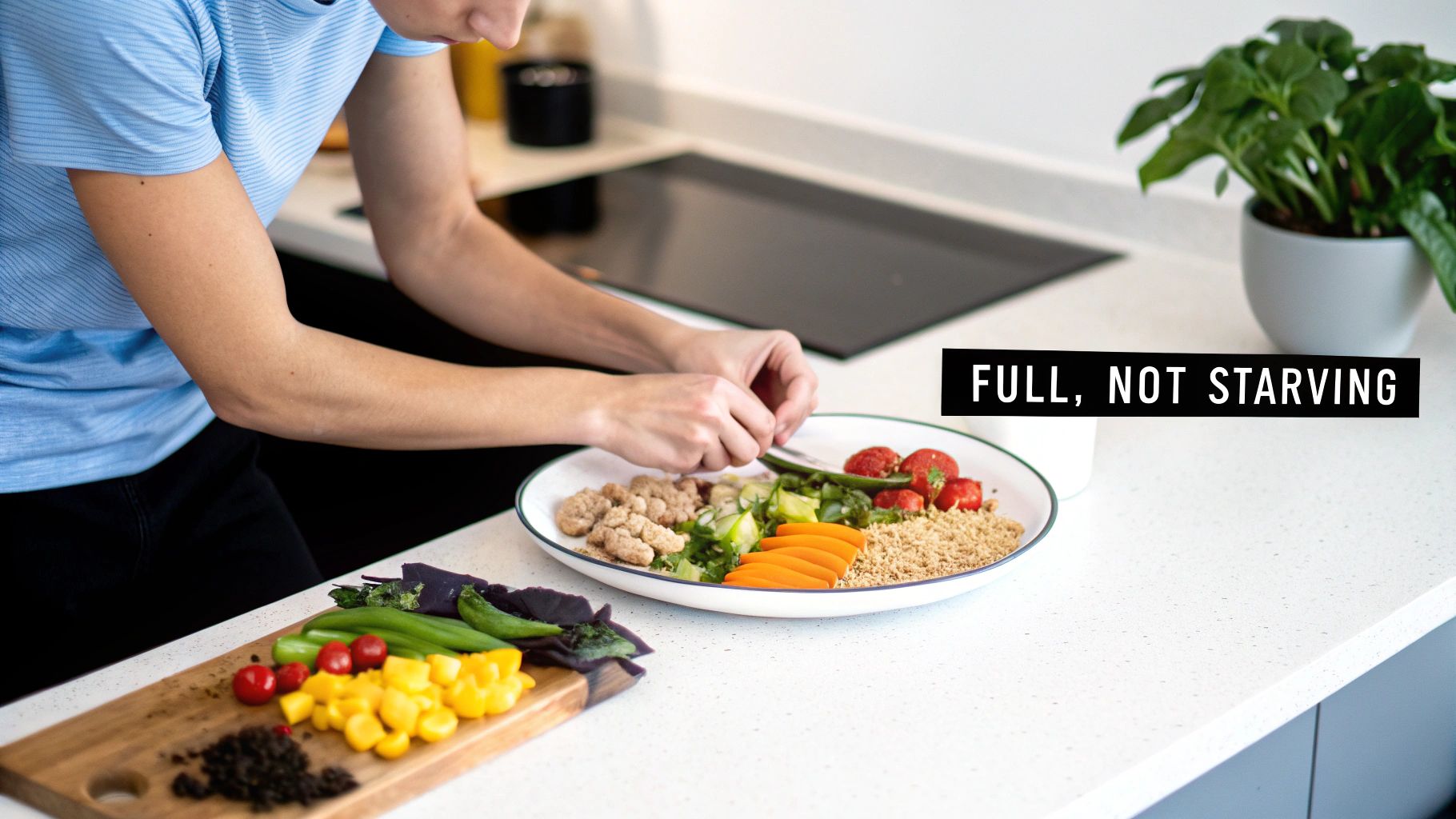
Why is a moderate deficit better than extreme dieting?
For decades, diet culture has pushed the idea that faster is better, leading people to slash their calories to dangerously low levels. But this approach is fundamentally flawed and works against your body's biology.
When you drastically cut calories, your body goes into survival mode. It doesn't know you're trying to fit into a smaller pair of jeans; it thinks there's a famine. In response, it slows down your metabolism to conserve energy and ramps up hunger hormones, making you feel ravenous. This is why crash diets are nearly impossible to stick with and almost always lead to rebound weight gain.
A moderate deficit, on the other hand, is a much smarter strategy. It creates a small energy gap that allows your body to tap into fat stores without sounding the alarm bells.
How do I find my sustainable calorie target?
The first step is figuring out your daily maintenance calories—the amount you need to eat to stay at your current weight. Once you know that number, subtracting 400-700 calories gives you a sustainable target for fat loss. This range is the sweet spot; it’s effective for weight loss but still leaves plenty of room for satisfying, nutrient-rich meals.
You don’t have to guess this number. Using a tool that calculates your needs based on your age, gender, activity level, and goals is the best way to get a reliable starting point. To get your personalized numbers, check out our calorie deficit calculator.
This moderate approach isn't just theory; it's backed by global health data. According to the World Health Organization, 2.5 billion adults were overweight in 2022, a number that has more than doubled since 1990. The reason? Unhealthy eating patterns and unsustainable diets. Research consistently shows that a staggering 80–90% of people who lose weight via severe restriction regain it all back. The evidence is clear: moderate deficits paired with high-protein, high-fiber meals deliver steady, lasting results.
What are the main problems with extreme dieting?
Extreme diets don't just leave you feeling hungry and miserable; they can also be detrimental to your health. By slashing calories too low, you risk missing out on essential nutrients, which can lead to fatigue, muscle loss, and a sluggish metabolism over time.
A sustainable plan, however, focuses on maximizing nutrition within your calorie budget.
The goal isn't just to eat less; it's to eat smarter. Prioritizing foods that are high in protein and fiber provides the building blocks your body needs and keeps you feeling full for hours, effectively ending the cycle of starvation and overeating.
This is why understanding the difference between a sensible deficit and a starvation diet is so critical for long-term success.
How does a sustainable deficit compare to a starvation diet?
It's easy to get these two concepts confused, but their impact on your body and your results couldn't be more different. This table breaks down the key distinctions.
| Metric | Sustainable Deficit | Starvation Diet |
|---|---|---|
| Calorie Cut | Moderate (400–700 below maintenance) | Extreme (1000+ below maintenance) |
| Hunger Levels | Manageable, controlled with smart food choices | Constant, intense, and distracting |
| Energy Levels | Stable, supported by nutrient-dense foods | Low, leading to fatigue and irritability |
| Muscle Mass | Preserved with adequate protein intake | Significant muscle loss is common |
| Sustainability | High; feels like a lifestyle change | Very low; leads to a cycle of yo-yo dieting |
| Metabolic Impact | Minimal impact on metabolic rate | Can significantly slow down metabolism |
As you can see, the path to sustainable weight loss isn't about deprivation. It's about working with your body, not against it, by providing it with the right fuel in the right amounts.
Why do most restrictive diets fail?
Ever wondered why that crash diet you started with so much hope ended in a spectacular flameout? You’re not alone, and it’s almost certainly not because you lacked willpower. Most restrictive diets are built on a shaky foundation, one that pits you against your body’s most powerful survival instincts. It’s a setup for failure.
When you dramatically slash calories, your body doesn't see it as a noble quest for a six-pack. It sees a famine. In response, it triggers a powerful cascade of defense mechanisms designed to keep you alive. This reaction is pure biology, not a personal shortcoming.
This is exactly why figuring out how to lose weight without starving is the only game plan that leads to lasting success. It means ditching the "quick fix" mentality for a smarter strategy that actually works with your body, not against it.
What is metabolic adaptation?
One of the biggest reasons extreme diets backfire is a process called metabolic adaptation, which you might have heard of as "starvation mode." When your body senses a severe energy deficit, it gets incredibly efficient with the calories it does get. Your resting metabolic rate—the energy you burn just to exist—starts to slow down.
This metabolic slowdown makes it progressively harder and harder to lose weight, even if you’re sticking to the plan perfectly. You hit that dreaded plateau where the scale just won’t budge, no matter how little you eat. Your body is just doing its job, conserving energy to protect you from what it perceives as a legitimate threat.
This isn't just a feeling; it's a measurable physiological response. Your body is desperately trying to close the energy gap you've created, turning sustained weight loss on a crash diet into an uphill battle against your own biology.
Worse yet, this adaptation can stick around even after the diet is over. It’s a huge reason why so many people regain weight so quickly—your metabolism is still suppressed, but your appetite often comes roaring back with a vengeance.
How do hunger hormones sabotage weight loss?
Beyond slowing down your furnace, severe calorie restriction sends your appetite-regulating hormones into total chaos. The two main culprits here are ghrelin and leptin.
- Ghrelin: Known as the "hunger hormone," ghrelin is produced in your stomach and screams at your brain when it's time to eat. On a crash diet, ghrelin production goes through the roof, leaving you with constant, gnawing hunger and intense cravings.
- Leptin: This is the "satiety hormone" that tells your brain when you’re full. When you’re severely restricting, leptin levels plummet. The result? You never really feel satisfied, making it incredibly easy to overeat the second you give yourself a little freedom.
This hormonal one-two punch creates an overwhelming biological drive to eat that is nearly impossible to willpower your way through for long.
The failure of restrictive diets isn't just a personal struggle; it's a massive public health problem. The World Obesity Federation projects that the number of adults with obesity will soar by over 115% between 2010 and 2030. Despite this, only 7% of countries have health systems equipped to handle it, which pushes people toward these ineffective fad diets.
Real, evidence-based guidelines don't recommend extreme deprivation. They call for modest, sustainable calorie cuts of 500–750 kcal per day, combined with sufficient protein to manage hunger.
Ultimately, restrictive diets fail because they declare a war on your body—a war you are biologically programmed to lose. The only way to win is to stop fighting and start working with your physiology by learning how to lose weight without the misery of starvation.
What foods keep you full while losing weight?
If you want to lose weight without feeling like you're starving all the time, you need a smart hunger-management strategy. The secret isn't about eating less—it's about eating smarter. The entire game changes when you prioritize foods that give you the most fullness, or satiety, for the fewest calories.
Mastering this really comes down to three powerful elements in every meal: protein, fiber, and volume. Think of these as the "Big Three" of fullness. They work together to keep you satisfied, shut down cravings, and make your calorie deficit feel almost effortless. When your meals are built around these pillars, you’re signaling to your body that you’re nourished, not deprived.
This approach transforms weight loss from a constant battle against hunger into a positive experience of fueling your body the right way.
Harness the satiety power of protein
Protein is, without a doubt, the most important macronutrient for feeling full. Your body takes longer to digest it compared to fats and carbs, which means it hangs around in your stomach longer, helping you feel satisfied for hours. Simple as that.
On top of that, protein has a higher thermic effect of food (TEF), which is a fancy way of saying your body burns more calories just breaking it down. Countless studies have shown that high-protein diets crush hunger, leading people to naturally eat less throughout the day.
Here are some of the best sources to focus on:
- Lean Meats: Chicken breast, turkey, and lean cuts of beef.
- Fish: Salmon, tuna, and cod are fantastic choices, plus you get a dose of healthy omega-3s.
- Eggs: A versatile and affordable powerhouse of high-quality protein.
- Dairy: Greek yogurt and cottage cheese are packed with protein and make incredible snacks.
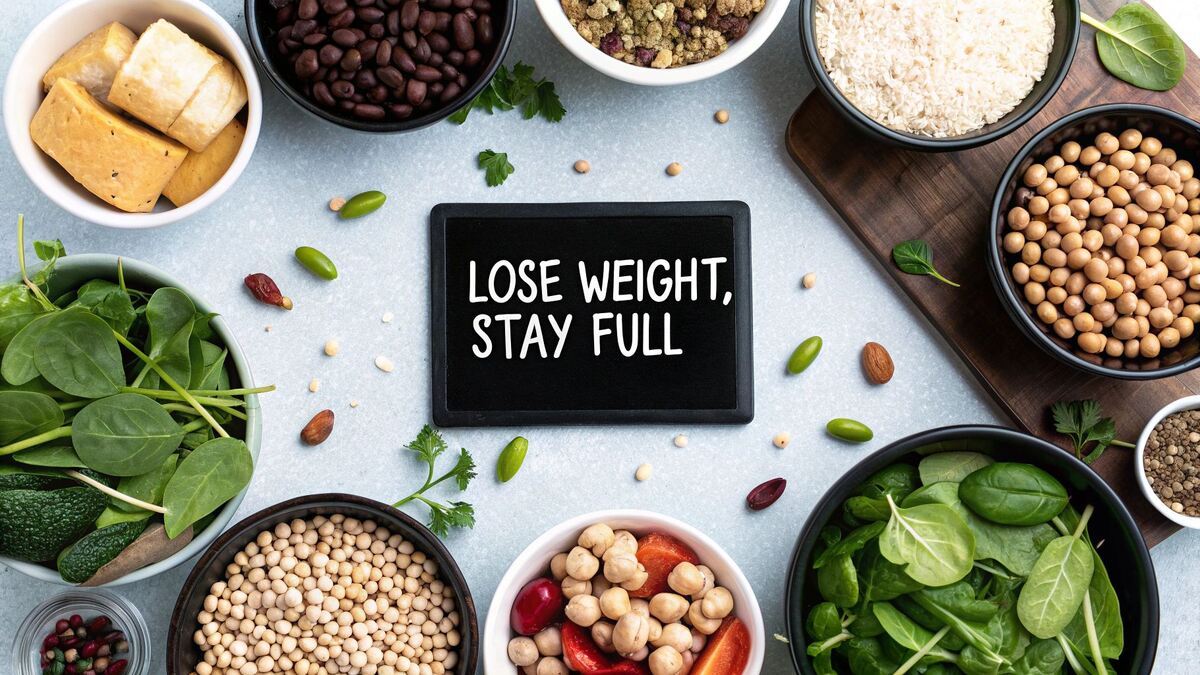
- Plant-Based Options: Lentils, chickpeas, black beans, tofu, and edamame.
Even a simple swap, like choosing Greek yogurt for breakfast instead of a sugary cereal, can dramatically increase your protein intake and keep you locked in until lunch.
Fill up with fiber
Fiber is a type of carb your body can't digest, and that's exactly what makes it so powerful for weight loss. As it moves through your system, it absorbs water and adds serious bulk to your food. This process slows down digestion and physically fills your stomach, sending strong "I'm full" signals to your brain.
There are two types of fiber, and you want both:
- Soluble Fiber: Dissolves in water to form a gel, slowing down how quickly your stomach empties. You'll find it in oats, barley, apples, citrus fruits, and beans.
- Insoluble Fiber: Doesn't dissolve in water but adds bulk, helping things move along smoothly. This is in whole grains, nuts, and veggies like cauliflower and green beans.
Most of us don't get nearly enough fiber. Aiming for 25–35 grams per day can be a total game-changer for managing hunger.
Embrace high-volume, low-calorie foods
This is my favorite trick in the book: volume eating. It’s the simple practice of eating a larger quantity of food that is naturally low in calories. These foods are almost always high in water and fiber, allowing you to load up your plate—and your stomach—without blowing your calorie budget.
Think about it this way: a small handful of pretzels might have the same calories as a massive salad loaded with leafy greens, cucumbers, tomatoes, and bell peppers. Which one do you think will actually make you feel full?
Volume eating allows you to eat more while consuming less. It's a psychological and physiological win, helping you feel satisfied and nourished instead of restricted and deprived.
Here are some go-to high-volume foods to build your meals around:
- Leafy Greens: Spinach, kale, arugula, and lettuce.
- Non-Starchy Vegetables: Broccoli, cauliflower, bell peppers, cucumbers, and zucchini.
- Fruits: Watermelon, strawberries, and cantaloupe are mostly water and incredibly filling.
- Broth-Based Soups: A warm bowl of vegetable or chicken soup can be surprisingly satisfying.
When you build your meals around these foods, you get to eat generous portions that are both nutritious and incredibly satisfying.
How can I build a satiety-focused meal plan?
The ultimate strategy is to combine protein, fiber, and volume in every single meal. A breakfast of Greek yogurt (protein) with berries (fiber) is worlds more satisfying than a pastry. For lunch, a huge salad (volume) topped with grilled chicken (protein) and chickpeas (fiber) will keep you energized and prevent that dreaded afternoon slump.
Let's be realistic—having a structured approach is essential for long-term success. Global statistics paint a clear picture. In OECD countries, about 54% of people aged 15+ are overweight or obese, and in the United States, that number is roughly 4 in 10 adults. For busy professionals and families, having a system that takes the guesswork out of planning is a lifesaver.
This is where modern tools like the AI Meal Planner come in. It can take a target of 1,600–1,800 calories per day and instantly convert it into a week of specific, satisfying meals tailored to your food preferences, complete with quick recipes. You can learn more about the global obesity challenge from the World Obesity Federation.
By focusing on these hunger-fighting foods, you can finally learn how to lose weight without starving and build a sustainable, enjoyable lifestyle that actually lasts.
To make things even easier, here's a grocery list built around the "Big Three" of fullness. Stock your kitchen with these items, and you'll always have what you need to build a satisfying meal.
What should my hunger-fighting grocery list include?
| High-Protein Foods | High-Fiber Foods | High-Volume (Low-Calorie) Foods |
|---|---|---|
| Chicken Breast | Oats | Spinach & Kale |
| Lean Ground Turkey | Quinoa | Broccoli & Cauliflower |
| Salmon & Tuna (canned/fresh) | Lentils & Chickpeas | Bell Peppers |
| Eggs | Black Beans | Cucumbers & Zucchini |
| Greek Yogurt (plain) | Berries (all kinds) | Lettuce & Arugula |
| Cottage Cheese | Apples & Pears | Mushrooms |
| Tofu & Edamame | Chia Seeds & Flax Seeds | Celery & Carrots |
| Lean Beef (sirloin, round) | Whole-Grain Bread/Pasta | Broth (vegetable/chicken) |
| Protein Powder (whey/plant) | Almonds & Walnuts | Watermelon & Cantaloupe |
With a pantry and fridge full of these options, you're setting yourself up for success. You can mix and match to create endless combinations of meals that keep you full, energized, and on track toward your goals.
How do you build a meal plan you can actually stick to?
Knowing which foods keep you full is one thing. Actually putting them together into a meal plan you can follow day-in and day-out is a whole different ballgame. The truth is, the "perfect" plan is useless if it’s too complicated, overly restrictive, or just doesn't mesh with your real life.
The secret to sustainable weight loss isn't about perfection; it's about consistency. So, let's ditch the idea of a rigid, unforgiving schedule where one slip-up ruins everything. The goal is to build a flexible framework that guides your choices, simplifies decisions, and gets rid of the daily guesswork that sends most of us reaching for unhealthy convenience foods.
This simple flowchart shows you the powerful sequence for building a satisfying meal. Always start with your protein, add a high-fiber carb or veggie, and then pack the rest of your plate with high-volume, low-calorie foods.
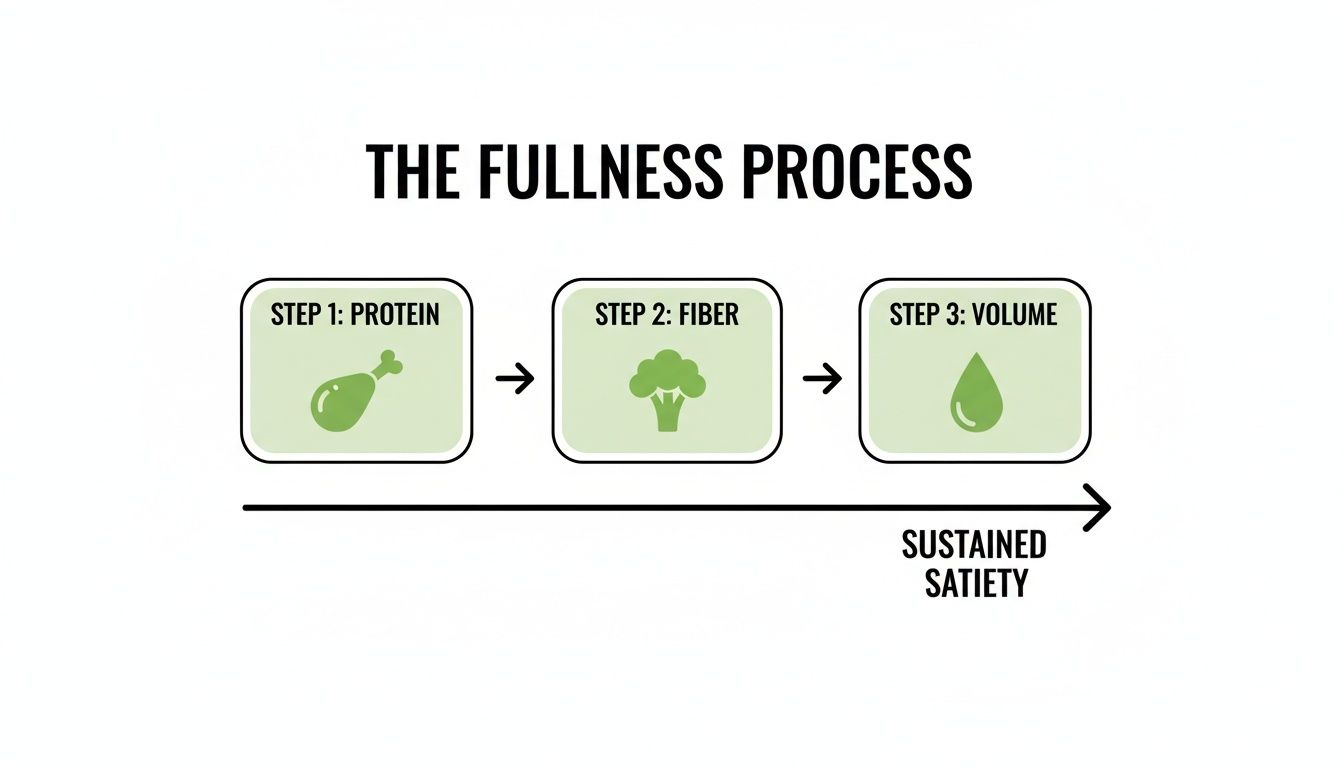
Following this structure for every meal is a game-changer. It ensures you’re maximizing satiety, which makes sticking to your calorie goals feel almost effortless instead of like a constant battle against hunger.
Why does meal timing matter?
While what you eat is obviously critical, when you eat can have a surprisingly big impact on your hunger levels and overall success. Establishing a consistent eating schedule helps regulate your body’s internal clock and appetite hormones.
When your body knows when to expect food, it’s far less likely to send out those frantic, primal hunger signals that lead to unplanned snacking and overeating. Try to eat around the same times each day, even on weekends. This doesn't mean you need to eat every two hours, but avoiding huge gaps—generally no more than four to five hours—is key to preventing that ravenous hunger that sabotages the best intentions.
A predictable eating schedule helps stabilize blood sugar and manage hunger. It shifts you from being reactive to your cravings to being proactive in fueling your body, which is a fundamental part of learning how to lose weight without starving.
Think of it as creating a rhythm. Whether you prefer three larger meals or three meals with a couple of small snacks, that consistency is your best weapon for keeping hunger in check.
What are some simple meal prep strategies?
"Meal prep" can sound like a major commitment, but it doesn't have to mean spending your entire Sunday chained to the stove. Seriously, even a little bit of prep can make a massive difference during a hectic week. The whole point is to make the healthy choice the easiest choice.
Here are a few practical strategies that work for real life:
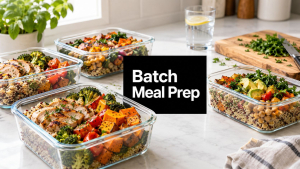
- Batch Cook the Basics: Forget prepping entire gourmet meals. Just cook up a big batch of a versatile grain like quinoa or brown rice. Grill a few chicken breasts. Roast a tray of your favorite vegetables. These simple components can be mixed and matched all week for quick salads, grain bowls, or simple dinners.
- Portion Out Your Proteins: Right after you cook your chicken, fish, or ground turkey, divide it into individual containers. This makes grabbing a protein for lunch or dinner incredibly fast and stops you from even thinking about ordering takeout.
- Prep "Grab-and-Go" Snacks: Wash and chop veggies like carrots, celery, and bell peppers and put them in bags. Portion out nuts or Greek yogurt into small containers. Having healthy snacks ready to go is the ultimate defense against reaching for chips when you're suddenly starving.
These small habits dramatically reduce "decision fatigue"—that mental burnout from constantly having to figure out what to eat. When healthy options are prepped and waiting for you, sticking to your plan becomes almost automatic.
How can technology help with meal planning?
Let’s be honest: manually creating a balanced meal plan, counting calories, and building a grocery list is a huge pain. It's time-consuming, overwhelming, and exactly where most people give up. This is where modern tools can completely change the game by automating the process.
An AI-driven platform like the AI Meal Planner does all the heavy lifting for you. Based on your goals and food preferences, it can instantly generate a full week of satisfying meals that hit your specific calorie and macro targets. If you're not sure what those targets should be, a good calorie and macro calculator can figure them out in seconds.
This approach offers a few key advantages:
- It's actually personalized. The plan is built for you and incorporates foods you genuinely enjoy eating.
- You get smart grocery lists. The platform automatically creates an organized shopping list, planning to reuse ingredients so you reduce food waste.
- The recipes are simple. Meals are designed to be quick and easy, typically taking under 30 minutes to prepare.
By handing the tedious planning over to technology, you can get a perfectly balanced, non-restrictive meal plan that you can actually stick with. It makes sustainable weight loss a realistic goal for anyone, no matter how busy life gets.
What habits support sustainable weight loss?
Real, lasting weight loss is about so much more than what’s on your plate. While a smart nutrition plan is absolutely the foundation, a few key lifestyle habits act as powerful force multipliers. Think of them as the support crew working behind the scenes to regulate your appetite, fire up your metabolism, and make the whole process feel less like a struggle.
When you start layering these behaviors, they create a powerful positive feedback loop. Better sleep leads to smarter food choices. Regular movement boosts your energy for everything else. Proper hydration keeps phantom hunger pangs at bay. Together, they build the scaffolding that holds your new, healthier lifestyle firmly in place.
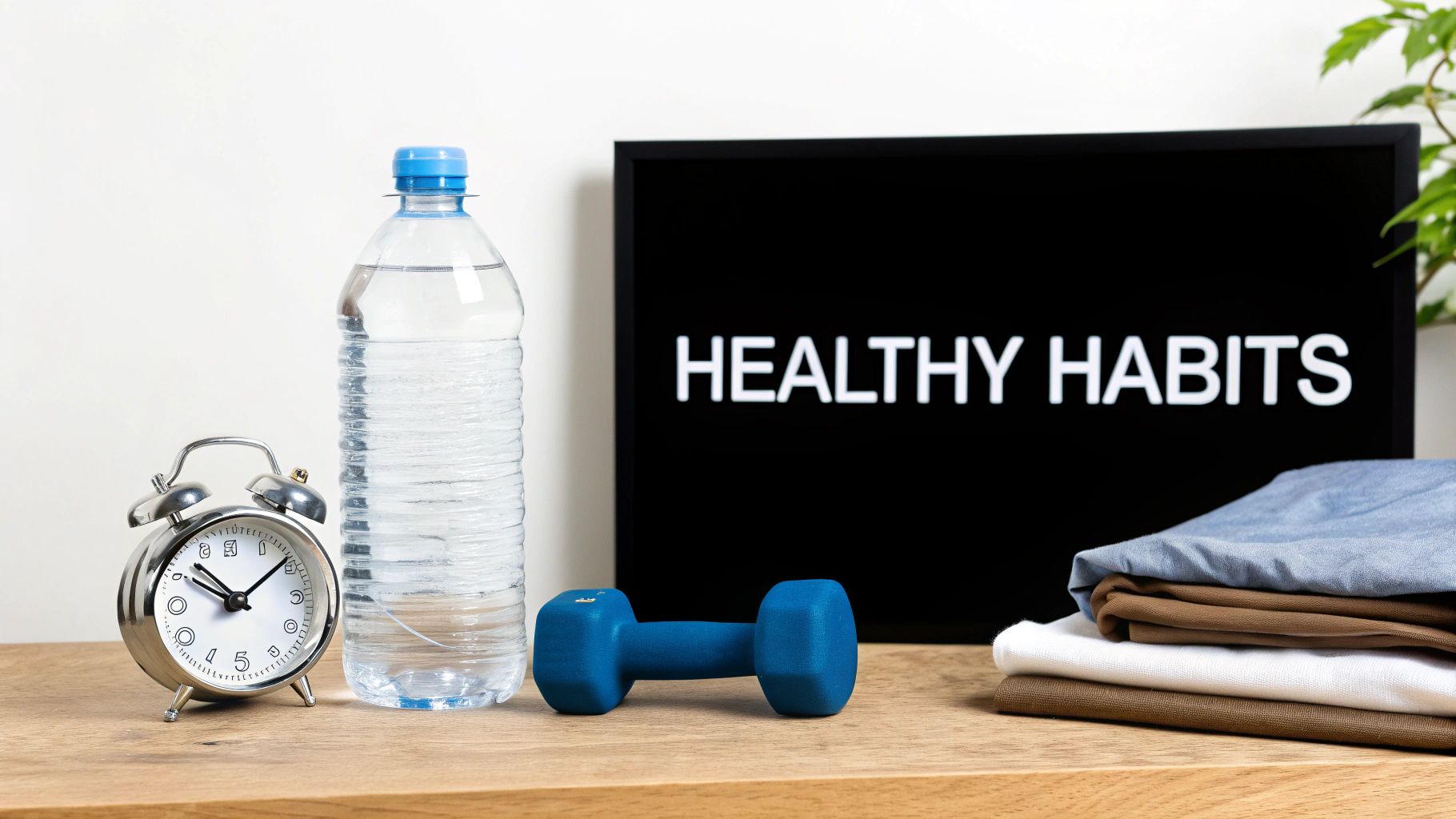
Why is proper hydration important for weight loss?
Water is so often overlooked, but it’s one of the simplest and most effective tools in your weight-loss arsenal. It’s incredibly common to mistake thirst for hunger, which leads to grabbing a snack when all your body really needed was a glass of water. Staying properly hydrated helps keep you feeling full and supports your metabolism.
Try starting your day with a large glass of water to kickstart your hydration and wake up your system. Another proven trick is to drink a full glass before each meal; studies have shown this can help reduce the amount of food you end up eating.
So, how much is enough? Everyone is different, but a great starting point for most adults is around 8–10 glasses (about 2–2.5 liters) per day. If you want to get more precise, you can find your personalized target using a hydration calculator.
How does strength training help with weight loss?
While all movement is good for you, strength training is a complete game-changer for long-term weight management. Cardio is great, but it primarily burns calories during the activity. Lifting weights, on the other hand, builds metabolically active muscle tissue.
The more muscle you have, the higher your resting metabolic rate (RMR) becomes. This means you burn more calories around the clock—even when you’re just sitting on the couch or sleeping.
This doesn't mean you need to live in the gym or become a bodybuilder. Just two or three solid sessions a week using dumbbells, resistance bands, or even your own body weight is enough to make a huge difference.
Building muscle is like upgrading your body's engine. A more powerful engine burns more fuel at rest, making it much easier to maintain a healthy weight without extreme dietary restrictions.
Focus on compound exercises like squats, push-ups, and rows. These movements work multiple muscle groups at once, giving you the most metabolic bang for your buck in the least amount of time.
Why is quality sleep critical for weight loss?
You can nail your diet and crush your workouts, but if you aren't getting enough quality sleep, you're fighting an uphill battle. A lack of sleep throws the hormones that control your appetite completely out of whack.
When you're sleep-deprived, two things happen:
- Your body produces more ghrelin, the hormone that screams "I'm hungry!"
- Your body produces less leptin, a hormone that signals "I'm full."
This hormonal imbalance is a perfect storm for intense cravings—especially for sugary, high-calorie junk food—and makes overeating almost inevitable. Make it a non-negotiable to aim for 7–9 hours of quality sleep per night. A relaxing bedtime routine and a consistent sleep schedule are just as important as your meal plan.
How can mindful eating help?
In our hyper-connected world, we're almost always eating while distracted. We’re scrolling our phones, typing at our desks, or watching TV. This kind of mindless eating completely disconnects us from our body's natural hunger and fullness cues, making it dangerously easy to eat far more than we need.
Mindful eating is the simple practice of being fully present with your food. It’s about paying attention to the taste, texture, and smell, and actually listening to what your body is telling you.
Here are a few easy ways to get started:
- Kill the Distractions: Put your phone away. Turn off the TV. Just for the meal.
- Slow Down: Chew each bite thoroughly. Try putting your fork down between bites.
- Check In: Pause about halfway through your meal. Ask yourself, "Am I still hungry, or just eating because it's there?" You might be surprised to find you're already satisfied.
By weaving these foundational habits—hydration, strength training, sleep, and mindfulness—into your life, you create an environment where your body can succeed. They don't replace your nutrition plan; they support it, making it easier to lose weight for good without the constant battle against hunger and deprivation.
Frequently Asked Questions
Is it better to eat three big meals or several small ones?
There is no single "best" approach for everyone. The right eating frequency is the one that fits your schedule and natural hunger patterns, whether that's three larger meals or several smaller ones.
What should I do if I overeat one day?
Don't panic or try to compensate by skipping meals the next day. A single day won't derail your progress; simply get back to your regular, balanced eating plan with your next meal.
Can I still eat out at restaurants?
Yes, you can absolutely eat out. To stay on track, review the menu online beforehand to find healthier options and ask for dressings or sauces on the side to control portions.
Are carbs the enemy when trying to lose weight?
No, carbs are not the enemy; your body needs them for energy. Focus on choosing high-fiber carbohydrates from whole foods like vegetables, fruits, and legumes to help manage hunger.
How do I manage cravings for junk food?
Ensure your meals are rich in protein and fiber to prevent intense cravings from starting. You can also incorporate small, planned portions of your favorite treats into your weekly calorie budget to stay on track.
Is it possible to lose weight without exercise?
While it is possible to lose weight through diet alone, incorporating exercise helps preserve muscle mass and boosts your metabolism. Even moderate activity like walking makes a significant difference.
Why do I feel hungrier when I start dieting?
Increased hunger is often a hormonal response to a sudden calorie drop, especially with extreme diets. A moderate deficit combined with high-protein and high-fiber foods will help manage this feeling.
Ready to stop guessing and start building a meal plan that actually works for you? The AI Meal Planner creates personalized weekly menus with smart grocery lists, taking all the hard work out of eating healthy. Get your customized plan and start your journey today. Get started with your personalized meal plan here
AI-powered nutrition
Get Your Personalized Meal Plan
AI creates the perfect meals for your goals, lifestyle, and taste.
Start Your Journej